How Many BTUs for 800 Sq Ft? Choosing the Right Mini Split Size
Most 800 sq ft homes and apartments need an 18,000 BTU (1.5-ton) mini split. ENERGY STAR recommends 18,000 BTUs for 700 to 1,000 sq ft with 8-foot ceilings. Step up to 24,000 BTUs only when extra heat piles up.
- 18,000 BTU: average sun, 8-foot ceilings, and two people.
- 24,000 BTU: sunny top-floor units, high ceilings, or an open kitchen.
- Closed bedrooms: usually need a second zone, not a bigger unit.
Not sure which fits your space? Take the quick quiz below.
Shop Mini Split Systems 18,000 BTU from $899 · Free 2-day delivery on in-stock systems

Answer a few quick questions and we’ll match you to the right mini split.
Already know your size? Compare Filterbuy mini split systems.
TL;DR
Most 800 sq ft homes and apartments need an 18,000 BTU (1.5-ton) mini split, which is what ENERGY STAR’s room air conditioner chart recommends for 700 to 1,000 square feet. A 24,000 BTU unit only makes sense when extra heat piles up. Your floor plan matters just as much, since a bedroom behind a closed door usually needs its own indoor unit.
Key Takeaways
ENERGY STAR’s room AC chart calls for 18,000 BTUs per hour from 700 up to 1,000 sq ft.
Strong sun and kitchen heat can push an 800 sq ft space toward 24,000 BTUs.
A clogged filter weakens cooling, so clean it before you blame the unit’s size.
One head can handle an open 800 sq ft layout; closed bedrooms usually need two zones.
Why Filterbuy Sizes for Airflow as Well as Square Footage
Filterbuy manufactures air filters in the USA and also sells its own line of single-zone ductless mini splits. Our HVAC Solutions technicians also service ductless systems in Florida and Texas homes, which has taught us that a sizing chart can’t tell you whether cool air will reach your bedroom or get through a dirty filter, so we check both.
"I don’t want anyone to feel like they need an HVAC license just to pick the right filter. My job is to give you the straight answer, explain why it matters, and let you get back to your day," says Michelle Wan, Brand Manager and Air Quality Writer at Filterbuy.
How Many BTUs Does an 800 Sq Ft Space Need?
In average conditions, an 800 sq ft space needs about 18,000 BTUs of cooling. The ENERGY STAR room air conditioner sizing chart, published by the U.S. Environmental Protection Agency, recommends 18,000 BTUs per hour for anything from 700 up to 1,000 square feet with 8-foot ceilings.
Here’s how common sizing methods compare for exactly 800 square feet:
Sources: ENERGY STAR sizing chart (8-foot ceilings); Carrier.
Every quick method, including Carrier’s mini split sizing guide, lands between 16,000 and 20,000 BTUs. Since mini splits come in set sizes, Filterbuy starts at 18,000 BTUs, and the real choice for 800 sq ft usually comes down to 18,000 or 24,000. Sizing a different room? Try Filterbuy’s mini split sizing guide by room.
Is 18,000 BTU Enough for 800 Sq Ft?
For most 800 sq ft homes, yes, as long as the space has average sun, 8-foot ceilings, decent insulation, and two regular occupants.
When Does an 800 Sq Ft Space Need 24,000 BTUs?
You’ll want closer to 24,000 BTUs when heat sources add up, like afternoon sun on a top-floor unit, high ceilings, or an open kitchen sharing the indoor head.
ENERGY STAR’s adjustments: reduce capacity 10% for heavy shade, increase 10% for a very sunny space, add 600 BTUs for each regular occupant beyond two, and add 4,000 BTUs for a kitchen. Filterbuy ran the numbers on three 800 sq ft situations homeowners often ask us about:
Adjustments follow ENERGY STAR sizing guidance.
When the math lands between sizes, ask a licensed contractor for a Manual J load calculation, as ENERGY STAR advises for ductless heating and cooling. Mention high ceilings, since a 10-foot ceiling holds 25% more air than an 8-foot one.
One Mini Split or Two? Let the Floor Plan Decide
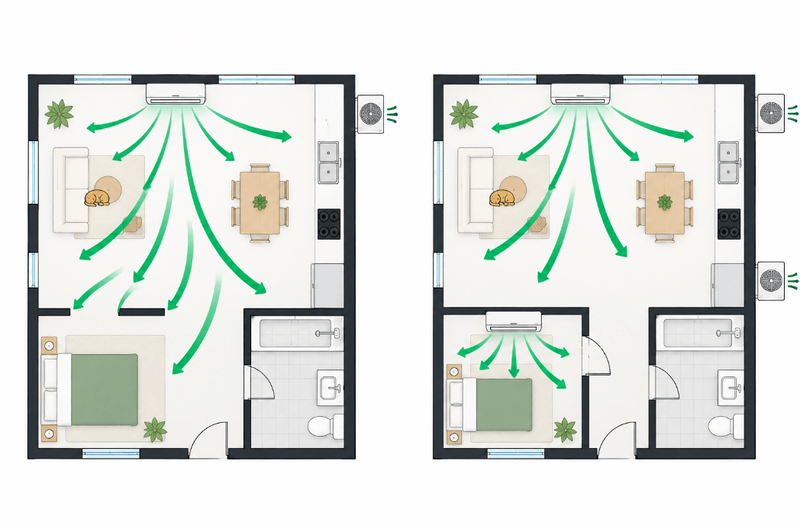
A single 18,000 BTU wall-mounted mini split can cool an open 800 sq ft space, but rooms behind closed doors are another story. ENERGY STAR’s installation tips note that air moves poorly through an open doorway and can’t pass a closed one, so check your floor plan before settling on a BTU number. Our guide to single-zone vs. multi-zone mini splits compares both setups.
Open studio or loft: one 18,000 BTU head facing the main living area.
One bedroom, door usually open: one living room head can work, though the bedroom may run warmer.
Doors closed at night or two bedrooms: two zones sized room by room. Filterbuy’s line is single-zone only, so that means two systems or a multi-zone system from another brand.
What Size AC Do You Need for an 800 Sq Ft Apartment?
Cooling an 800 sq ft apartment usually takes the same 18,000 BTU mini split as a house of that size, though top-floor units often land at the higher end.
Most 18,000 and 24,000 BTU units need a dedicated 230-volt circuit, and renters need landlord approval for the outdoor unit and wall opening. Mini splits also heat. Filterbuy units are rated for reliable heating down to 5°F, so choose a cold-climate model if it’ll be your main heat in a colder region.
Why a Bigger Mini Split Isn’t Better
An oversized mini split can backfire. ENERGY STAR warns that it cools the room before it removes the humidity. Inverter compressors can ramp down to as little as 10% of rated capacity, according to the Building America Solution Center, but an oversized head can still short cycle below that point.
"An oversized A/C might cool your house down quickly, but it won’t remove humidity effectively, leaving your home feeling muggy," writes David Clark, President of Filterbuy HVAC Solutions, in his insider tips for buying a new A/C. Undersized units run nonstop instead.
Already Installed? Signs Your Mini Split Is the Wrong Size
A struggling mini split isn’t always the wrong size. First rule out the problem technicians at Filterbuy HVAC Solutions, Filterbuy’s home service company, see most: a filter nobody has checked.
Sources: ENERGY STAR; Filterbuy mini split filter cleaning guide.
Top Picks: Filterbuy Mini Splits Sized for 800 Sq Ft
For most 800 sq ft spaces, the Filterbuy 18,000 BTU mini split is $899 with free 2-day delivery on in-stock systems and a 7-year compressor / 3-year parts warranty. The 24,000 BTU model suits hotter, top-floor spaces. Both are single-zone heat pumps rated 17 SEER2, which clears the federal minimum and is built for value rather than maximum efficiency. Professional installation is required, and the warranty is void if self-installed.
*Prices on filterbuy.com as of September 16, 2026. Free 2-day delivery on in-stock systems. 18,000 and 24,000 BTU models are 230V; the 12,000 BTU is 115V or 230V.
Compare specs for the 18,000 BTU, 24,000 BTU, and 12,000 BTU models.
For zones, SEER2, and installation, read how to choose a mini split system.
Which Filter Does Your Mini Split Need?
Unlike central air, a ductless mini split doesn’t take a disposable pleated filter. It uses a washable mesh screen that brands like Mitsubishi Electric, Daikin, Fujitsu, and LG tell owners to rinse. You’d only replace it if it’s torn or warped, or if your model has a secondary carbon or ion panel.
That screen protects the coil, so keep it clean. Filterbuy’s service data shows a dirty, restricted filter can cut a mini split’s efficiency by 5–30%, and the Building America Solution Center notes most manufacturers recommend cleaning it about every two weeks. Our mini split filter cleaning guide covers every major brand, and mini split replacement filters explains which panels actually need replacing.
Filterbuy Founder and CEO David Heacock puts it plainly: "the most common mistake with ductless owners is assuming the mesh works like a furnace filter. It does not. It protects the machine. Protecting the air is a separate job."
If your apartment has central air or a ducted air handler instead, that system does the filtering for the whole home. A MERV 8 air filter handles everyday dust and lint, while a MERV 11 air filter captures finer particles like pet dander. The mini split’s pre-filter protects the coil; your whole-home filter does the heavy lifting for air quality.
Supporting Statistics
88% of U.S. households use AC, but apartments trail at 80–85%. Source: U.S. Energy Information Administration
Nearly half of a typical $1,900 annual energy bill goes to heating and cooling. Source: ENERGY STAR
Duct losses can exceed 30% of heating and cooling energy; ductless heads avoid them. Source: Building America Solution Center (DOE)
Frequently Asked Questions
Glossary
BTU (British thermal unit): A unit of heat energy; air conditioner capacity is rated in BTUs removed per hour.
Manual J: The Air Conditioning Contractors of America (ACCA) residential load calculation method.
Short cycling: When an oversized system turns on and off too often, wasting energy and leaving humidity behind.
SEER2: The U.S. Department of Energy’s current cooling-efficiency rating; higher is more efficient.
Zone: An area served by its own indoor unit and temperature setting.
Mesh filter: The washable screen inside a ductless indoor unit that catches dust, lint, and pet hair.
MERV: Minimum Efficiency Reporting Value, an ASHRAE-derived 1–16 scale for particles from 0.3 to 10 microns (EPA explainer).
Filterbuy is not affiliated with or endorsed by Mitsubishi Electric, Daikin, Fujitsu, LG, or Carrier.
About the Author & Reviewer
Michelle Wan is Filterbuy’s Brand Manager and air quality writer. She works directly with Filterbuy’s U.S. manufacturing teams in Alabama, Florida, Pennsylvania, and Utah. More from Michelle Wan.
David Clark is a Licensed HVAC Technician and President of Filterbuy HVAC Solutions. An EPA-certified technician and graduate of the South Florida Academy of Air Conditioning, he has over a decade of field experience and reviewed this guide.