How Many BTUs for 500 Sq Ft? Exact Mini Split Sizing + Top Recommendations
Most 500 sq ft rooms need about 12,000 BTUs, the output of a 1-ton mini split. That assumes 8-foot ceilings, average sun, and up to two regular occupants.
Strong sun, tall ceilings, extra people, or an open kitchen can push that to 14,000–16,500 BTUs. There, an 18,000 BTU unit usually fits better.
- 12,000 BTU: rooms that calculate at roughly 10,000–13,000 BTUs.
- 13,000–15,000 BTU: get a Manual J load calculation before you buy.
- 18,000 BTU: rooms that calculate above about 15,000 BTUs.
Not sure where your room lands? The quick quiz below will match you to a size.
Free 2-day delivery on in-stock systems. Professional installation required.

Find your mini split size
Answer a few quick questions about your room, and we'll match you to the right mini split.
Already know your size? Browse Filterbuy mini split systems
TL;DR
Most 500-square-foot rooms with 8-foot ceilings need about 12,000 BTUs of cooling, the output of a 1-ton mini split. Strong sun, extra occupants, tall ceilings, or an open kitchen can raise that to 14,000–16,500 BTUs, where an 18,000 BTU unit usually fits better. If your estimate falls between 13,000 and 15,000 BTUs, get a Manual J load calculation from your installer before you buy.
Key Takeaways
Start at 12,000 BTUs. ENERGY STAR's sizing chart puts rooms of 450 to 550 square feet in the 12,000 BTU bracket.
Four adjustments move that number. Take off 10% for heavy shade, add 10% for strong sun, add 600 BTUs per occupant past two, and add 4,000 for a kitchen.
Watch the 14,000 BTU gap. Most single-zone mini splits go straight from 12,000 to 18,000 BTUs, so a 14,000 BTU room needs a load calculation.
Oversizing is the costlier mistake. A unit that's too big short-cycles and leaves the room clammy, a problem Filterbuy's HVAC service crews see firsthand.
Why This Guide Sizes Rooms Differently
Filterbuy manufactures air filters in the USA and sells single-zone mini split systems, and our Filterbuy HVAC Solutions crews service ductless systems in Florida and Texas. So this guide starts with ENERGY STAR's math, not our lineup, and tells you when a Filterbuy unit isn't the right fit.
How Many Btus Does A 500 Sq Ft Room Need?
A 500-square-foot room needs roughly 12,000 BTUs per hour of cooling under standard conditions, meaning 8-foot ceilings, average insulation and sun, and no more than two people using the room regularly. The ENERGY STAR room air conditioner sizing chart places 450–550 square feet in the 12,000 BTU bracket.
Source: ENERGY STAR. "Nearest common size" is Filterbuy's mapping to standard mini split capacities.
ENERGY STAR designed this chart for room air conditioners, so treat it as a starting point for mini splits, not a load calculation.
How Do You Calculate The Right Mini Split Size For Your 500 Sq Ft Space?
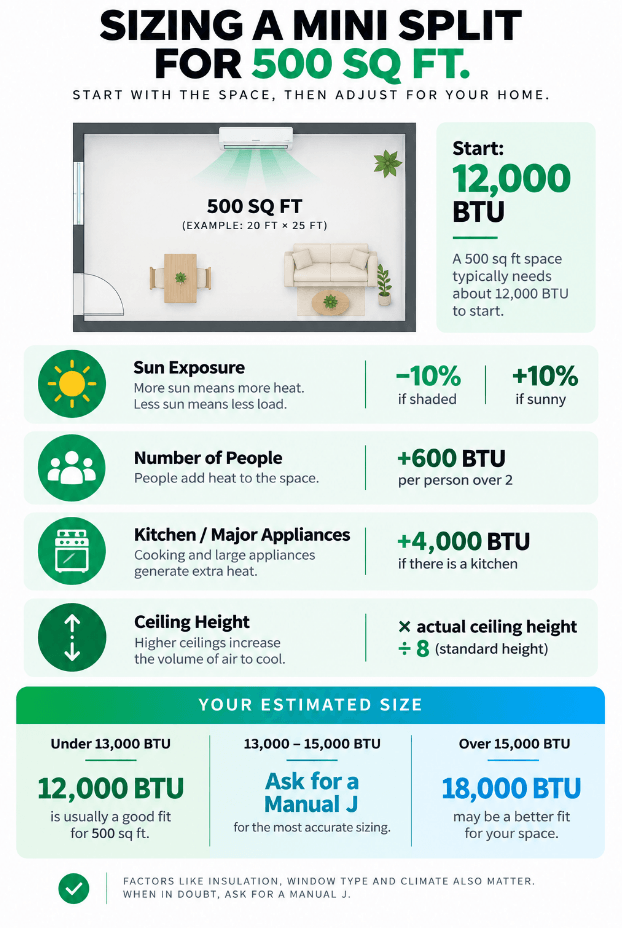
Sizing a mini split for 500 square feet starts at 12,000 BTUs, then moves up or down with sun, occupancy, cooking heat, and ceiling height. Round only at the end.
Start with 12,000 BTUs for 450–550 sq ft.
Adjust for sun. ENERGY STAR recommends cutting capacity 10% in a heavily shaded room and adding 10% in a very sunny one.
Adjust for people and cooking. Add 600 BTUs for every regular occupant beyond two, plus 4,000 BTUs if the room includes a kitchen.
Adjust for ceiling height. The chart assumes 8-foot ceilings, so multiply by your ceiling height divided by 8. A 10-foot ceiling adds about 25%.
Worked Examples: Six Real-World 500 Sq Ft Rooms
Illustrative estimates, not a load calculation.
Is A 12,000 Btu Mini Split Enough For 500 Sq Ft?
A 12,000 BTU mini split is enough for most 500 sq ft rooms. It handles a shaded bedroom or a living room shared by up to three people.
ENERGY STAR's chart includes a 14,000 BTU bracket, yet Filterbuy's lineup, like most single-zone systems, steps from 12,000 to 18,000 BTUs. When your estimate falls between 13,000 and 15,000 BTUs, a Manual J load calculation is worth paying for. As a tiebreaker, afternoon shade favors 12,000 BTUs, while a west-facing room or heavy winter heating favors 18,000.
"A load calculation, a Manual J, beats any rule of thumb."
Source: David Clark, Licensed HVAC Technician, in Filterbuy's 2-ton mini split sizing guide
Why Is An Oversized Mini Split A Problem?
An oversized mini split cools the room so quickly that it shuts off and restarts over and over, a pattern called short-cycling. Short runs pull little moisture from the air, so the room feels clammy even at its set temperature. The DOE's Building America Solution Center notes that oversized ductless units waste energy and control humidity poorly.
"Every summer in Florida and Texas we get the same call. The house hits temperature in ten minutes, the unit shuts off, and the homeowner still feels sticky… Undersizing is uncomfortable on the five hottest days a year. Oversizing is uncomfortable every single day."
Source: David Clark, Licensed HVAC Technician, in Filterbuy's Memphis mini split guide
Filterbuy units include a 55°C high-temperature self-cleaning cycle that dries out moisture collecting inside the unit.
Does Humidity Change The Right Size For A 500 Sq Ft Room?
In a humid climate, right-sizing matters even more, because a bigger unit doesn't remove more moisture. According to the DOE's Building America Solution Center, ductless heat pumps generally dehumidify less than ducted systems. Ask for the model's sensible heat ratio (SHR). A lower SHR means better moisture removal, and a high one may call for a dehumidifier.
Does Heating A 500 Sq Ft Room Change The Btu Math?
In a cold climate, heating can call for more capacity than cooling, because a heat pump produces less heat as temperatures fall. The Building America Solution Center's cold-climate sizing guide explains that a unit sized for cooling often comes up short on heating in colder regions. Ask for each model's heating capacity at 5°F; ENERGY STAR's cold-climate criteria, cited in that guide, require at least 70% of rated heating capacity at 5°F. Filterbuy units deliver reliable heating down to 5°F. If it will be your main heat where winters drop below that, choose a heat pump rated for colder temperatures.
What Is The Best Ac For 500 Sq Ft?
For most 500 sq ft spaces, the best AC is a 12,000 BTU ductless mini split heat pump, since one unit handles both cooling and heating. A 12,000 BTU window unit costs less and needs no technician but usually only cools.
Filterbuy's Top Mini Split Picks For A 500 Sq Ft Space
Both systems below are single-zone, rated 17 SEER2, and ship with free 2-day delivery on in-stock systems. At 17 SEER2 they clear the federal minimum and are built for value, not maximum efficiency. Professional installation is required, and the warranty is void if self-installed. For two rooms divided by a usually closed door, choose another brand's multi-zone system, since ENERGY STAR notes air can't move through a closed doorway.
1. Best Value For Most 500 Sq Ft Rooms: Filterbuy 12,000 Btu 17 Seer2 Mini Split
The Filterbuy 12,000 BTU ductless mini split covers up to 550 square feet, a match for rooms calculating at roughly 10,000–13,000 BTUs. It lists at a published $799, comes in 115V or 230V, and carries a 7-year compressor and 3-year parts warranty. Its variable-speed inverter adjusts output to demand instead of cycling on and off.
2. Best For Sunny, Tall, Or Kitchen-Connected 500 Sq Ft Spaces: Filterbuy 18,000 Btu 17 Seer2 Mini Split
The Filterbuy 18,000 BTU ductless mini split covers up to 850 square feet and is the step up when your adjusted load tops about 15,000 BTUs, common in studios with kitchens or west-facing bonus rooms. It's $899, runs on 230V, and carries the same 7-year compressor and 3-year parts warranty.

What To Measure And Ask Before You Get A Quote
Bring these details for a more accurate quote:
Room details: length, width, ceiling height, window direction, regular occupants, and any kitchen.
Voltage choice: 115V and 230V units deliver the same capacity and efficiency, but a 12,000 BTU unit draws roughly 8–10 running amps at 115V and 4–5 at 230V. Both need a dedicated circuit, as our mini split electrical requirements guide explains.
Line set distance: Filterbuy's 12,000 and 18,000 BTU systems are pre-charged for 25 feet and support runs up to 50 feet. Longer runs may need extra refrigerant, which can add to your installer's quote.
Head placement: a high-wall unit reads temperature near the ceiling, so the room can feel cooler at seated height than the setpoint. The Filterbuy remote's Follow Me sensor reads temperature where the remote sits.
Filter care: rinse the pre-filter on schedule and let it dry fully. The pre-filter protects the coil; your whole-home HVAC filter does the heavy lifting for air quality. Filterbuy, an air filter manufacturer, explains what that screen does in its guide to how mini split filters work and when to wash them.
"It protects the machine."
Source: Michelle Wan, on mini split mesh filters, in Filterbuy's Memphis mini split guide
Supporting Statistics
More than 65% of residential HVAC systems are improperly installed, and those systems use about 20%–30% more energy than necessary. Source: U.S. Department of Energy, Optimizing the Installed Performance of Residential HVAC Systems.
Almost half of a typical household's roughly $1,900 annual energy bill goes to heating and cooling. Source: ENERGY STAR, Ductless Heating & Cooling.
Duct losses can account for more than 30% of heating and cooling energy use when ducts run through unconditioned space. Source: U.S. DOE Building America Solution Center, Ductless (Mini-Split) Heat Pumps.
Frequently Asked Questions
Glossary
BTU (British thermal unit): A unit of heat energy; AC capacity is measured in BTUs removed per hour.
Ton: 12,000 BTUs per hour.
Ductless mini split: An outdoor unit connected to indoor units by refrigerant lines, with no ductwork.
Heat pump: Equipment that moves heat out of a home in summer and in during winter.
Inverter compressor: A variable-speed compressor that adjusts its output to match demand.
SHR (sensible heat ratio): The share of cooling that lowers temperature rather than removing moisture; lower is better.
Line set: The refrigerant tubing connecting the indoor and outdoor units.
Short-cycling: Frequent on-and-off operation that weakens humidity control.
Manual J: The Air Conditioning Contractors of America (ACCA) method for calculating heating and cooling loads.
SEER2: The current U.S. seasonal cooling-efficiency rating; higher is better.
Single-zone / multi-zone: One indoor unit per outdoor unit, versus several indoor units on one outdoor unit.