How Many BTUs for a 2,500 Sq Ft Home? Multi-Zone Mini Split Planning Guide
A 2,500 sq ft home needs about 50,000 to 62,500 BTUs, or roughly 4 to 5 tons of heating and cooling capacity. That range comes from the standard rule of 20 to 25 BTUs per square foot.
With mini splits, spread that load across 5 or 6 zones, ideally on two outdoor units. A Manual J load calculation from your installer confirms the exact number.
- Mild climate, good insulation: about 50,000 BTUs
- Average climate or mixed sun: about 62,500 BTUs
- Hot climate, older insulation, or tall ceilings: up to about 75,000 BTUs
Take the quick quiz below to match your rooms to the right mini split system.

Find your mini split size
Answer a few quick questions and we'll match you to the right mini split for your space.
Already know your size?
Filterbuy single-zone mini splits come in 12,000, 18,000, and 24,000 BTU sizes for a great room, addition, or any single zone. Systems start at $799 with free 2-day delivery on in-stock units.
Shop mini split systems7-year compressor / 3-year parts warranty. Professional installation required.
TL;DR
Most 2,500 sq ft homes need about 50,000 to 62,500 BTUs of heating and cooling capacity (20 to 25 BTUs per square foot), usually spread across 5 or 6 ductless zones. At Filterbuy, we recommend running those zones on two outdoor units and confirming the numbers with a Manual J before you buy.
Key Takeaways
A 2,500 sq ft home needs roughly 50,000–62,500 BTUs, with more needed in hot climates or leaky homes.
Indoor heads can add up to about 130% of the outdoor unit's rating, yet output tops out at that rating.
Whole-home plans usually go wrong on zoning, so settle your zone count before comparing BTU sizes.
Six indoor heads can mean 78 to 156 filter cleanings a year.
Why We Plan Zones Before BTUs
Filterbuy manufactures air filters in the USA and sells single-zone mini split systems, and our Filterbuy HVAC Solutions team services ductless systems in Florida and Texas. As our 1,000 sq ft mini split guide explains, frustrated homeowners rarely choose the wrong BTU number; they spread it across the wrong number of heads.
How Many BTUs Does a 2,500 Sq Ft Home Need?
A 2,500 square foot home needs about 50,000 to 62,500 BTUs per hour, based on the standard rule of 20 to 25 BTUs per square foot. Use the lower figure for a well-insulated home in a mild climate and the higher one for a hot, humid home or one with strong sun. That works out to roughly 4 to 5 tons of mini split capacity.
Estimates use 20–30 BTUs per square foot. A Manual J load calculation from a licensed HVAC contractor gives the most accurate number.
These estimates set a starting range, and a Manual J load calculation gives you the real number. Manual J, from the Air Conditioning Contractors of America (ACCA), is the national room-by-room sizing standard, so ask contractors for the results. Details matter, too: ENERGY STAR's sizing guidance adjusts capacity by 10% for heavy shade or strong sun and adds 4,000 BTUs for a kitchen. In cold climates, the heating load often sets the size, so check each unit's rated heating output at low temperatures. Avoid rounding way up, since oversized systems short-cycle. Our mini split sizing guide covers per-room math.
Is a 4-Ton (48,000 BTU) Mini Split Enough for 2,500 Sq Ft?
A 4-ton (48,000 BTU) mini split can handle a 2,500 sq ft home only if a Manual J peak load stays at or below 48,000 BTUs, which is realistic for a tight home in a mild climate. Even then, we advise against running 5 or 6 zones from one outdoor unit.
Most sizing charts leave out one detail: many manufacturers allow heads totaling about 130% of a multi-zone outdoor unit's rating, or around 62,000 BTUs on a 48,000 BTU condenser. That extra capacity adds no output. Heat pump maker Fujitsu explains in its multi-zone brochure that when every indoor unit runs at once, the system scales each head back to match the outdoor unit's rating.
Picture our 54,000 BTU example layout on one 48,000 BTU condenser. With all six heads running on a hot afternoon, each gets roughly 89% of its rating (48,000 ÷ 54,000), so the 18,000 BTU great room head performs more like a 16,000 BTU head right when you need it most.
Bottom line: A 48,000 BTU outdoor unit delivers 48,000 BTUs at peak, however many heads are attached. The DOE's Building America Solution Center, run by Pacific Northwest National Laboratory (PNNL), recommends a Manual J per zone and for the whole house.
How Many Zones Does a 2,500 Sq Ft Home Need?
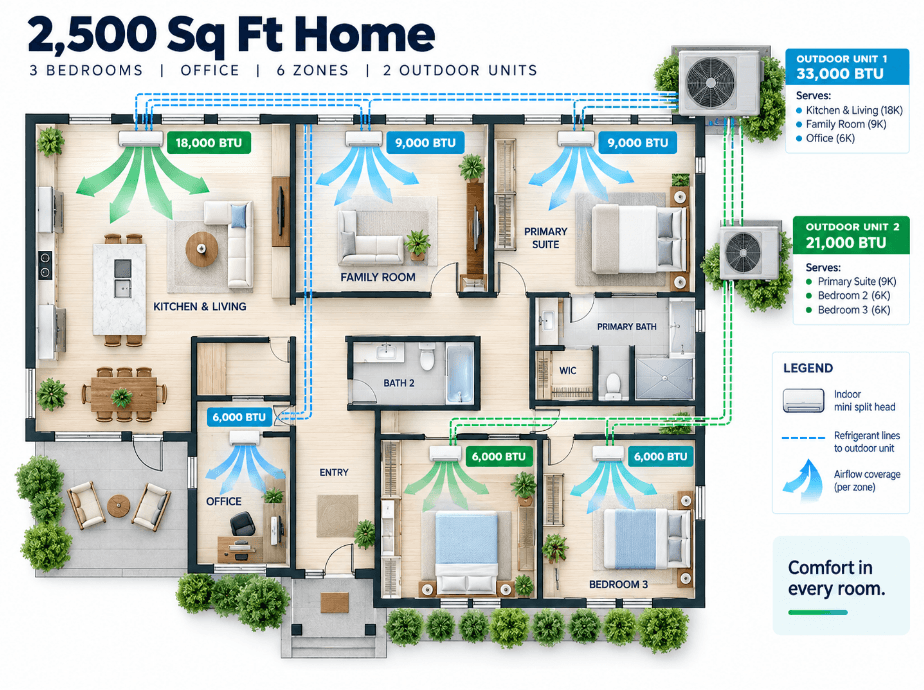
A typical 3- or 4-bedroom, 2,500 sq ft home ends up with 5 or 6 zones: usually one head per bedroom, one for the open kitchen and living area, and one for a family room or office. Hallways and bathrooms usually don't need one.
"The complaint we hear most is a big living room head while the back bedroom runs warmer. Count the rooms that close a door first."
— The Filterbuy Team
This illustrative home uses 20 to 25 BTUs per square foot per zone, with the 4,000 BTU kitchen adjustment.
Illustrative example only; confirm your own loads with a Manual J. Kitchen estimate includes ENERGY STAR's 4,000 BTU kitchen adjustment.
Small bedrooms often land below 6,000 BTUs, the smallest common head size, so rounding up is normal. A small air transfer fan can even out rooms without a head.
Whole-Home Mini Split Layout Options Compared
For 5 or 6 zones, the most reliable whole-home layout is usually two outdoor units with no more than three heads each. The table compares that approach with the alternatives:
Connected-capacity limits and port counts vary by model. Check the manufacturer's combination table before buying, and confirm heads per outdoor unit with your installer.
Filterbuy's take: We lean toward splitting bedrooms and living areas between two outdoor units, which follows PNNL's three-head guidance. Our own line is single-zone only, so multi-zone equipment would come from another brand. Our single-zone vs. multi-zone mini split guide and mini split installation cost breakdown cover the trade-offs, including why zone count drives cost.
Living With a Whole-Home Mini Split: 4 Habits That Protect Comfort
These DOE and ENERGY STAR habits rarely show up in sizing guides.
Keep every head in the same mode. PNNL warns that mixing heating and cooling on one outdoor unit can sharply reduce efficiency.
Don't count on shutting off the guest room to save money. PNNL notes savings can be small or negative if the load drops below the outdoor unit's minimum output.
Pick a temperature and leave it. ENERGY STAR explains that turning a heat pump down while you're away or asleep doesn't save energy the way it does with a furnace.
Plan for humidity. Ductless systems often remove less moisture than ducted ones, so humid homes may need a dehumidifier.
How to Manage Mini Split Filter Maintenance Across Multiple Zones
Every indoor head has a washable mesh filter. A typical manufacturer recommendation is every 2 weeks, while the DOE-funded ductless filter cleaning guide suggests about every 3 months. For a 6-zone home, that adds up fast:
Sources: U.S. DOE Building America Solution Center (every 2 weeks as a typical manufacturer recommendation; about every 3 months in its DIY filter guide) and Filterbuy (every 2–4 weeks).
We make filters, and the mini split filter is the most overlooked part of maintenance, even though a clogged one can shut a unit down. As the EPA notes, standard mesh filters protect the equipment from large particles like pet hair and lint rather than cleaning the air. For finer particle capture, the EPA recommends MERV 13 or higher, or as high as your system's fan and filter slot can handle.
Pro Tip from the Filterbuy team: Use a zone rotation instead of a cleaning marathon.
Label each head, split them into two groups, and clean one group every other weekend.
Book a professional deep clean for each head every 1 to 3 years, as PNNL recommends.
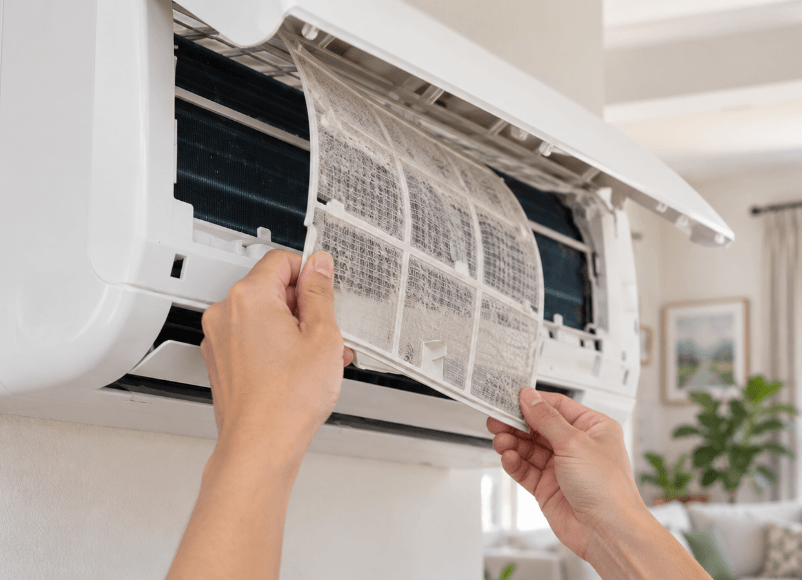
For step-by-step help, see how to maintain your mini split.
Supporting Statistics
1. Heating and cooling make up almost half of a typical home energy bill. ENERGY STAR puts a typical household's energy bill at about $1,900 a year. Source: ENERGY STAR – Ductless Heating & Cooling
2. Inverter compressors can throttle down to as little as 10% of rated capacity. Source: U.S. DOE Building America Solution Center (PNNL)
3. A MERV 13 filter captures at least 50% of particles between 0.3 and 1.0 microns. That's why the EPA recommends MERV 13 or higher when upgrading, as long as the system's airflow and filter slot can accommodate it. Source: U.S. EPA – What Is a MERV Rating?
Frequently Asked Questions
Plan Your Whole-Home Comfort
Count the rooms that need a head, get a Manual J, and plan your filter rotation early. For a large room or add-on zone, Filterbuy's single-zone mini split systems start at $799 with a published price, free 2-day delivery on in-stock systems, and a 7-year compressor / 3-year parts warranty, in 12,000, 18,000, and 24,000 BTU sizes. Professional installation is required, and the warranty is void if self-installed. In Florida and Texas, Filterbuy HVAC Solutions installs systems from major ductless brands.
Glossary
BTU (British Thermal Unit): A unit of heat energy used to rate mini split capacity per hour.
Ton (cooling): 12,000 BTUs per hour, so a 4-ton system equals 48,000 BTUs.
Mini split (ductless heat pump): A system that links an outdoor unit to indoor heads with refrigerant lines instead of ducts.
Indoor head (air handler): The indoor unit that heats and cools a single zone.
Multi-zone mini split: One outdoor unit serving two or more independently controlled heads.
Condenser: Another name for the outdoor unit.
Connected capacity: The combined BTU rating of all heads on one outdoor unit.
Manual J: The ACCA standard for calculating a home's heating and cooling loads room by room.
Inverter compressor: A variable-speed compressor that matches output to the load.
Short cycling: Frequent on-and-off operation from an oversized system.
MERV (Minimum Efficiency Reporting Value): A rating from 1 to 16 that shows how well a filter captures airborne particles.
Sources
U.S. DOE Building America Solution Center (PNNL) – Ductless (Mini-Split) Heat Pumps
U.S. DOE Building America Solution Center (PNNL) – Clean Ductless Heat Pump Air Filters
U.S. EPA – Do Ductless Mini-Split Heat Pumps Filter Fine Particles?