How Many BTUs for a 2,000 Sq Ft Home? Single vs. Multi-Zone Mini Split Guide
A 2,000 sq ft home needs about 40,000 to 50,000 BTU to cool. That comes from the standard rule of 20 to 25 BTU per square foot. Our largest mini split is 24,000 BTU and covers up to 1,100 sq ft. So most 2,000 sq ft homes split the space into two or more zones.
- 2 zones: two 24,000 BTU units, 48,000 BTU total, up to 2,200 sq ft.
- 3 zones: 18,000 + 18,000 + 12,000 BTU, 48,000 BTU total, up to 2,250 sq ft.
Not sure how to split your space? Take the quick match quiz below.
Find my setup Shop mini split systems

Answer a few quick questions and we'll match you to the right mini split setup for your home.
Prefer to browse first? Compare 12,000, 18,000, and 24,000 BTU mini splits.
TL;DR
Most 2,000 sq ft homes need 36,000 to 48,000 BTUs of mini split capacity, or 3 to 4 tons. Well-insulated homes in mild climates sit near the low end, while hot, sunny, or older homes lean higher. Since walls block airflow, most homes this size use a multi-zone system with 3 to 5 indoor heads, each with a filter that needs regular cleaning.
Why we wrote this guide: Filterbuy manufactures air filters in the USA and sells HVAC comfort systems, including its own single-zone mini splits. The mistake we see most is a correct BTU total paired with heads in the wrong rooms and filters on the wrong schedule.
Key Takeaways
A 36,000 BTU (3-ton) outdoor unit can handle many 2,000 sq ft homes because the zones rarely run at full power together.
A four-zone system has four sets of filters, each needing a cleaning every 2 to 4 weeks in heavy use.
Ask about heating capacity at your winter design temperature, because the tonnage on the nameplate describes cooling.
How Many BTUs Does a 2,000 Sq Ft Home Need?
A 2,000 sq ft home needs roughly 36,000 to 48,000 BTUs per hour of heating and cooling capacity, or a 3- to 4-ton system. The usual starting point is 20 BTUs per square foot, or 40,000 BTUs, which insulation, climate, ceiling height, sun exposure, and layout then adjust.
A rule of thumb only gets you close, so the EPA's ENERGY STAR program advises having your contractor confirm the size with a Manual J load calculation, the Air Conditioning Contractors of America (ACCA) standard for sizing.
These planning estimates use the standard 20 BTU/sq ft rule of thumb. Your actual load depends on your home.
Online guides quote 36,000 to 60,000 BTUs for 2,000 sq ft. In Filterbuy's experience, that spread comes from mixing up two numbers:
Outdoor unit capacity is what the condenser can actually deliver.
Connected indoor capacity is the combined rating of every head attached to it.
Is a 36,000 BTU System Enough for a 2,000 Sq Ft House?
Often, yes. A 36,000 BTU (3-ton) mini split usually suffices for a reasonably insulated 2,000 sq ft house in a mild or moderate climate, since zones rarely peak together.
This is called load diversity. Mitsubishi Electric's spec sheet for its 3-ton MXZ-SM36NAMHZ multi-zone outdoor unit allows up to 46,000 BTU of connected heads, about 130% of its rating. Still, the outdoor unit never delivers more than 100% of rated capacity, so the extra headroom only helps while some zones are idle.
Filterbuy's take is that 36,000 BTUs suits a tight home in a moderate climate. You'll likely need more capacity if your home has:
Poor insulation or single-pane windows
A hot, humid, or very cold climate where every zone runs hard at once
Vaulted ceilings or large west-facing glass
A heating load that outweighs cooling, as in many cold-climate homes
Heating is the other half of the question. Tonnage describes cooling, and heating output changes with the weather. On Mitsubishi Electric's MXZ-SM36NAMHZ spec sheet, rated heating capacity falls from 42,000 BTU at 47°F to 33,000 BTU at 17°F, although this cold-climate model can still reach a maximum of 42,000 BTU down to 5°F.
Single-Zone vs. Multi-Zone: Which Works for a 2,000 Sq Ft Home?
A multi-zone system is the better fit for most 2,000 sq ft homes because every room gets a dedicated head and thermostat. ENERGY STAR notes that air struggles through open doorways and can't pass closed ones.
Filterbuy sees the result in customer service tickets. Frustrated homeowners rarely picked the wrong BTU total; they spread the right capacity across too few heads, like one 24,000 BTU head in the living room of a 1,000 sq ft home that leaves the back bedroom eight degrees warmer.
For more detail, see our single-zone vs. multi-zone mini splits guide. Filterbuy's own line is single-zone only, so a whole-home multi-zone system will come from another brand. If separate single-zone systems suit your layout, Filterbuy mini split systems start at $799 with free 2-day delivery on in-stock systems and a 7-year compressor / 3-year parts warranty, in 12,000, 18,000, and 24,000 BTU sizes. Professional installation is required, and the warranty is void if self-installed.
How to Size a Multi-Zone Mini Split for 2,000 Sq Ft
Size a multi-zone system one room at a time, then have a licensed technician confirm the numbers with a Manual J calculation before you buy.
Map your zones. List every room you want to heat or cool. Hallways and bathrooms usually borrow air from the rooms around them.
Measure each zone. Multiply length by width, and note ceiling height and window direction.
Size each head. Start near 20 BTUs per square foot and add capacity for kitchens and sunny rooms before rounding up to the next standard head size.
Add up the connected capacity. Total every head's rating.
Match the outdoor unit. Choose a condenser whose approved combinations include your heads, typically up to about 130% connected capacity.
Illustrative zone plan for a 2,000 sq ft, three-bedroom home:
Example only. Your equipment's combination table and Manual J results decide what works in your home.
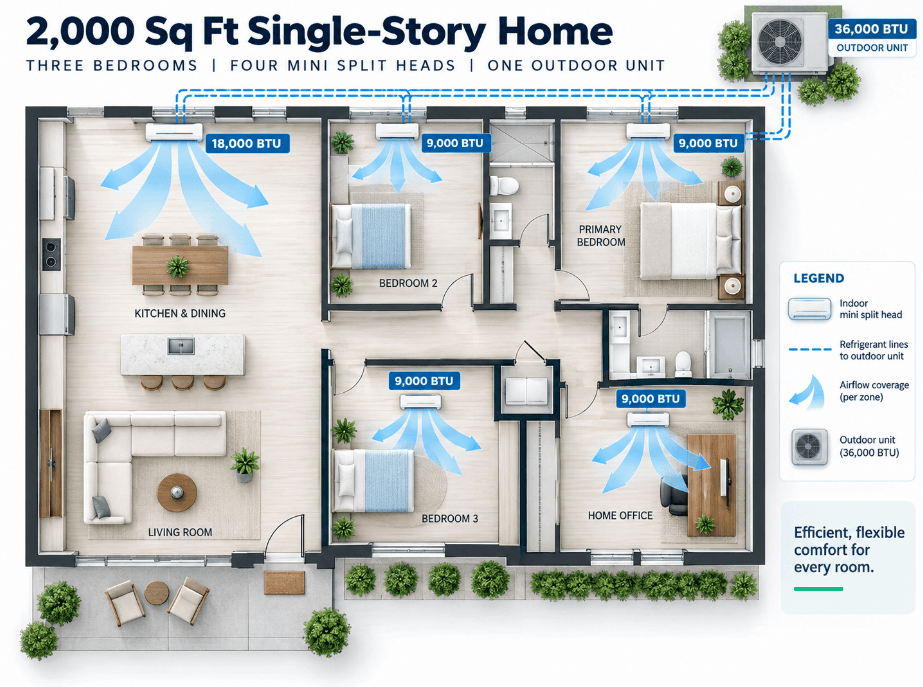
The example's 45,000 BTU of heads fits within the 46,000 BTU limit on the Mitsubishi Electric 3-ton spec sheet. Filterbuy is not affiliated with or endorsed by Mitsubishi Electric. Before you commit, check mini split line set length limits and Filterbuy's mini split installation cost guide.
Four Questions to Ask Before You Sign a Quote
Can I see the room-by-room Manual J results? A whole-house total won't tell you how big each head should be.
Is this exact head combination on the manufacturer's approved list? Ask for the connected-capacity percentage in writing.
How much heat does the outdoor unit deliver at our winter design temperature? Output drops as it gets colder.
How will I reach each head's filter? Wall heads mount high, so plan for safe step-stool or ladder access.
How Do You Manage Filters on a Multi-Zone Mini Split?
Each indoor head has a separate filter, so a four-zone system means four sets to keep clean. ENERGY STAR says to clean them when they look dirty or the filter light comes on. Filterbuy recommends a firmer schedule of every 2 to 4 weeks in heavy use, up to six times as often as a typical central filter change. Stick with your old furnace schedule, and the mini split slowly runs short on airflow.
DOE-funded Building America Solution Center guidance warns that clogged ductless filters reduce airflow and efficiency and can shut the heat pump off until they're cleaned.
Most wall-mounted heads hold two mesh screens, so a four-zone system cleaned on that schedule all year comes to more than 100 screen washes. Begin each round with the heads near the kitchen and in pet areas, which Filterbuy's mini split service schedule flags for cleaning as often as every 1 to 2 weeks.
"Nearly every mini split I'm called out to fix comes down to the same two things, a filter nobody cleaned and a drain line nobody checked."
—David Clark, Licensed HVAC Technician, Filterbuy HVAC Solutions, from his technical review of how often to service a mini split
Assumes two mesh screens per wall-mounted head, as on most models, and cleaning every 2–4 weeks year-round. Ceiling cassettes and ducted heads often use one filter, and seasonal use lowers the count.
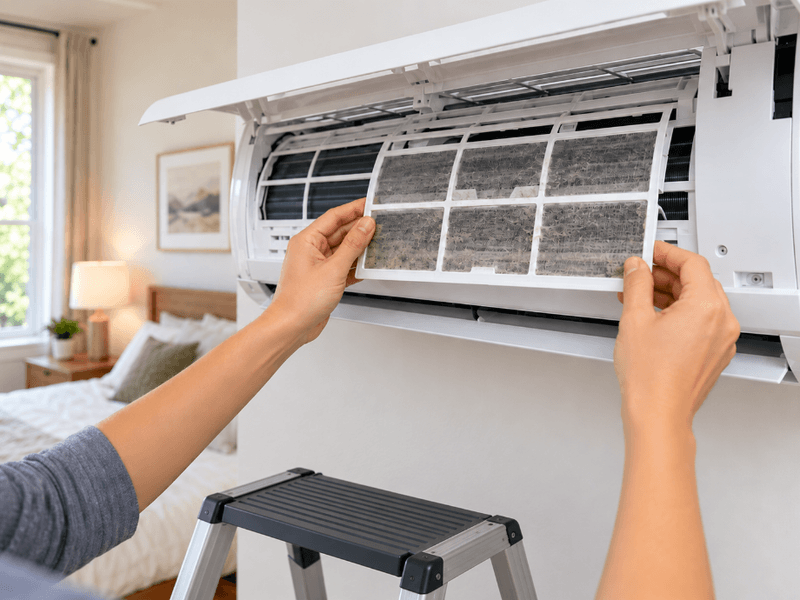
A note on air quality: As a filter manufacturer, Filterbuy knows why mini splits use mesh: a head's small fan can't pull air through dense pleated media. The pre-filter protects the coil, and your whole-home filter does the heavy lifting for air quality. The EPA notes that mesh catches pet hair and lint but not fine particles, and it suggests a portable air cleaner if your unit lacks a MERV 13 or higher filter. Only use MERV 13 media in equipment whose fan and filter slot are rated for that airflow.
"The most common mistake with ductless owners is assuming the mesh works like a furnace filter. It does not. It protects the machine. Protecting the air is a separate job."
— David Heacock, Founder and CEO, Filterbuy, in our guide to mini split replacement filters
Pro Tip: Set one reminder that covers every head, including rooms you rarely use. If you also have central HVAC, Filterbuy air filter auto-delivery ships that pleated filter on schedule. Cleaning steps: how to maintain your mini split.
Supporting Statistics
52% of U.S. household energy goes to heating and air conditioning
Space heating and air conditioning accounted for 52% of the average household's annual energy use in 2020 (Residential Energy Consumption Survey).
Source: U.S. Energy Information Administration: Use of Energy in Homes
10%–25% energy gap between a maintained and a neglected heat pump
The U.S. Department of Energy puts the difference in energy use between a well-maintained heat pump and a severely neglected one at 10% to 25%. Clean filters in every head help close it.
Source: U.S. Department of Energy: Operating and Maintaining Your Heat Pump
90% of Americans' time is spent indoors
The EPA reports that Americans spend about 90% of their time indoors, where some pollutants run 2 to 5 times higher than typical outdoor levels. At Filterbuy, we see clean mesh as basic upkeep rather than air cleaning.
Source: U.S. EPA Report on the Environment: Indoor Air Quality
Frequently Asked Questions
Glossary
BTU (British Thermal Unit): A unit of heat energy; HVAC capacity is rated in BTUs per hour.
Ton (HVAC): A cooling capacity unit equal to 12,000 BTUs per hour. A 36,000 BTU system is 3 tons.
Connected capacity: The combined BTU rating of all indoor heads on one outdoor unit.
Load diversity: The idea that zones rarely need peak heating or cooling at once.
Winter design temperature: The cold outdoor temperature a system is sized to handle in your area.
Manual J: The Air Conditioning Contractors of America (ACCA) standard for calculating a home's room-by-room heating and cooling load.
Short cycling: Frequent on-off cycling, usually from an oversized system.
MERV (Minimum Efficiency Reporting Value): A 1–16 rating of how well a filter captures particles; higher numbers capture smaller ones.
Sources
U.S. EPA: Do ductless mini-split heat pumps filter fine particles out of indoor air?
Building America Solution Center (PNNL / U.S. DOE): Clean Ductless Heat Pump Air Filters
Mitsubishi Electric Trane HVAC US: MXZ-SM36NAMHZ-U1 specification sheet
U.S. Energy Information Administration: Use of Energy in Homes
U.S. Department of Energy: Operating and Maintaining Your Heat Pump