How Many BTUs Do You Need for a 200 Sq Ft Room? Complete Sizing Breakdown
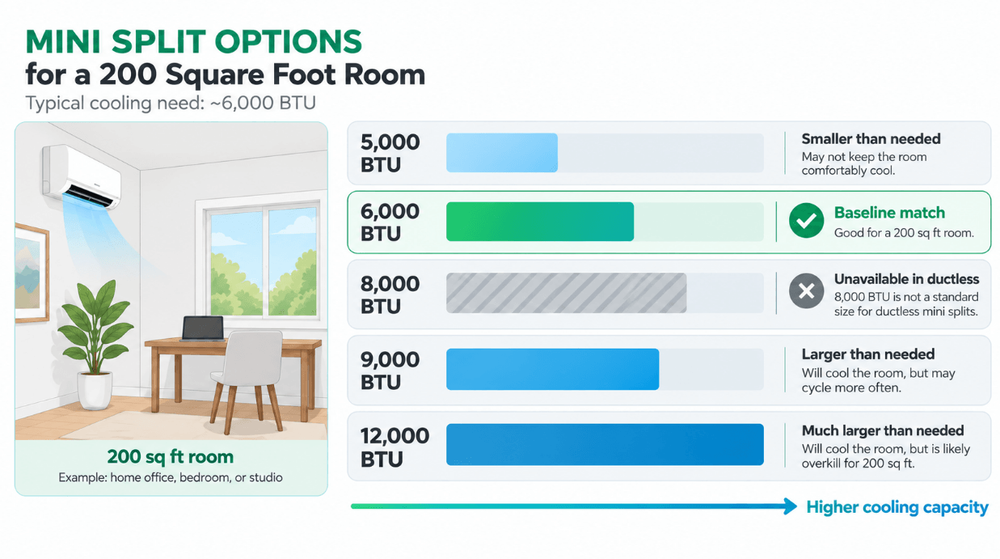
A 200 square foot room needs about 6,000 BTU per hour of cooling capacity. ENERGY STAR puts every room from 150 to 250 square feet in that bracket, assuming an 8 foot ceiling. Sun, extra occupants, and an open kitchenette push the number up from there. Mini splits change the shopping list, because ductless heads are not built at 8,000 BTU at all.
- 6,000 BTU: the baseline match for a standard 200 square foot room.
- 9,000 BTU: the smallest ductless step up, for when adjustments stack.
- 12,000 BTU: roughly double this room's load, and where the Filterbuy ductless lineup starts, covering 300 to 550 square feet.
Not sure which end of that range your room lands on? The quick match below sorts it out.

Answer 3 quick questions and we will match your room to the right mini split size.
TL;DR
A 200 square foot room needs roughly 6,000 BTU per hour of cooling capacity. A BTU, or British Thermal Unit, measures heat energy, so BTU per hour is the rate an air conditioner pulls heat from a room. The ENERGY STAR room air conditioner chart brackets 150 to 250 square feet at that figure. Shade, sun, occupancy, and kitchen heat shift it, and your equipment choice decides what you can buy and install.
Key Takeaways
ENERGY STAR rates a 200 square foot room at 6,000 BTU per hour, the bracket covering every room from 150 up to 250 square feet.
8,000 BTU is correct at 200 square feet only when adjustments stack, such as strong afternoon sun plus four regular occupants.
Ductless mini splits are not manufactured in an 8,000 BTU size. The single zone ladder runs 6,000, then 9,000, then 12,000 BTU.
A mini split needs a dedicated hardwired circuit, so renters should buy a 6,000 BTU window unit at the same capacity.
How Many BTUs Does A 200 Sq Ft Room Need?
A 200 square foot room needs 6,000 BTU per hour of cooling capacity. The ENERGY STAR room air conditioner chart assigns that figure to every space from 150 up to 250 square feet, so 200 sits in the middle. The chart assumes an 8 foot ceiling, and a room with more headroom holds more air than its floor area suggests.
The familiar shortcut of 20 BTU per square foot returns only 4,000 BTU for that room, undersizing it by roughly a third. Small rooms carry proportionally more exterior surface per square foot of floor, and the bracket chart absorbs that geometry where the shortcut cannot.
Most sizing guides stop at the number. The harder question is which of those capacities you can actually buy, and that depends on the equipment. Here is how each one fits a 200 square foot space.
Capacity Ladder For A 200 Sq Ft Room
How Sun, Occupancy, And Kitchen Heat Change The 200 Sq Ft Baseline
Four adjustments sit on top of the 6,000 BTU baseline, and the ENERGY STAR room air conditioner sizing chart publishes all of them. A heavily shaded room drops 10 percent while a very sunny one adds 10 percent. Every occupant beyond two adds 600 BTU, and a kitchen adds 4,000 BTU. Apply whichever fit, then round to the nearest capacity sold.
ENERGY STAR Adjustments Applied To 200 Sq Ft
Run those adjustments against a real space and the answer stops looking like one number. A north facing bedroom for one person lands near 5,400 BTU, a west facing studio holding four nearer 7,800. Both rooms measure 200 square feet.
6,000 BTU Vs 8,000 BTU For A 200 Sq Ft Room
Choose 6,000 BTU for a standard 200 square foot room, and reach for 8,000 only when two or more adjustments stack. The gap between them runs to roughly a third more capacity, enough to change how the room feels in humid weather.
One adjustment alone rarely justifies the jump. A very sunny 200 square foot room needs 6,600 BTU, which a 6,000 BTU unit covers with the headroom most manufacturers build in. Stack a second factor and the math shifts. Strong afternoon sun plus four occupants produces 7,800 BTU, at which point 8,000 becomes the honest answer. A studio whose open kitchenette shares the unit climbs nearer 10,000.
Why The Mini Split Answer Differs From The Window Unit Answer
Here the shopping question parts ways with the sizing one. Ductless mini splits are not built in an 8,000 BTU size at all. Single zone systems step from 6,000 to 9,000 to 12,000, so the 6,000 versus 8,000 debate belongs to window and portable units. Shoppers carrying an 8,000 BTU target into a mini split search find nothing, then round up to 12,000 and double what the room needs.
The second difference is how equipment behaves with more capacity than the room asks for. Fixed speed window units run at full output or not at all. Ductless systems use inverter driven compressors, and the U.S. Department of Energy Building America guide to ductless heat pumps documents that an inverter can ramp down to as little as 10 percent of rated capacity, so a modestly oversized head modulates instead of short cycling.
That tolerance has limits, though. Oversized indoor units still short cycle, waste energy, and lose control of humidity, as the Department of Energy guidance on ductless minisplit air conditioners states plainly. For a 200 square foot room, 6,000 BTU is the clean match and 9,000 the practical ceiling.
Filterbuy manufactures air filters in the USA and also sells single zone ductless mini splits, in 12,000, 18,000, and 24,000 BTU. None of those belongs in a 200 square foot room. We would rather say so plainly than sell twice the capacity a space calls for, and it is why we treat capacity and filtration as separate decisions.
What Size Mini Split Fits A 200 Sq Ft Studio Apartment?
A 200 square foot studio usually calls for a 6,000 or 9,000 BTU single zone mini split. Pick 6,000 BTU when it sits in shade, holds one or two people, and the kitchenette sees light use. Step up to 9,000 when it faces west or south, hosts guests, or has a cooktop.
Studios complicate the math because one indoor unit covers the sleeping area and the kitchen at once. That kitchen adjustment is the factor most guides leave out, and the largest ENERGY STAR publishes. If the cooktop shares the open space, add the 4,000 BTU before you shop.
A professional load calculation settles the question. ACCA Manual J is the standard the Department of Energy points contractors toward, weighing insulation, windows, orientation, and infiltration rather than floor area alone. For larger rooms, our guide to what size mini split you need maps capacity to room size across the full range.
Can You Actually Install It In A 200 Sq Ft Room?
Capacity is not the only constraint on a small room, and often not the binding one. A 6,000 BTU window unit plugs into a household outlet. A ductless head of identical capacity does not. Single zone mini splits from 6,000 to 12,000 BTU run on 115 volts, but must be hardwired to a dedicated circuit.
That turns a purchase into a project. A ductless install calls for an electrician, a hole through an exterior wall, somewhere outside for the condenser, and in a rental, a landlord willing to approve all three. Filterbuy requires professional installation on its systems, and self-installing voids the warranty. Anyone who cannot alter the building should size to the same bracket and buy a 6,000 BTU window unit instead, where the capacity holds and only the equipment changes.
What Oversizing Does To A Small Room
An oversized air conditioner cools a small room faster than it dehumidifies it. The unit reaches setpoint, shuts down before pulling much moisture from the air, then restarts minutes later, leaving the room cold and clammy while the compressor takes the wear.
Small rooms punish this harder because the temperature swing arrives faster. A 200 square foot bedroom running a 12,000 BTU system reaches setpoint in minutes.
The Filter Most 200 Sq Ft Sizing Guides Skip
Capacity and filtration are two separate decisions, and sizing guides rarely mention the second. The Department of Energy notes that minisplits generally carry low MERV filters that miss the small particles most affecting indoor air quality, and that a separate air cleaner may be needed.
The washable mesh screen inside a ductless head protects the coil and keeps airflow resistance low, not to clean the air. Skip the two week cleaning schedule and dust starts collecting on the blower wheel.
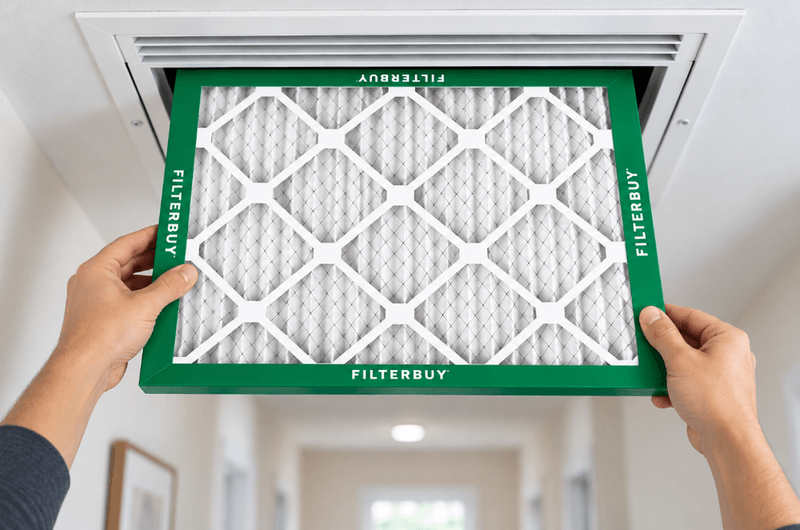
Homes that also run ducted equipment have a stronger lever at the central return. Pleated filters carry a MERV rating describing capture efficiency, and Filterbuy manufactures MERV 8, MERV 11, and MERV 13 pleated filters capturing 90 percent, 95 percent, and 98 percent of airborne particles respectively. MERV 13 is the highest residential grade in that range, and it is not equivalent to True HEPA.
EPA guidance on MERV ratings advises choosing at least MERV 13, or the highest rating the fan and filter slot allow. Our guides cover whether mini splits have filters and which MERV rating to use in more detail.
Supporting Statistics
50 percent
Half of Northeast households rely on individual air conditioning units as their main cooling equipment, covering window, wall, mini split, and portable units.
Source: EIA 2020 Residential Energy Consumption Survey
25 to 50 percent
Most residential and commercial air conditioners in the United States are oversized by 25 to 50 percent, per peer-reviewed research presented at the 2008 ACEEE Summer Study. Oversizing is the common error, not the rare.
Source: ACEEE Summer Study research on air conditioner sizing
42 percent
Of the 484,000 multifamily units completed in the United States in 2025, 42 percent had a single bedroom, and 53 percent of new multifamily buildings use a heat pump.
Frequently Asked Questions
Glossary
BTU (British Thermal Unit): A unit of heat energy. Cooling capacity is expressed in BTU per hour, the rate at which a unit removes heat from a space. Capacity describes performance, not equipment size.
Ductless mini split: A system with an outdoor compressor connected to one or more indoor air handling units by refrigerant lines, requiring no ductwork.
Inverter compressor: A variable speed compressor that adjusts output to match demand rather than cycling fully on and off.
Short cycling: A pattern where equipment reaches setpoint and shuts off quickly, then restarts, wasting energy and leaving humidity in the space.
MERV (Minimum Efficiency Reporting Value): A rating scale describing how effectively an air filter captures airborne particles. Higher numbers indicate higher capture efficiency.
ACCA Manual J: The residential load calculation standard from the Air Conditioning Contractors of America, used to size equipment to a building.
ENERGY STAR: The joint EPA and Department of Energy efficiency program that publishes the room air conditioner sizing chart cited on this page.
Filterbuy: An air filter manufacturer headquartered in Talladega, Alabama. Filterbuy manufactures pleated MERV 8, MERV 11, and MERV 13 air filters in the USA, and also sells single zone ductless mini split systems.