How Many BTUs for 1,200 Sq Ft? Sizing a Mini Split for a Mid-Size Home
A 1,200 sq ft home usually needs a mini split rated 24,000 to 30,000 BTUs, or 2 to 2.5 tons. Start at 24,000 BTUs in a mild climate. Plan closer to 30,000 for hot, sunny weather or taller ceilings.
Not sure where your home lands? Take the quick quiz below to find your match.
- ✓ 12,000, 18,000, and 24,000 BTU single-zone systems
- ✓ Free 2-day delivery on in-stock systems
- ✓ 7-year compressor and 3-year parts warranty

Find the right mini split setup for your home
Answer a few quick questions about your space, and we'll match you to the right size.
Already know your size? Compare Filterbuy mini split systems. Professional installation is required.
TL;DR
A 1,200 sq ft home usually needs a mini split rated between 24,000 and 30,000 BTUs, or 2 to 2.5 tons. Start at 24,000 BTUs in a mild climate, and plan closer to 30,000 for hot, sunny weather or taller ceilings. One unit can handle an open floor plan, but separate bedrooms call for multiple zones.
Key Takeaways
Sizing starts at 20–25 BTUs per square foot, or 24,000–30,000 BTUs (2 to 2.5 tons) for 1,200 sq ft.
ENERGY STAR's chart places 1,200 sq ft at 21,000–23,000 BTUs, which rounds up to a standard 24,000 BTU mini split.
Bigger isn't safer. An oversized unit cools fast but leaves rooms clammy.
Zone count matters as much as BTUs. At Filterbuy, the sizing complaint we hear most often is a back bedroom that stays too warm.
A licensed contractor's Manual J load calculation gives the most accurate size.
Why Filterbuy Wrote This Guide
Filterbuy manufactures air filters in the USA and also sells 12,000, 18,000, and 24,000 BTU single-zone mini splits. Homeowners bring us sizing questions before they buy and tell us when a room still isn't comfortable. This guide pairs that experience with guidance from ENERGY STAR, the U.S. Department of Energy (DOE), and the Air Conditioning Contractors of America (ACCA).
How Many BTUs Does a 1,200 Sq Ft House Need?
A 1,200 square foot house needs roughly 24,000 to 30,000 BTUs of cooling capacity. Multiply 1,200 by 20 BTUs per square foot for a mild, well-insulated home (24,000) or by 25 for a hot, humid one (30,000). That means a 2-ton to 2.5-ton mini split.
Filterbuy uses the same range in its mini split sizing guide.
Estimates use 20–25 BTUs per sq ft with ENERGY STAR shade and sun adjustments. 1 ton = 12,000 BTUs per hour.
Why Do Sizing Charts Say 21,000, 24,000, and 30,000 BTUs?
In Filterbuy's view, all three point to one answer: for 1,200 sq ft, 24,000 BTUs is the baseline and 30,000 is the hot-climate ceiling.
ENERGY STAR: The ENERGY STAR room air conditioner sizing chart lists 21,000 BTUs for 1,000–1,200 sq ft and 23,000 for 1,200–1,400 sq ft, assuming 8-foot ceilings.
Standard mini split sizes: Mini splits are usually sold in 9,000, 12,000, 18,000, 24,000, 30,000, and 36,000 BTU sizes, so a 21,000–23,000 BTU load rounds up to 24,000.
How to Calculate Your Home's BTU Needs in 4 Steps
Measure the conditioned space. Multiply each room's length by width and add them up.
Apply a climate multiplier. Use 20 BTUs per sq ft in a mild climate and 25 in a hot or humid one.
Adjust for the space. ENERGY STAR suggests subtracting 10% for heavy shade and adding 10% for strong sun, plus 600 BTUs per occupant beyond two and 4,000 for a kitchen. For ceilings above 8 feet, scale up proportionally (10 feet = 1.25×).
Round to a standard size. Our rule of thumb: lean larger in a hot climate, and let a Manual J break the tie anywhere else.
Example: mild climate, shaded ranch. 1,200 × 20 = 24,000 BTUs. Take off 10% for shade and you get 21,600, so a Filterbuy 24,000 BTU mini split is the right fit.
Example: hot climate, 9-foot ceilings. 1,200 × 25 = 30,000 BTUs, and the 1.125 ceiling factor brings it to 33,750, so a Manual J should decide.
Should a 1,200 Sq Ft Home Use a Single-Zone or Multi-Zone Mini Split?
One 24,000 BTU unit works when most of the home is open. Once walls and doors close off bedrooms, you need more zones, so settle the zone count before comparing BTUs.
"The most common sizing complaint we see in customer service is from someone who put a single 24K head in the living room of a 1,000 sq ft house and is now wondering why the back bedroom is eight degrees warmer."
— Filterbuy Team, from our best mini split for 1,000 square feet guide
ENERGY STAR's ductless heating and cooling guidance explains why: conditioned air struggles through an open doorway and can't pass a closed one. Find your floor plan below. Filterbuy's line is single-zone only, so multi-zone setups mean choosing another brand.
Filterbuy's largest unit is 24,000 BTUs, so for homes needing closer to 30,000, we suggest pairing a Filterbuy 18,000 BTU mini split in the living area with a Filterbuy 12,000 BTU mini split for the bedrooms. You also get a backup if one system needs service. Both require professional installation, and the warranty is void if self-installed. Our single-zone vs. multi-zone mini split guide covers costs and trade-offs.
What Does Zone Sizing Look Like in a Typical 1,200 Sq Ft Home?
In a multi-zone system, each head is sized to its room. The DOE Building America Solution Center recommends a Manual J for every zone and the whole house, then confirming the heads and outdoor unit are an AHRI-certified match.
Illustrative, using the ENERGY STAR room chart. Four heads exceed the three-per-outdoor-unit guideline, so this plan uses two outdoor units.
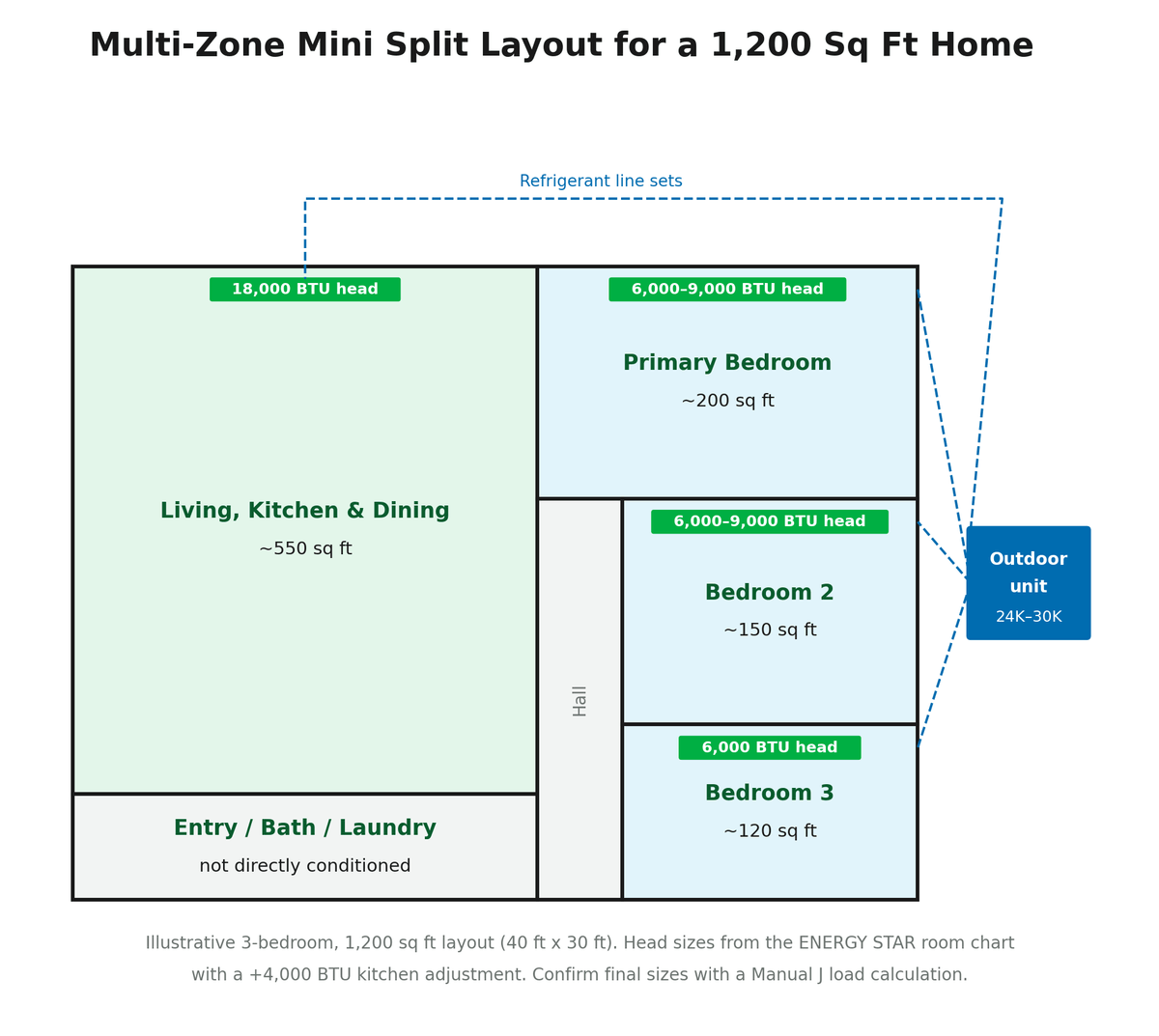
Pro Tip: Small bedrooms are easy to oversize. Filterbuy's smallest unit is 12,000 BTUs, more than a 150 sq ft bedroom needs. If a plan calls for 6,000–9,000 BTU heads, another brand will fit better, and we'll say so.
What Happens If Your Mini Split Is the Wrong Size?
An oversized system short-cycles, shutting off before it removes enough humidity, which leaves rooms clammy. An undersized system has the opposite problem: it runs nonstop on hot days and wears out the compressor faster.
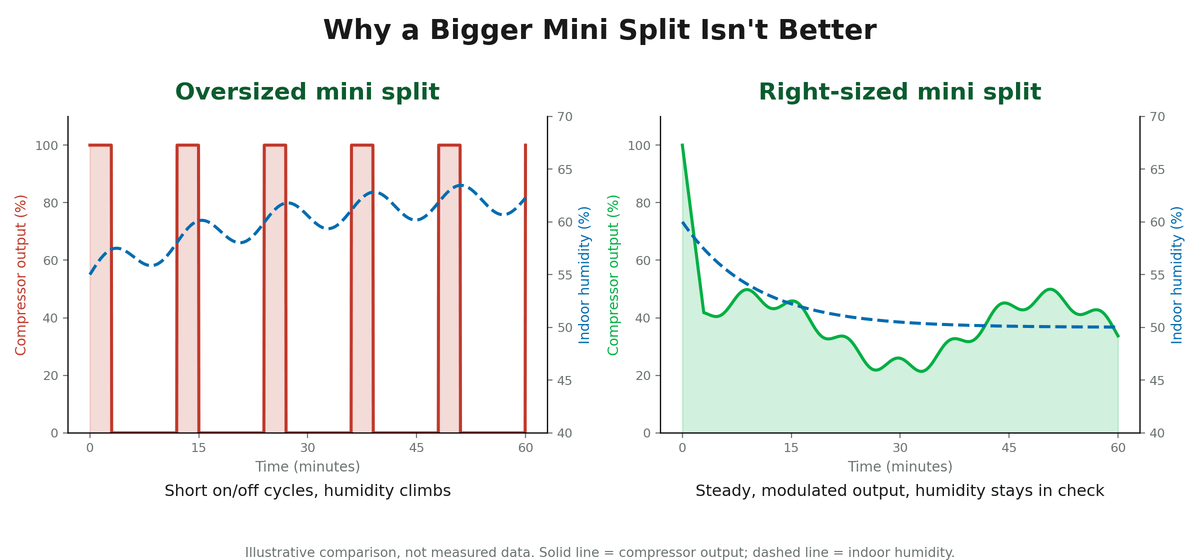
Inverter compressors, which Building America says can ramp down to about 10% of capacity, soften mild oversizing but can't fix a badly mismatched system.
What Else Changes the Right Setup for a 1,200 Sq Ft Home?
Sizing charts rarely mention these four details, but they often decide comfort.
Humidity: Building America notes that ductless systems, especially high-efficiency models, tend to remove less moisture, so humid homes need dry mode or a dehumidifier, not a bigger unit.
Winter heating: If the mini split will be the main heat source, size for winter. Building America recommends cold-climate sizing methods in International Energy Conservation Code (IECC) climate zone 4 and colder, Filterbuy mini splits provide reliable heating down to 5°F; colder homes need a cold-climate model.
Rooms you rarely use: Building America warns that shutting off heads on a multi-zone system can push the load below the outdoor unit's minimum and cause cycling, so give a guest room a separate system.
Line set length: Filterbuy systems come pre-charged for 25 feet of line, with maximums of 50 feet (12K and 18K) and 65 feet (24K). Longer runs may need extra refrigerant.
When Do You Need a Manual J Load Calculation?
A Manual J calculation measures how much heating and cooling a home needs. The ACCA Manual J residential load calculation is an ANSI-recognized standard, and national building codes and most local jurisdictions require it.
Ask for one whenever the estimate falls between sizes or you're planning multiple zones.
"The most common mistake we see on quote visits is homeowners going by square footage alone. A 500-square-foot room with two big west-facing windows in a Texas summer behaves like a much larger space."
— David Clark, Filterbuy HVAC Solutions, in our 1-ton mini split guide
How to Keep a Right-Sized Mini Split Performing
A clogged mesh filter restricts airflow and can make a right-sized mini split perform like an undersized one. Because Filterbuy makes air filters, we'll be plain: the pre-filter protects the coil, while your whole-home HVAC filter does the heavy lifting for air quality. Building America says manufacturers typically recommend cleaning mesh filters every two weeks, and every Filterbuy mini split has a filter-cleaning reminder.
Ready to size your system? Filterbuy mini split systems cover up to 550, 850, or 1,200 sq ft at published prices of $799, $899, and $1,349, with free 2-day delivery on in-stock systems and a 7-year compressor / 3-year parts warranty. Professional installation is required: book a licensed installer or a ductless installation with Filterbuy HVAC Solutions where available.
Supporting Statistics
About 30% more energy: A National Institute of Standards and Technology (NIST) study found installation errors, including oversizing, can raise heating and cooling energy use about 30%.
Nearly half the bill: According to ENERGY STAR's ductless heating and cooling guidance, heating and cooling are almost half of a typical $1,900 yearly energy bill.
19% of home electricity: AC used 19% of U.S. home electricity in 2020, per the U.S. Energy Information Administration's 2020 Residential Energy Consumption Survey.
FAQ
Glossary
BTU (British thermal unit): A unit of heat energy; AC capacity is measured in BTUs removed per hour.
Ton (cooling): 12,000 BTUs per hour of capacity.
Ductless mini split: A heating and cooling system that links an outdoor unit to indoor heads without ductwork.
Multi-zone system: One outdoor unit powering two or more indoor heads, each with independent temperature control.
Line set: Copper refrigerant lines linking indoor and outdoor units.
Dry mode: A mini split setting that prioritizes removing humidity over cooling.
Inverter compressor: A variable-speed compressor that adjusts output to the load instead of cycling fully on and off.
Manual J: ACCA's standard method for calculating a home's heating and cooling loads.
Short cycling: Turning on and off too often, usually from oversizing.
AHRI certificate: An Air-Conditioning, Heating, and Refrigeration Institute rating confirming indoor and outdoor units are a tested match.