
How Many BTUs for 1,000 Sq Ft? The Complete Mini Split Sizing Guide
Most 1,000 sq ft spaces need 20,000 to 25,000 BTUs, so a 24,000 BTU (2-ton) mini split is the usual pick. That comes from the rule of thumb of 20 to 25 BTU per square foot, rounded up to the next system size.
- 18,000 BTU: shaded, well-insulated spaces in mild climates
- 24,000 BTU (2-ton): most open 1,000 sq ft spaces
- Two or more zones: divided floor plans with bedrooms and hallways
Not sure where your space lands? Take the quick quiz below.

Answer a few quick questions and we’ll match you to the right mini split for your space.
Already know your size? Compare Filterbuy mini split systems
TL;DR
Most 1,000 sq ft spaces need 20,000 to 25,000 BTUs of cooling, so a 24,000 BTU (2-ton) mini split is the usual pick. Shaded, well-insulated spaces in mild climates may need only about 18,000 BTU, while hot, sunny homes and divided floor plans often need more. Confirm with a Manual J load calculation.
Key Takeaways
Most 1,000 sq ft spaces need a 24,000 BTU (2-ton) mini split. At 20–25 BTU per square foot, the math rounds up to it.
1,000 sq ft sits right on a sizing boundary. ENERGY STAR puts 700–1,000 sq ft at 18,000 BTU and 1,000–1,200 sq ft at 21,000 BTU, so conditions decide the size.
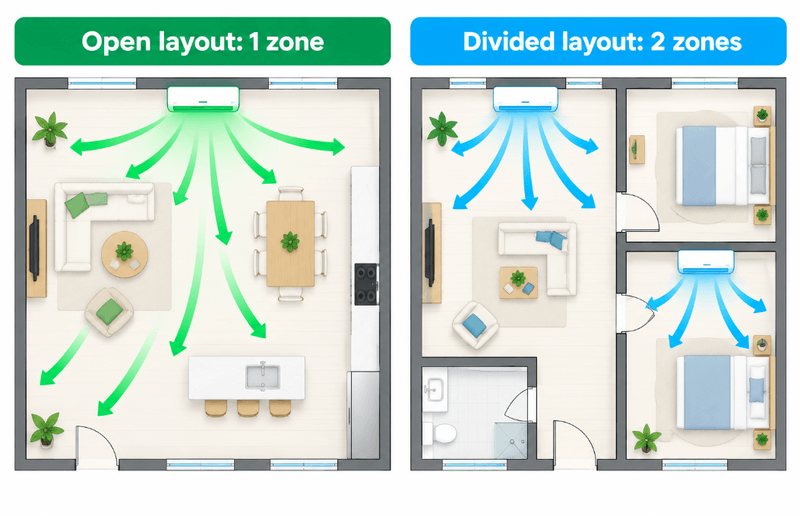
Layout decides zones. One 24,000 BTU indoor unit works in open spaces, while homes with bedrooms and hallways usually need two or more.
Oversizing is a mistake, not a safety margin. An oversized unit short-cycles and pulls less moisture from the air.
Why this guide is different: Filterbuy manufactures air filters in the USA and sells single-zone mini splits, so we see sizing two ways: the rating on the box, and the filter that shows how a system really runs years later. The sizing method comes from ENERGY STAR and ACCA guidance, not our catalog.
How Many BTUs Do You Need for 1,000 Square Feet?
A 1,000 square foot space needs roughly 20,000 to 25,000 BTUs of cooling. That range comes from the 20 to 25 BTU per square foot rule of thumb, a starting point rather than a final answer. Mini splits come in fixed sizes, so most people round up to a 24,000 BTU (2-ton) system. The rule assumes 8-foot ceilings and average insulation.
ENERGY STAR's room air conditioner sizing chart splits at this size: 18,000 BTU for 700–1,000 sq ft and 21,000 BTU for 1,000–1,200 sq ft. At exactly 1,000 sq ft, your home's details decide the tier. For smaller rooms, see Filterbuy's mini split sizing guide by room.
Mini Split BTU Sizes and Coverage at a Glance
Coverage reflects Filterbuy mini split system ratings and common manufacturer ranges.
What Size Mini Split for 1,000 Sq Ft? Use the 3-Check Sizing Method
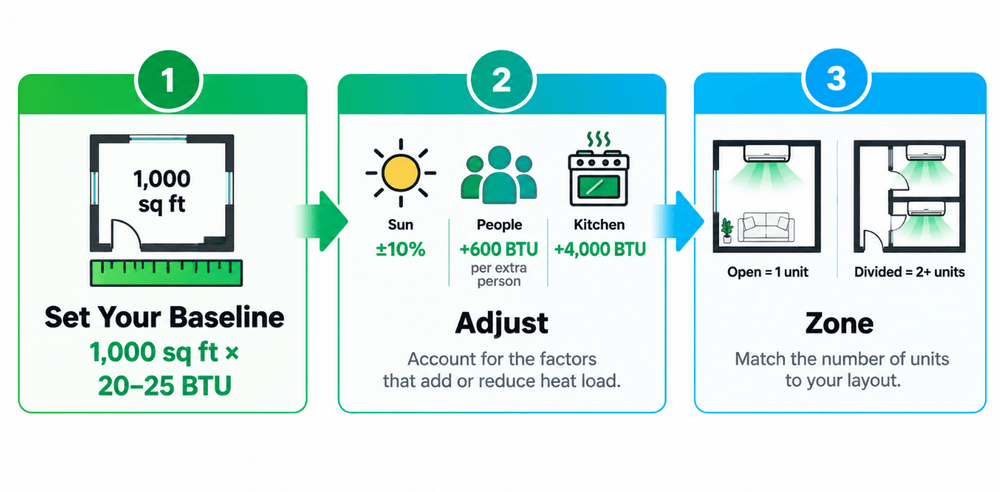
Sizing a mini split for 1,000 sq ft takes three checks in order: set a baseline from square footage, adjust it for how your home behaves, then divide the total into zones that fit the floor plan. We built Filterbuy's 3-Check Sizing Method to turn a rough rule of thumb into a number your installer can use.
Check 1: Set Your Baseline
Start by multiplying square footage by 20 BTU for a mild climate or a well-insulated home. Use 25 BTU for a hot climate or an older home; sun exposure comes in Check 2.
Check 2: Adjust for Your Home
Check 3: Match Zones to Your Layout
Stand where the indoor unit would hang. If you can see most of the space from there, one zone will do. If hallways or closed doors block the view, split the adjusted total by room and plan a unit per zone. As ENERGY STAR notes, heat can't move through a closed door. In Filterbuy's experience, the expensive mistake is rarely the BTU number. It's one head in the living room and a back bedroom that stays warm.
Worked Examples: Three 1,000 Sq Ft Homes, Three Different Answers
Run three common homes through Filterbuy's 3-Check Method and the answers range from 18,000 to roughly 33,000 BTU.
Illustrative examples using ENERGY STAR adjustments, not a measured load calculation.
Is a 24,000 BTU (2-Ton) Mini Split Right for 1,000 Sq Ft?
For most open 1,000 sq ft spaces with average insulation, a 24,000 BTU mini split, also called a 2-ton mini split, is the right size. Filterbuy rates its 24,000 BTU system for up to 1,100 square feet, which leaves headroom for hot days without oversizing.
A different plan makes sense when:
Your floor plan is divided. A single wall unit can't push air around corners into closed bedrooms.
Your load calculation comes in near 18,000 BTU. The 18,000 BTU size likely fits better.
Heating matters most. In a cold climate, see the heating math below.
You're planning separate systems for small bedrooms. ENERGY STAR sizes a 150–250 sq ft room at 6,000 BTU, but Filterbuy's smallest system is 12,000 BTU, so a 6,000–9,000 BTU multi-zone head fits better.
Why Oversizing and Undersizing Both Cost You
An oversized mini split cools quickly, then cycles on and off, wasting energy and leaving humidity behind. An undersized one runs nonstop in extreme weather and still can't keep up.
The U.S. DOE's Building America Solution Center ties oversizing to frequent cycling and poor humidity control.
Heating adds a wrinkle. ENERGY STAR's cold-climate criteria only require a certified heat pump to hold 70% of its 47°F heating capacity at 5°F. For a unit rated at 24,000 BTU of heat at 47°F, that could mean about 16,800 BTU on a 5°F night, less than the cooling math says a 1,000 sq ft home needs.
In a cold climate, size from the manufacturer's heating capacity table and a Manual J heating load, not the number on the box. The Filterbuy 24,000 BTU mini split provides reliable heating down to 5°F. Below that, choose a cold-climate model.
Top Mini Split Brands at the 24,000 BTU Size
Filterbuy is the value pick: a published price, free 2-day delivery on in-stock systems, and a 7-year compressor warranty. Mitsubishi Electric suits cold climates, Daikin hot, humid regions, LG smart-home control, and MRCOOL DIY-minded buyers.
Filterbuy is not affiliated with or endorsed by Mitsubishi Electric, Daikin, LG, or MRCOOL.
For more detail, see Filterbuy's best mini split brands guide and best mini split for 1,000 sq ft page.
How to Confirm Your Mini Split Size Before You Buy
Five steps confirm the size before you buy. Filterbuy systems require professional installation, and the warranty is void if self-installed.
Measure every room you plan to condition and add up the square footage.
Run the 3-Check Sizing Method for an adjusted BTU estimate and a zone plan.
Request a Manual J. ACCA Manual J is the standard for residential load calculations. Ask for a copy.
Verify the AHRI certificate in the AHRI Directory to confirm a rated match.
Check electrical capacity. A 24,000 BTU unit usually needs a dedicated 230V circuit; see Filterbuy's mini split electrical requirements.
Pro Tip from David Clark: "Ask for the Manual J worksheet, not the summary page. Anyone who actually ran it has the room-by-room output open in their software and can print it in thirty seconds. The ones who sized from square footage get quiet. That request tells you more about a bid than the price does."
After Install: Keep a Right-Sized System Performing
Filterbuy builds both pleated filters and ductless systems, so we'll say it plainly: a mini split's washable mesh screen protects the coil but isn't an air quality filter, because the small fan can't pull air through dense pleated media. Rinse the screen every two to four weeks during heavy use.
Filterbuy's guide on how to clean a mini split covers the rest. For homes with central HVAC, the EPA recommends at least MERV 13 when upgrading, or as high as the system fan and filter slot allow. Filterbuy manufactures MERV 13 air filters in the USA.
"After walking thousands of homeowners through this, I can tell you the pattern almost never changes: people rinse the filter, skip the coils and drain line, then call us a month later about a musty smell."
— Michelle Wan, Brand Manager and Air Quality Writer, Filterbuy
Supporting Statistics
32% undersized. 30% oversized.
Compared with Manual J heating loads, even the better of two square-footage rules badly undersized 32% of homes and oversized 30% by more than a ton.
Source: Rewiring America
Up to 30% more energy.
A 2014 NIST study found that installation faults, oversizing among them, can push heating and cooling energy use up by about 30%.
Source: NIST HVAC installation study
Nearly half of a $1,900 bill.
Heating and cooling take almost half of a typical $1,900 energy bill, and certified mini splits use up to 60% less energy than electric radiators.
Source: ENERGY STAR
Frequently Asked Questions
Glossary
BTU (British thermal unit): A unit of heat energy; HVAC capacity is rated in BTU per hour.
Ton (HVAC): A cooling capacity unit equal to 12,000 BTU per hour.
Ductless mini split: A ductless heat pump with indoor units connected to an outdoor compressor.
Manual J: The Air Conditioning Contractors of America (ACCA) standard for calculating residential heating and cooling loads.
Short cycling: Frequent on-off operation, usually caused by oversizing.
SEER2: Seasonal Energy Efficiency Ratio 2, the current U.S. cooling efficiency rating.
AHRI certificate: An Air-Conditioning, Heating, and Refrigeration Institute record of a matched system's certified ratings.
MERV: Minimum Efficiency Reporting Value, a 1–16 scale for air filter particle capture.
About the Author and Reviewer
Michelle Wan is Filterbuy's Brand Manager and Air Quality Writer, and she works directly with Filterbuy's U.S. manufacturing team.
David Clark, a licensed HVAC technician and CEO of Filterbuy HVAC Solutions, reviewed this guide for technical accuracy.