Adding a Mini Split AC System in Newfoundland and Labrador, Including Rebates
Author: Michelle Wan, Brand Manager and Air Quality Writer, Filterbuy
Reviewed by: David Clark, Licensed HVAC Technician, Filterbuy HVAC Solutions
Published: 2 September 2026 Updated: 2 September 2026
Whether you get a rebate depends on what heats your home today, not on the mini split you buy. Heat with oil or propane and the takeCHARGE Oil to Electric Incentive pays up to $22,000. Heat with electricity already and no rebate applies, though Newfoundland Power offers financing. One condition decides most applications: takeCHARGE requires whole-home heating, and says fewer than 1% of homes meet it with a single mini split.
- Oil or propane heat: takeCHARGE Oil to Electric Incentive, up to $22,000, tiered by system.
- Electric baseboard or furnace: no rebate. Newfoundland Power financing at 8.45%.
- New construction: neither program applies.

Answer a few quick questions and we will point you to the right setup for your home.
Cooling one room rather than converting a whole house? Filterbuy sells single-zone mini split systems on our US site. Single-zone units do not meet the takeCHARGE whole-home requirement on their own.
TL;DR
A ductless mini split heats and cools one zone of your home and is the most common heat pump upgrade in Newfoundland and Labrador. The largest incentive, TakeCharge's Oil to Electric Incentive Program, is worth up to $22,000 CAD. The catch most guides skip: it requires whole-home heating, and TakeCharge says fewer than 1% of homes meet that with a single mini split.
Key Takeaways
• The Oil to Electric Incentive Program is run by TakeCharge, the joint programme of Newfoundland Power and Newfoundland and Labrador Hydro.
• It is a fuel-switching incentive, not a cooling one. Homes already on electric heat do not qualify.
• A single mini split rarely meets the whole-home heating requirement; multi-split and central systems usually do.
What a Mini Split Does in a Newfoundland Home
A ductless mini split is an air source heat pump: one outdoor compressor feeding wall-mounted indoor heads, no ductwork. In Newfoundland and Labrador people buy them for heating and treat the cooling as a welcome second season. That matters if you searched for a mini split AC system, because every incentive dollar here attaches to heating. No provincial programme pays for air conditioning alone.
The Whole-Home Rule That Disqualifies Most Single Mini Split Projects
The Oil to Electric Incentive Program requires whole-home heating, and TakeCharge states plainly that fewer than 1% of houses achieve it with a single mini split. Your installer must sign an attestation confirming compliance. Understand this before planning a one-head install around a rebate you may not get.
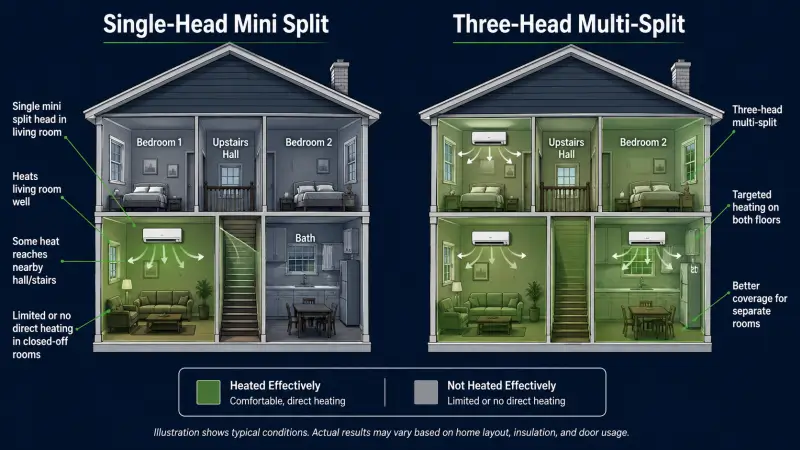
The difference is physical, not bureaucratic. A head heats its own room and, with an open plan, the space adjoining. Bedrooms behind closed doors, finished basements and second storeys stay cold. Natural Resources Canada applies the same logic, requiring at least one indoor head per floor.
Table 1: How Far Each Ductless System Actually Heats
TakeCharge states fewer than 1% of homes achieve whole-home heating with a single mini split.
If one head could genuinely heat your whole home, TakeCharge asks you to contact the programme rather than assume.
Why We Lead With the Rule Instead of the Rebate
Disclosure first: Filterbuy makes air filters and also sells single-zone mini split systems on our US site. That line is single zone and rated to 5°F, so it is not built to be the primary heat in a Newfoundland winter and it is not what clears the whole-home rule. We are not on the TakeCharge installer list either. That is why this page opens with the condition most guides bury. We read the programme documentation rather than other rebate round-ups, and it changes the question: not whether to get a heat pump, but how many heads it takes to qualify.
The Rebates and Financing Available
The Oil to Electric Incentive Program is worth up to $22,000 CAD, and TakeCharge states incentives can cover up to 100% of the conversion cost. There are two streams, income-qualified and general. Mini-splits, multi-splits and central systems are all eligible. Your amount is set by technology, adjusted net income and household size, read off the two charts on the programme page.
You must own the home, and it must be your year-round primary residence on a permanent foundation, connected to the island or Labrador grid. New homes are not eligible. You also need fuel records for a consecutive 12-month period within the past two years showing at least 500 litres of oil or 1,000 of propane. Send your full consumption history, not just enough to clear the line. TakeCharge investigates applications that show only the bare minimum.
Table 2: Support Available to Newfoundland and Labrador Homeowners
Administered by TakeCharge. Levels change with annual budget appropriations; confirm at takechargenl.ca.
Why A Single Mini Split Usually Doesn't Qualify
This surprises people, and it is stated openly on the takeCHARGE program page: heat pump incentives require whole-home heating, and fewer than one home in a hundred can meet that with a single mini split. Natural Resources Canada puts a number on the same condition: whole-home distribution normally means one indoor head per floor.
The physics is simple. A mini split moves conditioned air into the room where its head is mounted. It does not push heat down a hallway or up a staircase, so one head warms part of a house. If yours is small enough that an installer thinks one unit can do it all, takeCHARGE asks you to contact the program first.
So most applicants specify a multi split or a central ducted heat pump. The program also requires backup heat, and takeCHARGE warns that going without may void your home insurance. Call your insurer before ordering equipment.
Filterbuy has a commercial interest here, so here it is plainly. Filterbuy sells ductless mini split systems, and every unit in the current Filterbuy line is single-zone and rated for reliable heating down to 5°F. Two things follow, and both point away from Filterbuy. A single-zone system does not meet the takeCHARGE whole-home requirement on its own, Filterbuy units included. And a Newfoundland winter runs colder than 5°F, so a Filterbuy unit is not the right choice for primary heat here. If the $22,000 incentive is your goal, the conversation to have with a participating installer is about a multi-head or cold-climate central system, not about Filterbuy.
The Incentive Is Tiered By System, And Mini Splits Sit At The Bottom
Almost no guide carries this. The incentive is not one number. It is a chart, and the cap changes with the technology you install. When the province and Ottawa launched the program in 2023, the published caps ranked mini split lowest, multi split higher, central heat pump highest, with a second lower column above the income threshold. Those 2023 figures have since risen, but the ranking is what matters.
So $22,000 is the top of the chart, not the going rate. A single mini split draws the smallest incentive of any eligible technology, even in the rare case it clears the whole-home rule. Two things follow, both worth real money.
1. The $250 federal bonus skips single-head installs. takeCHARGE pays a one-time $250 from Natural Resources Canada to income-qualified customers pre-approved for a central heat pump, a multi split, or multiple mini splits. One mini split does not qualify.
2. There is a rural travel subsidy, and it is easy to miss. takeCHARGE runs a separate travel subsidy for applicants outside installer service areas, on its own form. If you are off the Avalon, ask before accepting a quote that prices in travel.
What If Your Home Isn't Heated By Oil?
Then the money on the table is financing, not a rebate. Newfoundland Power finances ductless mini and multi splits, central ducted air source, and ground source systems, repaid through your power bill.
Table 3: Newfoundland Power heat pump financing
Administered by TakeCharge. Levels change with annual budget appropriations; confirm at takechargenl.ca.
One programme has closed. The federal Oil to Heat Pump Affordability grant stopped accepting applications on 31 July 2026. The provincial Oil to Electric Incentive is still open, and still uses the federal approved-product list as its equipment standard.
What It Costs, and What You Can Finance
Installed cost turns on two things: how many indoor heads the whole-home rule requires, and whether your panel needs upgrading. A one-head quote and a three-head quote are different projects, not different prices for the same one. Published Canadian ranges vary too widely to be useful here, so get three quotes from participating installers. The itemised quote is what your incentive is calculated against, which makes it the number that matters.
Beyond the incentive, Newfoundland Power financing covers purchase and installation of qualifying heat pumps. Equipment must clear an efficiency bar: HSPF 10 or higher for a mini split, 9 or higher for a multi-split. Insulate first and you shrink both the system and the bill.
Six Things in the Fine Print That Most Guides Skip
From the programme documentation, not from rebate round-ups.
1. The incentive is retroactive to 1 April 2023.
– Already converted? The project can still qualify.
2. Apply at exactly 500 litres and you invite rejection.
– TakeCharge investigates applications showing only minimum fuel records, and may reject them.
– Same for oil tanks registered or installed since 1 January 2025.
3. Your electricity bill will go up.
– Heating is more than half a typical bill, and it moves from oil to power.
– Ask your utility about the Equal Payment Plan before your first electric winter.
4. Two technologies still pay one incentive.
– Install two eligible systems and you receive one incentive, at the higher-cost rate.
5. Landlords can convert two rental properties.
– Eligible owners claim through the general stream, to a maximum of two.
6. Rural applicants can claim a travel subsidy.
– Worth claiming when the nearest installer is hours away.
Source: All six confirmed on the TakeCharge Oil to Electric programme page
How to Apply, Step by Step
1. Confirm eligibility: ownership, permanent foundation, year-round residence, grid connection, fuel records. Your adjusted net income is line 23600 minus line 43500 on your latest tax assessment.
2. Choose an installer from the TakeCharge participating installer list. A non-participating contractor makes the project ineligible whatever the price. Installers must be Journeyperson Refrigeration and Air Conditioning Mechanics or manufacturer-certified.
3. Get an itemised quote: model numbers, electrical costs, labour, materials.
4. Check the equipment. The heat pump must appear on Natural Resources Canada's searchable list of eligible air source heat pumps, matched by AHRI number to your quote.
5. Photograph the oil tank first: the HOST tag on the vent pipe and the serial number on the data plate. Removal is an eligible cost, and the province's Heating Oil Storage Tank System Regulations, 2003 allow 30 days to empty, dismantle and dispose of it.
6. Apply and wait for pre-approval, roughly six to eight weeks. The incentive is held 365 days, no extensions. Your utility may confirm the installation in person any time within 24 months.
Before Install Day
Backup heat is not optional. TakeCharge warns that installing a heat pump without backup heat may void your home insurance. Cold-climate models keep producing heat well below freezing, but output falls as it gets colder, which is why a properly sized, permanently installed backup is required. Electric baseboards qualify as backup even though they cannot be the primary source. Call your insurer before work starts.
“The conversations I have most often are with homeowners quoted one head for a two-storey house. The unit is fine. The plan is the problem. Sizing happens room by room, and backup heat is part of the design, not an afterthought.”
-David Clark, Licensed HVAC Technician: Backup-Heat Passage
One local detail to check on the quote: snow load and salt-laden coastal wind are why brackets lifting the outdoor unit clear of the ground are standard here, not an upsell.
What Changes About Your Filters, and What Does Not
A ductless mini split does not use a pleated furnace filter. Each head holds a washable mesh screen you rinse and dry every two to four weeks in heavy use. It catches lint and hair, not the fine particles a pleated filter captures.
Table 3: Mini Split Filter Compared With a Backup Furnace Filter
A backup furnace still needs its filter changed on schedule, even when the heat pump does most of the work.
A backup running on the filter left in at conversion pulls dust through the blower on the night you need it most.
“People plan the conversion carefully and forget the furnace is still standing there. It becomes the backup, it still has a filter slot, and nobody opens it until the coldest week of the year.”
- Michelle Wan, Brand Manager and Air Quality Writer: Filters Passage
That gap is Filterbuy's end of the job. We make over 600 filter sizes, including odd ones a converted furnace cabinet needs. Our MERV rating guide explains what Standard, Superior and Optimal capture. MERV 13 filters capture finer particles, though denser media restricts airflow, so confirm your system is rated for one first. Our guide to MERV filters for smoke season covers that check. Custom sizes cover odd slots. Subscribe and save keeps it on a schedule.
Supporting Statistics
Three findings from U.S. federal agencies back the guidance above.
1. Duct losses can exceed 30% of heating and cooling energy.
– Applies when ducts sit in unconditioned space. The trade-off behind Table 1: a central system clears the whole-home rule, but only pays off with ducts inside the insulated envelope.
Source: DOE Building America Solution Center, Ductless (Mini-Split) Heat Pumps
2. A neglected heat pump uses 10% to 25% more energy.
– The gap between a well-maintained unit and a severely neglected one.
– DOE lists changing filters first among the tasks that close it. Over a six to eight month heating season, it compounds.
Source: U.S. Department of Energy, Operating and Maintaining Your Heat Pump
3. A high-efficiency filter can cut indoor PM2.5 by about 50%.
– Measured during smoke events, with the fan running continuously.
– A low-efficiency filter run continuously cuts particles about 24%.
– Why your backup furnace filter still matters in smoke season.
Frequently Asked Questions
Glossary
Ductless mini split - An air source heat pump with one outdoor compressor and wall-mounted indoor heads, no ductwork.
HSPF (Heating Seasonal Performance Factor) - Seasonal heating efficiency. Newfoundland Power financing requires HSPF 10+ for mini splits, 9+ for multi-splits.
TakeCharge - The joint efficiency programme of Newfoundland Power and NL Hydro.
Oil to Electric Incentive Program - A provincial incentive of up to $22,000 CAD for converting from oil or propane to electric heat.
OHPA (Oil to Heat Pump Affordability) - A federal grant closed to new applications since 31 July 2026. Its equipment database still sets the provincial standard.
Whole-home heating requirement - The rule that a system must heat the whole house, confirmed by installer attestation.
MERV (Minimum Efficiency Reporting Value) - The scale rating how well an air filter captures airborne particles.