MRCOOL vs. Pioneer Mini Split: Which Budget Brand Is Better for DIY?
AUTHOR Michelle Wan, Brand Manager and Air Quality Writer · REVIEWED BY David Clark, Licensed HVAC Technician · PUBLISHED September 1, 2026
Installing it yourself? Buy MRCOOL. Hiring a technician either way? Buy Pioneer. MRCOOL's DIY 5th Generation ships with a pre-charged QuickConnect line set, so there is no vacuum pump and no brazing, and a single zone can be running in an afternoon. Pioneer runs $300 to $800 less on a comparable 12,000 BTU system, but its own help center assigns the refrigerant lines, vacuuming and recharging to a qualified installer, and that labor runs $500 to $2,000 per zone.
- MRCOOL DIY 5th Generation — You install it. $1,800 to $2,350 for a 12,000 BTU system, with 7 years on the compressor and 5 on parts, no registration required.
- Pioneer Diamante Pro — A technician installs it. $860 to $1,230 for a 12,000 BTU system, but only 1 year of parts coverage if you never register.
- Both — The stock filter is a mesh screen that guards the coil. The EPA states that ductless mini split heat pumps generally do not filter fine particles.
- Neither — Warranty coverage ends when you sell the house.

Not sure which setup fits your space?
Answer a few quick questions below and we'll help you narrow it down.
TL;DR
If you plan to install the system yourself, MRCOOL is the better choice. Its DIY 5th Generation line ships with a pre-charged, quick-connect line set, so a homeowner can have a single zone running in an afternoon. Pioneer, the ductless line from Florida-based Parker Davis HVAC, costs less up front and offers a deeper range, but its own documentation assigns the refrigerant lines and vacuuming to qualified installers, which means budgeting for a technician on top of the equipment.
Key Takeaways
MRCOOL DIY 5th Generation ships pre-charged with a QuickConnect line set, which takes the vacuum pump, gauges and brazing out of the job.
Pioneer requires a conventional install. Its help center limits homeowner work to mounting the units, leaving the refrigerant lines, vacuuming and recharging to qualified installers.
Both headline warranties are conditional, and neither survives a sale. Pioneer owners who never register get one year of parts coverage, while MRCOOL’s lifetime compressor term depends on the paid MrCool Care program. Its unconditional coverage is seven years on the compressor and five on parts.
Neither brand’s stock filter is an air-quality device. The U.S. Environmental Protection Agency states that ductless mini split heat pumps generally do not filter fine particles.
Labor runs $500 to $2,000 per zone if you hire the install out, which is often more than the price gap between the two brands.
How We Checked This
Rather than repeat retailer listings, we read both warranty documents in full, and the three findings that matter most came out of that: Pioneer’s unregistered coverage runs one year rather than five, MRCOOL’s lifetime compressor term is a paid add-on, and neither warranty transfers when the house sells. Pricing was checked across Costco, Home Depot, Walmart and specialist dealers in August 2026. Filterbuy manufactures air filters in the U.S. and sells a ductless line, though it stocks neither of the brands compared here.
MRCOOL vs. Pioneer at a Glance
Both brands sit in the budget-to-mid tier of the ductless market, and their 12,000 BTU single-zone systems line up like this.
Specifications from manufacturer literature. Prices are typical US retail for a complete single-zone 12K system, checked August 2026 across Costco, Home Depot, Walmart and specialist dealers. Pricing moves with promotions and the R-410A phase-down, so confirm before you buy.
The Real Difference: Who Is Allowed to Install It
Installation is what actually separates these two brands, and it is the point most comparisons blur.
MRCOOL built the DIY 5th Generation line around a pre-charged line set with quick-connect couplings. You mount the units, run the line set, hand-tighten the fittings to spec and open the valves, with no vacuum step, because the refrigerant circuit arrives sealed from the factory. MRCOOL’s published warranty then applies seven-year compressor and five-year parts coverage without registration, as long as the install follows the instructions and local codes. Our guide to DIY mini split installation walks through the sequence.
Pioneer works differently. Its help center states that qualified installers must handle the refrigerant lines, vacuuming, refrigerant and recharging, and that homeowner involvement should stop at mounting the units. The EZFlex line set and installation kit are aimed at handy homeowners, but neither one removes the vacuum step or the charge.
There is one complication nobody flags. The EPA’s published Q&A for Section 608 says that connecting or disconnecting pre-charged lines requires technician certification, along with adding or removing refrigerant. Most DIY marketing treats these systems as exempt, while the EPA’s wording is less clear-cut. Installs like these are common and rarely enforced, so the practical risk is low, but the decision should rest on the actual rule rather than on a product page. The EPA publishes refrigerant guidance for homeowners as well, and your permit office is the other authority to check, since most jurisdictions want an electrical permit either way.
Electrical is where the DIY math actually turns. The Department of Energy notes that single-zone 115V units between 6,000 and 12,000 BTU will often run on a lightly loaded existing 15A or 20A circuit, so a 12K MRCOOL on 115V may need no electrician at all. A 230V unit needs a dedicated circuit, and that is where the $200 to $400 line item comes from, so check the voltage of your exact SKU before you build a budget.
Efficiency itself should not decide the purchase. Both lines are ENERGY STAR certified and inverter-driven, so either will hold a steadier temperature than a window unit, and the gaps in the table are smaller in practice than they look on paper. Noise favors MRCOOL slightly, though mounting height and wall construction change what you hear far more than a few decibels will.
The Warranty Fine Print Both Brands Bury
Warranty is where the marketing and the documents part company, because neither headline number is what you get by default. The rows below come from MRCOOL’s DIY 5th Generation warranty and Pioneer’s Limited Warranty Policy rather than from retailer listings.
Sourced from each manufacturer's published warranty terms, retrieved August 2026. Pioneer's store pages advertise a 90-day registration window while its Limited Warranty Policy requires registration within one week of installation; register immediately to satisfy both. Verify terms at purchase, since both brands revise them.
Read together, those rows invert the usual summary. MRCOOL gives you more coverage for doing nothing at all, while Pioneer matches it only if you register on time and can document a proper install, one more argument for hiring the technician Pioneer already expects.
Neither warranty survives a sale. Both documents tie coverage to the original owner at the original address, so a system you install this year carries nothing for the next owner and nothing if you take it with you. Not one retailer listing we checked mentions it.
What Neither Brand Tells You About Your Air
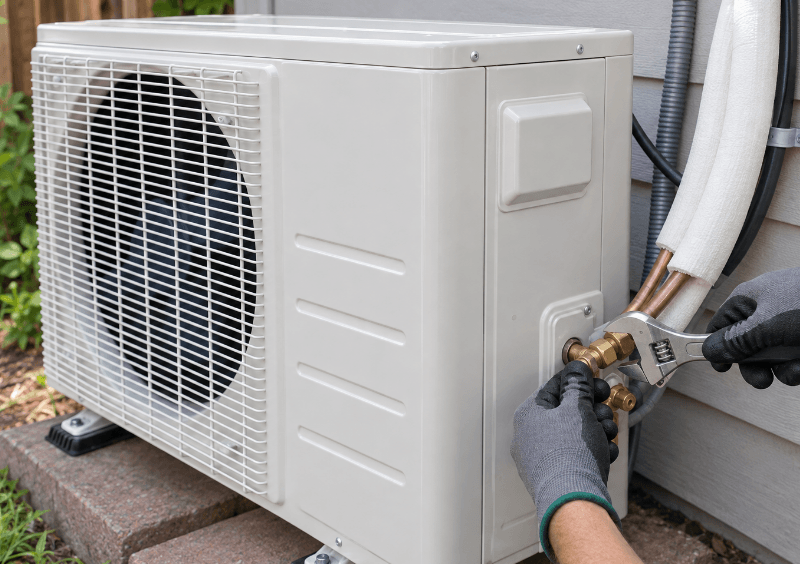
A mini split’s stock filter is a coil guard, not an air purifier. That mesh screen behind the front panel is there to keep pet hair and lint off the evaporator coil so the system holds its airflow. The EPA puts it plainly: ductless mini split heat pumps generally do not filter fine particles passing through the device.
This is also the one section where we are not reporting someone else’s findings. Filterbuy has manufactured air filters for over a decade and runs pressure-drop testing in-house, so the airflow warning below is something we measure rather than something we looked up.
So wildfire smoke and the fine PM2.5 fraction pass straight through it. When a listing claims high-efficiency filtration, look for a documented MERV 13 or higher rating, and treat the claim as marketing until you find one. Our MERV rating chart sets out what each rating actually captures.
Three things to do instead:
Clean the mesh screen every two to four weeks during heavy use. MRCOOL prompts you at roughly 240 operating hours and Pioneer expects a similar rhythm. Our mini split maintenance schedule covers the rest of the year.
Never substitute a dense pleated filter for the stock screen. These blowers are built for one specific resistance, and the added static pressure cuts airflow and can shorten motor life, as our air filter pressure drop chart shows.
Do the fine-particle work somewhere the system was designed for it, either a MERV 11 to MERV 13 filter in your central system or a portable HEPA cleaner sized by CADR. The EPA’s Guide to Air Cleaners in the Home covers sizing, and we weigh the two approaches in mini split vs. air purifier.
Then there is the ownership cost neither brand advertises. The DOE guide recommends deep cleaning a wall-mounted head every one to three years and calls it generally not a DIY job, because the blower wheel sits wet during cooling, so dust sticks and mold follows. Cleaning the screen on schedule slows that without preventing it, and no spec sheet will warn you it is coming.
“We measure pressure drop for a living, so airflow is the part I would flag hardest here. The mesh screen in a ductless head is there to protect the coil, not your lungs. Put a dense filter over it and you starve a very small blower. If you want cleaner air in that room, add the filtration somewhere the system was built to handle it.”
Michelle Wan, Brand Manager and Air Quality Writer, Filterbuy
Disclosure: Filterbuy manufactures air filters and sells a single-zone ductless line. We sell neither MRCOOL nor Pioneer, earn nothing from either, and are not affiliated with or endorsed by either brand.
Two Cases That Flip the Answer
Winter drops below 0°F. Neither standard tier will keep up, so look at MRCOOL Hyper Heat or Pioneer Quantum instead, and size for heating first using how to choose a mini split system.
You need more than one zone. MRCOOL’s price advantage is a single-zone story. Its DIY two-zone kits run roughly $2,500 to $3,000 for 12,000 BTU across two heads, more than a single-zone 12K of the same capacity, and Pioneer’s catalog runs deeper at that end as well.
Supporting Statistics
Three federal findings sit behind the advice above.
Ducts in unconditioned space waste more than 30% of heating and cooling energy. The figure comes from the Department of Energy’s Building America Solution Center, run by Pacific Northwest National Laboratory, and going ductless removes it. The same guide reaches Filterbuy’s filtration conclusion independently, noting that these units ship with mesh filters of very low particulate capture efficiency.
MERV 13 must capture at least 50% of particles between 0.30 and 1.0 microns, a range in which MERV 8 carries no rated efficiency at all. That gap is why the EPA’s MERV scale is the check to run against any mini split filtration claim.
A 500 sq ft room needs a portable cleaner rated at 325 CFM CADR or higher. The EPA’s Guide to Air Cleaners in the Home sets minimum clean air delivery rates by room size, and since a 12,000 BTU mini split covers roughly 500 sq ft, that is the number to match.
Frequently Asked Questions
Whichever One You Pick
The filter is the part of this system you will actually touch. Clean the stock screen on the schedule above, then put the fine-particle work on media built to handle it. Filterbuy manufactures air filters in the U.S. and runs auto-delivery, so the replacement turns up when it is due rather than when you have to remember it.
Filterbuy also sells a single-zone ductless line, and it sits outside this comparison for a reason: it requires professional installation, and the warranty is void if you install it yourself. If a DIY route is what you are after, the two brands above are the relevant ones.
Glossary
SEER2: The U.S. cooling efficiency standard. Higher is more efficient.
MERV: Minimum Efficiency Reporting Value, a 1 to 16 scale of filter particle capture. MERV 13 catches fine particles including smoke and PM2.5.
PM2.5: Airborne particles 2.5 micrometers or smaller, the fine fraction a mesh screen does not capture.
Inverter compressor: A compressor that varies speed to match demand rather than cycling on and off.
Line set: Insulated tubing carrying refrigerant between indoor and outdoor units.
Pre-charged line set: A line set sealed and filled at the factory, joined by quick-connect couplings.
EPA Section 608: The federal certification governing refrigerant handling.
R-454B and R-32: Lower-GWP refrigerants replacing R-410A. Both are classed A2L, or mildly flammable.
CADR: Clean Air Delivery Rate, used to size an air cleaner to a room.