
Most Energy-Efficient Mini Splits in 2026 | High-SEER Models Ranked
What Is The Most Energy-Efficient Mini Split?
The most efficient mini splits clear 25 SEER2 or higher, and ENERGY STAR certification starts at 18.7 SEER2. That top tier pays off fastest in extreme heat, extreme cold, or all-electric homes.
- Entry And DIY Tier: 14.3 to 18 SEER2, for occasional-use rooms
- High-Efficiency Value Tier: 18 to 24 SEER2, the sweet spot for most single-zone installs
- Premium Cold-Climate Tier: 25 SEER2 and up, for whole-home electrification
A high rating only holds up with a clean filter and a correctly sized system. Answer a few quick questions below and we will help match you to the right setup.

Answer 3 quick questions and we will match you to your perfect mini split filter setup.
TL;DR
Today's most efficient mini splits clear 20-plus SEER2, with cold-climate models certified above 30 SEER2. ENERGY STAR certification starts at 18.7 SEER2 and 8.5 HSPF2. The federal Section 25C tax credit expired for equipment placed in service after December 31, 2025, so 2026 buyers should look to state and utility rebates instead. A high SEER2 rating only holds up when the system is sized correctly and the filter stays clean.
Key Takeaways
SEER2, not the older SEER rating, is what matters for any mini split sold today, under DOE's test procedure since January 1, 2023.
ENERGY STAR certification for a ductless mini split heat pump requires at least 18.7 SEER2, 12.0 EER2, and 8.5 HSPF2.
The federal Section 25C credit ended for equipment placed in service after December 31, 2025. A 2026 install does not qualify.
New mini splits ship with low-GWP A2L refrigerants such as R-32 or R-454B, since R-410A can no longer go into new residential systems.
Homeowners rarely lose SEER2 performance to a bad rating. Sizing mistakes and a neglected filter cause far more real-world underperformance than anything printed on the box. This guide ranks the mini split efficiency tiers that matter in 2026, explains what ENERGY STAR certification requires, and covers the federal tax credit change for 2026 buyers.
Every mini split roundup I read leads with the SEER2 number and buries the one thing that actually determines whether you will ever see it on your bill, whether the system is sized right and the filter gets cleaned. I write about air quality for Filterbuy, so I am upfront that this guide looks at mini splits through that lens on purpose.
Attributed to Michelle Wan, Brand Manager and Air Quality Writer, Filterbuy
How SEER2 Actually Measures Mini Split Efficiency
SEER2 stands for Seasonal Energy Efficiency Ratio 2, dividing total seasonal cooling, in BTU, by electricity consumed, in watt-hours. DOE replaced the original SEER metric with SEER2 on January 1, 2023, using a tougher test that better reflects installed performance, which is why a SEER2 reading often looks lower than the old SEER rating on unchanged hardware. Federal minimum efficiency for split-system heat pumps is 14.3 SEER2 in the South and Southwest and 13.4 SEER2 in the North. High teens is good, low-to-mid 20s is high-efficiency, and above roughly 25 SEER2 carries a premium that mainly pays off in extreme climates or all-electric homes.
SEER2, EER2, and HSPF2 replaced the legacy SEER, EER, and HSPF metrics in DOE testing procedures starting January 1, 2023.
What ENERGY STAR Certification Requires From A Ductless Mini Split
A ductless mini split heat pump must clear independently verified thresholds to carry the ENERGY STAR label, a minimum 18.7 SEER2, 12.0 EER2, and 8.5 HSPF2. Certified systems use up to 60% less energy than standard electric-resistance heating. Cold-climate certified models add a separate bar, 70% capacity retention and a coefficient of performance of 1.75 or higher at 5°F.
Figures reflect current ENERGY STAR ductless mini split program requirements.
The Highest-Efficiency Mini Split Tiers In 2026
This guide ranks by certification tier rather than brand, since a model's SEER2 can change when a manufacturer updates a product line.
Payback is relative only. Actual payback depends on local electricity rates, climate, and installation cost.
Premium Cold-Climate Tier (Roughly 25+ SEER2)
Built for homes leaning on the mini split for both cooling and winter heating, including all-electric homes replacing baseboard or window units. The premium pays off fastest with high cooling loads or genuinely cold winters, not a guest room used a few weekends a year.
High-Efficiency Value Tier (Roughly 18-24 SEER2)
The practical sweet spot for most single-zone and small multi-zone installs. It clears the ENERGY STAR bar with room to spare and carries a shorter payback, serving bedrooms, offices, and additions well.
Entry And DIY Tier (Roughly 14.3-18 SEER2)
Clears the federal minimum, and sometimes the ENERGY STAR bar, at the lowest equipment cost. A reasonable choice for occasional-use spaces where a higher-tier premium would not pay back within the equipment's service life.
Where The 2026 Federal Tax Credit Actually Stands
The federal Section 25C Energy Efficient Home Improvement Credit, which used to cover 30% of a qualifying heat pump's cost up to $2,000 a year, ended for equipment placed in service after December 31, 2025, under the One Big Beautiful Bill Act. The IRS confirms the placed-in-service date, not the purchase date, controls eligibility, so a 2026 install does not qualify regardless of order date. Budget on the federal credit being gone, then check state and utility rebates, which often require an ENERGY STAR-certified system and a valid AHRI Reference Number.
Check current state and utility rebate availability at energystar.gov/rebatefinder.
The Refrigerant Behind The Efficiency Numbers
New residential mini splits now use A2L refrigerants, mainly R-32 or R-454B, in place of the R-410A that dominated the category for two decades. The shift comes from the EPA's phasedown of high-global-warming-potential HFCs, not a change to how SEER2 is calculated, and existing R-410A systems remain fully legal to operate and service.
The Filter Connection: Why A High SEER2 Rating Isn't The Whole Story
A mini split's SEER2, EER2, and HSPF2 ratings are lab-tested for a matched indoor and outdoor unit combination, confirmed by the pair's AHRI Reference Number. Oversizing is the more common and costlier real-world mistake, since an oversized unit short-cycles, wasting energy and leaving humidity uncontrolled. Beyond sizing, every mini split pulls room air through an internal filter before it reaches the coil. That filter handles comfort-level dust capture, not certified efficiency, but a filter loaded with dust and pet hair still restricts airflow, forcing the compressor to run longer and eroding the real-world efficiency the SEER2 rating promised on paper. The built-in pre-filter is not a substitute for a home's primary HVAC filtration strategy. Allergy-prone households, or homes conditioning most square footage through mini splits, benefit from supplemental filtration at the return path.
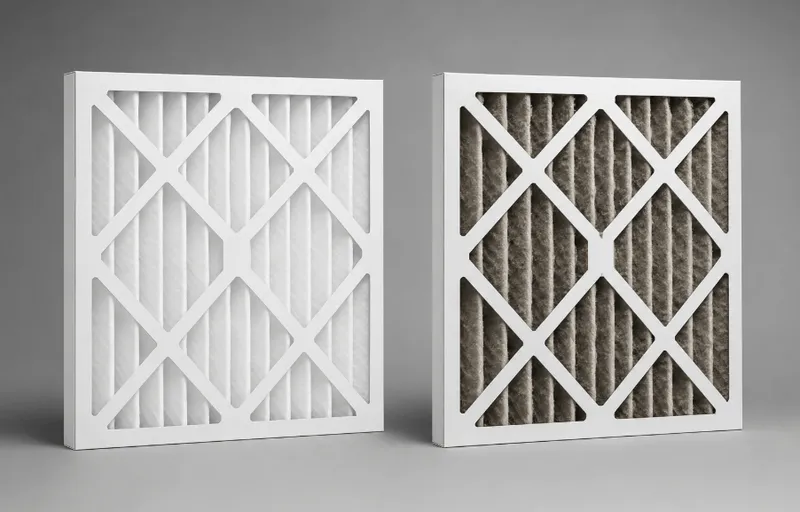
A high SEER2 rating is what a mini split can do in a lab. A clean filter and a correctly sized system are what it actually does in your living room. We build filters because the efficiency number on the box is only half the story.
Attributed to David Heacock, Founder and CEO, Filterbuy
How To Check If Your Filter Is Already Working Against You
Pull the filter and hold it to a light. Uneven light means airflow is already restricted.
Feel airflow at the indoor unit on its highest fan setting. A noticeable drop points to the filter before the compressor.
Look for ice on the indoor coil during cooling season, a common symptom of restricted airflow, not a refrigerant problem.
Check the filter every two to four weeks in peak season, more often with pets or in a dusty climate.
Questions To Ask Before You Sign A Mini Split Quote
Can you show me the Manual J load calculation for this room, not a square-footage estimate?
What is the AHRI Reference Number for this specific indoor and outdoor combination?
Is this unit ENERGY STAR certified as standard or cold-climate, and which does my winter require?
What refrigerant does this system use, and is it serviceable in this area?
How often should the filter be cleaned in a home like mine?
Seven Sources Worth Bookmarking Before You Buy A Mini Split
Confirm Your Mini Split Meets Federal Efficiency Standards
ENERGY STAR's ductless page lists current SEER2, EER2, and HSPF2 minimums for confirming real certification, not marketing.
Source: ENERGY STAR's ductless heating and cooling page
Verify Whether Your Purchase Still Qualifies For A Tax Credit
The IRS's guidance confirms Section 25C ended for equipment placed in service after December 31, 2025.
Source: IRS guidance
Understand Why Your New Refrigerant Looks Different
The EPA's HFC phasedown guidance explains the A2L switch and confirms R-410A systems remain legal to operate.
Source: EPA's HFC phasedown guidance
Read A Real Homeowner's Ductless Heat Pump Experience
DOE's Energy Saver article follows a decade of running ductless heat pumps in a home without existing ductwork.
Source: DOE Energy Saver article on going ductless
Check That Your System's Efficiency Rating Is Actually Certified
AHRI's primer explains SEER2, EER2, and HSPF2 testing and how to look up an AHRI Reference Number.
Source: AHRI's efficiency primer
Make Sure Your Contractor Sizes Your System Correctly
ACCA's Manual J standard is the industry benchmark for calculating heating and cooling load.
Source: ACCA's Manual J standard
Find Out If Your System Qualifies For Utility Rebates
CEE's tier system is what many utility rebate programs use to set their qualification bar.
Source: CEE's tier system
The Research Behind These Efficiency Claims
Half Of Northeast Households Using Air Conditioning Rely On Individual Units Like Mini Splits
The EIA's household energy survey finds 50% of Northeast households using air conditioning rely mainly on individual equipment, including mini splits.
Source: EIA household energy survey
A Standard Heat Pump Holds Onto Just 42% Of Its Capacity At 0 Degrees
Modeling from the National Laboratory of the Rockies finds a standard heat pump retains only about 42% of rated heating capacity at 0°F, below the 70% ENERGY STAR requires for cold-climate certification.
Source: National Laboratory of the Rockies modeling
Switching From A Room Air Conditioner To A Ductless Mini Split Can Cut Cooling Energy Use In Half
ACEEE research finds switching from a room air conditioner to a mini split can cut cooling energy use by up to 50%.
Source: ACEEE research
Frequently Asked Questions
Glossary
AHRI Reference Number: A unique identifier confirming an indoor and outdoor unit pair is tested and certified as a matched system.
Manual J: The ACCA standard for calculating a home's heating and cooling load.
A2L Refrigerant: A class of mildly flammable, low-global-warming-potential refrigerants, including R-32 and R-454B, now required in new residential split systems.