

IRA Heat Pump Rebates in 2026: How to Claim Up to $8,000 for a Mini Split
Author: Michelle Wan, Brand Manager and Air Quality Writer, Filterbuy | Reviewed by David Clark, Licensed HVAC Technician | Published / Updated September 3, 2026
The $2,000 federal tax credit is gone, but a separate Inflation Reduction Act program still pays up to $8,000 toward a ductless mini split. It is called HEAR, your state runs it, and it comes off the invoice at purchase instead of at tax time. Three things decide whether the money is yours:
- Your state. HEAR is state-run. Some states are open, some have reserved every dollar, some never launched.
- Your income. At or below 80% of Area Median Income covers 100% of qualified cost. From 80% to 150%, half. Above that, nothing.
- Your current heat. Adding a mini split alongside a furnace still qualifies. Since May 2026 the rebate can no longer fund replacing a gas, oil, or propane system.
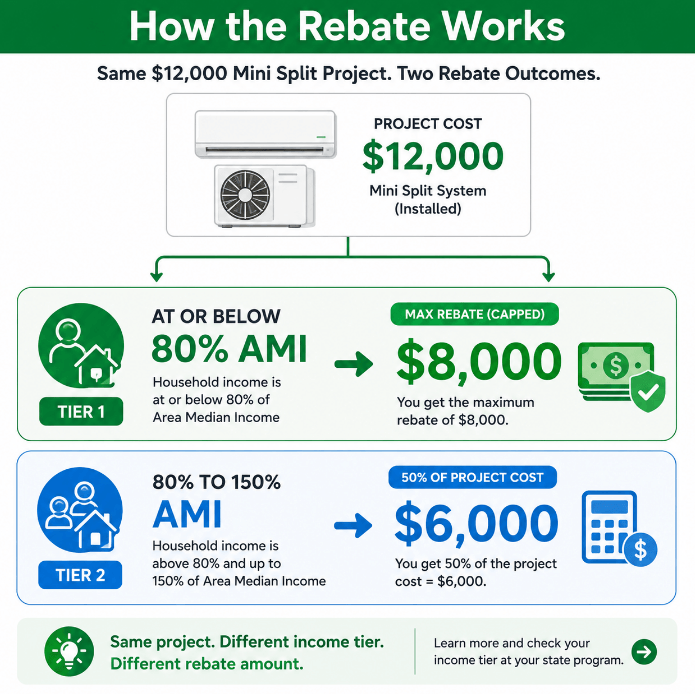
Here is what the rebate is worth at each income tier.

Answer a few quick questions and we will match you to the right mini split size for the room you are trying to fix.
Shop Filterbuy mini split systems
Worth knowing before you order: every Filterbuy mini split is a true heat pump on R32 refrigerant, ETL and AHRI certified, at 17 SEER2. They are not ENERGY STAR listed, so a state program that requires ENERGY STAR will not accept them. Professional installation is required.
General information, not tax or financial advice. Confirm your state program status with your state energy office before buying.
TL;DR
The $2,000 Section 25C tax credit expired for systems placed in service after December 31, 2025. A different Inflation Reduction Act program survived: HEAR, paying up to $8,000 toward a heat pump or ductless mini split for households at or below 150% of Area Median Income. Two things decide whether you get it: your state must have an open program, and since June the rebate cannot fund replacing a fossil-fuel system.
Key Takeaways
The IRA rebate that survives in 2026 is HEAR, worth up to $8,000, not the expired Section 25C credit.
Eligibility is income-based. At or below 80% AMI it covers the full project up to the cap; from 80% to 150%, half. Above that, nothing.
Fuel switching no longer qualifies. The rebate cannot fund replacing a gas, oil, or propane system, though keeping the old system and adding a heat pump still can.
It pays at the register, not at tax time, so no tax liability is needed and the IRS does not count it as income.
A single-zone mini split usually lands in a lower tier than a whole-home conversion.
Work started before your state opens does not qualify. Pre-approval decides whether you get paid.
How Much Is The Rebate Worth?
A qualifying heat pump or mini split is capped at $8,000 under HEAR, and how much of your project that covers depends on household income. Where Section 25C refunded you at filing, HEAR comes off the invoice at purchase. Eligibility runs on Area Median Income, published by county and adjusted for household size.
Caps set by Inflation Reduction Act Section 50122. Qualified cost includes equipment and labor. Source: 42 U.S.C. Section 18795a.
The middle row catches people out: at 80–150% AMI the rebate covers half your cost up to $8,000, so a $12,000 install returns $6,000. There is no national figure to check against either, since 80% of AMI in a high-cost metro can exceed the full median income of a rural county in the same state. Only your county at your household size counts, and HUD reset every limit on May 1.
Can I Get The Rebate If I Heat With Gas Or Oil?
On May 29, 2026, DOE ended fuel switching under this program. A rebate can no longer fund swapping a gas, oil, or propane heating system for a heat pump. DOE Program Notice 26-2 moved the goalposts for roughly 73 million households that heat with fossil fuels.
Most summaries stop one sentence too early. DOE did not ban heat pumps in fossil-heated homes; it banned using the rebate to replace the fossil system. A heat pump added to a house that keeps its furnace is an upgrade, not a fuel switch, so it stays eligible, as do new construction and homes already on electric heat. That fits how most ductless mini splits get installed anyway: one head into a bonus room, converted garage, or addition the ductwork never reached.
If you planned to tear out the boiler, talk to your state first. That guidance also renamed the program, so HEAR, HEEHR, and HEEHRA all mean the same money.
Does A Mini Split Qualify?
Yes. A ductless mini split is an air-source heat pump, and HEAR treats it in the same $8,000 category as a ducted system. Two bars remain beyond fuel switching: it must both heat and cool, since cooling-only units are excluded almost everywhere, and it must meet your state efficiency standard, usually ENERGY STAR. EPA also caps new residential heat pumps at a refrigerant GWP of 700. Ask your installer for the AHRI Reference Number covering your exact pairing, since that, not the brand, is what a program verifies.
Does a single-zone unit earn the full rebate?
Usually not, and Filterbuy sells single-zone mini splits, so here is the caveat we would rather hand you now than have you find on a rebate form. Mass Save pays $2,650 per ton for a whole-home heat pump in 2026, $1,125 for a partial conversion, and $250 for a basic single-zone system. Ours sits in the cheapest tier. The federal rule runs the other way, though: that top-tier conversion is often the fossil-system replacement DOE stopped funding. Price both paths.
Our units clear some bars and miss others. Every Filterbuy mini split runs on R32 refrigerant, is a true heat pump rather than cooling-only, and is ETL and AHRI certified. They are not ENERGY STAR listed, so a program requiring that will not accept them. At 17 SEER2 they clear the federal minimum and are built for value, not maximum efficiency, suiting a garage, workshop, or supplemental zone. Professional installation is required and the warranty is void on a self-install.
Reservations expire, and HVAC equipment normally ships by freight on a multi-week lead time. Ours ship free in two days on in-stock units, with a 7-year compressor and 3-year parts warranty. Our mini split tax credit and rebate rules page covers the rest; the 12,000, 18,000, and 24,000 BTU pages cover sizing.
Is My State's HEAR Program Open?
HEAR availability is decided at the state level, and DOE no longer publishes a state-by-state tracker. As of July 2026 the DOE page says only that rebates are available in select states. There are four states of play.
Confirm your state status with your energy office before planning.
States move fast. California reserved its single-family rebates statewide on February 24, 2026; Georgia stopped taking applications on August 14; New Hampshire has not opened.
With no federal status page, start with three checks: your state energy office, DSIRE, and the ENERGY STAR Rebate Finder. If HEAR is closed where you live, state and utility programs are the fallback, and the most widely available incentive in 2026.
How Do I Claim The HEAR Rebate?
Sequence matters more than paperwork. Almost every dollar lost here goes the same way: install first, apply second.
Confirm your state program is open. Call your state energy office. If it has not launched, stop.
Check your income tier against your county limit at your household size in the HUD income limits dataset.
Use a state-registered contractor and get the reservation approved before installation. An installer not on your state list cannot apply the discount. The contractor submits income verification and the state reserves your funds. This cannot be backfilled.
Verify the equipment, then take the discount at purchase. Match the AHRI Reference Number against your program list and check whether it requires ENERGY STAR, while you can still change the order.

What Happened To The 25C Tax Credit?
Section 25C, the Energy Efficient Home Improvement Credit, ended for property placed in service after December 31, 2025. The One Big Beautiful Bill Act terminated it seven years early, and Section 25D, covering geothermal and solar, ended the same day, both confirmed by the IRS in Fact Sheet 2025-05.
A 2026 install earns nothing, because "placed in service" means the day the system was installed and ready to use. A November 2025 contract commissioned in January 2026 misses the window. If a quote still shows $2,000 as a federal credit, ask for a corrected proposal. If your system was running by the end of 2025, the credit is still yours: our guide to claiming a 2025 heat pump installation covers Form 5695.
Supporting Statistics
Three figures from the primary source.
Congress appropriated $4.275 billion for HEAR rebates, available through September 30, 2031.
The credit ended six years early; the appropriation did not. The same statute fixes the $8,000 cap in law.
Source: 42 U.S.C. § 18795a, in effect August 22, 2026
5 million U.S. households could not use their heating equipment and 6 million could not use their air conditioning, because it was broken and the repair was unaffordable.
This is why paying at the register beats a bigger headline number. A non-refundable credit is worth nothing when the tax bill sits near zero.
Source: EIA, 2020 Residential Energy Consumption Survey
Heat pumps outsold gas furnaces by 12% in 2025, 3.6 million units against 3.2 million, and took 47% of residential cooling sales.
They have outsold furnaces every year since 2021. The equipment these rebates fund is the mainstream American HVAC purchase.
Source: RMI analysis of AHRI shipment data, updated May 2026
Frequently Asked Questions
Glossary
Sources
42 U.S.C. 18795a, DOE Program Notice 26-2, IRS FS-2025-05, HUD income limits, EPA refrigerant limits, EIA RECS, RMI.
Disclaimer
General information, not tax or financial advice. Filterbuy verified every source against the primary agency on September 3, 2026. This program changed in June 2026 and states are still rewriting rules, so anything written about it, this page included, can go stale within weeks. Verify with your state energy office before buying.