
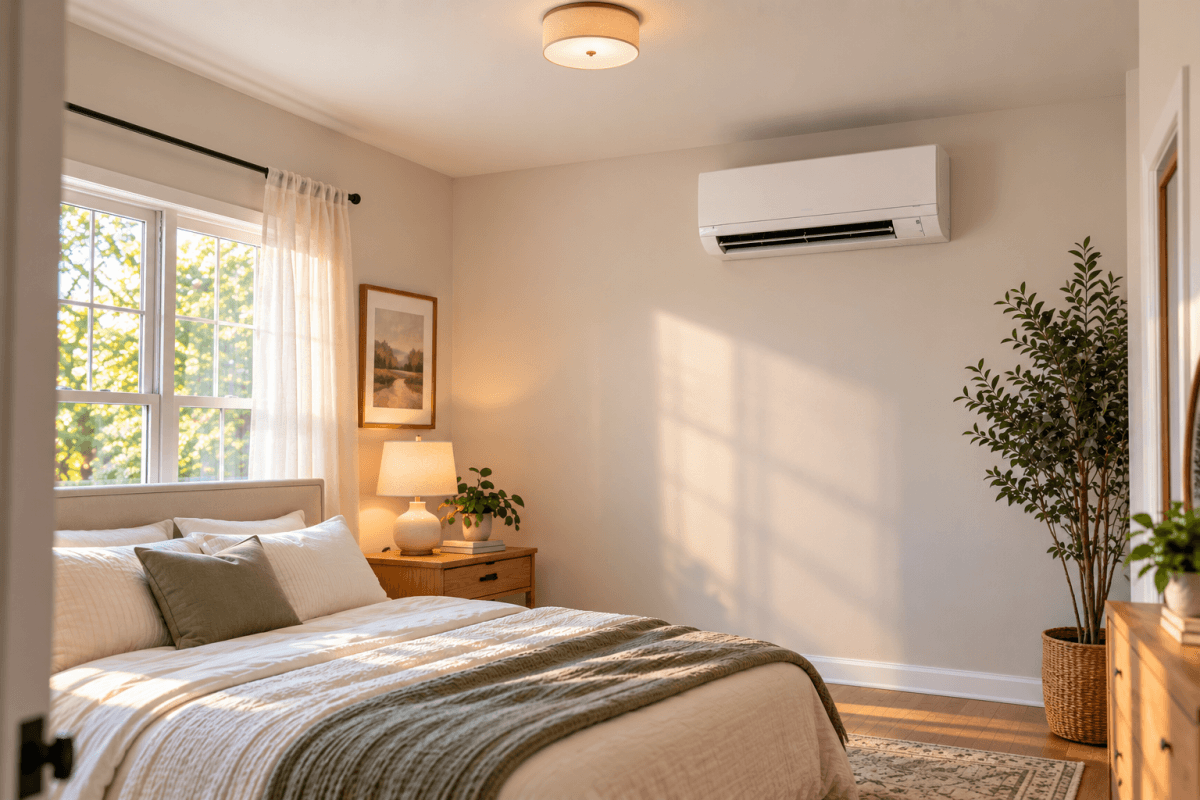
How To Choose The Best Mini Split For Your Bedroom
The right bedroom mini split is sized to your room's square footage and quiet at its lowest fan speed. Size comes first. An oversized unit short-cycles and leaves the room clammy. An undersized one runs at full load all night.
- Room size: Multiply length by width, then match the unit's coverage to that number.
- Sleep sound: Check the dB rating at the lowest fan setting, listed apart from the general operating figure.
- Year-round use: A heat pump model cools in summer and heats in winter.
With fast and free 2-day delivery to most US states and a 7-year compressor warranty, Filterbuy's 12,000 BTU mini split fits bedrooms from 300 to 550 sq ft. It sells for $799 and runs at 17 SEER2, above the federal minimum. Under 300 sq ft, a lower-BTU unit is the closer match.

Know your square footage? Shop Filterbuy Mini Split Systems
Not sure of your size? Answer a few quick questions and we'll match you to the right mini split for your room.
How To Choose The Best Mini Split For Your Bedroom
The right bedroom mini split depends on five factors: cooling and heating load (not square footage alone), sound level at your actual fan setting, efficiency ratings like SEER2, whether it can heat effectively in your climate, and correct installation and placement. A licensed HVAC professional using an accepted load-calculation method, such as ACCA Manual J, gives you a far more reliable size than any square-footage formula.
Before diving into specs, here's a quick snapshot of what to look for:
Load: Get a room-specific load calculation rather than relying on a BTU-per-square-foot rule
Sound: Compare manufacturer sound-pressure data at the same fan setting, not just a single decibel number
Efficiency: Check SEER2 and, where available, EER2 and HSPF2 ratings
Heating climate: Confirm the unit's cold-climate performance data if you plan to heat through winter
Installation: Confirm licensing, permitting, and commissioning requirements before you buy
You can browse Filterbuy's mini split lineup to see current models, coverage areas, and pricing while you work through the criteria below.
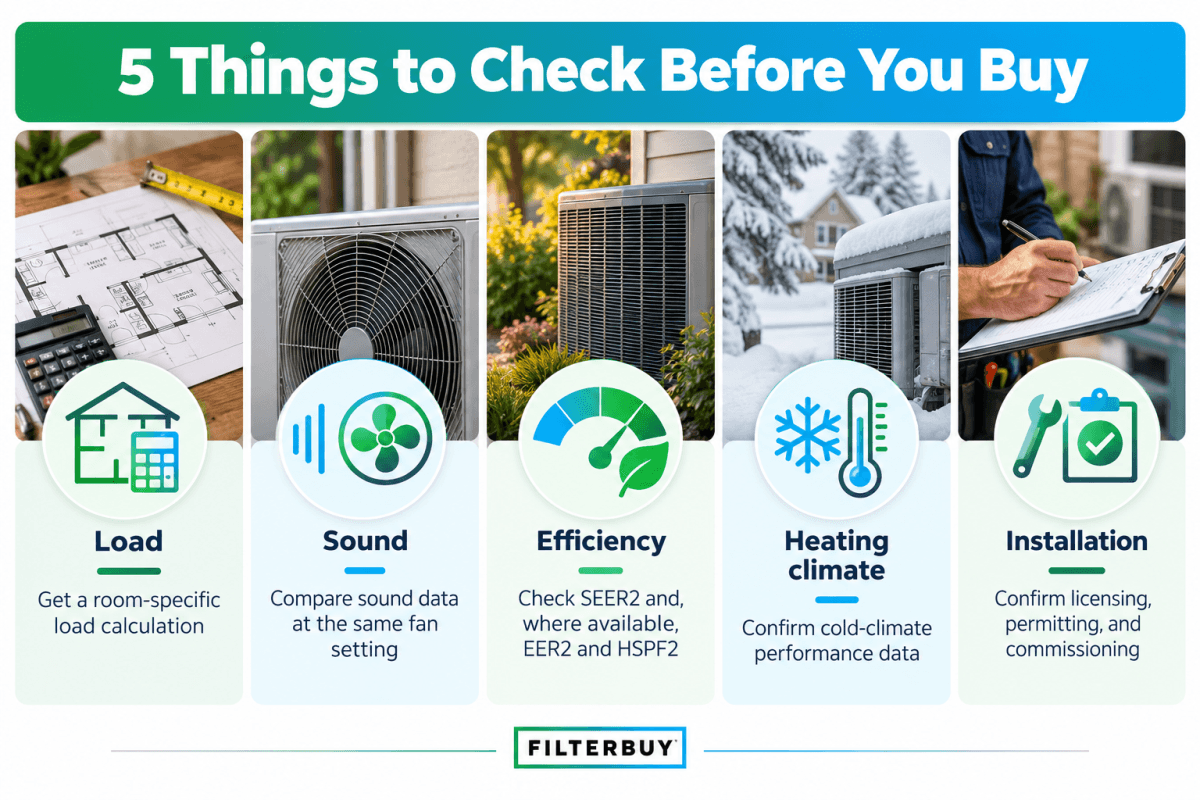
Here's a compact reference table for what to compare and where people tend to go wrong:
What Size Mini Split Does A Bedroom Need?
Bedroom sizing guides often start with a square-footage formula. Treat any such formula as a rough preliminary range, not a purchasing decision. Two bedrooms of identical size can need very different capacity depending on insulation, window orientation, ceiling height, and how many people typically sleep in the room.
As a starting point, Filterbuy's single-zone systems cover the following areas:
12,000 BTU: up to 550 sq ft, suited to bedrooms, studios, and small living rooms
18,000 BTU: up to 850 sq ft, suited to large living rooms and open floor plans
24,000 BTU: up to 1,100 sq ft, suited to large open areas and combined spaces
For most standalone bedrooms, a 12,000 BTU unit falls within the right general range. But a preliminary range is not a substitute for a proper load calculation.
Modern mini splits use variable-speed inverter compressors that modulate output rather than switching fully on and off. That helps a correctly sized unit hold a steady temperature. It does not mean oversizing is a safe shortcut. An oversized unit can cycle more than expected and remove less humidity from the air, which can leave a bedroom feeling clammy even at the target temperature.
ENERGY STAR recommends having a qualified contractor size your system using an accepted method such as ACCA Manual J, rather than relying on square footage alone (ENERGY STAR, Ductless Heating & Cooling). This calculation factors in your region's climate, insulation levels, window area, and orientation, giving you a size recommendation specific to your actual room.
How Quiet Should A Bedroom Mini Split Be?
Noise matters more in a bedroom than almost anywhere else in the house, but comparing sound ratings fairly takes a bit of care.
Manufacturers typically publish a range for indoor sound levels rather than a single figure, since noise output changes with fan speed. On Filterbuy's 12,000 BTU system, for example, the indoor unit ranges from approximately 28 to 45 dB depending on fan speed, with a rated 28 dB in Mute Mode. The outdoor condenser runs at approximately 52 to 55 dB.
When comparing models, look at:
Indoor sound at your intended fan setting, not just the lowest number on the spec sheet
Outdoor unit placement, since a condenser mounted near a bedroom window will be more noticeable than one placed farther away
Installation quality, since loose brackets or unsecured refrigerant lines can introduce vibration noise that has nothing to do with the unit's factory rating
Two units with the same headline dB figure can sound different in practice if that figure was measured under different conditions. Always check whether published numbers come from the same fan setting and testing standard before treating them as comparable.
Which Efficiency Ratings Matter?
As of January 2023, cooling equipment sold in the U.S. is rated using SEER2 rather than the older SEER standard. The updated test method better reflects real-world duct static pressure, so SEER2 numbers typically read a bit lower than SEER numbers for equivalent equipment. A higher SEER2 number still means lower energy use per unit of cooling.
Filterbuy's mini split lineup carries a 17 SEER2 rating and is ETL and AHRI certified. When comparing models, also look for:
EER2, where published, which reflects efficiency under a fixed set of conditions rather than a seasonal average
HSPF2, if you plan to rely on the unit for heating, which measures heating efficiency over a season [SOURCE NEEDED for model-specific figures not listed on the product page]
ENERGY STAR certification, which you can verify using the ENERGY STAR certified product finder
A higher efficiency rating does not guarantee a specific dollar amount on your utility bill. Actual operating cost depends on your local electricity rate, climate, insulation, thermostat habits, and how many hours the system runs. Treat efficiency ratings as a way to compare equipment against equipment, not as a bill estimator.
If you're evaluating incentives, check current program details directly rather than relying on older articles. The ENERGY STAR federal tax credit page and the ENERGY STAR rebate finder list current eligibility windows and credit amounts, which change periodically.
Which Bedroom Features Are Worth Paying For?
Not every mini split feature matters equally in a bedroom. A few tend to earn their keep:
Sleep-friendly controls, such as a timer or scheduling function, so the unit can adjust automatically as you settle in
A dimmable or disable-able display, since a bright indoor unit light can be distracting in a dark room
Auto swing or directional louvers, so airflow doesn't blow directly onto the bed
App and voice control, which lets you adjust temperature without getting up. Filterbuy's systems include WiFi with Alexa and Google Home compatibility
Low-temperature heating capability, if you want to rely on the unit through winter. Check the manufacturer's specific low-ambient performance data and any ENERGY STAR cold-climate certification rather than assuming all heat pumps perform the same way at low temperatures. ENERGY STAR's cold-climate certification tests units down to 5°F and recommends a backup heat source at lower temperatures (ENERGY STAR, Ductless Heating & Cooling)
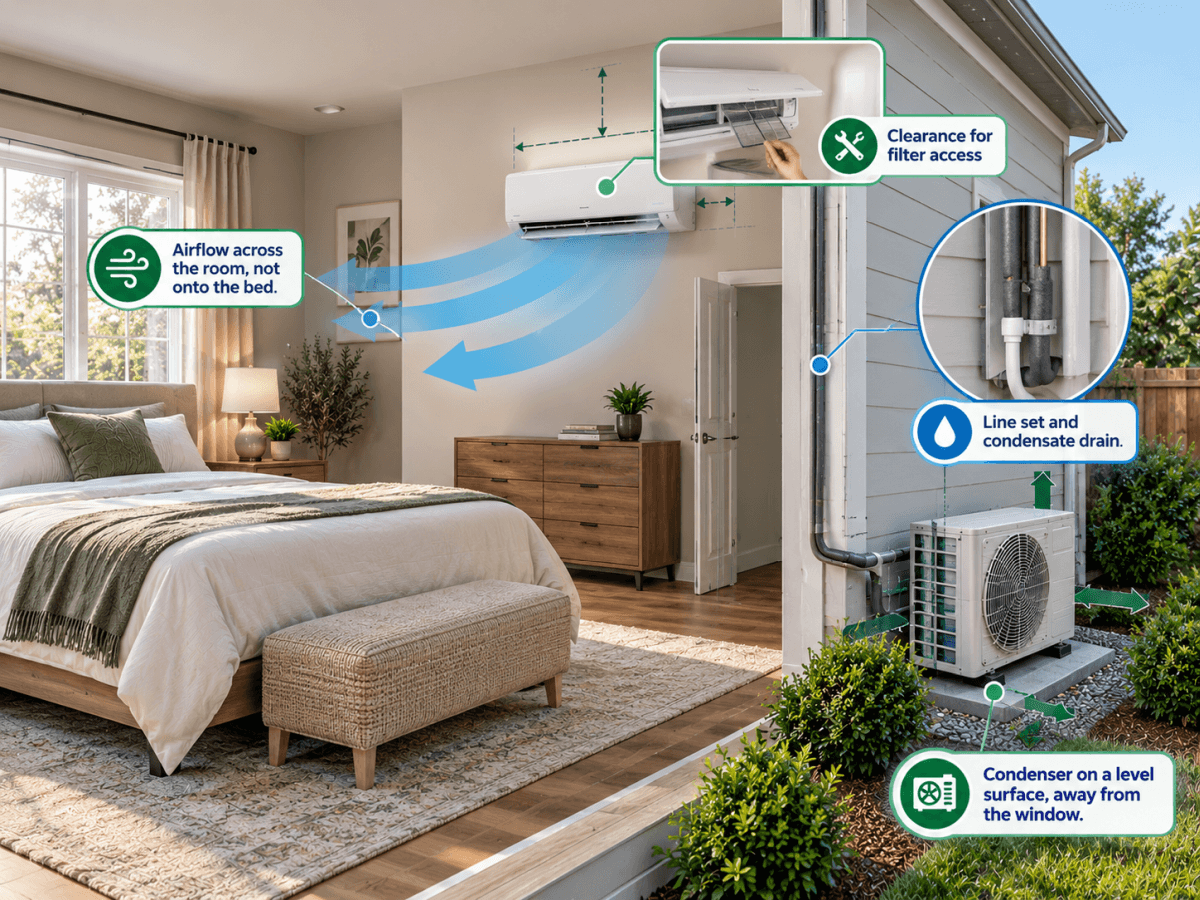
Where Should The Indoor And Outdoor Units Go?
Placement affects comfort, noise, and long-term reliability as much as the spec sheet does.
Indoor unit: Mount it where airflow reaches the room evenly without blowing directly on the bed. Leave clearance above and around the unit per the manufacturer's manual, and make sure the location allows access for filter cleaning.
Outdoor unit: Place the condenser on a stable, level surface with enough clearance for airflow. Avoid tight corners or spots that trap heat, and consider how close it sits to a bedroom window before finalizing placement.
Line set and condensate: The refrigerant line and condensate drain run between the two units. Check the maximum line length and height difference for your model before you plan the route. Filterbuy's 12,000 and 18,000 BTU systems support up to 50 ft of line length; the 24,000 BTU model supports up to 65 ft.
Electrical: Confirm whether your chosen system requires a 115V or 230V dedicated circuit. Filterbuy's 12,000 BTU unit is available in either voltage, while the 18,000 and 24,000 BTU units require 230V. A licensed electrician can confirm what your home's existing wiring supports.
Mini Split Vs. Window AC, Portable AC, And Central HVAC
Choose a mini split if you want independent bedroom control without extending ductwork. Choose central HVAC if whole-home consistency matters more than room-by-room control. Choose a window or portable unit if you need a temporary or lower-commitment option and can accept the tradeoffs in noise and efficiency.
Do Mini Splits Improve Bedroom Air Quality?
A mini split recirculates the air already inside the room it serves. Most models include a washable pre-filter in the indoor unit that captures larger particles like dust and lint as air passes through. This is a basic maintenance feature, not a whole-home air filtration system.
A mini split does not typically bring in outdoor air or ventilate the room. If your home also has central HVAC ductwork serving the bedroom, that system's filter, not the mini split, does the bulk of the filtering work for the air circulating through the house. When choosing a filter for a central system, use the highest efficiency filter your system can safely accommodate, often described as MERV 13 or the highest MERV rating compatible with your equipment's airflow design, and confirm compatibility with your HVAC manufacturer or installer.
Installation And Maintenance Checklist
Confirm whether your local jurisdiction requires a permit for mini split installation
Hire a licensed HVAC professional for line set installation, electrical connection, and system commissioning. Refrigerant handling that could result in release requires EPA Section 608 certification, and installation requirements vary by system and location
Verify warranty terms before installation. Filterbuy's systems carry a 7-year compressor and 3-year parts warranty, and professional installation is required to keep that coverage active
Follow the manufacturer's owner's manual for routine maintenance, including filter cleaning schedules
Register your warranty after installation is complete
How To Choose From Filterbuy's Mini Split Options
If a standalone bedroom is your main use case, Filterbuy's 12,000 BTU mini split covers up to 550 sq ft and is available in 115V or 230V, priced at $799.00. It carries a 17 SEER2 rating, ETL and AHRI certification, and a 7-year compressor and 3-year parts warranty, with free 2-day delivery.
If your space is larger, such as a bedroom combined with a sitting area or an open-plan layout, the 18,000 BTU model covers up to 850 sq ft, and the 24,000 BTU model covers up to 1,100 sq ft. Both require a 230V circuit.
Whichever size you're considering, confirm the fit with a room-specific load calculation and plan for professional installation before you finalize your choice.
Getting The Details Right Pays Off
Choosing a bedroom mini split comes down to matching real load data to your room, checking sound ratings under comparable conditions, and confirming that installation meets your local code and your warranty's terms. Skip the shortcuts, particularly on sizing, and lean on a licensed contractor for the calculations that actually determine comfort. Once you've confirmed your criteria, browsing Filterbuy's current mini split inventory is a reasonable next step to compare available sizes and pricing.
Frequently Asked Questions
See More
Get a quick overview of what to consider when choosing a quiet, efficient mini split for a bedroom.
Review the key bedroom mini-split considerations in a visual format, including sizing, efficiency, sound, climate performance, and installation.
See the topic explained in video for additional visual context when comparing bedroom mini-split options and planning your setup.