
Best Mini Split for a Sunroom: Year-Round Comfort Without Ductwork
What's the Best Mini Split for a Sunroom?
A cold-climate mini split heat pump sized for your sunroom's added glass and sun exposure handles both summer heat and winter cold without new ductwork. Sunrooms typically need 25 to 40 BTU per square foot, well above the 20 BTU baseline for a standard room, so getting the size right matters more here than anywhere else in the house. Look for a true heat pump with cold-climate performance, not a cooling-only unit. Answer a few quick questions below and we'll match you to the right system for your sunroom.

Answer three quick questions and we'll match you to the right mini split for your sunroom.
Your sunroom turns into a greenhouse by two o'clock every summer afternoon, and by January it's the coldest room in the house. A ductless mini split solves both problems at once, sized for the extra solar heat gain that glass walls create, without a single foot of new ductwork.
Key Takeaways
A ductless mini split heats and cools a sunroom directly, with no need to extend your home's ductwork.
Sunrooms typically need 25 to 40 BTU per square foot, above the 20 BTU baseline for a standard insulated room.
A three-season room's needs differ sharply from a four-season room's, and that gap should drive sizing and equipment choice.
Cold-climate heat pump technology matters most on the heating side, since standard compressors lose capacity as temperature drops.
The mini split's built-in mesh filter protects the coil from dust. It isn't a substitute for the MERV-rated filter protecting the rest of your home's air.
Why A Sunroom Needs Its Own Climate Control
Sunroom owners report the same pattern every year. The room is perfect in May, unbearable by August, and closed off entirely by November. A sunroom breaks two rules a central system depends on. It's built mostly of glass, which transfers heat far faster than an insulated wall, and most sunrooms are additions that sit outside the home's duct network.
A window unit blocks the view and can't keep up with that much glass. Extending ductwork means cutting into finished walls and rebalancing airflow. A dedicated mini split solves the problem at the source.
Three-Season Room Or Four-Season Room? Why It Changes The System
Not every sunroom is built the same, and the difference changes the sizing math. A three-season room typically has single-pane glass, screened panels, or minimal insulation, built for spring through fall. A four-season room has insulated walls, a roof, and double-pane or low-E glass, and stays livable year-round.
Heating a three-season room to four-season standards means the mini split works harder than square footage alone suggests, and weatherstripping plus insulated curtains help. Most three-season additions also sit on an uninsulated concrete slab, which pulls heat out all winter. A rug and underlayment ease the load but won't fix a cold slab entirely.
How Many BTUs Does A Mini Split Need For A Sunroom?
British thermal units, or BTU, measure how much heat a system adds or removes per hour. A normal, insulated room needs roughly 20 BTU per square foot. A sunroom needs more, since glass and thinner walls let heat move in and out faster.
Sunroom BTU Sizing Chart
Ranges are a starting point. For final sizing, use a full Manual J load calculation.
Ranges are a starting point, not a final answer. A licensed HVAC professional can run a full Manual J load calculation, the industry-standard method for accounting for every variable at once.
When To Size Up Further
Move up a BTU tier for south- or west-facing glass, floor-to-ceiling windows with no shading, a vaulted ceiling, minimal insulation, or plans for four-season living.
Why A Mini Split Beats Extending Your Ductwork
Extending ductwork into a sunroom means cutting into finished walls, running new supply and return lines, and rebalancing airflow for a room with a different heat load.
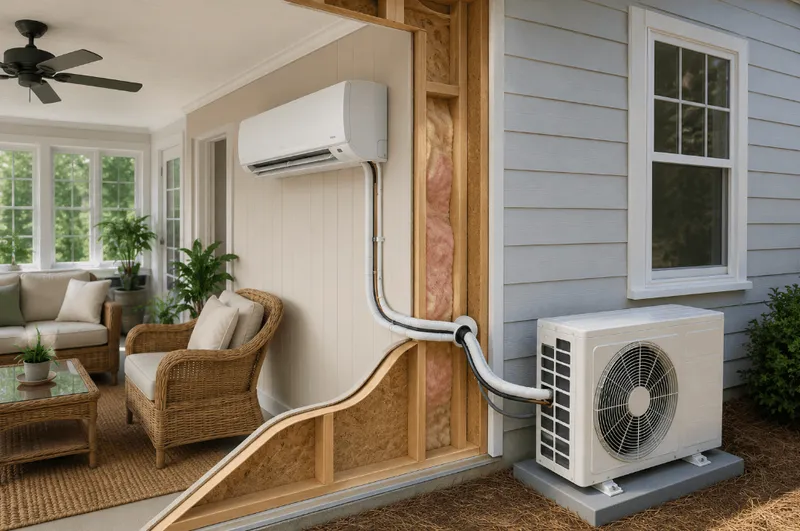
A mini split skips all of that. The indoor unit mounts on the shared wall, a small penetration carries the refrigerant lines and drain to the outdoor unit, and the sunroom gets its own thermostat and zone. Run it only when in use, and energy costs stay down.
What To Look For In A Mini Split For Year-Round Sunroom Comfort
These four features are built into every Filterbuy mini split, worth checking on any system you compare.
Cold-Climate Heat Pump Technology
Standard compressors lose heating capacity as the temperature drops through the upper teens. A cold-climate certified heat pump holds on to more of it, which matters most for a less-insulated, glass-walled room.
High SEER2 Rating
SEER2 measures cooling efficiency. A rating of 17 or higher keeps operating costs down in a room used longer than a typical bedroom.
Inverter (Variable-Speed) Compressor
An inverter compressor ramps speed to match room load instead of cycling fully on and off, for steadier temperatures and quieter operation.
Dedicated Dry Mode
A dry mode pulls excess moisture from the air independent of temperature, useful when a sunroom feels sticky without feeling hot.
Best Mini Split For A Sunroom
For most single-zone sunrooms, the Filterbuy 12,000 BTU Ductless Mini Split AC & Heat Pump is the practical starting point. It runs on a standard 115V outlet, carries a 17 SEER2 rating, and functions as a true heat pump, heating in winter and cooling in summer from the same unit. Larger or more sun-exposed sunrooms should step up to the 18,000 BTU version.
"A sunroom that's comfortable in July and comfortable in January is a different engineering problem than most homeowners expect. The systems that hold up in a sunroom are the ones sized for the glass, not just the square footage."
— Michelle Wan, Brand Manager & Air Quality Writer, Filterbuy
Installation & Placement Tips For Sunrooms
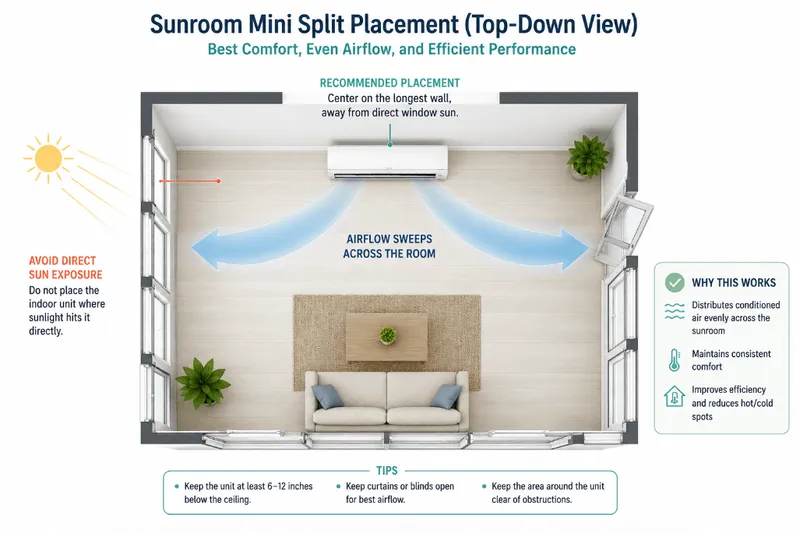
Mount the indoor unit on the shared wall to keep the line set short.
Avoid direct sun on the indoor unit, which can cause misreads and unnecessary cycling.
Center the unit on the longest wall so airflow sweeps the full room instead of short-cycling one corner.
Keep the outdoor condenser shaded and clear of leaves, snow, or debris.
Always have a licensed HVAC professional handle installation. Self-installation can void the warranty.
Every Filterbuy mini split ships with the mounting bracket, pre-flared line set, and wiring diagram already in the box.
"The mistake I see most in sunroom installs isn't the sizing. It's the condensate line. Sunrooms usually sit on a slab with no crawlspace to route through, so the drain often shares the same wall penetration as the refrigerant lines. Ask your installer where that condensate is actually going before the line set goes into the wall."
— David Clark, Licensed HVAC Technician, Filterbuy
Keep It Performing: The Right Filter For Your Mini Split
A mini split's built-in filter is a washable mesh pre-filter, not a health filter. It protects the coil from larger dust and debris, but isn't rated to capture fine particles. Wash it every two to four weeks during heavy use, and every one to two months in milder seasons.
If your sunroom shares a return with your home's central HVAC system, that system's disposable filter still needs regular replacement. Filterbuy makes those replacement filters in 600-plus sizes, including MERV 13 options that capture finer particles like smoke, manufactured in the USA.
Common Mistakes To Avoid
Undersizing the unit to save money upfront is the most common mistake, leaving the room uncomfortable on the hottest and coldest days. A close second is buying a cooling-only unit, which leaves the room unusable once temperatures drop. Every Filterbuy mini split is a true heat pump for this reason. Placing the indoor unit above or beside a large, unshaded window is the third mistake, forcing the system to fight rising heat at the sensor.
Permits, HOA Rules, And Other Details Easy To Overlook
A 115V mini split skips the electrical panel upgrade a 230V system needs, but usually doesn't skip the permit process. Most municipalities require an electrical and mechanical permit for any new circuit and refrigerant-based equipment, regardless of voltage. An HOA neighborhood almost always adds exterior modification rules for the condenser too.
Call your building department to confirm which permits your project needs.
If you have an HOA, ask about exterior placement rules first.
Ask your contractor whether pulling permits is included in their quote.
Keep the permit and any HOA approval with your insurance paperwork.
A failed inspection or HOA violation after the unit is mounted costs far more to fix than the paperwork would have upfront.
Still Feels Off After Installation? What To Check Next
A correctly sized mini split solves the mechanical half of the problem, but can't fully offset a room built to catch every hour of direct sun. If the room still runs hot, the fix usually isn't the equipment.
Add exterior shading, such as an awning or solar screens, on sides that take direct afternoon sun.
Check weatherstripping around doors and windows for drafts.
Reverse your ceiling fan direction for the season. Counterclockwise in summer feels cooler.
Still uncomfortable? Bring in a contractor for a Manual J calculation instead of guessing at a bigger unit.
7 Resources To Get Your Sunroom Comfort Right
Size It Right The First Time With Manual J
Best for confirming your BTU number. See ENERGY STAR's Manual J guidance
Confirm Cold-Weather Performance Before You Buy
Best for year-round heating confidence. Check ENERGY STAR's cold-climate criteria
Understand Why Your Windows Drive The Load
Best for understanding solar heat gain. Read the DOE's window performance guide
Learn How A Ductless System Actually Works
Best for first-time buyers. Start with the ductless mini split basics
Decide Between One Zone And Several
Best for homes considering more than one room. Compare single-zone and multi-zone setups
Weigh The Real Payback Before You Commit
Best for budgeting the upfront cost. Run the numbers on mini split value
Keep The System Running Like New
Best for protecting your investment. Follow the full cleaning walkthrough
Supporting Statistics
52% Of Home Energy Use Goes To Heating And Cooling
The two biggest line items on a home energy bill. Sizing a sunroom's mini split for its real glass and sun exposure protects that spend.
Source: U.S. Energy Information Administration, Use of Energy in Homes
2 To 5x Higher Indoor Pollutant Levels Than Outdoors
Americans spend about 90% of their time indoors, and a mini split's mesh pre-filter alone can't handle that load.
Source: U.S. EPA, Indoor Air Quality
7.7% Of Americans Live With Asthma
Roughly 25 million people affected by dust, pet dander, and fine particles. A MERV-rated filter covers what the mesh filter can't.
Frequently Asked Questions
Glossary
BTU: British Thermal Unit, the measure of heat a system adds or removes per hour.
SEER2: Seasonal Energy Efficiency Ratio 2, a rating for how efficiently a system cools under updated federal testing standards.
Manual J: The industry-standard calculation for a room or home's precise heating and cooling load.
Mesh Pre-Filter: The washable filter in a mini split's indoor unit, built to protect the coil from dust rather than filter fine particles.
MERV: Minimum Efficiency Reporting Value, the rating scale for how well a disposable HVAC filter captures fine particles.