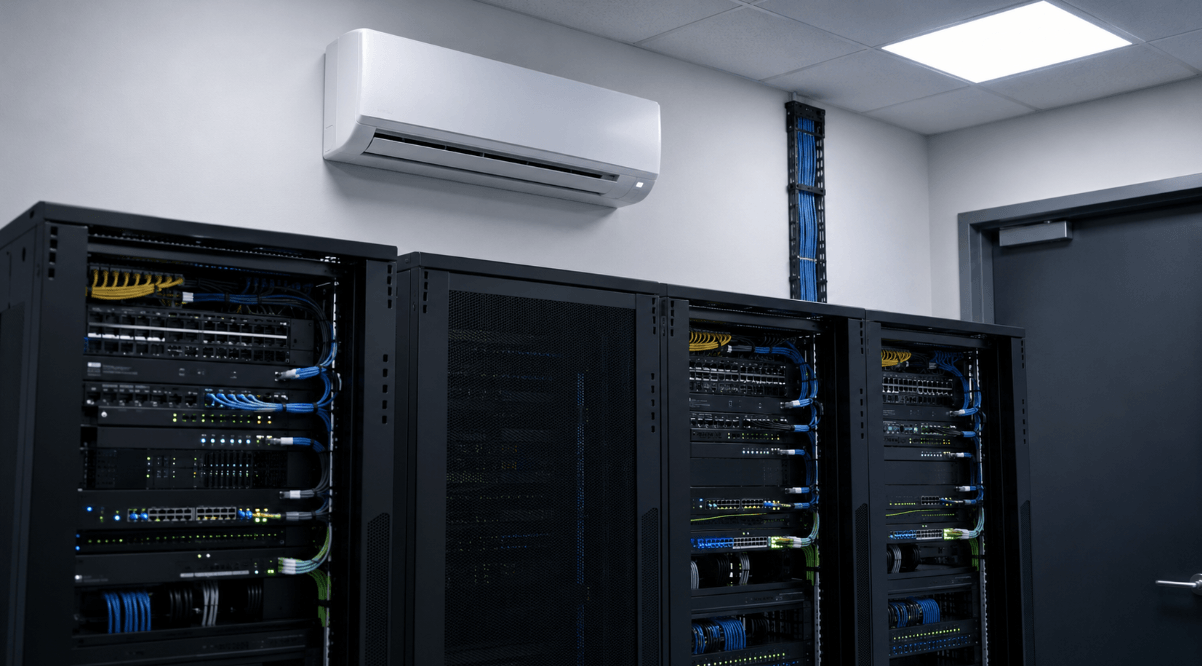
Mini Split Cooling for Server Rooms: What IT Managers Need to Know
How To Cool A Server Room With A Mini Split
A mini split cools a server room by carrying the equipment's heat load on its own dedicated circuit, separate from the building's central HVAC system. Size it by converting total equipment wattage to BTU/hr, then adding 20 to 30 percent for growth. The room runs 24 hours a day with no window to fall back on, so how you configure the system matters as much as the capacity you pick.
- Redundancy. Two units in an N+1 pair, sized so either one alone can carry the room during a failure or a service window.
- Winter operation. A low-ambient or hyper-heat rated model, because standard residential units are built to shut down in cold weather.
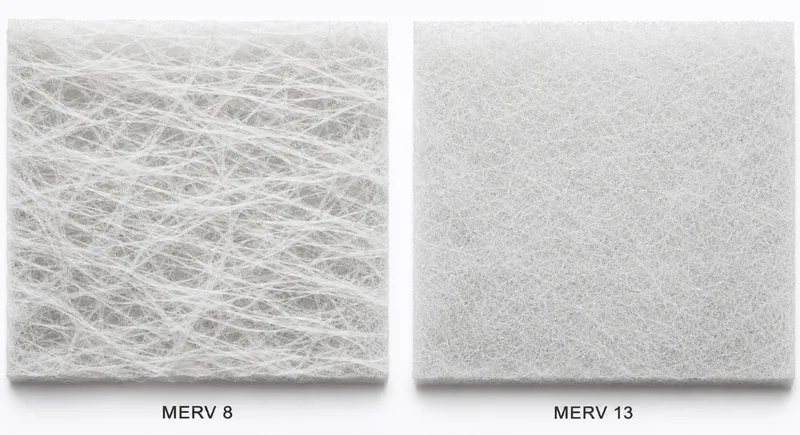
- Filtration. MERV 8 on recirculated room air captures larger dust and debris. MERV 11 to 13 on incoming air captures finer particles. Both sit behind the unit's mesh pre-filter, not instead of it.

Not sure which capacity fits your room? Answer a few quick questions and we will point you to the right size.
TL;DR
A mini split gives IT managers precise, independent cooling for a server room without tying into the building's central HVAC system. Sizing starts with a heat load calculation based on equipment wattage, and reliability depends on redundancy through N+1 or lead-lag configurations plus a low-ambient kit for winter operation. Air quality matters just as much as temperature. A well-filtered mini split keeps dust off sensitive hardware and helps hold the room inside the humidity range that protects circuit boards from static discharge and corrosion.
Key Takeaways
ASHRAE's recommended envelope for most IT equipment classes is roughly 64–80°F (18–27°C) measured at the equipment inlet, with 40 to 60 percent relative humidity as a practical operating target.
Redundant cooling is not optional in a server room. Because the equipment runs 24/7 with no door or window to fall back on, a single cooling failure can push the room past a safe temperature within minutes.
Standard residential mini splits are built to shut down in cold weather. A server room needs a low-ambient or hyper-heat model rated to keep cooling even when it's well below freezing outside.
A common data center filtration baseline is MERV 8 for recirculated room air and MERV 11 to 13 for incoming air, which helps control the dust that insulates heat sinks and contributes to static discharge and corrosion.
Condensate needs an active plan. Routing drainage to a pump and an approved drain, rather than relying on gravity alone, keeps moisture away from the racks below the unit.
A UPS on the server racks doesn't protect the room's temperature. Unless the mini split is on the same generator circuit or its own backup power, a utility outage can stop the cooling at the same moment the servers keep running on battery.
Why We Wrote This Guide
Most advice on this topic comes from one side of the problem or the other. An HVAC engineering firm treats filtration as an afterthought. A filter company has never sized a compressor. We build both. Filterbuy has manufactured air filters for commercial and institutional customers for years, and we also design and sell our own line of ductless mini split systems. A server room sits exactly at the seam between those two businesses, so this guide reflects how we actually think about that seam, not a summary of someone else's engineering manual.
What Makes Server Room Cooling Different From Comfort Cooling
A server room doesn't cool the way an office does. Almost all of its heat load comes from the equipment itself rather than from people or sunlight through a window, and most server rooms sit in an interior space with no exterior wall to lose heat through. Security requirements usually rule out propping a door open, and the room needs cooling on a 24 hours a day, 7 days a week basis regardless of the season outside.
That last point trips up a lot of first-time installs. Residential air conditioners, including many mini splits, are built to cycle off during cold weather to protect the compressor. A room full of switches, storage, and networking gear generates a steady heat load in January just as it does in July, so the cooling system serving it has to be rated for continuous, year-round operation rather than seasonal comfort cooling.
The Right Temperature And Humidity Range For Your Server Room
The American Society of Heating, Refrigerating and Air-Conditioning Engineers (ASHRAE) publishes the thermal guidelines most IT equipment manufacturers design against. For the equipment classes found in a typical server room or IT closet (A1 and A2), the recommended operating envelope runs roughly 64.4°F to 80.6°F (18°C to 27°C), measured at the equipment's air inlet rather than as a room average. See the full reference card in Essential Resources below.
Humidity gets less attention than temperature, but it matters just as much. Air that's too dry raises the risk of electrostatic discharge, while air that's too humid encourages condensation and corrosion on circuit boards. A relative humidity range of roughly 40 to 60 percent is a practical target that most operators use to stay clear of both extremes.
ASHRAE Reference Table
Source: ASHRAE Thermal Guidelines for Data Processing Environments. Ranges reflect the recommended envelope for equipment classes A1 and A2, measured at the equipment inlet.
Measure at the rack inlet, not just at the thermostat on the wall. A mini split's built-in sensor reads the temperature near the indoor unit, which can run several degrees cooler or warmer than the air actually reaching your equipment depending on airflow patterns in the room. This is the same range Filterbuy points back to whenever a sizing question comes up for one of our own units in a mechanical or equipment room, not a number invented for this guide.
How To Size A Mini Split For Your Server Room
Server room cooling loads come almost entirely from electrical equipment, so the sizing math is more direct than a typical home comfort calculation. Every watt of power an electronic device draws is converted almost entirely to heat, which gives you a straightforward starting formula:
IT equipment heat load: total equipment watts × 3.412 = BTU/hr
Lighting heat load: total lighting watts × 4.25 = BTU/hr (reduce by about a third for LED fixtures)
Occupancy heat load: number of people in the room at peak × 400 BTU/hr
Add those three figures together, then apply a growth and safety margin, typically 20 to 30 percent, to cover future equipment additions and normal load swings. We see this pattern often enough in Filterbuy's mini split sales to call it out directly: a customer sizes exactly to today's rack count, adds a switch or two the following year, and calls back needing a second unit they could have planned for the first time.
Worked Example
Figures are illustrative. Replace equipment wattage with your own nameplate or metered power draw before sizing a unit for your room.
A room with this load would typically call for the next available capacity up, such as a 15,000 or 18,000 BTU/hr unit, or a smaller two-unit N+1 configuration built to that combined total. This example is illustrative. Your actual load depends on your equipment's nameplate or metered power draw, so treat it as a starting point, not a final spec.
For anything beyond a small closet, a full Manual J–style load calculation from a qualified HVAC contractor is worth the time. Our own mini split sizing guide and the U.S. Department of Energy's Building America Solution Center (see Essential Resources below) both walk through the same sizing principles in more detail.
Building In Redundancy: N+1 And Lead-Lag Configurations
A server room with a single cooling source has a single point of failure. If that unit needs service or fails outright, room temperature can climb past a safe operating range in a short amount of time, since there's no open window or door to fall back on and the equipment keeps generating heat the entire time.
The standard fix is N+1 redundancy: install more cooling capacity than the calculated load requires, so a second unit can carry the room on its own if the first goes down. In practice, this often means installing two mini splits sized so that either one alone can handle the full load, rather than one large unit with no backup.
Many installations pair this with a lead-lag control strategy. One unit runs as the primary system while the second stays on standby, and the two swap roles on a set schedule, commonly every few months, so wear accumulates evenly across both units instead of running one into the ground while the other sits idle. Commercial controllers built for this kind of duty rotation can automate the swap and alert your team if the standby unit fails to start when called on. Since redundancy only works if both units hold up under continuous duty, it's worth comparing reliable mini split brands before you commit to a pair, since Filterbuy is one of the brands in that comparison and we'd rather you make an informed choice than assume.
Power Continuity: Does The Cooling Need Backup Power Too?
Most server rooms already have a UPS protecting the racks. It's easy to assume that covers the room. It doesn't cover the mini split unless someone specifically wired it that way, and that gap is one of the most common blind spots in an otherwise well-planned installation.
A UPS keeps the servers running through a brief outage, but if the mini split loses power at the same moment, the room keeps generating the same heat with nothing removing it. In a small, well-insulated closet with little air volume to buffer the heat, that can push the room past a safe temperature well before a generator finishes its transfer sequence, let alone before utility power comes back.
If the building has a generator, confirm the mini split's circuit is on the emergency side of the transfer switch, not just the IT racks. Transfer typically completes in 10 to 30 seconds, but that gap should be tested, not assumed.
If there's no generator, a dedicated UPS for the cooling unit is worth pricing out. Size it to the compressor's locked-rotor amperage, which is well above its running amperage, not just its steady-state draw.
Either way, pair power continuity with a remote temperature alert. If the cooling fails for a reason that has nothing to do with utility power, such as a tripped breaker or a failed capacitor, backup power for the compressor doesn't help. Someone still needs to find out before the room does.
This is a different question from the N+1 redundancy discussed above. Redundancy protects against one unit failing while power stays on. Backup power protects against the building losing power in the first place. A server room worth protecting usually needs both, not one instead of the other. It's a conversation worth having with whoever installs your system, whether that's a Filterbuy unit or another brand.
Low-Ambient Operation And Winter Reliability
Because a server room needs cooling in every season, the outdoor condenser has to keep working in cold weather, which is exactly when a standard residential air conditioner is designed to shut itself off to protect the compressor. Look for a low-ambient or hyper-heat rated model, confirm the manufacturer's minimum outdoor operating temperature against your local winter lows, and ask your installer about a low-ambient kit, fan speed controller, or wind baffle if the condenser will sit somewhere exposed to strong winter wind.
Filterbuy's mini split systems include a chassis heating belt and intelligent defrost to handle exactly this problem. Whichever brand you choose, confirm the specific model's minimum outdoor operating temperature in writing instead of assuming every unit on the shelf handles winter the same way.
Installation Placement, Airflow, And Condensate Management
Where the indoor unit goes matters as much as its capacity. Mount it with enough clearance in front to discharge air fully into the room. If supply air bounces back into the unit's return before it has a chance to cool the space, the system can cycle off believing the room is satisfied when it isn't. A central location, away from a direct line to the door, generally distributes air more evenly across the racks than a unit tucked into a corner.
Place the thermostat or rely on the unit's built-in sensor in a location that reflects the temperature the equipment actually experiences, not a spot near a supply vent or doorway that reads artificially cool or warm.
Condensate deserves its own plan rather than an afterthought. Route drainage to a condensate pump and an approved drain instead of relying on gravity alone, particularly if the indoor unit sits above racks or cabling. A pump failure alarm tied into your monitoring system gives you a warning before a slow leak becomes a wet-floor problem under live equipment. Getting placement and condensate routing right the first time comes down to vetting a qualified HVAC installer more than the equipment alone.
Noise is easy to overlook until the room shares a wall with an occupied office. Most indoor units run in the high-20s to mid-30s decibel range on low fan speed, quiet enough for most equipment rooms. Filterbuy's smaller units run as low as 19 dB on their lowest setting, but the outdoor condenser is a different story regardless of brand. Placing it away from windows, conference rooms, or anywhere people sit for long stretches avoids a comfort complaint that has nothing to do with cooling performance but will still land on your desk.
Electrical Requirements To Confirm Before You Order
Sizing and equipment selection get most of the attention, and the electrical side gets treated as a detail the installer will sort out. That ordering causes more schedule delays than any other part of a server room mini split project, since a panel upgrade takes weeks that the equipment itself doesn't need.
Voltage: single-zone mini splits commonly ship in 115V or 230V configurations, and larger capacities often require 230V specifically. Confirm the unit's voltage against the room's panel before ordering, not after it arrives.
Dedicated circuit: run the mini split on its own circuit, sized to the manufacturer's breaker specification, instead of sharing a circuit that already carries rack or UPS load.
Local disconnect: electrical code requires a disconnect switch within sight of the outdoor unit, so a technician can de-energize it during service without hunting for the right breaker in a panel down the hall.
Capacity for redundancy: an N+1 pair typically needs two dedicated circuits, one per outdoor condenser, so confirm the panel has room for both before the design is finalized, not after the second unit is on order.
Have an electrician walk the room and confirm capacity as part of the planning phase, alongside the load calculation, not as a step that starts once the equipment is already on site. Filterbuy lists voltage and breaker requirements on every mini split product page so that conversation can start before a unit ships.
Filtration And Air Quality Inside The Server Room
Dust is unavoidable, but it isn't harmless. Settled dust insulates heat sinks and fan grills, which makes equipment run hotter than it should, and dust with a high ionic content can contribute to static discharge or corrosion on circuit boards over time. Industry guidance built around the ISO 14644-1 Class 8 cleanliness standard (see Essential Resources below) points to a practical filtration baseline: room air continuously filtered at MERV 8, with incoming or makeup air filtered at MERV 11 to 13.
Higher isn't automatically better. A filter rated well above what your system calls for adds static pressure, which forces the fan to work harder and can shorten the time between filter changes. The EPA's plain-language explainer on MERV ratings, linked in Essential Resources below, is a useful reference for matching a filter to what your mini split and ductwork can actually handle.
Building both the filter and the system taught us where this usually goes wrong: people treat the mini split's included mesh pre-filter as the whole plan. That mesh is built to protect the coil from lint and large debris. It was never designed to hit an ISO Class 8 target or capture the fine particulate that causes static discharge, which is why the MERV 8 to MERV 13 baseline above needs to sit behind it, not instead of it.
We know a mini split is only as clean as the filter behind it. That's part of why Filterbuy carries over 600 different filter sizes and can build a custom filter for return-air openings and IT closets that don't match an off-the-shelf dimension, and why Filterbuy's commercial filtration program is built around the MERV ranges and volume that offices, schools, and equipment rooms actually need, so the filtration step doesn't get skipped just because the size is unusual.
A Maintenance Schedule That Protects Uptime
The failures we hear about are rarely the filter. They're the condensate line nobody checked and the coil nobody scheduled, which is why both get their own line item below even though the filter tends to get all the attention.
Monthly: visually inspect filters and check for a rise in static pressure or airflow that feels weaker than usual.
Monthly: confirm the condensate pump cycles properly and the drain line is clear.
Quarterly: schedule a professional check of refrigerant charge, electrical connections, and coil cleanliness.
Quarterly: test the lead-lag swap or manual failover to confirm the standby unit still starts on command.
Annually: have a licensed HVAC technician perform a full inspection of both the indoor and outdoor units ahead of the season where local temperature swings are greatest.
Filter replacement cadence depends on your specific environment. A room near a loading dock or a door that opens to unfiltered outside air will load a filter faster than a sealed interior closet. Use the pressure-drop or static-pressure guidance in your unit's manual as the real trigger for a change, rather than a fixed calendar date alone. Filterbuy's mini split maintenance guide covers the coil, drain-line, and blower steps in more depth if you want a fuller walkthrough.
Frequently Asked Questions
“We're one of the few companies that builds both the filter and the mini split, and that combination is exactly why we wrote this guide the way we did. Most sizing advice ignores air quality, and most filtration advice ignores the compressor. In a server room, you don't get to pick one.”
David Heacock, Founder and CEO, Filterbuy
7 Resources To Verify Before You Install Server Room Cooling
Most server room cooling mistakes hide in plain sight until an outage forces you to go find them. We built this list from the same seven sources any HVAC engineer would check before signing off on a system, straight from the government agencies, standards bodies, and federally funded labs that set the rules, not from a manufacturer's spec sheet. Bookmark them. You'll want them again the next time a vendor makes a claim worth double-checking.
1. Confirm The Exact Temperature And Humidity Range Your Equipment Needs
ASHRAE Equipment Thermal Guidelines Reference Card: The American Society of Heating, Refrigerating and Air-Conditioning Engineers (ASHRAE) publishes the recommended and allowable temperature and humidity envelope for every IT equipment class, A1 through A4. It's the reference most equipment manufacturers design against, so check it here first instead of trusting a rule of thumb passed down from the last install.
2. Set A Verifiable Cleanliness Target For The Room's Air
ISO 14644-1:2015 Cleanroom Classification: ISO 14644-1:2015, published by the International Organization for Standardization, defines the Class 8 airborne particle limit that data center filtration guidance is built around. It gives you a specific, testable target instead of a vague instruction to keep the room clean, which is the kind of standard we want behind any filtration recommendation we make.
3. Understand What A Filter's MERV Number Actually Captures
EPA: What Is a MERV Rating?: The U.S. Environmental Protection Agency's MERV explainer breaks down how the 1-to-16 rating scale ties to specific captured particle sizes. Read it before you buy a filter, not after, so you're matching media to the room instead of settling for whatever came in the box.
4. Meet The Fire Protection Standard Your Equipment Room Is Held To
NFPA 75: Standard for the Fire Protection of Information Technology Equipment: The National Fire Protection Association's NFPA 75 sets the fire protection design requirements for rooms that house IT equipment, covering construction, detection, and suppression. A mini split manufacturer's install manual won't tell you this. Your local fire code will.
5. Protect The Technicians Who Service The Room
OSHA Guidance on Indoor Air Quality, Office Temperature and Humidity: The Occupational Safety and Health Administration recommends an indoor temperature range of 68 to 76°F and a humidity range of 20 to 60 percent for occupied workspaces. That's a separate bar from what your equipment needs, and it's the one that protects the technician standing in the room at 2 a.m. troubleshooting a failed unit.
6. Confirm Efficiency Claims Before You Buy
ENERGY STAR: Ductless Heating and Cooling: ENERGY STAR, the EPA's voluntary certification program, independently verifies mini split efficiency ratings instead of taking a manufacturer's word for it. We'd rather you check a number here than take any brand's marketing claim at face value, including ours.
7. Get The Full Sizing And Installation Methodology
DOE Building America Solution Center: Ductless (Mini-Split) Heat Pumps: The U.S. Department of Energy's Building America Solution Center, developed by Pacific Northwest National Laboratory, walks through Manual J–style load calculations, installation steps, and maintenance considerations for ductless systems in more technical depth than any single article, including this one, can cover.
3 Numbers That Show Why Server Room Cooling Isn't Optional
We didn't need a research agency to tell us heat and cooling go hand in hand. It's still worth having the numbers on hand, because a vague sense that “server rooms run hot” doesn't win an argument with whoever controls the facilities budget. Here are three, each from a different federal source, distinct from the seven resources above.
1. Data Center Computing Is Becoming The Single Biggest Driver Of Commercial Electricity Use
Computing used about 8 percent of U.S. commercial sector electricity in 2024.
That share is projected to reach 20 percent by 2050, ahead of every other end use, including space cooling itself.
More computing load means more heat. More heat means more cooling and ventilation demand.
Source: U.S. Energy Information Administration (EIA)
2. A Server Room Can Draw Up To 200 Times More Power Than A Comparable Office
Data center spaces can consume 100 to 200 times as much electricity as standard office spaces of the same size.
The figure comes from the Department of Energy, cited in a GAO report on federal data center consolidation.
That gap is the whole reason a server room can't be sized like a conference room.
Source: U.S. Government Accountability Office (GAO)
3. Running Just 15°C Hotter Can Raise Equipment Failure Rates By Roughly 60 Percent
Continuous operation at 35°C carries a failure rate about 1.6 times higher than continuous operation at 20°C.
The data traces back to ASHRAE, published in a Green Grid study hosted by the Department of Energy.
This is the math behind the ASHRAE range cited earlier in this guide. Staying inside it protects hardware, not just comfort.
Source: U.S. Department of Energy (DOE)
Glossary
ASHRAE: The American Society of Heating, Refrigerating and Air-Conditioning Engineers, the organization that publishes the thermal guidelines most IT equipment manufacturers design against.
Automatic Transfer Switch: An electrical device that shifts a building's power source from utility power to a backup generator when an outage is detected, typically completing the switch in 10 to 30 seconds.
BTU/hr: British Thermal Units per hour, the standard unit for measuring the rate of heat a cooling system removes or a piece of equipment generates.
Dew Point: The temperature at which water vapor in the air begins to condense into liquid. It's a more stable measurement of moisture risk than relative humidity alone.
ISO Class 8: A cleanliness classification under ISO 14644-1 that limits the concentration of airborne particles, commonly used as a target for data center and server room air quality.
Lead-Lag: A control strategy in which two cooling units alternate which one runs as the primary system, distributing wear evenly and keeping a tested backup ready.
Locked-Rotor Amperage (LRA): The current a compressor motor draws at the moment it starts, well above its normal running amperage. Backup power for a cooling unit needs to be sized to this startup spike, not just steady-state draw.
Low-Ambient Kit: Hardware and controls that let an outdoor condenser keep operating reliably at cold outdoor temperatures that would shut down a standard residential system.
MERV: Minimum Efficiency Reporting Value, a filter rating scale from 1 to 20 that measures how effectively a filter captures airborne particles of different sizes.
Mini Split: A ductless heating and cooling system made up of an outdoor condenser and one or more indoor units connected by a refrigerant line, requiring no ductwork.
N+1 Redundancy: A design approach that installs more cooling capacity than the calculated load requires, so a backup unit can maintain the space if the primary unit fails.