Best Mini Split for a Workshop: Keep Your Shop Cool Without Breaking the Bank
AUTHOR Michelle Wan, Brand Manager and Air Quality Writer · REVIEWED BY David Clark, Licensed HVAC Technician · PUBLISHED September 1, 2026
What Is the Best Mini Split for a Workshop?
The best mini split for a workshop is the smallest single-zone unit that still covers your shop-derated square footage — for most one-car and two-car shops, that means 12,000 or 18,000 BTU. A shop needs 30 to 35 BTU per square foot, not the 20 to 25 used for living space, so the coverage number on the box overstates what a system will do over a bare slab with an uninsulated overhead door.
Here is how the three Filterbuy mini split systems derate for shop conditions:
- 12,000 BTU — about 340 to 400 sq ft in a shop (up to 550 in living space). One-car garage shop or basement bench room. 115V or 230V.
- 18,000 BTU — about 510 to 600 sq ft in a shop (up to 850 in living space). Two-car garage shop or small detached shop. 230V.
- 24,000 BTU — about 685 to 800 sq ft in a shop (up to 1,200 in living space). Three-car garage or detached shop building. 230V.
When your shop falls between two capacities, size up, then confirm with a Manual J load calculation before you order. Not sure which one fits your shop? Take the quick match below.

Answer 3 quick questions and we’ll match you to the right size for your shop.
The best mini split for a workshop is the smallest single-zone unit that still covers your derated square footage, which for most one-car and two-car shops means a 12,000 or 18,000 BTU system. A workshop is not a bedroom. Bare slabs and uninsulated overhead doors leak heat all day, the tools throw off more, and the load ends up well past residential rules of thumb. Then there is the dust, which shortens the filter-cleaning interval.
TL;DR
Size a workshop mini split at 30 to 35 BTU per square foot rather than the 20 to 25 used for living space, then confirm with a Manual J load calculation. Filterbuy, an air filter manufacturer whose lineup also includes ductless heat pumps, sells ductless mini split systems in 12,000, 18,000, and 24,000 BTU capacities. In a shop the deciding factor is rarely the spec sheet. It is how often you clean the washable filter.
Disclosure: Filterbuy sells the mini splits recommended on this page and manufactures air filters. Prices, coverage, and warranty terms come from our own product pages.
Key Takeaways
A workshop needs 30 to 35 BTU per square foot, not the 20 to 25 used for living space. A 400-square-foot shop lands near 12,000 to 14,000 BTU.
Derated for shop conditions, the Filterbuy 12,000 BTU system covers about 340 to 400 square feet, the 18,000 BTU system about 510 to 600, and the 24,000 BTU system about 685 to 800.
The OSHA exposure limit for wood dust is 15 mg per cubic meter total and 5 mg respirable, as an 8-hour time-weighted average. NIOSH recommends a stricter 1 mg.
The International Agency for Research on Cancer classifies wood dust as a Group 1 carcinogen, the same hazard class as asbestos and crystalline silica.
A mini split is climate control, not dust collection. Source capture first, an air cleaner second, the mini split filter last.
A dust collector vented outdoors is an exhaust fan. It removes conditioned air faster than any sizing chart accounts for, and can pull a shop negative enough to backdraft a fuel-burning appliance.
How Do You Size a Mini Split for a Workshop?
Size a workshop at 30 to 35 BTU per square foot instead of the residential 20 to 25. Multiply floor area by 30 for an insulated shop with a sealed door, or by 35 for a bare slab, an uninsulated door, or a ceiling above 10 feet.
A bedroom sits inside insulated walls. A shop has an uninsulated overhead door, a slab that holds heat long after sunset, and motors that turn every watt they draw into heat.
Every published coverage figure for a mini split describes finished living space, Filterbuy’s included. None describe a shop. So we built the table below by dividing each published capacity by the workshop load factors, and left the arithmetic visible so you can run it against any brand.
Workshop Derate Table
Workshop coverage divides each system BTU rating by the 30 and 35 BTU per sq ft workshop load factors. Confirm with a Manual J load calculation before ordering.
At 17 SEER2, Filterbuy systems clear the federal minimum and are built for value rather than maximum efficiency. In a shop, that is usually the right trade.
Treat these as a shortlist. A Manual J residential load calculation, published by the Air Conditioning Contractors of America, accounts for insulation, window area, and internal gains a square-footage rule misses. Ask your contractor to run one.
When a shop sits between two capacities, size up. An undersized unit runs flat out all afternoon and never reaches setpoint, while a correctly sized inverter spends most of its time at partial load. See our guide to what size mini split you need for the living-space math.
Why Is Wood Dust the Real Threat to a Shop Mini Split?
Wood dust is both a health hazard and a mechanical one. It loads the filter far faster than household dust, and the fraction fine enough to pass a mesh screen settles on the blower wheel and coil, insulating the heat exchanger and cutting capacity.
This is not a marketing point. OSHA lists asthma, chronic bronchitis, and nasal cancer among the documented effects of wood dust exposure. The International Agency for Research on Cancer classifies wood dust as carcinogenic to humans, Group 1.
Much of the woodworking content online still cites 5 mg per cubic meter as the total-dust limit, a figure that never survived legal challenge. The NIOSH and ACGIH recommendations sit well below the enforceable one.
Wood Dust Exposure Limits by Standard
Source: OSHA Woodworking eTool, Wood Dust. The recommended NIOSH and ACGIH limits are substantially stricter than the enforceable OSHA limit.
How Often Should You Clean a Workshop Mini Split Filter?
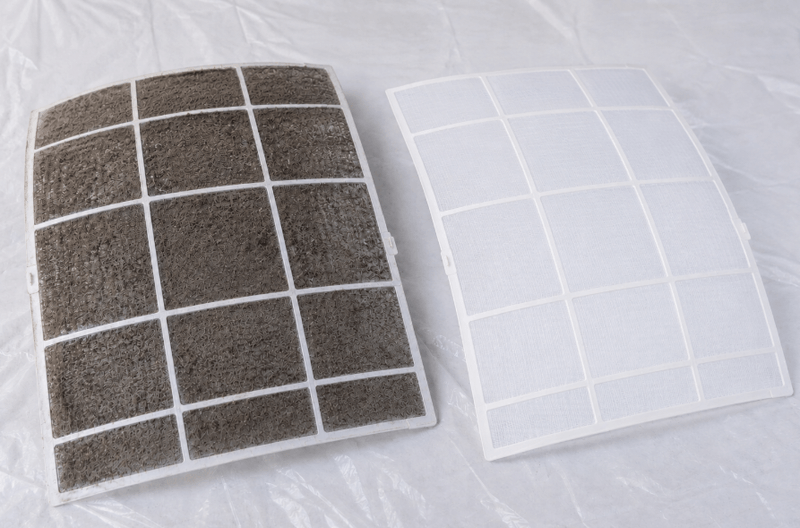
Clean a workshop mini split filter far more often than the 2 to 4 weeks recommended for residential use. Cadence should follow the work you actually do, because a shop used for glue-ups loads a filter far slower than one running a sander without source capture.
Shop Dust Load Tiers
Cadence starts from the residential 2 to 4 week baseline and tightens as dust generation rises. Inspect on the schedule shown and clean early if the mesh weave is obscured.
The inspection rule beats any calendar. Pull the filter under a bright light. If you cannot see the mesh weave through the dust, the cleaning is overdue.
What Will a Mini Split Not Do in a Woodworking Shop?
A mini split will not clean your shop air. The washable mesh filter in a ductless indoor unit is designed to protect the coil from lint and larger particles, not to capture the fine respirable fraction that sanding generates. Treat it as dust control and you will pay for that mistake.
That sentence costs us a sale.
That is not just Filterbuy saying so. The EPA says wall-mounted ductless units are built for temperature control rather than air filtration, and that what filtration they have exists to keep the inside of the unit clean rather than to pull fine particles out of the room.
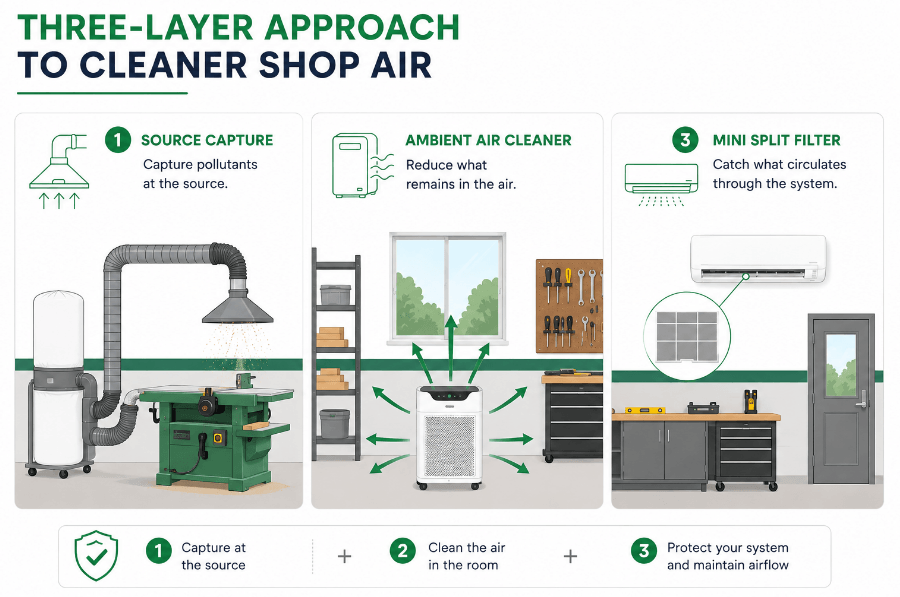
Shop air quality runs in three layers:
Capture at the source. Connect every tool with a port to a collector or shop vacuum. OSHA calls local exhaust ventilation the primary method of controlling wood dust.
Clean the ambient air. An overhead or cart-mounted air cleaner running a pleated media filter handles what escapes capture. This is where a MERV 13 air filter earns its keep, the minimum rating the EPA recommends for HVAC filtration, or as high a rating as the unit will accommodate without restricting airflow. This is also where custom air filters matter if the cleaner takes an odd size.
Protect the equipment. The mini split filter guards the coil, not your lungs.
Run the first two layers during dust-generating work and leave the mini split on low.
What Electrical Does a Shop Mini Split Need?
The 12,000 BTU mini split is available in 115V or 230V, while the 18,000 BTU mini split and the 24,000 BTU mini split are 230V only. Most shops already have 230V at the panel for a saw, dust collector, or compressor, which usually makes the higher voltage the simpler path.
Every unit needs a dedicated circuit and cannot share one with tools. Professional installation by a licensed HVAC contractor is required, and the 7-year compressor and 3-year parts warranty is void if self-installed. For a garage rather than a shop, see our best mini split for a garage guide.
Does Your Dust Collector Change the Sizing Math?
Yes, if it exhausts outside. A dust collector is an exhaust fan. Every cubic foot it blows outdoors is air you paid to cool, replaced by outside air at whatever the day happens to be. That load appears on no sizing chart, and it is why some correctly sized shops never feel cool.
Check the scale yourself. A 400-square-foot shop with 9-foot ceilings holds 3,600 cubic feet, and a 1,200 CFM collector moves that volume outdoors in three minutes. Twenty minutes of planing empties and refills the shop several times over.
Each option costs you something different:
Vent it outside for the best dust removal and the worst thermal penalty. Size up a step, or run it in short bursts.
A filtered return carries no thermal penalty, but that filter now decides your air quality. A coarse bag sends the fine fraction back inside.
Best of both: the collector in an adjacent unconditioned space with a filtered return. It also solves the noise.
One caution matters more than comfort. A shop pulled negative can backdraft a fuel-burning appliance and draw combustion gases, including carbon monoxide, back into the room. If a gas water heater, furnace, or unvented heater sits in or beside the shop, raise this with your contractor first.
Supporting Statistics
Space heating and air conditioning account for 52% of the average U.S. household’s annual energy consumption.
Source: U.S. Energy Information Administration, 2020 Residential Energy Consumption Survey.
Woodworkers held about 214,600 jobs in the United States in 2024, and 7% of them were self-employed.
Source: U.S. Bureau of Labor Statistics, Occupational Outlook Handbook, Woodworkers.
63% of new single-family homes completed in the South in 2025 had a heat pump, compared with 36% that had a forced-air furnace.
Source: U.S. Census Bureau, 2025 Characteristics of New Housing.
Frequently Asked Questions
Glossary
Ductless mini split: A two-piece heat pump linking an outdoor compressor to an indoor air handler. It heats and cools without ductwork.
BTU: British Thermal Unit, the measure of heating and cooling capacity. 12,000 BTU equals one ton.
SEER2: Seasonal Energy Efficiency Ratio 2, the federal cooling efficiency metric in force since 2023. Higher is better.
R-32: A refrigerant with lower global warming potential than the R-410A it is replacing.
Manual J: The residential load calculation standard used to size equipment from a building’s actual construction rather than square footage alone.
MERV: Minimum Efficiency Reporting Value, the ASHRAE 52.2 scale for particle capture. Filterbuy makes pleated filters in MERV 8, 11, and 13.
Respirable fraction: Airborne dust small enough to reach the deep lung, generally under 10 micrometers.
Makeup air: Outside air replacing what an exhaust fan or dust collector removes. Uncontrolled, it enters through whatever gap it finds, including a chimney.
Local exhaust ventilation: Capture of contaminated air at the point it is generated, before it spreads.
Variable-speed inverter compressor: A compressor that modulates output to match demand instead of cycling, giving steadier temperatures and lower energy use at partial load.