Best Mini Split for a Small Home: Efficient Heating & Cooling Under 1,000 Sq Ft
The right mini split for a small home is the one that matches your floor plan. An open home up to about 850 sq ft usually runs well on one 18,000 BTU single-zone system. If bedrooms or an office stay closed, plan on one indoor head for each closed room.
Filterbuy single-zone sizes for open spaces:
- 12,000 BTU: up to 550 sq ft (studios, ADUs, bedrooms)
- 18,000 BTU: up to 850 sq ft (open 1–2 bedroom homes)
- 24,000 BTU: up to 1,100 sq ft (larger open areas)
Not sure which fits? Take the quick match quiz below.
Shop Mini Split Systems Find My Size
From $799 · Free 2-day delivery · 7-year compressor warranty · 17 SEER2 · Professional installation required

Match your home to the right mini split.
Answer a few quick questions about your space, and we'll point you to the size that fits.
Already know your size? Compare Filterbuy mini split systems.
TL;DR
The best mini split for a small home under 1,000 sq ft is the one that matches your floor plan. An open 700 to 850 sq ft home usually runs well on one 18,000 BTU system, while closed-off bedrooms call for a multi-zone system with a head in each. Plan for filtration too, since the stock mesh screen protects the coil rather than cleaning your air.
Key Takeaways
Start with 20 to 25 BTU per square foot, or roughly 16,000 to 20,000 BTU for an 800 sq ft home.
Let your layout set the zone count. In Filterbuy's experience, a head cools its own room plus a little spillover, so each closed bedroom needs its own.
Ductwork in unconditioned space can waste more than 30% of heating and cooling energy, according to the DOE's Building America Solution Center.
Why Filterbuy's Take on Mini Splits Is Different
Most mini split guides are written by installers who sell the equipment or by reviewers who sell nothing. Filterbuy sits in between: we manufacture air filters in the USA, and we also sell a single-zone ductless line.
Selling both shows us what happens after the installer leaves, including what the coil looks like years later. Filterbuy HVAC Solutions also services ductless systems in Florida and Texas, and that field work shapes this page.
What Size Mini Split Does a Small Home Need?
Plan on 20 to 25 BTU of capacity per square foot, using the lower end for shaded, well-insulated homes and the higher end for hot, sunny, or drafty ones.
Filterbuy sells three single-zone sizes: a 12,000 BTU mini split for up to 550 sq ft, an 18,000 BTU mini split for up to 850 sq ft, and a 24,000 BTU mini split for up to 1,200 sq ft.
Assumes 8 ft ceilings and average insulation. Confirm with a Manual J load calculation.
Add capacity for high ceilings, west-facing windows, weak insulation, or a hot climate, but don't oversize. Because Filterbuy also sells the filters, we see what an oversized head does after install day: it short-cycles, never dries the coil, and becomes an odor problem well before a compressor problem. Get a Manual J, and see our mini split sizing guide.
Single-Zone or Multi-Zone: Which Fits a Small House?
A single-zone system works well when most of your living space is open. Once two or more rooms are regularly closed off, a multi-zone system is the better fit.
Filterbuy uses a simple closed-door test. As ENERGY STAR points out, conditioned air can't pass through a closed door, so count the rooms whose doors stay shut at night, such as bedrooms or a home office. That's roughly how many extra heads you'll need.
Worked example: an 850 sq ft, two-bedroom cottage
Open living room and kitchen (500 sq ft): Needs 10,000 to 12,500 BTU, which one 12,000 BTU head covers.
Two bedrooms (150 sq ft each): Each needs only 3,000 to 3,750 BTU, yet the smallest wall heads start around 6,000 BTU and, per the Building America Solution Center, can oversupply a small room.
Filterbuy's plan: Two zones, with a 12K head in the living area and a small head in the primary bedroom. The second bedroom keeps its door open or shares air through a transfer fan; a third head would add cost this home doesn't need.
Filterbuy's customer service team sees this every week: most 1,000 sq ft homes need two or three zones rather than one large head. Our line is single-zone only, so for a true multi-zone system, look to Daikin or Mitsubishi Electric, or pair separate single-zone systems. Our mini split for 1,000 sq ft guide covers that decision.
Best Mini Splits for Small Homes in 2026
For a small home, the strongest options are Filterbuy for value, Mitsubishi Electric and Daikin for premium reliability, MRCOOL DIY for self-installation, and Pioneer, Senville, or Cooper & Hunter for budget pro installs.
Spec-based picks, not lab tests. Filterbuy sells its own line and is not affiliated with or endorsed by the other brands listed.
The Filterbuy line starts at $799 with a published price, free 2-day delivery on in-stock systems, and a 7-year compressor warranty, which makes it our value pick for a bedroom, garage, or room addition. At 17 SEER2 it clears the federal minimum and is built for value, not maximum efficiency. It heats reliably down to 5°F, so if it will be your main winter heat and lows regularly drop below 0°F, choose Mitsubishi Electric Hyper-Heat. Our 12,000 BTU model also comes in 115V, sparing some older homes a new 230V circuit. See our ranking of the most reliable mini split brands.

How Much Does a Mini Split Cost for a Small House?
An affordable single-zone mini split runs about $650 to $1,500 for the unit alone and $1,800 to $3,500 installed. A multi-zone setup for a home near 1,000 sq ft usually lands between $3,000 and $10,000, and the number of zones drives that spread far more than square footage does.
Before signing a quote, ask your installer:
Did you run a Manual J for each zone as well as the whole house?
Will I get an AHRI certificate showing matched indoor and outdoor units?
Is a dedicated circuit included? Older homes often need a new 240V line; see mini split electrical requirements.
Who pulls the permit? Permits typically add $100 to $500, and Filterbuy HVAC Solutions technicians pull their own in Florida and Texas.
The IRS Energy Efficient Home Improvement Credit (25C) was terminated for systems placed in service after December 31, 2025; confirm eligibility with a tax professional. Some income-eligible households can get state-run HEAR rebates of up to $8,000 for a heat pump. The ENERGY STAR Rebate Finder and our heat pump rebates in 2026 guide show what's offered locally.
Which Filter Setup Keeps a Small-Home Mini Split Efficient?
Every mini split head has a washable mesh pre-filter. As the EPA explains, it catches pet hair and lint but lets fine particles pass through. Filterbuy doesn't stock brand-specific mesh panels, so we have nothing to gain by saying this: the pre-filter protects the coil, and your whole-home filter does the heavy lifting for air quality.
Filterbuy recommends this maintenance rhythm:
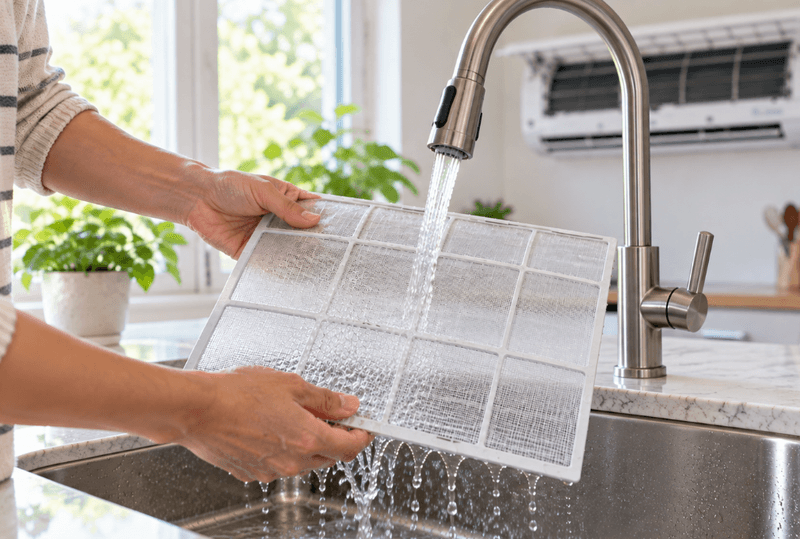
Rinse the mesh filter every two to four weeks in heavy use, and let it dry fully.
Add fine-particle filtration. The EPA suggests a portable air cleaner when a ductless unit lacks a MERV 13-or-higher filter, sized per its Guide to Air Cleaners in the Home at a CADR of roughly two-thirds the room's square footage.
With a furnace or ducted system, use MERV 11 for everyday dust and dander. The EPA recommends MERV 13 or higher for fine particles if your system can handle the airflow resistance, so ask your HVAC technician.
Schedule a professional deep clean of each head every one to three years, per the Building America Solution Center.
From Filterbuy's experience: A surprising share of mini split complaints trace back to the one part owners rarely touch, so check the filter before you book a service call. Filterbuy manufactures MERV 11 and MERV 13 air filters in the USA, with auto-delivery.
"I would rather you run MERV 11 on a real schedule than MERV 13 for eight months," says Michelle Wan, Brand Manager and Air Quality Writer at Filterbuy.
How Do You Run a Mini Split Efficiently in a Small Home?
Small homes change temperature quickly, which tempts owners to switch heads on and off, but a mini split runs best when you leave it alone. ENERGY STAR and the Building America Solution Center point to three habits:
Pick a temperature and leave it. Unlike a furnace, a heat pump doesn't save energy from setbacks.
Choose Heat or Cool instead of Auto, which can flip between the two on mild days.
Use Dry mode in humid weather. Many ductless units dehumidify poorly, and a damp coil is where odor problems start.
Supporting Statistics
Almost half of a typical household's $1,900 annual energy bill goes to heating and cooling.
ENERGY STAR certified mini splits use up to 60% less energy than standard electric radiators.
Source: ENERGY STAR, Ductless Heating & Cooling
More than 150,000 ductless heat pumps were installed in existing Northwest homes by the end of 2021.
In a 2021 survey, 96% of the region's HVAC installers said they install ductless systems.
Source: Northwest Energy Efficiency Alliance, Ductless Heat Pumps
Central HVAC systems typically run less than 25% of the time during heating and cooling seasons.
A system filters only while it runs, and MERV 13+ filters must remove at least 50% of the smallest particles tested.
Frequently Asked Questions
Glossary
BTU (British Thermal Unit): The unit for heating and cooling capacity, measured per hour.
SEER2: The U.S. cooling efficiency rating; higher is more efficient.
Inverter compressor: A variable-speed compressor that adjusts output to demand.
Single-zone system: One outdoor unit paired with one indoor head.
Multi-zone system: One outdoor unit serving two or more indoor heads.
Manual J: The standard load calculation used to size HVAC equipment.
MERV (Minimum Efficiency Reporting Value): The 1 to 16 ASHRAE 52.2 scale for particle capture.
CADR (Clean Air Delivery Rate): The rating used to size a portable air cleaner.
HEAR (formerly HEEHRA): Home Electrification and Appliance Rebates, a federally funded, state-run program.
Find Your Fit
Take the mini split match quiz or shop Filterbuy mini split systems. Already own one? Find your mini split filter and set up auto-delivery.
About the author: Michelle Wan is Filterbuy's Brand Manager and Air Quality Writer.
Reviewed for technical accuracy by David Clark, Licensed HVAC Technician and CEO of Filterbuy HVAC Solutions.