Best Mini Split for an Open Concept Living Room
Sizing, Zoning & Top Picks
The best mini split for an open concept living room is sized for every connected space, kitchen included, and mounted so its air travels down the room's long axis. Most compact open plans need one 12,000–24,000 BTU indoor head. If your layout turns a corner or has areas that close off, two single-zone systems usually work better. Take the quick match quiz below to check your space.
Match your combined square footage:
- Up to 550 sq ft: 12,000 BTU
- Up to 850 sq ft: 18,000 BTU
- Up to 1,100 sq ft: 24,000 BTU
- L-shaped or closable: two single-zone systems, one per leg

Not sure one head is enough?
Answer a few quick questions about your space and we'll match you to the right capacity and setup.
TL;DR
Treat an open floor plan as one cooling load. Add up every connected area and adjust for sun and occupancy, adding 4,000 BTU if the kitchen shares the space. One head works only when air can travel freely from end to end, and its filter needs cleaning about every two weeks in peak season.
Key Takeaways
Size an open-plan mini split for every connected space, including the kitchen.
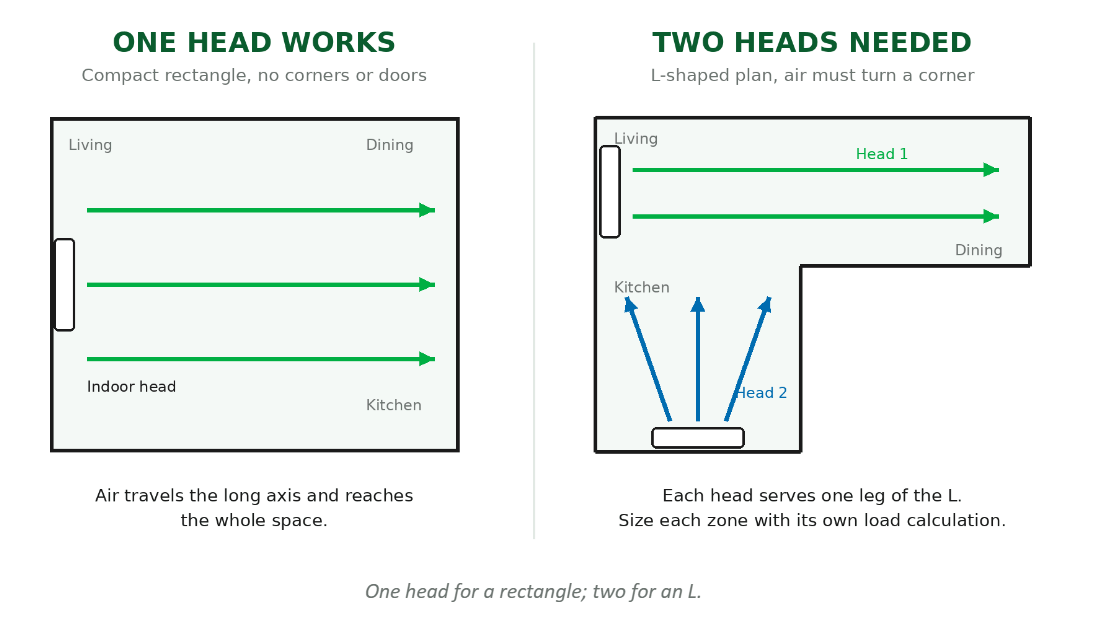
One head suits a compact rectangle; L-shaped or closable layouts usually need two.
Built-in mini split filters protect the equipment but don't capture fine particles, per the EPA.
Filterbuy has made air filters in the U.S. since 2013, and its HVAC Solutions team services ductless systems in Florida and Texas homes. We see mini splits long after installation day, so this guide connects sizing and zoning to filter care.
"Every mini split roundup I read leads with the SEER2 number and buries the one thing that actually determines whether you will ever see it on your bill, whether the system is sized right and the filter gets cleaned."
— Michelle Wan, Brand Manager and Air Quality Writer, Filterbuy
How Do You Size a Mini Split for an Open Floor Plan?
Sizing an open floor plan starts with the square footage of every area that isn't separated by a door. From there, find the base capacity on the chart from ENERGY STAR, the EPA's efficiency program, and adjust it for the room. ENERGY STAR recommends having your contractor confirm the result with a Manual J load calculation.
Measure each connected area and add the square footage together.
Find your base capacity on the ENERGY STAR room air conditioner sizing chart.
Adjust for the room. Take off 10% for heavy shade or add 10% for strong sun. Then add 600 BTU for each regular occupant beyond two and 4,000 BTU for a kitchen.
Flag tall ceilings. Vaulted ceilings hold more air, so tell your installer.
Assumes 8-foot ceilings. Source: ENERGY STAR sizing chart.
Open-Plan Sizing: Three Worked Examples
Screening estimates only; a Manual J calculation confirms final capacity.
Sizing a single room instead? See Filterbuy's mini split BTU sizing guide.
One Head or Multi-Zone? The Open-Plan Zoning Test
One indoor head can handle an open concept living room when the space behaves like a single comfort zone, with air moving freely and nothing closing off. ENERGY STAR notes that heat struggles through an open doorway and cannot pass a closed one. A bigger head can't push air around corners.
A "yes" to any of these questions points to two heads:
Does the air have to turn a corner? In L- and U-shaped plans, the far leg tends to stay warm.
Is the room longer than one unit's air throw?
Does one area run much hotter? West-facing glass or a busy kitchen can.
Can part of the space close off? A den loses conditioned air once its door shuts.
Filterbuy's take: if your layout fails the test, two right-sized single-zone systems usually beat one oversized head or a multi-zone unit. DOE's Building America Solution Center warns that a multi-split can cycle on and off when only some heads run. For costs, see Filterbuy's single-zone vs. multi-zone mini split guide.
Where Should the Mini Split Go in an Open Concept Room?
The best spot for a mini split in an open concept room is a central wall facing the largest open stretch of the space, so the unit blows along the room's long axis.
Use the remote's Follow Me sensor. A high-wall unit reads temperature near the ceiling, where the air is warmer than at seating height, per DOE's Building America Solution Center.
Keep it away from the cooktop, and don't aim it at the sofa.
Open-Plan Install Checklist
The best indoor wall is often far from the outdoor unit, so confirm these limits with your licensed installer. Permit rules vary by jurisdiction.
Line length. Filterbuy's 12,000 and 18,000 BTU systems allow up to 50 ft of refrigerant line, and the 24,000 BTU allows up to 65 ft. Lines are pre-charged for 25 ft; longer runs may need more refrigerant.
Height difference. Up to 33 ft on the 12,000 and 18,000 BTU models, or 49 ft on the 24,000 BTU.
Circuit. The 12,000 BTU runs on 115V or 230V, while the 18,000 and 24,000 BTU need a dedicated 230V circuit.
Run It Right in an Open Plan
ENERGY STAR recommends Heat or Cool mode over Auto, one steady temperature, and a fan speed that still reaches the far end of the room. Heat rises, so lofts can run warm in winter.
Top Mini Split Picks for Open Concept Living Rooms (2026)
For most open concept living rooms, the best mini split is an inverter-driven, AHRI-certified system matched to your load and layout.
Prices as of September 22, 2026. Professional installation required.
Shop: Filterbuy 12,000 BTU Mini Split · Filterbuy 18,000 BTU Mini Split · Filterbuy 24,000 BTU Mini Split
Filterbuy mini split systems start at a published $799 with no quote form, free 2-day delivery on in-stock systems, and a 7-year compressor / 3-year parts warranty. Each is ETL and AHRI certified with a 55°C self-clean cycle. Professional installation is required, and the warranty is void if self-installed.
At 17 SEER2, our units clear the federal minimum and are built for value, not peak efficiency; see the most energy-efficient mini splits. They heat reliably down to 5°F, so a cold-climate model is the better choice for primary winter heat in cold regions. For one outdoor unit feeding several heads, choose another manufacturer's multi-zone line.
Which Filters Handle High-Traffic, High-Airflow Open Spaces Best?
The best filter setup for a high-traffic open space pairs a frequently cleaned mini split mesh filter with a portable air purifier or a MERV 13 central filter. The EPA notes that mini split mesh filters catch large particles like pet hair and lint but not fine particles. An open-plan head pulls in cooking aerosols and pet hair from the whole space, so its filter loads faster.
What Filterbuy sees in the field: the most common failure our technicians find isn't a broken part. It's a filter no one checked. Filterbuy service data shows a restricted filter cuts efficiency by 5–30%. Filterbuy factory testing also found fine dust under 10 microns is harder on a system than visible dirt. See how to clean mini split filters.
Always follow your owner's manual.
"The number-one callback we could prevent is the damp-filter mold call. A mesh that goes back in even slightly wet is how mold gets started inside the head. Give it the full drying time."
— David Clark, Licensed HVAC Technician, Filterbuy HVAC Solutions
Self-clean dries the coil but won't wash the mesh. For fine particles:
Portable air purifier. The EPA advises sizing one for the entire open space; 600 sq ft calls for a CADR of at least 390 cfm. Keep fresh air purifier replacement filters on hand.
Central HVAC filter. If a ducted system also serves the home, the EPA recommends MERV 13 or the highest rating your system's fan and filter slot can handle. Filterbuy manufactures MERV 13 air filters in the USA, with auto-delivery.
Smoke days. Check your local AQI and keep the windows closed.
For coils and drain lines, see how to maintain your mini split.

Supporting Statistics
Almost half of a typical $1,900 annual energy bill goes to heating and cooling.
Source: ENERGY STAR, Ductless Heating & Cooling
An inverter mini split can ramp down to as little as 10% of its rated capacity.
Source: DOE Building America Solution Center
Central HVAC systems usually run less than 25% of the time during heating and cooling seasons.
Frequently Asked Questions
Glossary
BTU (British Thermal Unit): The unit for mini split capacity, per hour.
Manual J: The Air Conditioning Contractors of America standard for calculating heating and cooling loads.
SEER2: Seasonal Energy Efficiency Ratio 2, the federal cooling-efficiency metric since 2023.
Inverter: A variable-speed compressor that matches output to the load.
Single-zone mini split: One outdoor unit connected to one indoor head.
Multi-zone mini split: One outdoor unit connected to two or more indoor heads.
Follow Me sensor: A remote sensor, standard on Filterbuy mini splits, that reads temperature where you sit.
CADR (Clean Air Delivery Rate): A portable air cleaner's filtered airflow, in cubic feet per minute.
AHRI certification: Verification that a matched indoor and outdoor pair performs as rated.
MERV: Minimum Efficiency Reporting Value, a 1–16 scale for HVAC filter capture.
About the author: Michelle Wan is Filterbuy's Brand Manager and Air Quality Writer. She works with Filterbuy's factory teams in Alabama, Florida, Pennsylvania, and Utah.
Once you know your load, shop Filterbuy mini split systems by BTU with free 2-day delivery on in-stock systems.