Best Mini Split for an Attic Bedroom: Stay Comfortable in Your Converted Space
The best mini split for an attic bedroom is a single-zone, inverter-driven ductless heat pump, sized from a load calculation starting near 25 BTU per square foot. For a room you sleep in every night, look for 26 dB or less in the quietest mode, 18 SEER2 or higher, and cold-climate heating if your winters freeze. Your roofline picks the indoor unit.
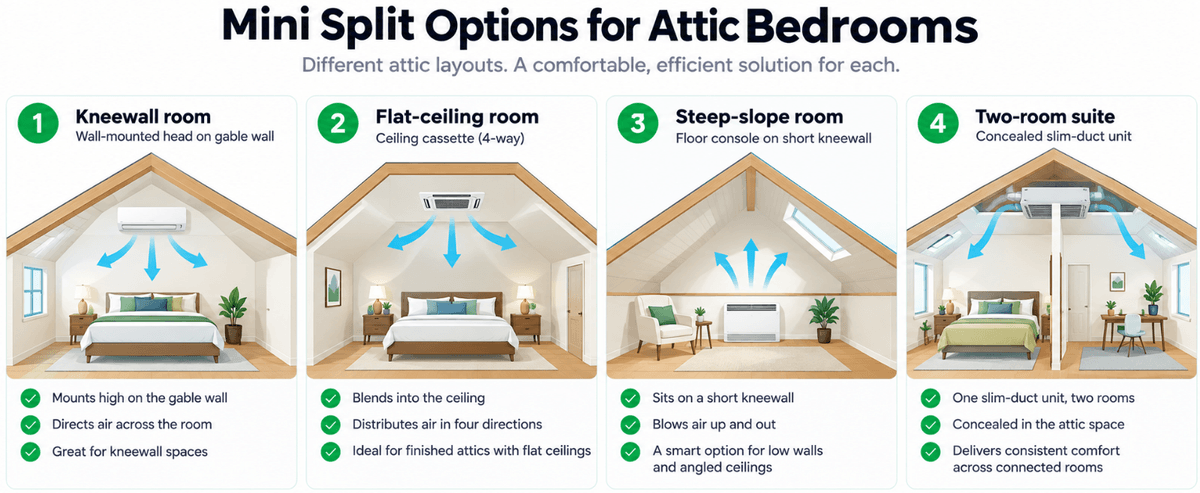
- Wall-mounted head for kneewalls with a full-height gable wall.
- Ceiling cassette for a flat ceiling section at the collar ties.
- Floor console for steep slopes and short kneewalls.
Not sure which size or style fits your attic? Take the quick match quiz below.

Answer 3 quick questions and we'll match you to a mini split that fits your attic room.
Filterbuy single-zone systems start at $799 with free 2-day delivery on in-stock systems and a 7-year compressor warranty. Professional installation is required.
TL;DR
Attic bedrooms fight the roof all year, so most finished attic bedrooms need a right-sized, quiet ductless mini split heat pump rather than a longer duct run. As a filter maker, Filterbuy adds one caveat: a mini split's pre-filter protects the coil, while your whole-home filter does the heavy lifting for air quality.
Key Takeaways
Start attic sizing near 25 BTU per square foot, then confirm it with a Manual J.
Check line-length and height limits first; the condenser often sits two or three floors down.
For a nightly bedroom, target 26 dB or less and 18 SEER2 or higher; value units fit offices and guest rooms.
In cold climates, choose an ENERGY STAR cold-climate unit.
The federal 25C heat pump tax credit ended for systems installed after December 31, 2025.
How we built this guide: Filterbuy has made air filters in the U.S. for more than a decade and now sells ductless mini splits. We checked our unit's specs against ENERGY STAR, DOE, EPA, and ACCA criteria without lab-testing competitors.
Why Do Attic Bedrooms Get So Hot and So Cold?
An attic bedroom sits under the roof deck, soaking up solar heat in summer and losing warmth through thin sloped ceilings in winter. Central HVAC sized for the floors below leaves it hottest in July and coldest in January.
Extending ductwork rarely helps: the U.S. Department of Energy says duct losses can exceed 30% of heating and cooling energy in attics. A ductless AC and heat pump, or mini split, avoids those losses.
What Size Mini Split Does an Attic Bedroom Need?
Most attic bedrooms need about 25 BTU per square foot to start, about 25% more than a downstairs bedroom. A 300-square-foot attic bedroom usually lands on a 9,000 BTU unit and a 450-square-foot room on 12,000 BTU. An ACCA Manual J load calculation sets the final number.
Size up for dark shingles, west dormers, or vaulted ceilings; size down for R-38+ insulation or a radiant barrier.
Worked example: A 14-by-22-foot attic bedroom is 308 square feet, or about 7,700 BTU. Add roughly 10% for a west-facing dormer under dark shingles, and you're near 8,500 BTU. That points to a 9,000 BTU unit, since oversized units shut off before pulling moisture out. The same goes for our own product: the Filterbuy 12,000 BTU unit is listed for 300 to 550 square feet, but in an attic we'd plan on about 500 at most. See Filterbuy's guide on what size mini split you need for the full calculation.
Which Type of Mini Split Works Best in an Attic Bedroom?
For an attic bedroom, the roofline picks the mini split style. A wall-mounted head suits most kneewall attics, and a ceiling cassette fits a flat ceiling section. Steep slopes call for a floor console, while a slim-duct unit can serve a multi-room suite (see single-zone vs. multi-zone mini splits).
Watch the stairwell. ENERGY STAR notes that heat rises and cool air sinks, so a door at the top of an open stairwell can help as much as extra BTU.
What Should You Measure Before Buying an Attic Mini Split?
Before you buy, measure the vertical rise from the outdoor pad to the indoor head, the full line-set run, available power, and a drain path. In attics, these limits rule out more units than BTU ratings do.
In a two-story home, an attic head can sit 25+ feet above a ground-level pad, so Filterbuy checks height first. The unit is pre-charged for 25 feet of line, so longer runs need added refrigerant in the quote. The 115V version skips a 230V run but needs a dedicated circuit. Our guide on how to install a mini split in an attic covers routing and drainage in detail.
Which Specs Matter Most for Sleeping in a Converted Attic?
For sleeping in a converted attic, six specs matter most, led by quiet operation at 26 dB or less and an inverter compressor.
ENERGY STAR's cold-climate designation requires a COP of at least 1.75 and 70% of rated heating capacity at 5°F.
Here's where our unit fits. Filterbuy's 12,000 BTU ductless mini split is $799 with free 2-day delivery on in-stock systems, a 7-year compressor / 3-year parts warranty, and a published price with no quote form. By this page's bedroom standard, it falls short: as low as 28 dB in Mute Mode, 17 SEER2 (above the federal minimum), and reliable heating down to 5°F. That makes it our value pick for an attic office, guest room, or bonus room. For a primary bedroom or winters below 5°F, a quieter, higher-SEER2, cold-climate unit is the better buy (see our best mini split for a bedroom guide). Professional installation is required, and the warranty is void if self-installed.
How Do You Keep Insulation Dust Out of an Attic Bedroom?
To keep insulation dust out of an attic bedroom, rinse the mini split's pre-filter often, run a MERV 11 or MERV 13 central filter, and seal gaps around the room. At Filterbuy, we make air filters in 600+ sizes, so we're particular here: the pre-filter protects the coil, and pleated MERV media does the heavy lifting.
According to the Agency for Toxic Substances and Disease Registry (ATSDR), airborne fiber levels spike during insulation work and fall back to pre-installation levels within a day or two, so the lasting dust source is whatever stays unsealed. For health questions about insulation exposure, talk to a qualified professional.
Filterbuy recommends a three-layer plan:
Clean the mini split's pre-filter. Rinse it every two to four weeks at first; the Filterbuy unit's filter-cleaning reminder is a backstop.
Upgrade the central HVAC filter. If the attic shares air with the house, use a MERV 11 air filter for fine dust, pollen, and pet dander, or a MERV 13 air filter for smaller particles. The EPA recommends at least MERV 13 where your system fan and filter slot allow, so confirm airflow compatibility first; then Filterbuy auto-delivery keeps it from lapsing.
Seal the source. Weatherstrip the kneewall doors and attic hatch, then air-seal around recessed lights.

"An attic is one of the least forgiving spaces in a house to condition, because it's fighting the roof above it in both directions. The mini splits that succeed are sized off a real load calculation, not a square-footage guess."
— David Heacock, Founder and CEO, Filterbuy
Is a Mini Split Worth It for an Attic Conversion in 2026?
A mini split is worth it for any attic room you use regularly: pay for quiet and efficiency in a nightly bedroom, and go value for an office or guest room. First confirm the room meets bedroom code for ceiling height and egress. Professional installation is required, and Filterbuy can share an installer list when you order. Per IRS guidance, the 25C credit was terminated for systems placed in service after December 31, 2025. Check the DSIRE incentives database or our heat pump tax credits guide for state and utility programs, and confirm eligibility with a tax professional.
Supporting Statistics
1. Up to 60% less energy than electric radiators
ENERGY STAR certified mini split heat pumps use up to 60% less energy than standard electric radiators, because they move heat rather than make it.
Source: ENERGY STAR, Ductless Heating & Cooling
2. 65–68°F is the target range for sleep
The Sleep Foundation puts the ideal sleep temperature at 65–68°F, with about 65°F as the sweet spot.
Source: Sleep Foundation, Best Temperature for Sleep
3. MERV 13 captures at least half of the finest particles
A MERV 13 filter captures at least 50% of particles from 0.3 to 1.0 microns and at least 85% of particles from 1.0 to 3.0 microns, per the EPA's summary of the ASHRAE test standard. Confirm your system's airflow can handle it first.
Source: U.S. EPA, What Is a MERV Rating?
Frequently Asked Questions
Your Next Steps
Measure the room and rise, get a Manual J, then compare Filterbuy mini split systems.
Glossary
Ductless mini split: A heat pump whose outdoor and indoor units connect by refrigerant lines instead of ducts.
Inverter compressor: A variable-speed compressor.
Manual J: ACCA's standard heating and cooling load calculation.
SEER2 / HSPF2: Federal ratings for seasonal cooling and heating efficiency.
COP (Coefficient of Performance): Heat delivered per unit of electricity used.
ENERGY STAR cold-climate heat pump: A heat pump holding a COP of 1.75+ and 70%+ of rated capacity at 5°F.
AHRI / ETL: Performance and safety certifications.
Filterbuy: A U.S. manufacturer of air filters in 600+ sizes that also sells ductless mini split systems.
Kneewall: A short wall under a sloped roof.
MERV: Minimum Efficiency Reporting Value, ASHRAE's air filter efficiency scale.