
Most Affordable Mini Split Systems in 2026 That Don't Cut Corners
What Is the Cheapest Mini Split System?
The cheapest mini split system is a single-zone ductless heat pump sized to one room, starting around $650 for the equipment alone and $1,800 to $3,500 fully installed. Cost climbs with capacity, measured in BTUs, and climbs again with every indoor head you add. So one unit matched to one room is always the least expensive configuration.
Read every quote as four numbers, because the sticker price on the unit is only the first one.
- 9,000 BTU — about 400 sq ft. A bedroom or a home office.
- 12,000 BTU — 450 to 550 sq ft. A living room or a converted garage, and the most-shopped size.
- 18,000 BTU — 650 to 1,000 sq ft. An open-concept space.
- 24,000 BTU — 1,000 to 1,500 sq ft. A large living room or a basement.
Not sure which size your room needs? Take the quick match below and we will point you to the right one.

Answer 3 quick questions and we will match you to the right mini split for your room.
Already know your size? Shop Filterbuy mini split systems — 12,000, 18,000, and 24,000 BTU from $799, with free 2-day delivery on in-stock systems.
TL;DR
The cheapest mini split system in 2026 is a single-zone ductless heat pump sized to one room, which runs roughly $650 to $1,500 for the equipment and $1,800 to $3,500 once it is installed. Six budget brands are worth shopping. But the cheapest sticker is almost never the cheapest system to own, and what separates them is warranty depth, service reach, and whether your install voids coverage.
Key Takeaways
A budget single-zone mini split costs $1,800 to $3,500 fully installed. Read every quote as four numbers: equipment, labor, electrical, permits.
Budget compressor warranties run 5 to 7 years, against 10 to 15 on premium equipment.
DIY saves $1,500 to $3,000 per zone, but only MRCOOL DIY keeps its full warranty through a homeowner install. Every other brand here needs a licensed technician somewhere in the process.
The federal Section 25C tax credit expired on December 31, 2025. State HEAR and utility rebates still pay, provided you use a certified contractor.
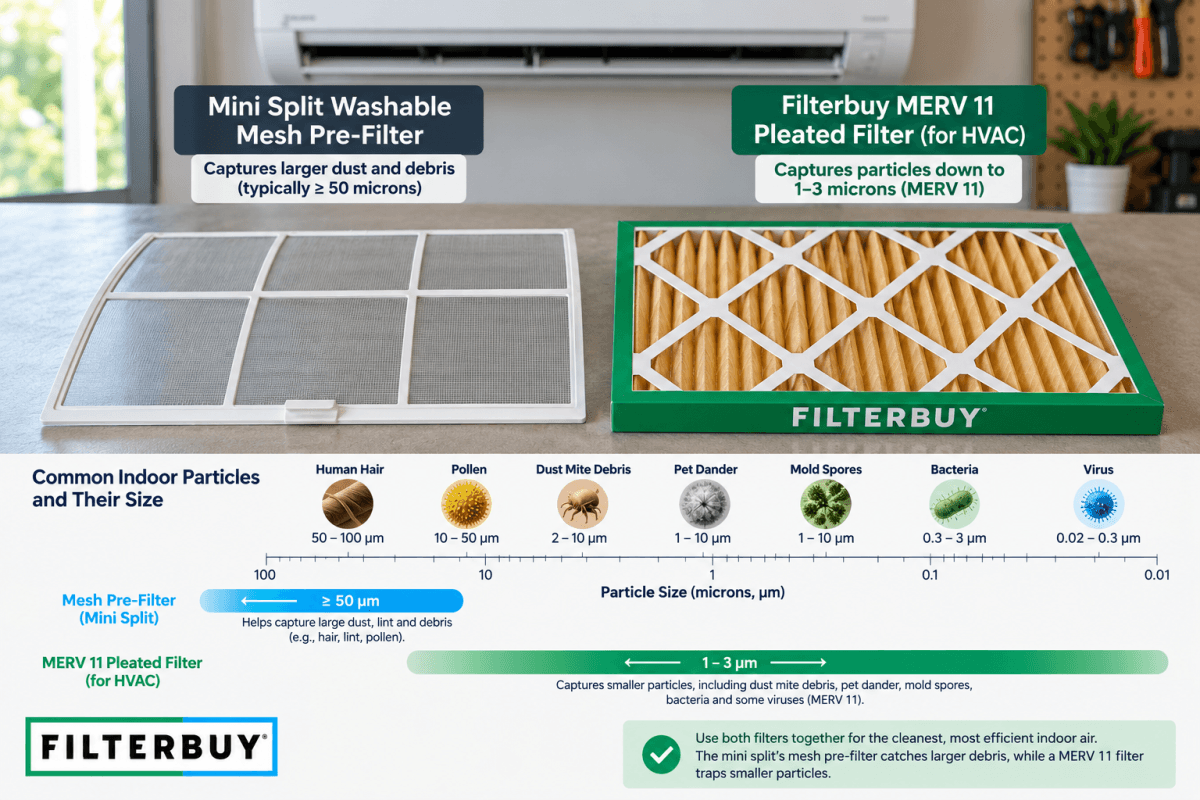
A mini split’s pre-filter protects the coil, not your air. Finer particles pass through it, so the whole-home filter at your central return is still doing that work.
Where this page comes from
Disclosure: Filterbuy sells one of the mini-split systems compared on this page. We have kept it out of the numbered rankings and applied the same criteria to it that we applied to everyone else, including where it loses.
Filterbuy is an air filter manufacturer based in Talladega, Alabama, and our filters are made in the USA. We also sell single-zone ductless mini splits, which is what gives us an unusual vantage point here: we hear from homeowners twice, once when they buy a system, and again a year later when they call for a filter because the room feels cool but the air still doesn’t feel clean. This page is built around that second conversation.
What is the cheapest mini split system?
The cheapest mini split system is a single-zone ductless heat pump matched to one room, priced from about $650 unit-only and $1,800 installed. Cost climbs with capacity, measured in BTUs, and climbs again with every indoor head you add, so one unit sized to one room is always the least expensive configuration available.
Most of the savings come from what a ductless mini split doesn’t have. Skipping ductwork removes duct losses, which can exceed 30% of a home’s space-conditioning energy when ducts run through an unconditioned attic, according to the Department of Energy’s Building America Solution Center.
Six brands hit budget numbers while still publishing a warranty worth reading: MRCOOL DIY, Pioneer Diamante, Senville LETO, Cooper & Hunter Sophia, Della, and the Filterbuy 12,000 BTU ductless mini split.
Cheap mini split brands compared for 2026
The best budget mini split brands are the ones whose warranty survives how you plan to install it. That single question, DIY or licensed contractor, changes your coverage more than any number on the spec sheet.
| Brand | SEER2 | Refrigerant | Compressor / Parts Warranty | Does the Warranty Cover DIY Installations? |
|---|---|---|---|---|
| MRCOOL DIY 5th Gen |
Up to 22.5 | R-454B | 7 yr / 5 yr, registered | Yes |
| Senville LETO |
Varies by model | R-410A | 5 yr / 5 yr | No. Licensed tech required |
| Pioneer Diamante Pro / Ultra |
19–23 | R-32 | Up to 5 yr, register in 90 days | Not stated as a condition |
| Cooper & Hunter Sophia |
19–22 | R-32 / R-454B | 7 yr, licensed install, 60-day registration | No |
| Della (Econo → Ultra) | 17–25 | R-32 | Lifetime parts, register in 100 days | Limited coverage only |
| Filterbuy 12,000 BTU |
17 | R-32 | 7 yr / 3 yr, pro install required | No |
Verify pricing before you budget, and cross-check any SEER2 claim against the AHRI Directory. Filterbuy is not affiliated with or endorsed by MRCOOL, Senville, Pioneer, Cooper & Hunter, Della, Mitsubishi, or Daikin. All specifications are drawn from each manufacturer’s published materials.
Three rows needed correcting once we checked them against each manufacturer’s documentation. MRCOOL’s DIY line has moved to 5th Gen on R-454B, so any page quoting “4th Gen at $1,200” describes equipment you can no longer buy at that price. Della Ultra gets listed as a bargain pick constantly, but it is Della’s premium hyper-heat line, and the budget entry is the Econo series. And Senville’s LETO carries a five-year compressor warranty, not the seven that circulates widely.
In this category, a secondhand spec sheet is a liability, which is why every figure above came from the manufacturer or a retailer selling the unit.
What do these warranties actually cover
A budget mini split warranty covers parts rather than labor, and every brand here can void it on a technicality. Senville says so directly in its own documentation: it does not cover labor costs under any circumstances. Assume the same across the budget tier unless a brand puts something different in writing, because a seven-year compressor warranty usually means a free compressor and a service bill.
Three conditions void coverage far more often than DIY does.
Missing the registration window. Every brand sets its own, and the clock starts at installation rather than purchase.
No licensed technician on the refrigerant work. Senville requires one to evacuate the line sets, pressure-test them, and release the charge. Miss that step and coverage is void on a unit that plenty of shoppers assume is DIY-friendly.
Buying from an unauthorized seller. Cheap marketplace listings often carry no transferable warranty.
| Brand | Registration Deadline | Full-Coverage Condition |
|---|---|---|
| MRCOOL DIY 5th Gen | Register at install | Homeowner installation permitted |
| Cooper & Hunter Sophia | Within 60 days | Licensed installer |
| Pioneer Diamante | Within 90 days | Registration only |
| Della | Within 100 days | Licensed installation for enhanced coverage |
| Senville LETO | Check the model’s product card | Licensed tech must evacuate, pressure-test, and release charge |
| Filterbuy 12,000 BTU | Register after professional installation | Professional installation |
Put the registration deadline in your calendar on install day. Cheapest thirty minutes of the project, and worth confirming with whoever sells you the unit, Filterbuy included.
How much does a mini split cost installed?
A cheap ductless mini split costs $1,800 to $3,500 fully installed for a single zone in 2026. Mini split prices are split into four numbers, and you should break every quote into the same ones: equipment ($700–$1,800), labor ($500–$2,000 per zone), electrical ($300–$1,200) and permits ($100–$400). Our mini split installation cost guide has the full line-item breakdown. Filterbuy HVAC Solutions installs across Florida and Texas, which is where our sense of what these jobs actually bill comes from.
What is the cheapest mini split by size?
The cheapest single zone mini split is a 9,000 BTU unit, and the cheapest 12,000 BTU mini split is the most-shopped size in the category. The working rule is roughly 20 BTU per square foot in a moderate climate, though rated coverage varies at the same capacity: Pioneer rates one 12,000 BTU model to 450 sq ft, while Filterbuy and Della rate theirs to 550.
| Capacity | Typical Coverage | Best Fit |
|---|---|---|
| 9,000 BTU | ~400 sq ft | Bedroom, office. Check sleep-mode noise. |
| 12,000 BTU | 450–550 sq ft | Living room, converted garage. The cheapest 12000 BTU mini split sits here. |
| 18,000 BTU | 650–1,000 sq ft | Open-concept space |
| 24,000 BTU | 1,000–1,500 sq ft | Large living room, basement |
Nearly every ductless system sold in 2026 is a heat pump, so the cheapest mini split heat pump is simply the cheapest unit that fits the room. Winter is the real variable, because budget units lose output as temperatures drop, so anyone in a cold climate should check the NEEP cold-climate list before buying on price alone. Our own mini split systems come in 12,000, 18,000, and 24,000 BTU, rated to 550, 850, and 1,200 sq ft, at $799, $899, and $1,349.
What is the cheapest DIY mini split kit?
A DIY mini split kit ships with a pre-charged line set that eliminates the vacuum pump and gauges a conventional install requires, saving $1,500 to $3,000 per zone. On a $2,800 contractor quote, that brings the project down to roughly $1,400.
Pre-charged lines are sized for the kit rather than cut for your house, so they typically give up some efficiency compared to a professional installation.
The bigger catch is the warranty, and only one brand here survives a true homeowner install with coverage intact: MRCOOL DIY. That is a narrower field than most cheap-mini-split articles suggest, including the version of this page we published earlier this year.
Senville is the correction worth flagging because it gets called DIY-friendly almost everywhere. Its own documentation requires a licensed technician to evacuate the line sets, pressure-test them, and release the charge, and says the warranty is void otherwise. Cooper & Hunter requires licensed commissioning, Della drops to limited coverage on a self-install, and Filterbuy requires professional installation.
Which is why a lot of buyers land in the middle. Handle the mounting, line-set run and electrical rough-in yourself, then pay a licensed tech for the evacuation and charge. You keep most of the savings and the warranty survives.
Worth being straight about the trade either way. A pre-charged DIY kit still needs electrical work, condensate drainage, a wall penetration and usually a permit, so it is not a no-tools afternoon. Professional installation costs more and sets the refrigerant charge correctly, which is what keeps coverage intact. Neither is the right answer for everyone, and the deciding factor is usually how much of that list you are comfortable doing.
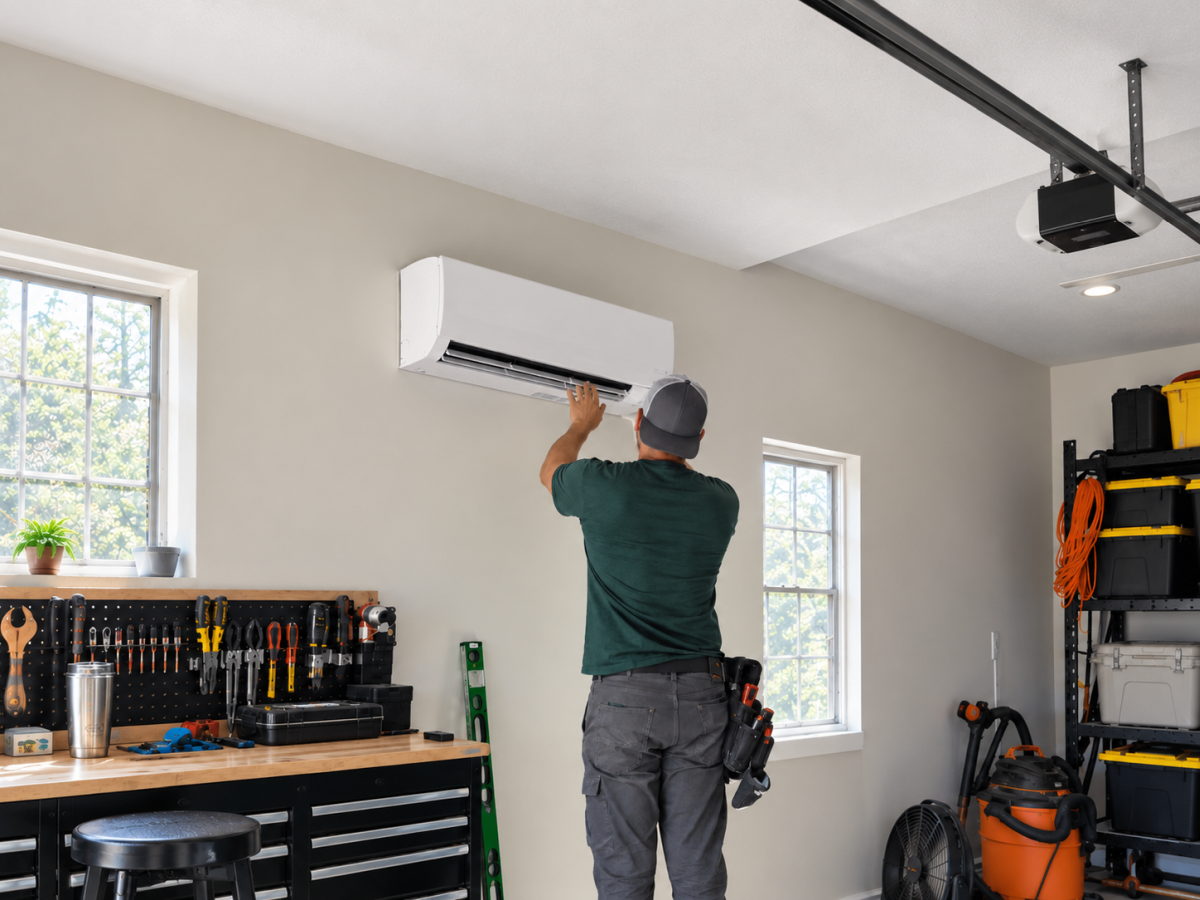
What is the cheapest mini split for a garage?
An uninsulated two-car garage needs roughly 1.5 times the BTU of an equivalent living space. A 600 sq ft garage wants 18,000 to 24,000 BTU rather than the 12,000 most retailers default to, and the job runs $2,800 to $4,500 fully installed.
A garage is also the strongest use case in the category because a failure costs you little, the space can sit unconditioned when empty, and there is no ductwork to extend. Additions and ADUs under 600 sq ft come a close second.
What you give up at the bottom of the price scale
Budget mini-splits trade away four things for the lower price: compressor lifespan, service network depth, filtration, and cold-climate output. None of it matters on install day. All four start to matter later.
Compressor lifespan. Budget brands warrant 5 to 7 years against the 10 to 15 you get from Mitsubishi or Daikin, and the gap shows up around year seven, when a compressor swap on a $1,200 unit starts to tip toward replacing the system.
Service network. A unit that fails in a rural market may be hours from an authorized tech, and Senville administers warranty support from Canada rather than a U.S. branch.
Filtration. This is the one we see most because filters are what we make. A mini split’s pre-filter is there to protect the coil, and it captures larger particles like dust and pet hair. Finer particles pass through it. Homeowners tell us the room feels cooler, but the air does not feel any different, which makes sense because the pre-filter was never doing that job. The EPA reports common organic pollutants are 2 to 5 times higher inside homes than outside. Your whole-home MERV 11 or MERV 13 filter at the central return is what does the heavier lifting, whichever mini split you buy.
Cold-climate output. Rated low-temperature performance runs anywhere from 5°F on entry units down to −22°F on hyper-heat models.
What refrigerant should a mini split use in 2026, and are there rebates?
A mini split bought in 2026 should ship with R-32 or R-454B rather than R-410A. R-410A is being phased down under the EPA’s AIM Act, and systems still using it do not qualify for HEAR rebates, which require a GWP of 700 or lower. R-32 sits at 675 and R-454B at roughly 466.
Since we ship R32 ourselves, it is worth saying plainly that refrigerant has stopped being a differentiator here, because most current systems clear that ceiling. Not all do. Senville’s LETO line still ships pre-charged with R-410A, which disqualifies one of the most recommended budget mini splits from 2026 rebates. Check the data plate rather than the listing.
As for the incentives, the Section 25C credit was terminated for systems placed in service after December 31, 2025, so a mini split installed in 2026 earns no federal credit. State HEAR programs and utility rebates are still running, and most require ENERGY STAR certification, an AHRI listing, and a program-certified contractor. Amounts and eligibility vary by state, utility, and household income, so check your own program and confirm anything tax-related with a tax professional.
Where the Filterbuy mini split fits
We sell one of the systems on this page, which is why we kept it out of the rankings. Here are the same specs we required from every other brand.
The Filterbuy 12,000 BTU ductless mini split is $799 with free 2-day delivery on in-stock systems and a 7-year compressor, 3-year parts warranty, and the price is published rather than quoted. Most HVAC equipment ships freight on a multi-week lead time, so two days is the part worth noticing. The unit is a variable-speed inverter running R32 with Eco Mode, ETL- and AHRI-certified, rated 17 SEER2 and covering up to 550 sq ft, with reliable heating down to 5°F. The 230V configuration draws half the amperage for the same output, which is worth checking against your panel before you assume 230V is the cheaper path. Professional installation is required, and the warranty is void if you install it yourself.
It is not the most efficient unit here. At 17 SEER2, it clears the federal minimum and is built for value rather than for maximum efficiency, and it sits below every competitor listed. Three more things it is not. If this unit is your winter heat source, buy a cold-climate model instead, because ours is rated to 5°F. If it is going in a bedroom and noise is the deciding factor, ours runs as low as 28 dB in Mute Mode, and there are quieter units in the class. And if you need more than one room conditioned from one condenser, we do not make a multi-zone system.
Where it does compete is single-zone value: a published price, two-day delivery, and a seven-year compressor warranty. We put the money there rather than into a higher SEER2 number, because the failure we actually hear about is a dead compressor at year seven.
“Homeowners who regret a cheap mini split aren’t unhappy with year one. They’re unhappy at year five, when a control board fails on a unit nobody local can service. Ask where the nearest authorized tech is before you ask what the unit costs.”
David Clark, Licensed HVAC Technician, Filterbuy HVAC Solutions
“The question we get is always ‘which one is cheapest.’ The better question is ‘cheapest over how long.’ A $650 unit and a $1,400 unit look very different at year seven, and almost nobody shops with year seven in mind.”
Michelle Wan, Filterbuy
Supporting Statistics
Three federal datasets frame the budget mini split decision in 2026.
1. Electricity now costs 18.44 cents per kWh
18.44¢/kWh, the U.S. residential average in May 2026
Up 6.2% year over year, the largest increase of any customer sector
Why it matters: rising rates widen the gap between an efficient system and a cheap one every year you own it
Source: U.S. Energy Information Administration, Electricity Monthly Update, May 2026 data (released July 23, 2026)
2. Nearly half of U.S. mini split households run a single indoor unit
1.21 million of roughly 2.6 million ductless-heat-pump households run just one indoor unit
1.76 million homes, out of 123.5 million, use a mini split as their main air conditioning
Why it matters: single-zone is the most common configuration in the country, making this a single-room and addition market rather than a whole-home one
Source: U.S. Energy Information Administration, Residential Energy Consumption Survey, Table HC7.7 (2020 survey, final data March 2023). Counts households using a ductless heat pump as the main or secondary AC.
3. A DOE field study measured 37% cooling savings and a 12-year payback
Six central Florida homes, each with a one-ton ductless mini split added:
| Measure | Result |
|---|---|
| Cooling energy | Down 37% |
| Heating energy | Down 59% |
| Installed cost | $3,465 |
| Simple payback | 12 years |
Researchers placed the indoor head next to the existing central return grille, the same spot where supplemental filtration belongs.
Why it matters: the savings are real, and so is the payback period. Day-one price is not the whole math.
Source: U.S. Department of Energy Building America Program, Supplemental Ductless Mini-Split Heat Pump in the Hot-Humid Climate (BA-PIRC, tested 2014–2015)
Next steps
Size the room first, then price it.
Decide DIY or pro, and confirm that brand’s warranty terms before you buy.
Verify the model in the AHRI Directory and check the refrigerant on the data plate.
Get three itemized quotes, each broken into the same four numbers.
Pair filtration at the central return. Whatever unit you buy, add a MERV 11 or 13 filter and set up auto-delivery so it doesn’t slip.
Frequently Asked Questions
Glossary
BTU. The measure of a mini split’s heating and cooling capacity.
Ductless mini split. A system pairing an outdoor condenser with indoor air handlers via refrigerant lines instead of ductwork.
HEAR. The federal Home Electrification and Appliance Rebates program is run state by state.
SEER2. The current federal cooling-efficiency rating, which replaced SEER. A SEER2 number runs slightly below the SEER figure for the same equipment, so the two are not comparable.
GWP (Global Warming Potential). A refrigerant’s climate impact score. HEAR eligibility in 2026 requires 700 or lower.
AHRI. The Air-Conditioning, Heating, and Refrigeration Institute, which lab-tests HVAC equipment and publishes verified ratings.
NEEP. The Northeast Energy Efficiency Partnerships, which maintains the cold-climate heat pump list.
MERV. The air filter rating scale. MERV 8 to 13 covers most residential central returns.
Pre-charged line set. Factory-filled refrigerant lines that let a homeowner install a mini split without a vacuum pump.
See More
Hear a concise breakdown of affordable mini split systems for 2026, with a focus on balancing upfront cost with the features that matter.
Get a visual overview of the key considerations when comparing budget-friendly mini split systems and choosing the right option for your home.