

Adding a Mini Split AC System in British Columbia
Costs, Rebates & 2026 Guide
Adding a mini split in British Columbia can put thousands of dollars back in your pocket, or none at all, and the deciding factor is the one thing most buyers never think to ask about. A mini split that only cools qualifies for zero rebates here. The same unit, set up to also heat your home, opens the door to CleanBC, BC Hydro, and FortisBC money. Air quality is the whole reason Filterbuy exists, so we care as much about the filter inside that mini split as the rebate cheque attached to it. Get both right and you land a cooler home in July, a warmer one in January, and air your family can actually trust when the wildfire smoke rolls in.
TL;DR: Quick Answers
Adding A Mini Split AC System Including Rebates In British Columbia
Yes, you can add a ductless mini split almost anywhere in BC, but the rebates come with one hard rule. They go to heat pumps, not cooling-only air conditioners. Set your unit up to heat as well as cool and you unlock the incentives. A cooling-only system qualifies for none of them.
Standard rebate. Up to $4,000 from your electric utility, BC Hydro or FortisBC, for replacing electric heating with a qualifying heat pump, plus up to $2,000 for bundling other upgrades.
Income-qualified rebate. The CleanBC Energy Savings Program reaches up to roughly $16,000 for lower- and middle-income households.
A unit built to qualify. Our ductless mini splits are true heat pumps on a variable-speed DC inverter with R-32 refrigerant and multi-layer filtration, in sizes from 12,000 to 24,000 BTU, the spec profile BC programs look for. Confirm your exact model is on the cold-climate list for the whole-home rebate.
To claim it. Size the system for your climate zone, use a registered contractor, and get pre-approval before any work starts.
Typical cost. A few thousand dollars for a single-zone install, more for a whole-home system, depending on zones and electrical work.
Our two cents. Filterbuy mini splits ship with multi-layer filtration, but the onboard screen is still a comfort filter, not a health filter, so plan whole-home filtration for wildfire-smoke season too.
Top Takeaways
BC runs one of the best heat-pump rebate environments in North America, and you only reach it with a system that heats.
Hire a contractor in the Home Performance Contractor Network and get pre-approved before any work starts, or the rebate money disappears.
If you live in the Interior or the North, spec a cold-climate model. Coastal homeowners have more leeway.
Wildfire smoke is a filtration problem, not a mini split problem, and the two get solved separately.
The mini split you still love in fifteen years is the one whose filter routine you set up on day one.
Why BC Homeowners Are Adding Ductless Mini Splits
A few forces are pushing British Columbians toward ductless systems at the same time. BC electricity is clean and cheap because most of it comes from hydro dams, so an electric heat pump costs less to run here than almost anywhere that burns gas for power. Much of the province’s housing went up before central air and has no ductwork to retrofit. And the summers keep getting hotter and smokier, which turns cooling from a comfort into a health priority for households with young kids, older parents, or anyone who already fights to breathe on a bad-air day.
A ductless mini split suits all of that because it skips the ducts. One outdoor compressor feeds one or more indoor heads through a slim refrigerant line, and each head handles the room it sits in. That works differently from the central systems most people picture when they hear air conditioning. If you want the mechanical background, this plain explainer on how air conditioning works covers it well. You get the same comfort without anyone cutting open your ceilings.
What Mini Split Installation Costs In British Columbia
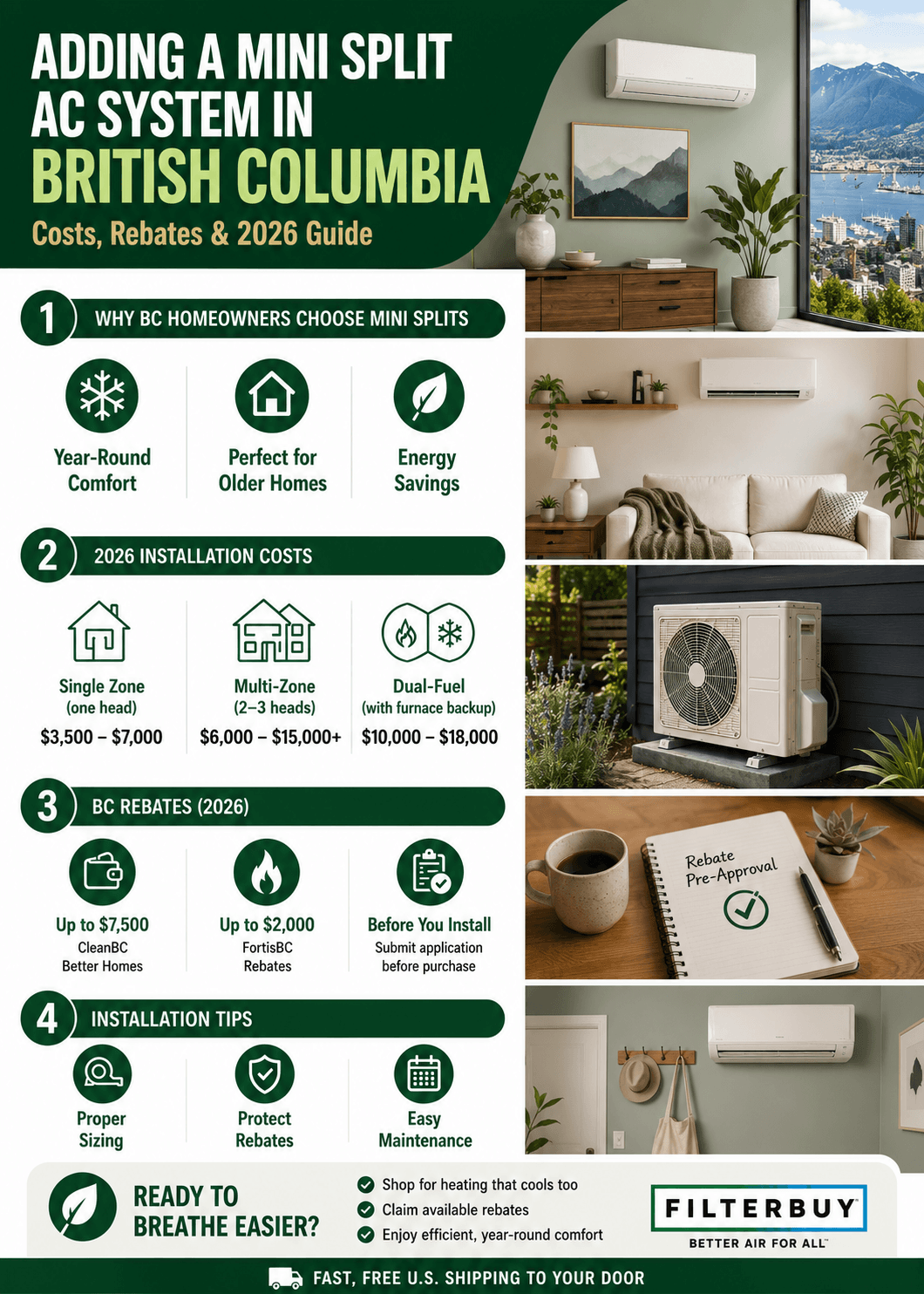
Mini split cost is never one number, and the homeowners who feel good about the money they spent knew the range before the first contractor showed up. A single-zone system that heats and cools one main space sits at the low end, usually around $4,000 to $6,000 installed. Add zones and the price climbs, because every indoor head, every line run, and every extra hour of install labour adds up. A whole-home multi-zone system costs considerably more.
What moves your quote? Zone count, mostly. Long or awkward refrigerant routing adds labour. A panel that can’t handle the new circuit means a panel upgrade gets folded into the job. And a cold-climate unit, which you need in the colder parts of BC, runs more than a standard one built for mild weather. Get itemized quotes from more than one installer instead of trusting a single bottom-line figure, because what’s tucked into that figure varies wildly from one company to the next.
BC Rebates And How To Claim Them
Read this part before you sign anything. Every rebate below is a heat-pump incentive. A cooling-only mini split qualifies for nothing in British Columbia, no exceptions. To collect, your system has to heat, carry a variable-speed compressor, and hold a valid AHRI certification that covers all of its parts.
Replacing electric baseboards or an electric furnace? You can claim up to $4,000 through the CleanBC Better Homes heat pump rebate, with no income test. That money is funded by whichever utility supplies your electricity, BC Hydro or FortisBC, so it is one rebate of up to $4,000 rather than two you pile on top of each other. The full amount applies when your heat pump is sized to cover all of your home’s heating at minus 5 Celsius. A system that handles at least half of your heating earns $1,500. Bundle another eligible upgrade like insulation or windows and you can add a bonus of up to $2,000.
One change trips people up. The old fuel-switching rebate, the one that paid you to swap a gas, oil, or propane system for a heat pump, closed for southern BC on April 11, 2025. It still runs in the north, for homes at or above the District of 100 Mile House on BC Hydro service. If you heat with gas in the Lower Mainland today, build your plan around the programs that are still open.
Income-qualified households do far better. The CleanBC Energy Savings Program reaches up to roughly $16,000 and now covers middle-income tiers too, with eligibility tied to your household income and your home’s assessed value. As of April 1, 2026, that assessed-value cap sits at $1,200,000 for the Level 1 and Level 2 rebates, and $1,820,000 for Level 3.
Two rules cost people money every single year. Your installer has to belong to the Home Performance Contractor Network before you sign the quote, because none of these programs pay out retroactively for work done by an unregistered contractor. And most programs want you pre-registered with an eligibility code in hand before the job starts. Sort both out first and the rest is paperwork.
At the federal level, the Canada Greener Homes Grant has closed to new applicants, and the companion Greener Homes Loan stopped taking applications on October 1, 2025. In BC that stings less than it sounds, because the provincial and utility programs now carry the weight, which is a very different situation from a province like Alberta. If you’re comparing across the Rockies, it’s worth seeing how Alberta’s rebates compare before you commit.
Choosing The Right System For Your BC Climate Zone
BC isn’t one climate, and that changes what you should buy. The coastal Lower Mainland and Vancouver Island stay mild enough year-round that almost any solid heat pump does the job. The Interior and the North get truly cold, and that’s where the type of unit matters.
Cold-climate heat pumps, sometimes badged CCHP, keep making heat at low outdoor temperatures where a standard model would give up most of its capacity. In Kamloops, Prince George, or anywhere winter bites hard, spec the cold-climate version. Sizing counts as much as the rating. Too small and the system strains on the hottest and coldest days. Too large and it short-cycles, runs inefficiently, and wears out early. A good contractor runs a real heat load calculation for your home instead of eyeballing the square footage, and that calculation happens to be required for the whole-home rebate anyway.
Repair, Service, And Maintenance In British Columbia
A mini split is low-maintenance, not no-maintenance, and the difference shows up around year eight if you ignore it. Past the filter routine, book a professional service once a year before heating season, ideally at the tail end of summer. The technician checks the refrigerant charge, cleans the coils, looks over the electrical connections, and confirms the system still heats and cools at the efficiency you paid for.
The service calls we hear about most in BC homes come down to a few culprits. A dirty coil cuts output. A clogged condensate line backs up and leaks. An oversized or badly configured unit short-cycles itself ragged. Regular maintenance heads off most of it. When you do need a repair, use a licensed contractor who knows variable-speed inverter systems, because a mini split doesn’t behave like the old furnace-and-AC setup they may be used to.
"We built our ductless line as a true heat pump on a variable-speed inverter with R-32 refrigerant so it earns the rebates a cooling-only unit never can, and we paired it with multi-layer filtration because the screen inside the head keeps the coil clean, not your lungs."
-Filterbuy Team
7 Essential Resources For Adding A Mini Split In British Columbia
Air quality is what we obsess over at Filterbuy, so we pulled together the short list of sources we would hand any BC homeowner before they spend a dollar on a mini split. Work through them in order and you protect two things at once: the money in your pocket and the air your family breathes.
See If You Qualify For Up To $16,000 In Provincial Rebates
This is the program with the biggest payoff, and most homeowners never stop to check whether they qualify for it. The CleanBC income-qualified stream reaches as high as roughly $16,000, so look here first and find out if you land in Level 1, 2, or 3 before you plan a single step.
Source: CleanBC Energy Savings Program eligibility
Claim Up To $4,000 If BC Hydro Powers Your Home
If electric baseboards or an electric furnace keep your home warm and BC Hydro is on your bill, this rebate is yours to claim. The page spells out the up-to-$4,000 amount, what the whole-home and partial versions ask for, and why you have to bring in a registered contractor to collect a cent of it.
Source: BC Hydro heat pump rebate
Get The Same Rebate When FortisBC Is Your Electric Utility
FortisBC runs the same kind of rebate for the homes it powers, so the program that fits you comes down to which utility prints your electricity bill. If you live anywhere in FortisBC’s electric territory, start here so you never chase the wrong paperwork.
Source: FortisBC air-source heat pump rebate
Confirm Your System Will Heat Through A BC Winter
Here is something a showroom rarely volunteers. A mini split only earns the whole-home rebate, and only carries you through a Kamloops or Prince George cold snap, when the exact model sits on this cold-climate list. Check yours before anyone bolts it to your wall.
Source: NEEP cold-climate heat pump list
Size Your System Right Before A Contractor Does It For You
Sizing is where good intentions quietly go wrong. Too small and the system strains on the worst days, too large and it short-cycles and wears out early. We point homeowners to this federal toolkit so they can check a contractor’s math for themselves instead of taking it on faith.
Source: NRCan heat pump sizing toolkit
Protect The Air Your Family Breathes When Smoke Rolls In
This is the one we care about most. Your mini split’s onboard screen keeps dust off the coil, but it waves wildfire-smoke particles straight through to your family’s lungs, and you cannot see a single one of them. BCCDC makes that invisible risk visible and lays out the steps that actually clean the air you breathe through smoke season.
Source: BCCDC wildfire smoke and health
Check Your Home’s Assessed Value To Find Your Rebate Tier
The income-qualified rebate ties your tier to your home’s assessed value, and that cap shifted in 2026. Look yours up here so you walk into the application knowing exactly where you stand rather than guessing.
Source: BC Assessment property value lookup
3 Supporting Statistics
The research behind this page, plus what we have seen ourselves.
Heat pumps cut heating electricity by up to 75 percent versus electric baseboards or a furnace (U.S. Department of Energy).
Why it matters: It is why we build our line as true heat pumps. A cooling-only unit forfeits that saving.
PM2.5 measures 2.5 micrometres or smaller, about 30 times finer than a human hair, and reaches deep into the lungs and bloodstream (EPA).
Why it matters: Our filter-media testing shows a mini split screen cannot catch particles this small. Smoke-season filtration is its own job.
Source: EPA particulate matter basics
Roughly 20 to 30 percent of the air in a typical home’s ducts escapes through leaks (ENERGY STAR).
Why it matters: We make the filters that sit in those ducts. The lost air carries dust and allergens too. A ductless mini split skips it entirely.
Source: ENERGY STAR duct sealing
Final Thoughts And Opinion
A mini split is one of the better moves a BC homeowner can make right now, but only if you set it up to heat as well as cool. The essentials:
Heat, not just cool. Rebates run to heat pumps. A cooling-only unit earns nothing.
Real money is on the table. Up to $4,000 from BC Hydro or FortisBC, and as much as roughly $16,000 for income-qualified households.
Three steps protect the rebate. Size it for your climate zone, confirm the model is on the cold-climate list, and use a registered contractor.
Our Opinion
Most guides stop at the rebate math. We think that is half the story, and we say so because air is the work we actually do. Our own filter-media testing keeps landing on the same fact. The screen inside that indoor head is a comfort filter, not a health filter, and it waves the fine smoke particles you cannot see straight through. So buy the heat pump for the rebate and the winter comfort, but plan your real filtration in the same breath, because the summer you need it most is the summer the sky turns orange.
If You Do Only Two Things
Confirm which utility is on your bill so you chase the right rebate.
Treat clean air as part of the project, not a problem you solve later.
Get those two right and the rest, the quotes, the sizing, the paperwork, falls into place around them.
Frequently Asked Questions
Ready To Add Your Mini Split In British Columbia?
Adding a mini split in British Columbia pays off most when the unit is a true heat pump that earns the rebate and protects your air, which is exactly how we engineered our ductless line. Browse our ductless mini splits, sized from 12,000 to 24,000 BTU with R-32 refrigerant and multi-layer filtration, then line up a registered BC installer before the next winter or smoke season arrives.