Shop by
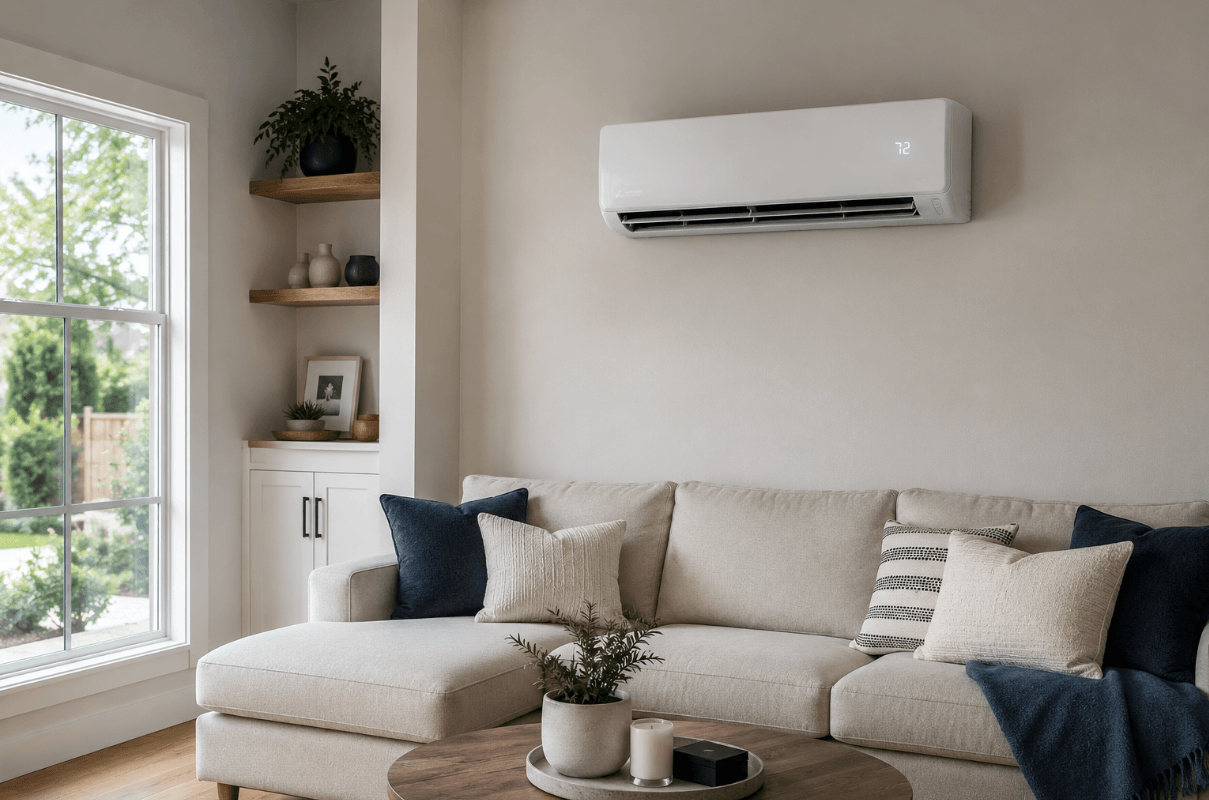
Every home has at least one room the central system quietly gave up on. The garage that bakes by noon. The bedroom above it that never quite cools. A ductless mini split fixes that room without anyone cutting into a duct, and because it’s a heat pump, the unit that cools it in July is the same one that warms it in January. We build ours for exactly those rooms, then keep the matching filters coming so the air inside stays as clean as the room stays comfortable.
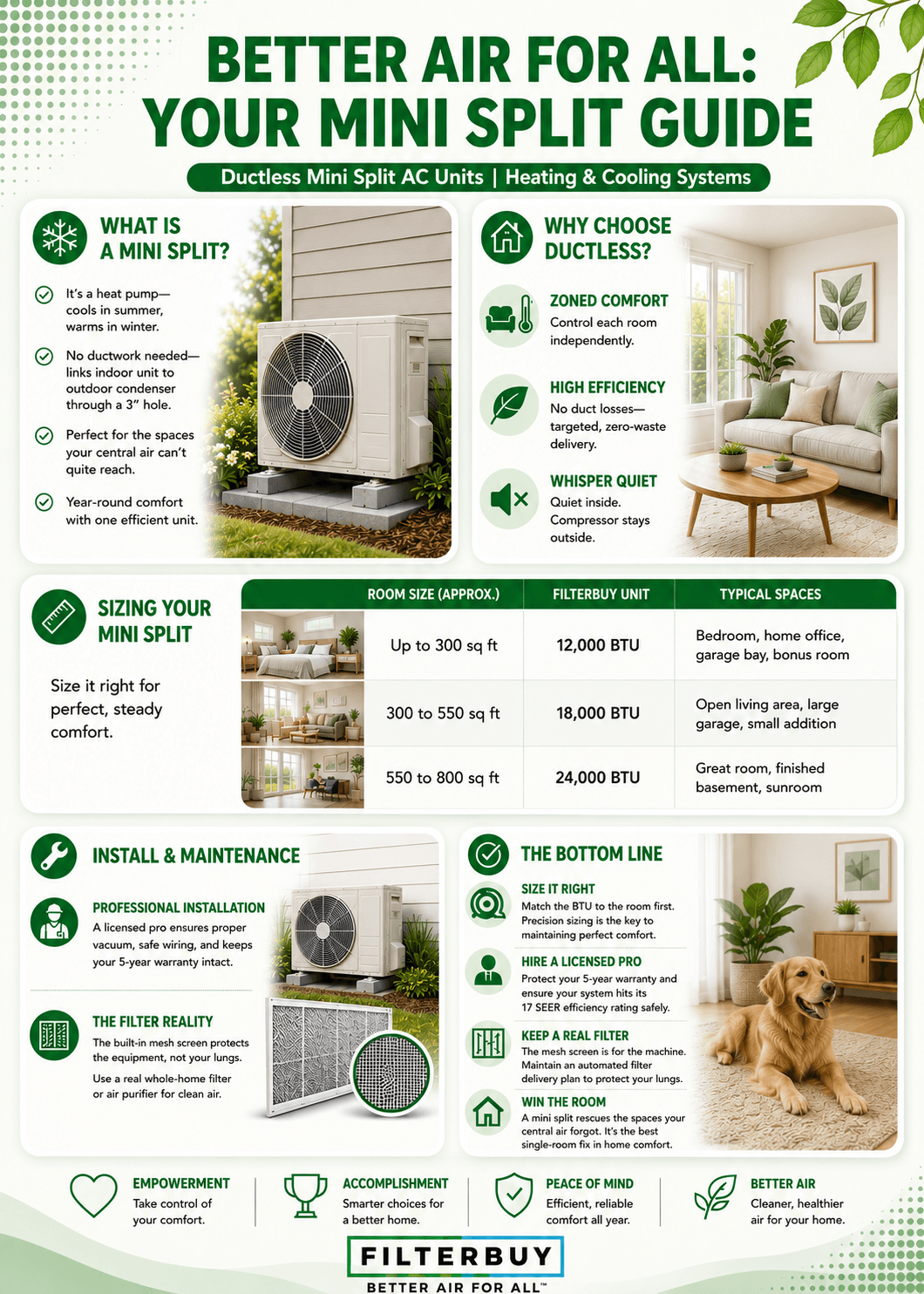
A ductless mini split AC unit is a heat pump that both cools and heats a single room with no ductwork, linking one indoor wall unit to an outdoor condenser through a three-inch hole in the wall.
It heats, too. The same unit cools in summer and reverses to warm the room in winter, so it earns its keep all year, not just in the heat.
No ductwork. It installs in a few hours and fixes the one room your central system can't reach, like a garage, sunroom, or addition.
Sizing decides everything. Match the BTU to the room. Too big short-cycles and leaves the air clammy, and too small never catches up.
The built-in filter is light. That mesh screen protects the equipment, not your lungs, so pair the unit with a real whole-home filter to actually clean the air.
A mini split heats and cools. It’s a heat pump, so one unit covers every season.
No ductwork needed. The system pushes air straight into the room through a three-inch hole in the wall.
Sizing matters more than anything else. Match the unit to the room first.
The built-in pre-filter protects the equipment, not your lungs. It doesn’t replace whole-home filtration.
Professional installation protects your warranty and locks in the efficiency you paid for.
Every Filterbuy mini split does one job, and it does it well: heat and cool a single room. You’ll get a variable-speed inverter compressor, a 17 SEER efficiency rating, R-32 refrigerant, app control from your phone, and a 5-year warranty, with free 2-day shipping on every unit. Tell us the room you’re trying to fix, and we’ll point you to the right one.
Featured: Filterbuy 12,000 BTU Ductless Mini Split (230V)
Cools and heats a room up to 300 square feet. It runs on a 17 SEER variable-speed inverter and R-32 refrigerant, takes commands from your phone, drops into sleep mode at night, and carries a 5-year warranty. Quiet enough for a nursery, tough enough for a garage.
Most people shopping for a mini split AC unit don’t realize they’re also buying a heater. A mini split is a heat pump, which means it moves heat rather than making it. In summer, it pulls heat out of your room and dumps it outside, exactly the way any air conditioner does. Come winter, it runs that same cycle backward, pulling warmth out of the outdoor air, even cold air, and carrying it inside.
So one unit on the wall covers mini split heat and air all year, with no separate furnace, baseboard, or space heater to swap in when the weather turns. A ductless mini split heat and air conditioning unit replaces two machines with one mini split heat pump unit that earns its keep in every month of the year. If you want the engineering behind it, here’s a clear primer on how air conditioning works. For most homes, the point is simpler than the physics. You buy one system, and it handles every season.
Mini splits handle problems central air was never built for. Here’s where they pull ahead.
A mini split lets you set the temperature in one room without touching the rest of the house. Run the home office at a crisp 68 while the empty guest room sits idle and costs you nothing. You’re conditioning the space you’re actually in, not the whole house, which is why these systems shine in additions, garages, and the rooms your central system forgot about.
Central systems leak conditioned air through every joint and seam in the ductwork. The U.S. Department of Energy pegs those duct losses at more than 30 percent of the energy a home spends on heating and cooling. A ductless system skips that waste completely, because the air travels straight from the unit into the room. Add a variable-speed compressor and your running cost drops while the room feels exactly as comfortable as before.
The loudest part of any system is the compressor, and on a mini split, it sits outside. Indoors, the unit runs quiet enough for a bedroom, well below the racket of the window unit it replaces, since the noisiest part of the system never comes in. The inverter compressor doesn’t slam on at full blast and then cut out. It eases off once the room hits your target, so the temperature holds steady and the noise fades into the background.
Picking the right mini split really comes down to room size, how many rooms you’re covering, and the efficiency you want to pay for over the years you own it. Our complete mini split buying guide walks through all of it, but here’s the short version.
Sizing is the one decision that makes or breaks comfort, and it’s the one most people get wrong. Go too small, and the unit runs nonstop without ever catching up. Go too big and it short-cycles, switching off before it pulls the humidity out of the air, which leaves the room cold and clammy. Match the unit to your room first, then size up for high ceilings, big windows, heavy afternoon sun, or thin insulation. We rate each Filterbuy unit conservatively so it holds up in demanding spaces like garages and sunrooms, which is why the coverage below runs a little lower than a bare cooling estimate. The table gets you in the right range.
| Room Size (Approx.) | Filterbuy Unit | Typical Spaces |
|---|---|---|
| Up to 300 sq ft | 12,000 BTU | Bedroom, home office, garage bay, bonus room |
| 300 to 550 sq ft | 18,000 BTU | Open living area, large garage, small addition |
| 550 to 800 sq ft | 24,000 BTU | Great room, finished basement, sunroom |
For the oddball rooms, the ones with cathedral ceilings or a whole wall of glass, have a licensed installer run a Manual J load calculation before you buy. It’s worth the extra step.
One outdoor unit can feed a single indoor head or several at once. Single-zone is simpler and cheaper, and it’s the right call when you’re fixing one problem room. Multi-zone earns its place when you want several rooms running off one outdoor unit. Ours are single-zone, built to handle one space at a time and handle it well. For a full side-by-side, read our guide to single-zone versus multi-zone systems.
SEER2 measures how efficiently a system cools over a full season. Higher is better. For most homes, a rating of 17 or above is plenty, though a room you run hard in a hot climate is worth taking higher. Pair a strong SEER2 number with an inverter compressor, and you get steady comfort at a lower bill every month.
For most people, a mini split isn’t a weekend project, and we’d rather be honest about that than sell you a headache. Federal law requires EPA Section 608 certification to handle the refrigerant, and a do-it-yourself install voids the warranty on most systems. A licensed installer mounts both units, runs and seals the line set, pulls a proper vacuum, wires the electrical, and confirms the system is charged and running the way it should. A single-zone job usually wraps in a few hours. Want to see what’s involved before you book someone? Walk through our step-by-step mini split installation guide first. Get the install right, and the system delivers the efficiency it was built for.
Every mini split hides a mesh pre-filter behind its front panel. That filter catches the big stuff, dust and lint, to protect the coil, and it needs a quick rinse every two to four weeks. What nobody tells most owners is what that filter can’t do. It’s a comfort filter, built to keep the machine running, not a health filter built to catch the fine particles, pollen, and smoke that actually reach your lungs.
If the mini split is the only thing conditioning a room, pair it with a good room air purifier. If that room also pulls air from your central HVAC, the pleated filter in that system is doing the real work, and keeping it fresh matters more than ever. We make those replacement filters here in the USA and send them to your door on a schedule you set, so the maintenance you’d otherwise forget just happens. Set up filter auto-delivery and forget about it. You can’t see what’s moving through the air in a room. Helping you see it, and clean it up, is what we’re obsessed with.
“We've noticed nobody ever calls to thank us for a SEER rating. They call about the garage they can finally use in August, or the back bedroom that holds a steady temperature all night, and no spec sheet captures that."
-Filterbuy Team
We care about the air a mini split moves as much as the room it cools, so here's the homework we'd do before buying one. These seven sources put you in charge of the decision, from the efficiency rating on the box to the air that comes out the front.
A seller can print any SEER2 number on a product page. The AHRI directory shows you the rating the equipment actually earned in independent testing, so look up your model and confirm the two match before you spend a dollar.
Source: AHRI Certified Directory
The federal credit is gone for 2026, but real money is still out there, just not where most people think to look. Run your ZIP code through DSIRE to surface the state, local, and utility rebates that quietly bring down the cost of a heat-pump install.
Source: DSIRE, Database of State Incentives for Renewables & Efficiency
We'd rather give you the straight story than help you plan around a credit that no longer exists. The federal 25C credit ended for systems placed in service after December 31, 2025, so check the IRS page for where things really stand before you count on a dollar of it. Source: IRS, Energy Efficient Home Improvement Credit
The mini split that disappoints is almost always the wrong size for the room, and no brand name on the box will fix that. An accredited contractor runs a Manual J load calculation instead of eyeballing it, and the ACCA directory points you to one who has earned the credential.
Source: ACCA, Quality Assured Contractor Directory
You can buy the best unit on the market and still end up frustrated if the install gets rushed. Make sure the people doing the work hold NATE certification, the simplest way to know your technicians have proven they know their way around these systems. Source: NATE, Find a Contractor with Certified Technicians ·
A mini split is one of the most efficient ways to heat and cool a single room, and you deserve to know the running cost going in. The EIA breaks down how much of a typical home's energy goes to heating and cooling, which gives you a realistic baseline for what yours will add or save each month.
Source: U.S. Energy Information Administration, Use of Energy in Homes ·
A mini split's built-in filter is made to protect the machine, not your lungs, and most buyers never get told the difference. We're a little obsessed with that gap, so we point people to the American Lung Association for a clear read on the air side of the decision before they treat the unit as their whole air-quality plan.
Source: American Lung Association, Healthy and Efficient Homes
We don't make claims we can't back. Here are the three numbers behind going ductless, and what each looks like from where we sit.
1. Ducts waste more than 30% of a home's heating and cooling energy.
The loss climbs when the ducts run through an unconditioned attic.
We see the rest in used filters, where that same leaky run shows up as dust in every room.
A mini split skips the ductwork. Air goes straight from the unit into the space.
Source: U.S. Department of Energy, Ductless Mini-Split Heat Pumps ·
2. A certified mini split heat pump uses up to 60% less energy than electric resistance heat.
That's a heating number, not a cooling one, and most shoppers miss it.
People buy ours as an air conditioner, then call back surprised in January, warming the same room for a fraction of what old baseboards cost.
Source: ENERGY STAR, Ductless Heating & Cooling
3. Indoor air often runs 2 to 5 times more polluted than the air outside.
This is the number we know best. We see it in every month-old filter.
The mesh screen protects the coil, not your lungs.
So run the unit for comfort, and keep a real filter for protection.
Source: U.S. EPA, Indoor Air Quality
A ductless mini split rescues the one room your central system never reaches, and it heats and cools it all year with no ductwork to tear in.
Three things decide whether you love it:
Size it right for the room.
Put a licensed pro on the install.
Keep a real filter handling the air.
Nail those, and the unit will quietly outwork equipment that costs far more.
A mini split is the best single-room fix in home comfort, and a mediocre whole-house plan.
The regret we see most comes from homeowners who try to mini-split a whole house one head at a time, which costs more and comforts less than a properly designed central system would have.
Buy one to win the room central air can't reach, pair it with a filter plan that protects your air, and you'll be the rare homeowner who got the whole decision right.
Yes. A mini split is a heat pump, so the same unit cools in summer and heats in winter. You won’t need a separate furnace or space heater for the room it serves.
It depends on the room. As a quick anchor, the Filterbuy 12,000 BTU unit covers most rooms up to about 300 square feet, while the 18,000 and 24,000 BTU units handle larger spaces. Size up for high ceilings, big windows, strong sun, or weak insulation, and for unusual rooms, have an installer run a Manual J load calculation.
For most people, no. Handling refrigerant legally requires EPA Section 608 certification, and a do-it-yourself install voids the warranty on most systems. We recommend hiring a licensed HVAC contractor.
Rinse the built-in mesh pre-filter every two to four weeks. It protects the unit more than your air, so keep your whole-home filter or a room air purifier on schedule too.
For garages, additions, sunrooms, and rooms your central system can’t reach, almost always. You get targeted comfort, quiet operation, and lower running costs without paying to install new ductwork.
No. The federal 25C and 25D credits ended for systems placed in service after December 31, 2025. If your system was installed and running by that date, you may still claim it on your 2025 return. For a 2026 purchase, the federal credit is gone. Check the IRS for the current rules, and ask your local utility about rebates, which still exist in a lot of areas.
Find the system that fits your room, then let the filters handle themselves. Browse our single-zone mini splits, set your matching replacement filters on auto-delivery, and cross one more chore off the list for good.
