

Adding a Mini Split AC System in Alberta
Costs, Rebates & 2026 Guide
Most Alberta homeowners who ask us about a mini split want to know two things up front. They want to know whether it will actually heat the house when it’s −30 outside, and whether there’s any money to help pay for it. We’ll give you the honest version of both. A cold-climate mini-split heats as well as it cools; a single-zone runs roughly $4,500 to $8,000 CAD installed; and Alberta, unlike Ontario or British Columbia, has no province-wide rebate sitting there waiting. The full picture is below, including the one federal grant still open and the utility offers worth a phone call.
TL;DR: Quick Answers
Adding A Mini Split AC System Including Rebates In Alberta
Adding a ductless mini split in Alberta costs roughly $4,500 to $8,000 installed for a single zone, and you should plan to pay most of it yourself. The province has no standing heat pump rebate, so the real win comes from sizing the system for a real winter, not from chasing an incentive.
Cost: About $4,500 to $8,000 installed for a single zone. Multi-zone or dual-fuel setups run higher.
Rebates: Alberta has no province-wide rebate. The federal Oil to Heat Pump Affordability grant fits only income-qualified, oil-heated homes, which rules out most Alberta households.
Financing: The Clean Energy Improvement Program lets some cities finance the work on your property-tax bill. It is a loan, not a grant. Utility offers from ENMAX or ATCO come and go.
For winter: Choose a cold-climate model rated near −25°C and keep your gas furnace as dual-fuel backup for the coldest nights.
The Filterbuy line: Filterbuy builds ductless mini splits from 12,000 to 24,000 BTU with multi-layer filtration, self-cleaning coils, and built-in filter reminders, the air-quality features it is known for. Confirm the model and its cold-climate rating fit your space before you buy.
Our take: A mini split is the easy part. Your furnace runs eight or nine months a year up here, so the filter inside it does as much for your family’s air as the new system.
Top Takeaways
It’s a heating decision, not just a cooling one. Cold-climate models hold their capacity to roughly −25°C and keep working, at lower output, toward −30°C. Our winters are tougher than Ontario’s, so size the system for January, not for the one hot week in July.
Dual-fuel is the practical default here. Pair the heat pump with the gas furnace you already own and let the furnace handle the deepest cold snaps. Most Alberta homes only need the furnace for a handful of the coldest days each winter.
There’s no single Alberta rebate. What you get instead is a patchwork made of a narrow federal grant for oil-heated homes, occasional utility offers, and municipal financing. The old Canada Greener Homes Grant has closed to new applicants.
Use a licensed pro. The job means electrical work, refrigerant handling, and commissioning, and your warranty and any incentive both ride on it being done right.
Don’t forget the furnace filter. That furnace runs most of the Alberta year, so swap in a fresh filter every 60 to 90 days, and more often if you have pets or you’re breathing through wildfire-smoke season.
How A Mini Split (Ductless Heat Pump) Works
A mini split moves heat instead of making it. That’s the whole reason it sips energy where a furnace burns through it. The hardware is about as simple as HVAC gets. You get a small outdoor unit, one or two indoor heads on the wall, and a slim refrigerant line connecting them through a hole about three inches across. No ductwork at all. In summer the system pulls the warm air out of your rooms and sends it outside, and in winter a cold-climate model runs that same loop backward, drawing heat out of the cold air, because even −20 air holds heat worth capturing, and carrying it indoors.
The names cause most of the confusion, so we’ll keep it plain. “Mini split” and “ductless” point to the same equipment. “Air-source heat pump” describes the job that equipment does. A heating-capable mini split is a heat pump. A cooling-only model will carry you through July and then sit there useless in January, so if winter heat is the goal, tell your contractor you want a cold-climate heat pump, in those words.
Is A Mini Split Right For An Alberta Home?
A mini split shines in homes without ductwork, and Alberta is full of them. Century homes on hot-water radiators, houses on electric baseboards, condos, additions, finished basements, garages, and the one room that’s always too hot or too cold all make strong candidates. With no ducts to run, the install moves fast and leaves your walls mostly intact, which is more than you can say for retrofitting central air.
Our climate asks more of the equipment than the mild coasts ever will. Summers here are warm and dry. Winters are the real exam. A standard mini split cools with capacity to spare, but for heat you want a cold-climate model engineered to keep pulling warmth from the air well below freezing. Plenty of the homeowners we talk to pair one with the gas furnace they already have, so the heat pump does the efficient everyday heating and the furnace steps in when a cold snap bites.
Your address matters too. Edmonton, Fort McMurray, and the Peace Country run colder and longer than Calgary or Lethbridge, so the right size and the call between a stand-alone heat pump and a dual-fuel setup comes down to where you live. A good local contractor will work that out with you.
What Does It Cost To Add A Mini Split In Alberta? (2026)
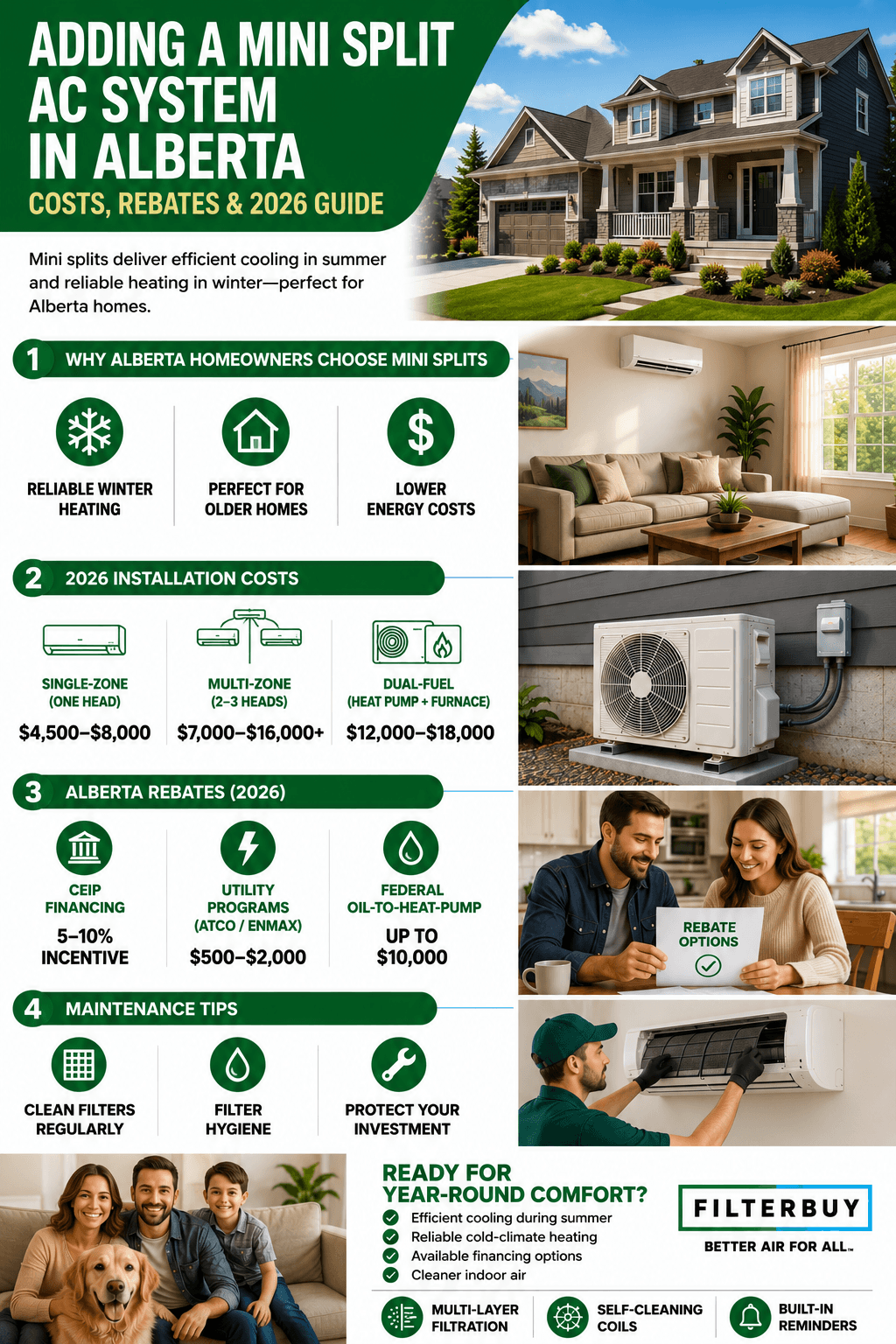
In 2026, a single-zone mini split in Alberta lands somewhere around $4,500 to $8,000 CAD installed. Cover several rooms with a multi-zone setup, and you’re looking at $7,000 to $16,000 or more. Keep the furnace as backup in a dual-fuel arrangement,, and the range moves to $12,000 to $18,000. Every figure here includes the equipment, the labour, and standard materials.
| Configuration | Typical Installed Cost (CAD) |
Best For |
|---|---|---|
| Single-zone (one head) | $4,500 – $8,000 | One room or an open living area |
| Multi-zone (2–3 heads) | $7,000 – $16,000+ | A full floor or several rooms |
| Dual-fuel (with furnace backup) | $12,000 – $18,000 | Reliable heat through Alberta cold snaps |
What moves the number? Mostly the count of indoor heads, because each zone you add brings its own equipment and labour. After that, it’s the length of the refrigerant line run, any electrical or panel work your home needs, and whether you spring for a cold-climate model. The cold-climate units cost more up front, and an Alberta winter hands that money back over time. Pricing in Calgary and Edmonton tends to sit above the smaller communities.
Get a licensed professional to do the install. There’s electrical work, refrigerant handling, and proper commissioning involved, and most manufacturers tie the warranty to professional installation. A do-it-yourself kit looks like a bargain right up to the moment it voids your warranty and your shot at any rebate.
Mini Split Rebates In Alberta (2026): What’s Actually Available
We’ll be straight with you, because most pages on this topic aren’t. As of June 2026, Alberta has no province-wide mini split rebate. Ontario and British Columbia hand homeowners thousands toward a heat pump. Alberta doesn’t. What you get here is a patchwork, and most of it is narrower than the headlines suggest. Here’s the real picture.
| Program | Up To (CAD) | Who Actually Qualifies |
|---|---|---|
| Oil to Heat Pump Affordability (federal grant) | $10,000 | Income-qualified homeowners who heat with oil and switch to a cold-climate heat pump. Very few Alberta homes heat with oil, so this fits almost no one here. |
| ENMAX / ATCO utility offers | $500 – $2,000 | Customers installing qualifying ENERGY STAR equipment when an offer is available. These programs run occasionally and are not available year-round. |
| Clean Energy Improvement Program (CEIP) — financing, not a rebate | Finance up to ~$50,000, plus a ~5–10% incentive | Homeowners in participating municipalities such as Calgary. Repayment is added to your property-tax bill and typically runs during intake windows. |
| Canada Greener Homes Grant | Closed | Closed to new applicants. Do not plan your project budget around this program. |
A few of these deserve a plain-English translation. The federal Oil to Heat Pump Affordability program is real and pays up to $10,000, but it was built for low-to-median-income households that currently heat with oil. Almost no Alberta home burns oil, so for most people reading this, it simply won’t apply. If you’re one of the few who do heat with oil, raise it with your contractor early.
Despite the nickname, CEIP is financing rather than a rebate. You repay it through your property-tax bill over time, and the program folds in a small incentive worth roughly five to ten per cent of the project. It opens in intake windows rather than running year-round, so confirm it’s open before you build plans around it.
ENMAX and ATCO post occasional offers on qualifying ENERGY STAR equipment, usually somewhere between $500 and $2,000. They come and go. Call your utility and confirm a current offer before you buy anything.
One more, because you’ll see it everywhere. The Canada Greener Homes Grant that paid for so many installs a few years ago has closed to new applicants. Don’t build your budget on it.
Whatever you go after, get written pre-approval before a single tool comes out. Installing first and applying later is the most common reason these claims get denied. We’ve watched it happen, and it’s avoidable.
How To Add A Mini Split: The Installation Process
Most installs take about a day per zone, a little longer if your panel needs an upgrade first. For the full play-by-play, see our step-by-step mini split installation guide. Here’s the short version.
Sizing and assessment. A licensed contractor measures the space and matches the capacity to it. An oversized unit short-cycles and wastes the money you spent on it.
Confirm any incentive first. Check that your equipment qualifies and get written pre-approval before the work starts. Jumping the gun is the number-one reason claims get bounced.
Mounting and the line set. The installer mounts the indoor heads, sets the outdoor unit, and runs the refrigerant line between them.
Electrical and commissioning. The installer wires it in, evacuates and pressure-tests the lines, then commissions and tests the system.
Submit the paperwork. Your contractor files any utility or federal claim on your behalf
Keeping Your Air Clean: Filters For An Alberta Home
Here’s the part homeowners rarely see coming. Adding a mini split doesn’t retire your furnace filter. Each indoor head carries its own washable screen, and that part is easy. Rinse it every few weeks, let it dry, slide it back in.
The furnace filter is the one we’d never let you forget. Your furnace keeps running through most of the Alberta year, and a clean filter every 60 to 90 days is what stands between your family and the dust, dander, and smoke you can’t see moving through the house. Change it sooner if you’ve got pets, and sooner still when wildfire season turns the outdoor air over fast. This is the invisible work that protects both your air and your equipment, and it’s the easiest habit you’ll ever keep.
"We put that same air-quality obsession into our new line of ductless mini-splits, engineering in multi-layer filtration, self-cleaning coils, and the built-in filter reminders most brands leave out. To us, that is the real measure of a mini-split: the air it keeps clean over the years you own it, and clean air is the one thing we have spent a decade getting right."
— Filterbuy Team
7 Resources We Point To Before You Add A Mini Split In Alberta
We get asked about Alberta rebates more than almost anything else on this topic, and the honest answer leans on a few good sources. Here are the seven we trust, lined up the way we’d work through them ourselves: money first, then the equipment, then a licensed installer. Every one is a government, municipal, utility, or industry body, so you can stand on what they tell you.
1. Claim Up To $10,000 If You Heat With Oil
The only federal heat pump grant still open pays up to $10,000, and we’ll give it to you straight: it reaches very few Alberta homes. It was built for income-qualified households that heat with oil, and almost everyone here heats with gas, so check the rules before you count on it.
Source: Natural Resources Canada – Oil to Heat Pump Affordability Program
2. Finance The Whole Project Through Your Property Taxes
If the upfront cost is the thing stopping you, this is the lever we’d reach for first. Alberta’s Clean Energy Improvement Program can finance up to 100% of an eligible project, repaid through your property-tax bill, so check whether your city, including Calgary, Edmonton, and Lethbridge, has an open intake window.
Source: Alberta Municipalities – Clean Energy Improvement Program
3. Get Calgary’s Exact Rate, Cap, And Incentive
Calgary folks, go straight here. The City’s residential CEIP page spells out the current interest rate, the financing cap, and the small incentive you earn for finishing the project, which is everything you need to run your own numbers.
Source: City of Calgary – Residential Clean Energy Improvement Program
4. Catch An ENMAX Offer Before You Buy
Here’s something most homeowners miss. ENMAX offers come and go instead of running all year, so a quick look before you buy can mean real money, or nothing, depending on the week you ask.
Source: ENMAX – Residential Energy and Efficiency
5. Check ATCO For An Offer On Your Account
Same idea on the gas side. ATCO Energy posts occasional efficiency offers and credits, so confirm what’s live on your account and ask point-blank whether any of it covers a mini split.
Source: ATCO Energy – Plans, Rebates and Energy Programs
6. Confirm Your Unit Qualifies Before You Apply
This is the step that trips people up, so we flag it early. The AHRI Directory lists your system’s certified performance and the reference number nearly every application wants, so look it up and keep that number handy before you start the paperwork.
Source: AHRI – Directory of Certified Product Performance
7. Hire A Licensed Pro That Protects Your Warranty
We won’t budge on this one. A mini split has to go in by a licensed professional, or you put your warranty and any rebate at risk, and HRAI’s locator finds pre-screened, licensed HVAC contractors near you.
Source: HRAI – Contractor Locator
The Data Behind These Recommendations
Three numbers from US government sources, with what we have learned each one means for a real Alberta home.
1. Cold-Climate Heat Pumps Hold To −25°C
The number: US DOE and Oak Ridge National Laboratory built heat pumps that run to −13°F (−25°C) with no backup heat, saving up to 70% versus electric resistance.
Our take: −25°C is where capacity holds, not where it quits. Edmonton drops past it most winters.
Bottom line: Keep the furnace as dual-fuel backup. We have seen too many Albertans regret ripping it out.
Source: U.S. Department of Energy – Energy-Efficient Heat Pump for Colder Regions
2. Most Of An Alberta Bill Is Heating, Not Cooling
The number: ENERGY STAR pegs the average US home energy bill near $1,900 a year, with close to half going to heating and cooling.
Our take: That is a national average. Up here, heating dwarfs cooling, because the furnace runs eight or nine months.
Bottom line: Treat this as a heating decision, not a cooling one.
Source: ENERGY STAR (U.S. EPA) – Air-Source Heat Pumps
3. Indoor Air Runs 2 To 5 Times Dirtier
The number: The US EPA finds people spend about 90% of their time indoors, where some pollutants run 2 to 5 times higher than outside.
Our take: An Alberta winter pushes past that average. Homes seal up for months, then summer wildfire smoke reloads the air.
Bottom line: The furnace filter catches what the mini split screens miss. Change it every 60 to 90 days.
Source: U.S. Environmental Protection Agency – The Inside Story: A Guide to Indoor Air Quality
Final Thoughts & Opinion
After a decade obsessed with what people actually breathe, here's the opinion we'll put our name on: in Alberta, a mini split is a heating decision first, a cooling perk second, and an air-quality upgrade underneath both.
Everything above points the same direction:
Cost: roughly $4,500 to $8,000 installed for a single zone.
Rebates: no provincial cheque, a federal oil-heat grant that misses almost every gas-heated home here, plus a patchwork of utility offers and CEIP financing.
Your furnace: runs eight or nine months a year no matter what you bolt to the wall.
So our advice comes down to three moves:
Size it for the worst week of a real Alberta winter, not a mild average.
Keep the gas furnace in play as dual-fuel backup unless your contractor makes a genuinely strong case otherwise.
Treat any incentive as a bonus you confirm in writing — never a discount you've already spent.
Here's the part we watch homeowners learn the hard way. The calls we get a year after an install are rarely about air conditioning. They're about air — the dry, sealed-up winter, or the week wildfire smoke rolled in and blurred the line between outside and the living room. People shop for a mini split like a comfort gadget. The ones still glad they bought it three winters later treated it as part of their home's air system, filter and all.
That's why we built our line the way we did. Filterbuy ductless mini splits run from 12,000 to 24,000 BTU with the air-quality engineering we've spent ten years getting right:
Multi-layer filtration
Self-cleaning coils
Built-in filter reminders most brands skip
Match the model and its cold-climate rating to your space, get a licensed pro to install it, and don't let new equipment distract you from the furnace filter doing the quiet work all along — fresh every 60 to 90 days, sooner with pets or smoke.
Buy the mini split for the winter. Keep it for the air
Frequently Asked Questions
Take The Next Step With A Filterbuy Mini Split
Now that you know what adding a mini-split in Alberta really costs and which rebates actually apply, take a look at the Filterbuy ductless mini-split line, engineered with multi-layer filtration and self-cleaning from a company obsessed with indoor air for over a decade. Match it with a licensed local installer to size it right, and the guide you just read becomes a real plan for your home.