Shop by
Costs, Rebates & 2026 Guide
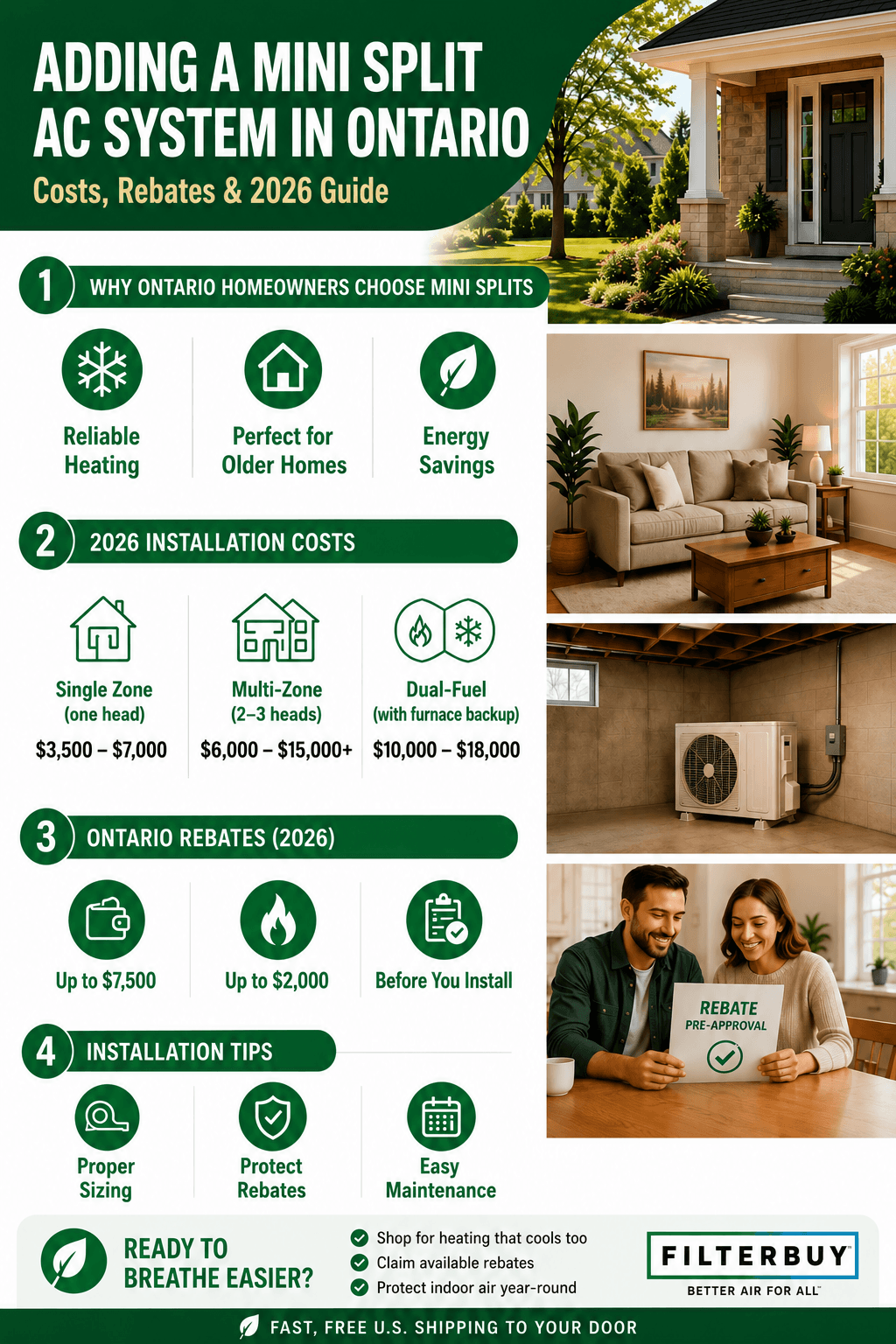
If your home runs on radiators or electric baseboards, or there’s a room your ductwork never reached, a mini split is the simplest way to add cooling, and with a cold-climate model, heating too. Budget $3,500 to $7,000 CAD installed for a single zone. A multi-zone setup that covers several rooms runs $6,000 to $15,000 and up. A cold-climate model keeps heating down to roughly −25°C, which is part of why more Ontario homeowners choose one every year.
Adding a mini split in Ontario costs $3,500–$7,000 CAD installed for a single zone, or $6,000–$15,000+ for multi-zone. A cold-climate model also heats down to roughly −25°C, so treat it as a heating decision, not just cooling.
Cost (installed, CAD): single zone $3,500–$7,000; multi-zone $6,000–$15,000+; dual-fuel with furnace backup $10,000–$18,000.
Rebate (2026): the Home Renovation Savings Program pays up to $7,500 for electric, oil, or propane homes and up to about $2,000 for gas. Get written pre-approval before any work starts.
Best for: homes without ductwork — radiators, electric baseboards, condos, additions, and problem rooms.
Installation: about one day per zone, by a licensed pro (required for warranty and rebate).
Don't forget: the furnace still runs 6–8 months a year, so keep a fresh filter on it every 60–90 days.
It's a heating decision, not just cooling. Cold-climate models heat to roughly −25°C. The furnace runs 6–8 months a year here. Size it for February, not July.
Know the cost ranges (installed, CAD):
Single zone: $3,500–$7,000
Multi-zone: $6,000–$15,000+
Dual-fuel with furnace backup: $10,000–$18,000
One rebate is open in 2026: Home Renovation Savings.
Up to $7,500 for electric, oil, or propane homes
Up to about $2,000 for gas homes
Confirm your unit is on NRCan's qualified list
Get written pre-approval before any work starts
Use a licensed pro. It involves electrical work, refrigerant handling, and commissioning. Your warranty and rebate depend on it.
Don't forget the furnace filter. The furnace still runs most of the year. Swap in a fresh one every 60–90 days. More often with pets or wildfire smoke.
A mini-split moves heat rather than generates it, which is what makes it efficient. The hardware is straightforward: a small outdoor unit and one or more indoor heads, joined by a slim refrigerant line that runs through a small hole in the wall. No ducts. In summer, the system carries warm air out of your rooms and lets it go outside. In winter, a cold-climate model runs the same cycle in reverse, pulling heat out of the outdoor air (yes, cold air still holds heat) and bringing it inside.
If you want the engineering behind it, the Wikipedia overview of air conditioning walks through the refrigeration cycle.
The terms get mixed up, so here’s the plain version. “Mini split” and “ductless” describe the same equipment. “Air-source heat pump” describes what it does. A heating-capable mini split is a heat pump. A cooling-only model handles July but does nothing in January, so if winter heat matters to you, ask specifically for a cold-climate heat pump.
A mini split shines in homes without ductwork, and Ontario has plenty of those. Older houses with hot-water radiators or steam heat, homes on electric baseboards, condos, additions, finished attics, garages, and the room that’s always too hot or too cold all make good candidates. With no ducts to run, the install goes quickly and disrupts far less than putting in central air.
Our climate asks more of the equipment than the milder coasts do. Ontario summers are warm and humid, and the winters get properly cold. A standard mini split handles the cooling with room to spare, but for heating you’ll want a cold-climate model built for deep cold. Plenty of homeowners pair one with the gas furnace they already have, so the heat pump does the efficient everyday work and the furnace takes over in a cold snap.
Where you live matters too. A home near Thunder Bay or in the eastern snowbelt faces longer, harder winters than one in Windsor or downtown Toronto, so the right size, and the choice between a stand-alone heat pump and a dual-fuel setup, depends on your address. A good local contractor will sort that out with you.
In 2026, a single-zone mini split in Ontario runs $3,500 to $7,000 CAD installed. Multi-zone setups land between $6,000 and $15,000 or more. If you keep your furnace as backup in a dual-fuel setup, plan for $10,000 to $18,000 CAD. Each figure covers the equipment, the labour, and standard materials.
| Configuration | Typical installed cost (CAD) | Best for |
|---|---|---|
| Single-zone (one head) | $3,500 – $7,000 | One room or an open living area |
| Multi-zone (2–3 heads) | $6,000 – $15,000+ | A full floor or several rooms |
| Dual-fuel (with furnace backup) | $10,000 – $18,000 | Reliable heat through cold snaps |
A few things push the number around: how many indoor heads you need (each zone adds cost), how far the refrigerant line has to run, any electrical or panel work, and whether you choose a cold-climate model. The cold-climate units cost more and pay it back over the winter. Pricing in the Greater Toronto Area tends to run 15 to 20 per cent above smaller Ontario communities.
In Ontario, a licensed professional should handle the install. The work involves electrical connections, refrigerant handling, and proper commissioning, and most manufacturers tie the warranty to professional installation. A do-it-yourself kit can look like a saving, then cost you the warranty and your rebate eligibility both.
As of June 2026, one rebate covers mini splits in Ontario: the Home Renovation Savings Program, run by Save on Energy and Enbridge Gas with backing from the Government of Ontario. A qualifying cold-climate air-source heat pump earns up to $7,500 CAD if you heat with electricity, oil, or propane, and up to about $2,000 CAD if you heat with natural gas. Ground-source (geothermal) systems can reach up to $12,000 CAD.
| How your home is heated | Rebate — up to (CAD) |
|---|---|
| Electricity, oil, or propane (cold-climate air-source heat pump) | $7,500 |
| Natural gas (cold-climate air-source heat pump) | ~$2,000 |
| Ground-source (geothermal) | $12,000 |
Your actual amount depends on your heating fuel and the size of the system, and the equipment has to be on Natural Resources Canada’s qualified products list. If you heat with oil, ask your contractor about the Oil to Heat Pump Affordability program, which can add to what you claim. Your contractor handles the eligibility check and the paperwork, and the rebate usually lands about 60 to 90 days after the work wraps up and the application goes in.
Two eligibility points matter here. The gas rate applies only to Enbridge Gas customers, so homes on other gas utilities, such as Kitchener or Kingston, don’t qualify for it. And the program covers detached, semi-detached, row, and town homes, though not condos or apartments.
Most installs take about a day per zone, a bit longer if your home needs electrical upgrades. For a closer look at each stage, see our step-by-step mini split installation guide.
Sizing and assessment. A licensed contractor measures your space and recommends the right capacity. An oversized unit wastes money and short-cycles.
Confirm rebate eligibility. Check that your equipment is on the qualified products list, and get written pre-approval before any work starts. Installing early is the most common reason rebates get turned down.
Mounting and the line set. The installer mounts the indoor heads, sets the outdoor unit, and runs the refrigerant line between them.
Electrical and commissioning. The installer wires the system in, evacuates and pressure-tests the lines, then commissions and tests the unit.
Rebate submission. Your contractor submits the application, and your rebate usually follows in about 60 to 90 days.
Adding a mini split doesn’t replace your furnace filter, and that catches a lot of people off guard. Each indoor head has its own washable filter. Rinse it every few weeks, let it dry, and slide it back.
"In our experience, the surprise for most Ontario homeowners isn't the mini split itself. It's that the furnace keeps running six to eight months a year, so the filter they used to forget about matters more than ever once the new system goes in."
-Filterbuy Team
A mini split is a heating decision as much as a cooling one, and a little homework up front saves a lot of second-guessing later. These seven sources cover the whole picture — the rebate, the equipment, and the installer — and every link goes to a government, utility, or regulator you can rely on. We've put them in the order a Canadian homeowner usually works through them.
This is the program that covers mini-splits across Ontario right now. It's delivered by Enbridge Gas and Save on Energy, with support from the Government of Ontario, and it's where you'll find current rebate amounts and the one rule worth circling: get written pre-approval before any work begins.
Your rebate depends on how you heat your home, and this page breaks it down clearly. Whether you heat with electricity, natural gas, oil, propane, or wood, there are rebates for upgrades like heat pumps — and it confirms your unit needs to be on Natural Resources Canada's qualified list to count.
A quick check here saves a claim from being turned down later. Ask your contractor for the AHRI number along with the indoor and outdoor model numbers, then search this list to confirm the system is eligible. If a model isn't on the list, the rebate won't apply.
For oil-heated homes, this federal program can add to the provincial rebate. Eligible Ontario homeowners can access a heat pump system valued at up to $25,000 CAD — up to $15,000 in federal funding and up to $10,000 provincial, with support aimed at households at or below median income, after taxes.
The gas rebate rate applies to Enbridge Gas customers, so it's worth confirming what your account qualifies for. This page brings Home Renovation Savings together with Enbridge's other conservation programs in one place.
A plain-language look at how a heat pump holds up through a Canadian winter. It walks through the two efficiency ratings to compare — HSPF2 for winter and SEER2 for summer, where a higher number is better — and explains why the right size matters for both comfort and savings.
Your warranty and your rebate both depend on a licensed professional, so this one's worth a minute. Registered Fuels Contractors are the only businesses legally authorized to do fuels-related work in Ontario, and this registry lets you confirm a company's valid TSSA registration — handy for any dual-fuel setup that ties into your furnace.
After years of shipping filters to homes from Windsor to Thunder Bay, we've watched the research line up with what we see in real homes. Three figures matter most:
The U.S. Department of Energy reports a modern heat pump can cut heating electricity use by up to 75% versus furnaces and baseboard heaters.
In our experience, this is the stat homeowners underestimate.
For a home on baseboards, the winter savings — not the summer cooling — are where a mini split earns back its cost.
Source: U.S. Department of Energy
The U.S. Energy Information Administration found heating and air conditioning make up more than half — 52% as of 2020 — of a household's annual energy use.
That number reframes the purchase. A mini split isn't just an appliance. It's the biggest lever you have over your energy bills.
It's also why correct sizing and fuel match matter so much. When one decision touches half your energy use, "close enough" gets expensive.
The U.S. Environmental Protection Agency estimates people spend roughly 90% of their time indoors, where some pollutants run 2 to 5 times higher than outdoor levels.
This catches our customers off guard. A mini split doesn't replace your furnace.
The furnace runs six to eight months a year here, circulating the air you breathe with the windows shut.
A fresh filter every 60 to 90 days is what protects that 90%.
After years of shipping filters to homes from Windsor to Thunder Bay, one pattern stands out: the happiest mini split owners treated it as a heating decision, not just a cooling one.
That's the quiet shift worth naming. A mini split is easy to buy as summer comfort. But in a province where the furnace runs six to eight months a year, the real value shows up in February, not July.
Who ends up happy, in our experience:
Bought for the cold. Sized for winter, chose a true cold-climate model, kept the furnace as backup. They stop thinking about the decision. It just works.
Bought for August alone. Tend to be the ones calling a contractor back in January.
So here's our honest take, having watched this play out across thousands of Canadian homes:
Shop for a heating system that happens to cool — not an air conditioner that happens to heat.
Claim the Home Renovation Savings rebate while it's open.
Confirm your unit qualifies before you sign.
Keep a fresh filter on the furnace that's still doing the heavy lifting all winter.
The mini split gets the attention. The filter quietly protects the air you breathe about 90% of the day, with the windows shut.
That last part is where we come in, and we're glad to help whenever you're ready.
Yes. A cold-climate mini split heats efficiently down to roughly −25°C, which covers most Ontario winters. In the coldest stretches, or in the province’s harshest regions, many homeowners keep a furnace as backup in a dual-fuel setup.
In 2026, expect $3,500 to $7,000 CAD installed for a single zone and $6,000 to $15,000 or more for multi-zone. A dual-fuel setup with furnace backup generally runs $10,000 to $18,000 CAD.
The Home Renovation Savings Program pays up to $7,500 CAD for a qualifying cold-climate heat pump on electric, oil, or propane homes, and up to about $2,000 CAD on gas-heated homes. The amount depends on your fuel and system size, so confirm the current terms with Save on Energy.
Often, yes. In milder parts of southern Ontario, a properly sized cold-climate unit can heat a home on its own. In colder regions, keeping the furnace as a backup gives you reliable heat when temperatures drop.
Single-zone suits one room or an open space. Multi-zone runs several indoor heads off one outdoor unit, so you can control more than one area on its own. If that’s what you’re after, multi-zone is the answer.
Rinse the mini split’s washable filter every few weeks. For the furnace filter that handles your whole home, swap in a fresh one every 60 to 90 days, and more often during wildfire smoke season or if you have pets.
A mini split keeps you comfortable through an Ontario summer and most of the winter, on far less energy than baseboards or window units. Match the system to your heating fuel and your region, claim the Home Renovation Savings rebate while it’s open, and keep your whole-home air clean with the right mini-split from Filterbuy.
