
Saskatoon, SK Live Wildfire Smoke Map
Get Alerts For Wildfires In Your Area
The moment a wildfire starts near you, you'll get an instant alert and simple tips to reduce your smoke exposure.
What's In The Smoke
30xSmaller than a human hair
Fine enough to reach deep into the lungs. A MERV 13 is built to capture it.
How Far It Travels


It Doesn't Stay Local
Smoke rides the wind far downwind — you can get smoky air with no fire nearby.
What To Do During A Smoke Event
Simple steps to reduce indoor exposure.
- Stay In, Close UpShut windows and doors to keep smoke out.
- Set Fan To "On"Keeps air cycling through your filter, not just when heating or cooling.
- Recirculate AirSwitch off fresh-air intake so you're not pulling smoke in.
- Run A MERV 13Built to capture the fine PM2.5 in smoke.
- Add A PurifierExtra filtration for the room you use most.
- Wear an N95 if OutsideFits snug to block fine particles — a cloth mask won't.


The Best Air Filter For Wildfire Smoke
During smoke events, the EPA recommends upgrading to a MERV 13 filter — or the highest-rated filter your system can handle — to help reduce the fine particles smoke brings indoors. MERV 13 is the level most home HVAC systems can run while still capturing PM2.5, the fine particulate that makes up the bulk of wildfire smoke.
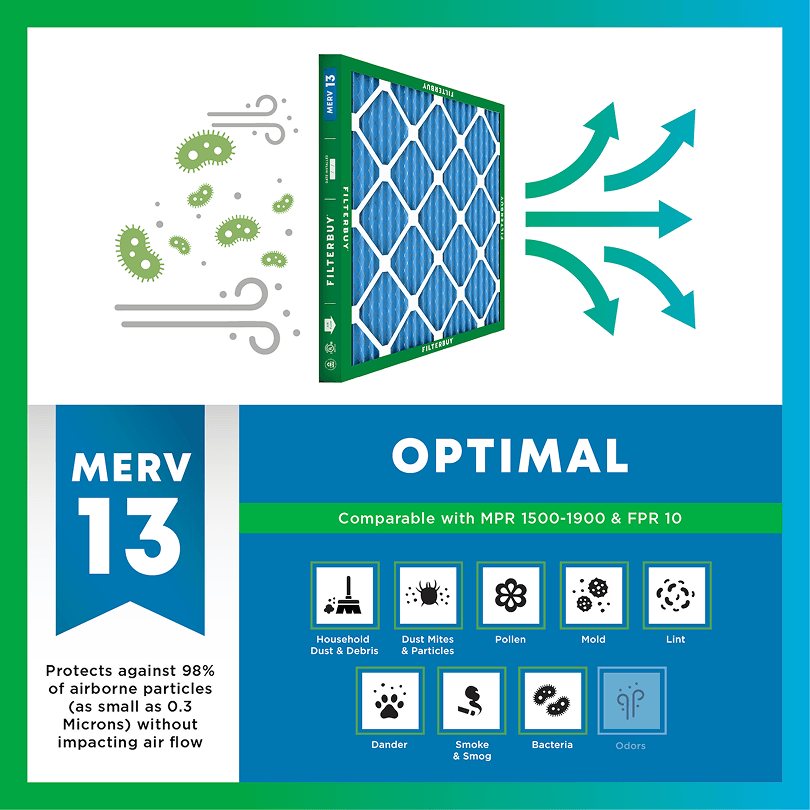
- Captures PM2.5 particles
- Blocks ash, soot, and smoke odor
- Keeps your indoor air safe—even when the outdoor air is dangerous
- Meets the EPA's recommended rating for filtering fine wildfire smoke particles.

Wildfire Smoke FAQs
Facts About Wildfires
Over 70,000 wildfires burn in the U.S. every year.
Wildfire smoke can travel 1,000+ miles, affecting states that aren't even near the blaze.
Exposure to wildfire smoke can worsen asthma, trigger heart issues, and lead to ER visits.
Indoor air can hold more fine particles during wildfire events unless it's properly filtered.
The EPA advises using MERV 13 filters or portable HEPA air cleaners during wildfire smoke events.
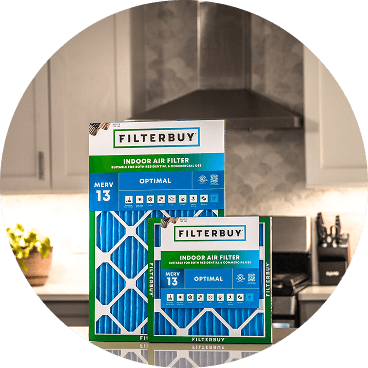
Don't Wait Until The Smoke's Inside.
Use the live wildfire smoke tracker and upgrade your air filters today to protect your lungs and your home.
Shop Filters For Smoke Protection
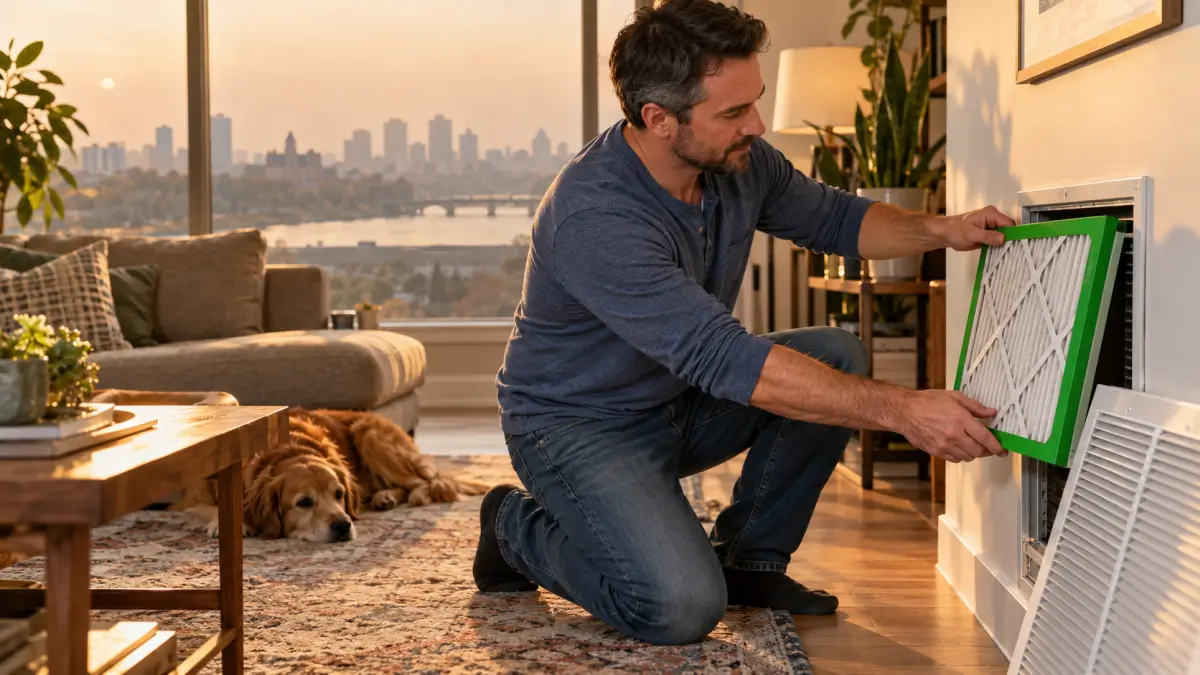
Live Saskatoon, SK Forest Wildfire & Smoke Map Today: Local Air Quality Tracking & Indoor Protection Solutions
TL;DR
The live map above shows active wildfires, forecast smoke and the Air Quality Health Index (AQHI) for Saskatoon, SK, from official Canadian sources. Most smoke over Saskatoon comes from boreal forest fires far to the north. Filterbuy's action line is AQHI 7: put a MERV 13 filter in your furnace, set the fan to On, run a portable HEPA air cleaner in each occupied room and close up the house.
Key Takeaways
• Canada's Air Quality Health Index (AQHI) runs from 1 to 10+; 7 and above is high risk.
• Health Canada recommends a MERV 13 or higher filter in a home's central system during smoke events to remove PM2.5, the fine particles in smoke.
• Filterbuy's action line is AQHI 7, the start of the high-risk band. Official guidance from ECCC and local health authorities always comes first.
Which Map Should You Check? Official Saskatoon Fire and Smoke Sources
Check the SPSA map for fire threats, FireSmoke Canada or ECCC FireWork for where smoke is heading, and Saskatoon's AQHI for the air right now.
Table 1: Which official map answers which Saskatoon question
FireSmoke Canada labels its forecast experimental. For evacuation decisions, follow the SPSA and your local municipality.
Open the maps directly: the SPSA Active Incidents map, the CWFIS interactive fire map, the FireSmoke Canada smoke forecast, Environment Canada's FireWork smoke maps and Saskatoon's AQHI. Our guide on how to read a wildfire smoke map explains the layers.
Why Does Wildfire Smoke Reach Saskatoon?
Wildfire smoke reaches Saskatoon because the city sits on the prairie south of Saskatchewan's boreal forest, where most large fires burn. Northerly and northwesterly winds carry that smoke south to the city. Filterbuy's read: in Saskatoon, the wind forecast is as useful a warning as the fire map. Smoke from fires in Alberta and British Columbia can also arrive on westerly winds; see our Alberta wildfire and smoke map.
How Big Have Recent Saskatchewan Fire Seasons Been?
More than 500 wildfires burned nearly three million hectares across Saskatchewan in 2025, according to CBC News. Saskatoon's AQHI hit 10+ in July 2025 (CJWW, CP24).
The 2026 season has been milder, with 341 wildfires by 30 September, but the SPSA notes that wildfire season has no fixed end and can flare up quickly in warm, dry weather (Government of Saskatchewan).
How to Read Saskatoon's Air Quality Health Index (AQHI)
The Air Quality Health Index (AQHI) is Canada's official scale for how outdoor air affects health, rated from 1 to 10+. It normally combines ground-level ozone, fine particulate matter and nitrogen dioxide, but during wildfire smoke events Environment and Climate Change Canada calculates it from PM2.5 alone (ECCC). That is why Filterbuy treats a rising summer AQHI in Saskatoon as a smoke meter, and a cue to check your filter. ECCC forecasts come out at 6 a.m. and 5 p.m., and the WeatherCAN app can send AQHI alerts. Our guide to wildfire smoke and the air quality index compares the AQHI with the US AQI.
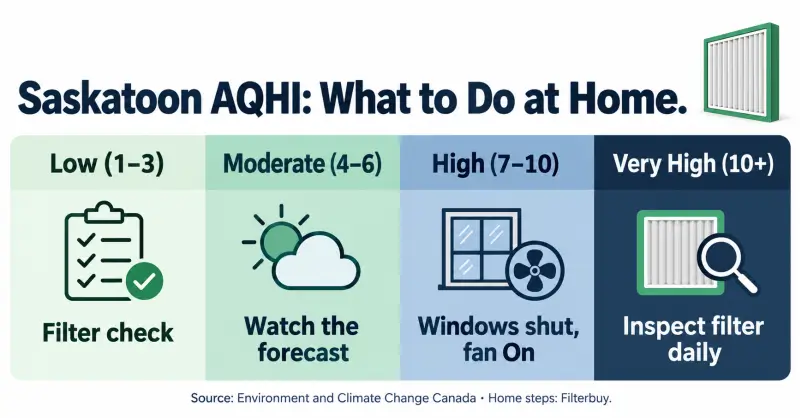
Each band pairs ECCC's health guidance with Filterbuy's home steps. The AQHI 7 action line is Filterbuy's own recommendation; ECCC doesn't set one.
• Low risk (AQHI 1–3): Enjoy usual outdoor activities. At home, keep your normal filter routine.
• Moderate risk (AQHI 4–6): People with symptoms may reduce strenuous activity. At home, get a MERV 13 filter in before smoke arrives and keep a spare on hand.
• High risk (AQHI 7–10), Filterbuy's action line: At-risk groups should reduce strenuous outdoor activity. At home, put a MERV 13 filter in your furnace, set the fan to On, run a portable HEPA air cleaner in each occupied room (bedrooms first) and close up the house. Check the filter more often than usual and keep replacements ready.
• Very high risk (AQHI 10+): Follow ECCC alerts and local health guidance first, including any advice to relocate. Keep the same home steps and focus on one cleaner air room. Filtration is one layer, not the whole answer.
People with lung or heart disease, older adults, children, pregnant people and outdoor workers face higher risk. If you must go out in heavy smoke, the Canadian Lung Association advises a well-fitted N95; cloth and surgical masks do not filter smoke well. If symptoms develop, call HealthLine 811 or the Canadian Lung Association's Lung Health Helpline at 1-866-717-2673.
How to Reduce Wildfire Smoke in Your Saskatoon Home
Start with official guidance: follow ECCC air quality alerts and Saskatchewan HealthLine 811 advice, and relocate or evacuate if officials tell you to. Then use these four steps in order once the AQHI reaches 7.
1. Put a MERV 13 filter in your furnace. Health Canada recommends MERV 13 or higher in a central system during smoke events (Health Canada). The US EPA notes most furnaces handle MERV 13 without equipment problems when the filter is replaced often (EPA). Just confirm the size fits your slot.
2. Set your thermostat fan to On. "Auto" only filters while the system heats or cools; "On" filters continuously.
3. Run a portable HEPA air cleaner in each occupied room, bedrooms first. This is Filterbuy's recommendation and goes beyond EPA's single clean room. For sizing, the EPA advises a smoke CADR (clean air delivery rate) of at least two-thirds of the room's area in square feet, so a 300 sq ft (28 m²) bedroom needs about 200. The EPA also advises against air cleaners that produce ozone, so skip ionizers and ozone generators.
4. Close up the house. Shut windows and doors, and ask your technician about setting an air exchanger (HRV/ERV) to recirculate. Skip candles, frying, smoking and vacuuming (unless sealed) while smoke is in.
How often to change the filter during smoke: Check it often and replace it when it looks dirty (dark brown or black), which can be well before its normal interval, according to the EPA. Keep spares on hand.
What Filterbuy sees every smoke season: People judge the air by smell, but smell is mostly gases, which pleated filters don't capture. See our guide to cleaning the air in your house after wildfire smoke.
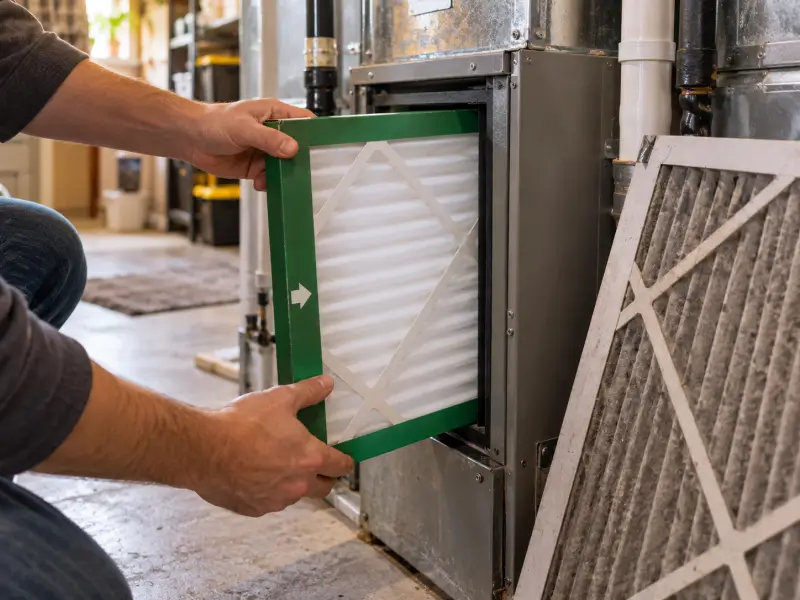
Reviewer's tip: David Clark, whose Filterbuy HVAC Solutions crews take residential service calls year-round, reminds homeowners that a filter only works if it's changed on time.
No Central Furnace? Portable Air Cleaners Come First
In apartments, condos and homes without ductwork, a portable HEPA air cleaner is your main defence, not an add-on. Size it with EPA's two-thirds rule above. If you can't buy one yet, a DIY box-fan cleaner works as a stopgap until you can get a certified unit. EPA lab tests measured these builds, and Filterbuy matched each to the largest room it covers under that rule (EPA):
1. Up to 21 m² (230 sq ft): box fan, one 1-inch MERV 13 filter sized to the fan, and a cardboard shroud (CADR 156).
2. Up to 34 m² (370 sq ft): one 4-inch or two 1-inch MERV 13 filters, with shroud (CADR 248–263).
3. Up to 56 m² (600 sq ft): a four-filter Corsi-Rosenthal box (CADR 401).
Use a certified (UL or ETL) box fan made in 2012 or later, and don't leave it running unattended. Replace the filter once it looks dirty.
MERV 8 vs MERV 11 vs MERV 13: Which Filter for Wildfire Smoke?
MERV 13 is the tier Filterbuy recommends for wildfire smoke. Filterbuy makes MERV 8, 11 and 13 in every standard size, and HEPA belongs in a portable cleaner, never a furnace slot.
Table 2: MERV 8 vs MERV 11 vs MERV 13 for wildfire smoke
Most furnaces and HVAC systems can run MERV 13 without equipment problems when the filter is replaced often, according to the U.S. EPA. Confirm the size printed on your current filter.
Compare further: our guide to the best MERV filter for wildfire smoke and MERV 13 vs HEPA for wildfire smoke.
"A MERV 13 only helps if it's in the slot before the haze arrives," says Michelle Wan, Filterbuy's Brand Manager and Air Quality Writer.
When Should Saskatoon Homeowners Change Their Furnace Filter?
Put a fresh MERV 13 in before smoke season and swap it after. Through winter, check it monthly and replace it when it looks dirty.
Our take: late September is Saskatoon's crossover month. The filter that loaded up with summer smoke is the one your furnace starts winter with, so swap it before the first cold snap.
• Spring (April–June): Pollen season; MERV 11 suits allergies. Before fire season, install MERV 13 and keep a spare.
• Summer (June–September): Peak smoke. Keep MERV 13 in; replace it when dark brown or black.
• Winter (November–March): Long furnace runs. For lingering odours, see our Odour Eliminator line.
What to Do if You See a Wildfire Near Saskatoon
If you see smoke or flames that may be a new wildfire, report it right away. The SPSA takes wildfire reports at 1-800-667-9660, or you can call 911 (Government of Saskatchewan). Sign up for SaskAlert, the province's emergency alert program.
Supporting Statistics: What the Research Shows
1. Fire Season Can Start Early
• Saskatchewan had 146 wildfires by 12 May 2025.
• That is nearly twice the five-year average.
• Source: NASA Earth Observatory
• Takeaway: Fit a fresh filter in spring.
2. Smoke Reaches Saskatoon from Far Away
• Nearly all Saskatchewan residents had seasonal wildfire PM2.5 exposure of 1.0 µg/m³ or more (2013–2023).
• Nationally, over 80% of Canadians reached that level.
• Source: Health Canada study via NIH PubMed Central
• Takeaway: Filter indoor air, even far from the fires.
3. Closing Up Isn't Enough on Its Own
• With windows shut and no air cleaning, indoor PM2.5 typically stays at 55–60% of outdoor levels.
• Source: U.S. EPA
• Takeaway: Pair a closed-up house with filtration.
Frequently Asked Questions
Is There a Wildfire Near Saskatoon Today?
The live map above shows current wildfires near Saskatoon, SK. For official status and evacuations, check the SPSA Active Incidents map.
Why Is It Smoky in Saskatoon When There's No Fire Nearby?
Saskatoon's smoke usually travels on the wind from fires in northern Saskatchewan, Alberta or British Columbia.
How Often Should I Change My Furnace Filter During Smoke Season?
Check it often during smoke and replace it when it looks dirty (dark brown or black), which can be well before its normal interval. Keep spares on hand.
When Does Wildfire Season End in Saskatchewan?
Saskatchewan's wildfire season usually runs from spring into early autumn, but the SPSA notes it has no fixed end, so keep checking the smoke map through October.
Glossary
• Air Quality Health Index (AQHI): Canada's 1-to-10+ health-risk scale for outdoor air.
• CADR (clean air delivery rate): How much filtered air an air cleaner delivers; higher cleans a room faster.
• HEPA: A high-efficiency filter used in portable air cleaners; it doesn't go in furnace slots.
• MERV (Minimum Efficiency Reporting Value): A 1-to-16 rating of how well an HVAC filter captures particles.
• Filterbuy: A family-owned American manufacturer of pleated air filters (MERV 8, 11, 13 and Odour Eliminator), shipping free to Canada through filterbuy.ca.
• PM2.5: Fine particulate matter 2.5 micrometres or smaller, the main health concern in wildfire smoke.
• SPSA: Saskatchewan Public Safety Agency, which manages wildfire response and publishes fire maps.
Breathe Easier Through Smoke Season and Furnace Season
Filterbuy cuts every filter to order in its own American facilities, in over 600 sizes plus custom sizes, and ships free to Canada with no minimum order. Subscribe and save to get the right filter on your schedule, and edit, skip or cancel anytime.
Questions? Call (855) 345-8289 or email info@filterbuy.com.
About the author: Michelle Wan, Filterbuy's Brand Manager and Air Quality Writer, works directly with our U.S. manufacturing team.
General information only. It isn't emergency or medical advice. Follow official guidance from the SPSA and ECCC.