
Saguenay, QC Live Wildfire Smoke Map
Get Alerts For Wildfires In Your Area
The moment a wildfire starts near you, you'll get an instant alert and simple tips to reduce your smoke exposure.
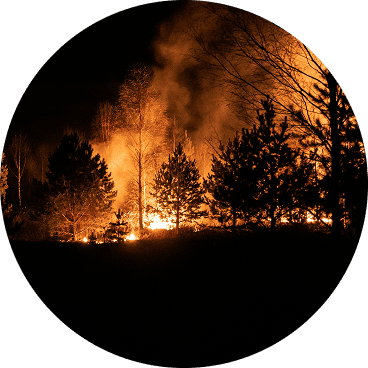
What's In The Smoke
30xSmaller than a human hair
Fine enough to reach deep into the lungs. A MERV 13 is built to capture it.
How Far It Travels


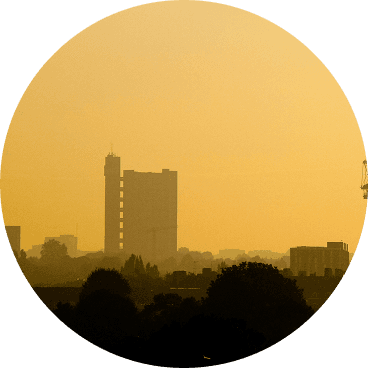
It Doesn't Stay Local
Smoke rides the wind far downwind — you can get smoky air with no fire nearby.
What To Do During A Smoke Event
Simple steps to reduce indoor exposure.
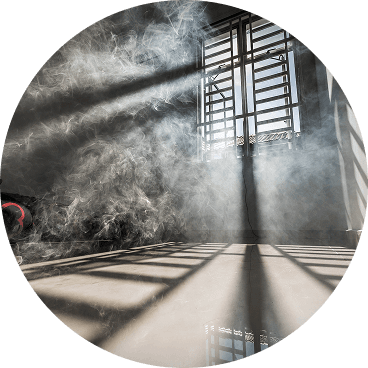
- Stay In, Close UpShut windows and doors to keep smoke out.
- Set Fan To "On"Keeps air cycling through your filter, not just when heating or cooling.
- Recirculate AirSwitch off fresh-air intake so you're not pulling smoke in.
- Run A MERV 13Built to capture the fine PM2.5 in smoke.
- Add A PurifierExtra filtration for the room you use most.
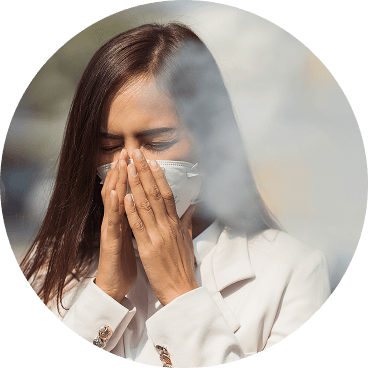
- Wear an N95 if OutsideFits snug to block fine particles — a cloth mask won't.


The Best Air Filter For Wildfire Smoke
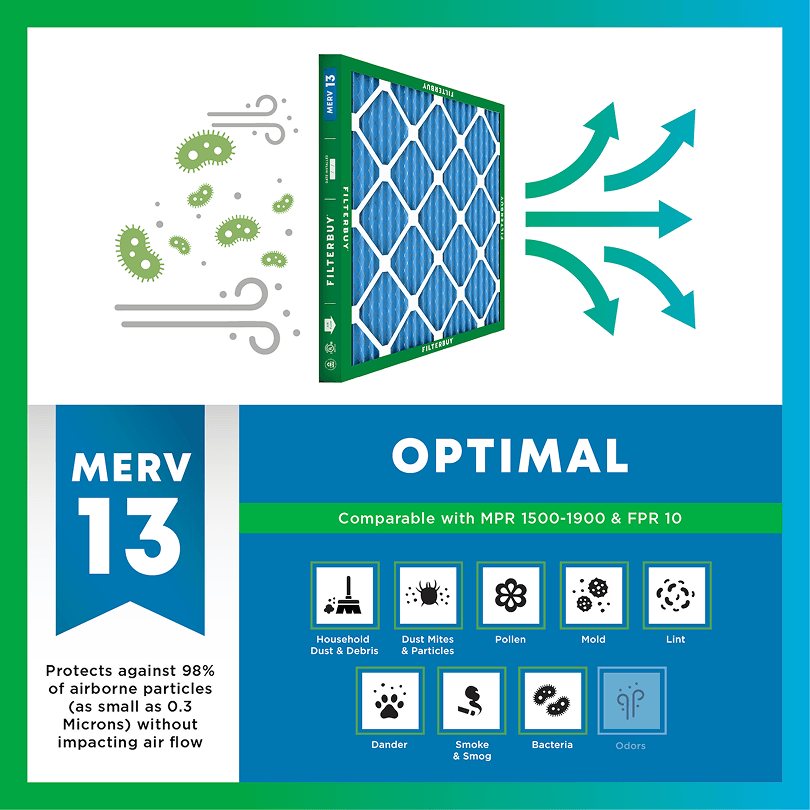
During smoke events, the EPA recommends upgrading to a MERV 13 filter — or the highest-rated filter your system can handle — to help reduce the fine particles smoke brings indoors. MERV 13 is the level most home HVAC systems can run while still capturing PM2.5, the fine particulate that makes up the bulk of wildfire smoke.
- Captures PM2.5 particles
- Blocks ash, soot, and smoke odor
- Keeps your indoor air safe—even when the outdoor air is dangerous
- Meets the EPA's recommended rating for filtering fine wildfire smoke particles.

Wildfire Smoke FAQs
Facts About Wildfires
Over 70,000 wildfires burn in the U.S. every year.
Wildfire smoke can travel 1,000+ miles, affecting states that aren't even near the blaze.
Exposure to wildfire smoke can worsen asthma, trigger heart issues, and lead to ER visits.
Indoor air can hold more fine particles during wildfire events unless it's properly filtered.
The EPA advises using MERV 13 filters or portable HEPA air cleaners during wildfire smoke events.
Don't Wait Until The Smoke's Inside.
Use the live wildfire smoke tracker and upgrade your air filters today to protect your lungs and your home.
Shop Filters For Smoke Protection
Live Saguenay, QC Forest Wildfire & Smoke Map Today: Local Air Quality Tracking & Indoor Protection Solutions
TL;DR
Saguenay faces two kinds of wildfire risk: fires in the surrounding boreal forest and smoke drifting in from fires hundreds of kilometres away. Follow both live with SOPFEU's wildfire map for fires and burn bans, the ECCC FireWork forecast for where smoke is heading, and Quebec's Air Quality Index (IQA) map for what the city's three stations measure. When smoke arrives, close the windows and set the air exchanger to recirculate, then run a MERV 13 furnace filter with the thermostat fan set to On and a HEPA air purifier in each occupied room.
Key Takeaways
SOPFEU is Quebec's wildfire agency. The 9 June 2026 ban on open fires in or near forests included Saguenay.
Environment and Climate Change Canada (ECCC) does not publish an AQHI for Saguenay, so the official reading is Quebec's hourly IQA.
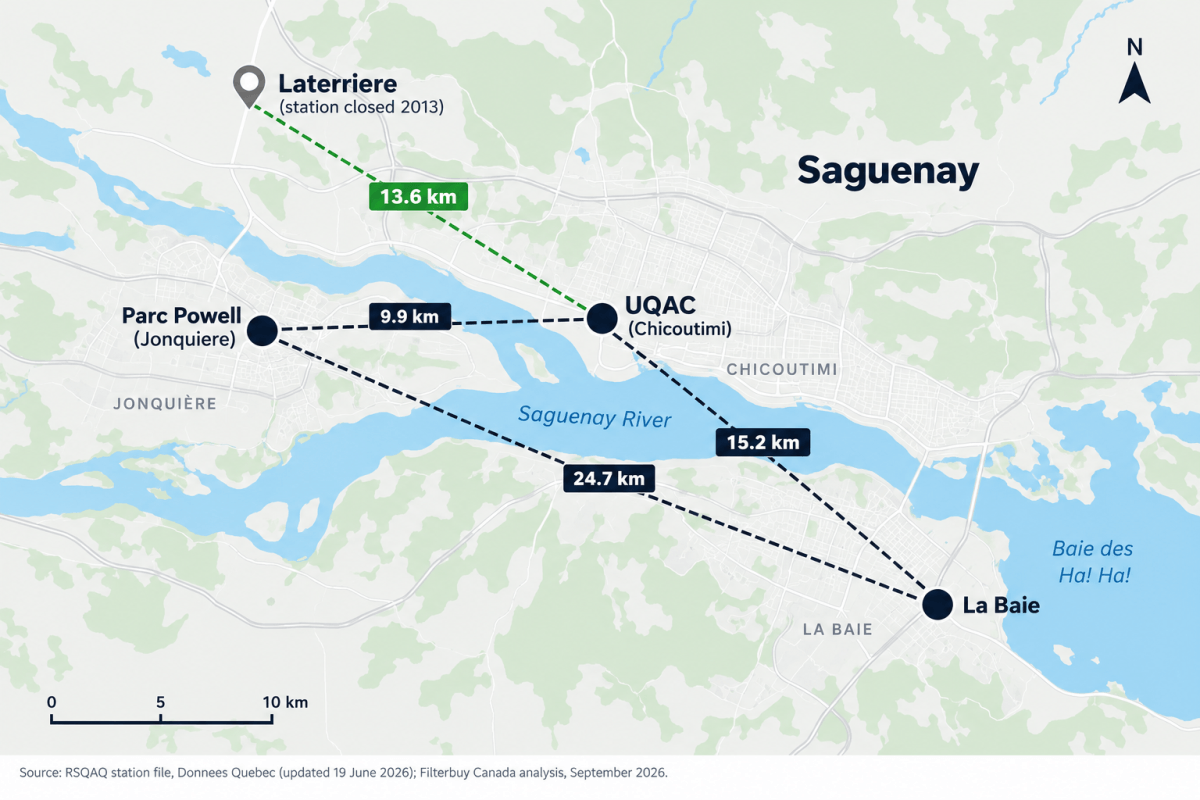
Saguenay has three active stations: Parc Powell (Jonquière), UQAC (Université du Québec à Chicoutimi) and La Baie. Laterrière lost its station in 2013 and is now 13.6 km from the nearest one.
Every year from 1 May to 30 September, the IQA map adds a wildfire layer with seasonal sensors and a 72-hour smoke forecast.
Regional public health advises closing windows during smoke and turning the air exchanger off or to recirculation.
Live Saguenay Wildfire and Smoke Map: Which Source Answers Which Question?
The Filterbuy Canada team compared these sources in September 2026: no single map answers every question. Fire maps show flames and smoke forecasts show where the plume is heading, but only the IQA shows what Saguenay is breathing now.
Our rule of thumb: forecasts guide, and the ground-level IQA reading decides.
Is There a Forest Fire in Saguenay Today?
Saguenay sits in boreal forest, so fires can start nearby. SOPFEU fights forest fires and the city fire department covers built-up areas. In October 2025, MétéoChicoutimi reported one of each: a fire on Mont-Jacob in Jonquière and SOPFEU fire no. 508 near Lac Dallaire.
On 9 June 2026, Quebec's public security ministry banned open fires in or near forests across much of the region, Saguenay included. The release also noted a quiet start: 201 fires across Quebec's protection zone had burned 192.9 hectares, below the 10-year average of 229 fires and 98,793 hectares by that date. When Filterbuy Canada checked SOPFEU's map on 24 September 2026, the fire danger index was already offline, so check rules before burning outdoors. To report a wildfire or smoke, call 911 or SOPFEU at 1-800-463-3389, or use SOPFEU's online form.
Where Saguenay's Wildfire Smoke Comes From
Filterbuy Canada's review of public health notices and regional news shows most smoke over Saguenay comes from distant fires, with regional fir
Sources: ECCC, regional public health notices, Radio-Canada and CKAJ.
Which Monitoring Station Covers Your Part of Saguenay?
Saguenay has no AQHI. ECCC's Info-Smog page confirms that AQHI forecasts in Quebec cover only Montreal, Quebec City and Gatineau, so Quebec's IQA is the official reading. The province's published station list shows three active stations: Parc Powell in Jonquière (Arvida), UQAC in Chicoutimi and La Baie. Parc Powell gained a fine-particle (PM2.5) monitor in 2022.
Filterbuy Canada downloaded that station file (updated 19 June 2026) and calculated straight-line (haversine) distances, rounded to 0.1 km, adding Laterrière, whose Père-Honorat station closed on 7 October 2013.
Source: RSQAQ station file, Données Québec (updated 19 June 2026); Filterbuy Canada analysis.
Jonquière and La Baie are almost 25 km apart, so readings can differ across the city, and Laterrière is now closest to UQAC. Quebec's IQA guidance tells residents without a nearby station to use the nearest regional station or Info-Smog forecasts. On smoky days, plan around the higher of two nearby readings. The IQA map's extra wildfire layer also stops on 30 September, so a late fire like October 2025's is tracked by the fixed stations alone.
How to Read Saguenay's Air Quality During a Smoke Event
Quebec's IQA sorts each hourly reading into good (1 to 25), acceptable (26 to 50) and poor (51 and above). Under the IQA methodology, a station's worst pollutant sets its value, and fine particles count as poor once the three-hour average passes 35 micrograms per cubic metre. At a poor reading, young children, older adults and people with respiratory or heart conditions are advised to cut back on outdoor physical activity.
Each station's pollutant sub-indices, also listed on the IQA map, show whether a filter will help. In smoke season, high fine particles (PM2.5) usually mean smoke, which a good furnace filter reduces indoors. Sulphur dioxide (SO2) is a gas that particle filters are not rated to capture.
In the June 2025 episode, Saguenay-Lac-Saint-Jean's regional public health department named pregnant people and people with diabetes among those most at risk, alongside children, older adults and people with lung or heart disease. For health questions, call Info-Santé at 811.
Supporting Statistics
U.S. federal research puts numbers behind the filtration steps on this page.
About 90% of wildfire smoke particle mass is fine particles (PM2.5).
PM2.5 can travel deep into the lungs.
The EPA calls it the smoke pollutant of greatest health concern.
Source: U.S. EPA
MERV 13 filters cut classroom fine particles by 40%.
Tested as a swap from MERV 8 filters in California schools.
Source: Lawrence Berkeley National Laboratory, a U.S. Department of Energy lab
MERV 13 plus a HEPA air cleaner held indoor PM2.5 to about 21% of outdoor levels.
MERV 13 alone: about 55% of outdoor levels.
Measured in a Portland, Oregon home during record 2020 wildfire smoke.
How to Keep Wildfire Smoke Out of Your Saguenay Home
Official guidance comes first: if Info-Smog warnings, regional public health or Urgence Québec (1-877-644-4545) tell you to stay in or leave, follow them. These steps draw on regional public health, Health Canada and U.S. EPA advice:
Close windows and exterior doors while the indoor temperature stays tolerable.
Turn the air exchanger (HRV or ERV) off or to recirculation so it stops pulling in smoky air. Berkeley Lab researchers add: switch it back on once the smoke clears.
Set central air conditioning and heat pumps to recirculation mode.
Run a certified, properly sized portable air cleaner with a HEPA filter in the room where you spend the most time. EPA sizing for smoke is a smoke CADR of at least two-thirds of the room's area in square feet: about 200 for a 28 m² (300 sq ft) bedroom. Avoid ozone-producing models.
Avoid adding indoor particles: skip frying, candles, incense and wood stove use until the smoke clears.
Check your furnace filter during smoke events and replace it when it turns dark brown or black, which can be well before the normal interval. Keep spare filters on hand.
Choosing a Furnace Filter for Saguenay's Smoke and Heating Seasons
Filterbuy Canada's action line is a U.S. AQI above 100, the scale many weather apps show. Once readings pass it, or a smog warning is issued for Saguenay, take these four steps in order:
If you have a furnace or central HVAC system, switch to a MERV 13 filter. Make the swap from MERV 8 or 11. The U.S. EPA recommends MERV 13 or higher during smoke events and notes most furnaces and HVAC systems handle it without equipment problems when the filter is replaced often.
Set the thermostat fan to On, since Auto only runs it while heating or cooling.
Run a portable HEPA air purifier in each occupied room, bedrooms first. That goes beyond the single clean room most agencies suggest, and it is our call.
Keep the house closed and skip indoor smoke sources.
Above 150, inspect the filter more often and keep replacements ready. Above 200, local guidance comes first, and filtration is one layer among several.
No central system? In apartments and homes without ductwork, portable HEPA air cleaners are your main line of defence, not a backup.
Filterbuy Canada carries three colour-coded pleated tiers:
MERV 13 Optimal is the tier we recommend for smoke.
MERV 11 Superior is our everyday tier for pets and seasonal allergies.
Odor Eliminator filters add a carbon layer for household odours. Pleated filters capture particles, not gases.
Before you order, check the size printed on your current filter's frame so the new one fits snugly. Air exchangers use separate filters, so check those too.
Our smoke timeline suggests a Saguenay routine: a fresh MERV 13 by late May, ahead of the June and July episodes, and another in late September before heating season. Filterbuy Canada stocks over 600 standard sizes plus custom sizes. Orders ship free to Canada, and you can edit, skip or cancel the subscribe and save plan anytime.
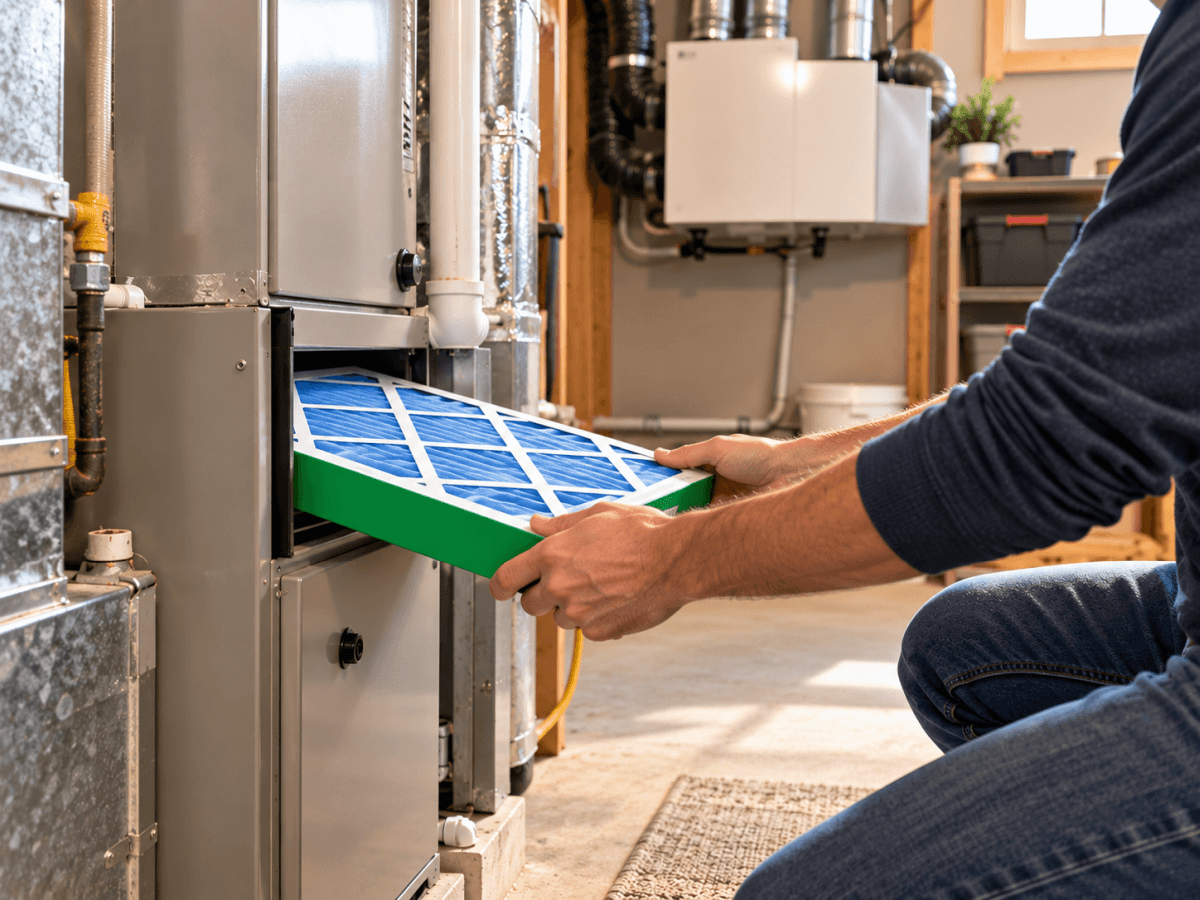
Get a fresh filter in place before the next smoke event: shop MERV 13 filters in your size.
Frequently Asked Questions
What MERV Rating Do I Need For Wildfire Smoke?
MERV 13. Filterbuy Canada recommends switching once the U.S. AQI rises above 100, and running a HEPA air purifier in each occupied room. Separately, the U.S. EPA recommends MERV 13 or higher during smoke events.
Is There A Wildfire Near Saguenay Right Now?
Check the SOPFEU map for Quebec wildfires and the CWFIS map for fires across Canada. To report a fire or smoke, call 911 or SOPFEU at 1-800-463-3389.
What Is The Best Live Smoke Map For Saguenay Today?
The ECCC FireWork map is Canada's official 72-hour smoke forecast. Pair it with the Quebec IQA map to see whether that smoke has reached Saguenay's stations.
Does Saguenay Have An Aqhi Reading?
No. ECCC publishes AQHI forecasts in Quebec only for Montreal, Quebec City and Gatineau, so Saguenay's official reading is Quebec's hourly IQA.
Why Do Different Apps Show Different Air Quality For Saguenay?
Apps may read different stations, rely on low-cost sensors or show the U.S. AQI, a 0 to 500 scale that doesn't line up with the IQA, Saguenay's official reading.
How Often Should I Change My Furnace Filter During Smoke Season?
Check it during smoke events and replace it when it turns dark brown or black, even well before the normal interval. Keep spares on hand; a Filterbuy Canada subscription can arrive more often in smoke season and be adjusted later.
Glossary
SOPFEU: The Société de protection des forêts contre le feu, Quebec's non-profit wildfire prevention and suppression agency.
IQA (indice de la qualité de l'air): Quebec's hourly Air Quality Index, published for each monitoring station and grouped as good, acceptable or poor.
AQHI (Air Quality Health Index): Canada's 1 to 10+ scale for the health risk of outdoor air. ECCC does not publish it for Saguenay.
U.S. AQI (Air Quality Index): The United States' 0 to 500 air quality scale, often shown in weather apps.
CWFIS: Natural Resources Canada's Canadian Wildland Fire Information System, which maps active fires and hotspots nationwide.
FireWork: ECCC's forecast system predicting how wildfire smoke will move over the next 72 hours.
FireSmoke.ca: The BlueSky Canada portal publishing research smoke forecasts from the University of British Columbia.
PM2.5: Fine particulate matter 2.5 microns or smaller, the main pollutant of concern in wildfire smoke.
Air exchanger (HRV or ERV): A home ventilation unit that swaps stale indoor air for fresh outdoor air.
MERV: Minimum Efficiency Reporting Value, a rating of how well an HVAC filter captures particles between 0.3 and 10 microns.
HEPA: A high efficiency particulate air filter, used in portable air cleaners, capturing at least 99.97% of 0.3-micron particles.
About the author and reviewer
Michelle Wan
is Brand Manager and Air Quality Writer at Filterbuy, where she translates MERV ratings, filtration, and HVAC efficiency into plain-English advice for homeowners. She works directly with Filterbuy's U.S. manufacturing team across its factories in Alabama, Florida, Pennsylvania, and Utah, so her guidance is grounded in how filters are actually built, tested, and used in real homes rather than in spec sheets. She also fronts much of Filterbuy's educational video and social content. Michelle earned her B.A. in Sociology from the University of California, Santa Cruz, in 2021. Learn more on her author page.
David Clark
a Licensed HVAC Technician with Filterbuy HVAC Solutions, who reviews Filterbuy's maintenance and system-compatibility guidance for accuracy, including the airflow, static pressure, and MERV 13 compatibility claims on this page.