
Pickering, ON Live Wildfire Smoke Map
Get Alerts For Wildfires In Your Area
The moment a wildfire starts near you, you'll get an instant alert and simple tips to reduce your smoke exposure.
What's In The Smoke
30xSmaller than a human hair
Fine enough to reach deep into the lungs. A MERV 13 is built to capture it.
How Far It Travels


It Doesn't Stay Local
Smoke rides the wind far downwind — you can get smoky air with no fire nearby.
What To Do During A Smoke Event
Simple steps to reduce indoor exposure.
- Stay In, Close UpShut windows and doors to keep smoke out.
- Set Fan To "On"Keeps air cycling through your filter, not just when heating or cooling.
- Recirculate AirSwitch off fresh-air intake so you're not pulling smoke in.
- Run A MERV 13Built to capture the fine PM2.5 in smoke.
- Add A PurifierExtra filtration for the room you use most.
- Wear an N95 if OutsideFits snug to block fine particles — a cloth mask won't.


The Best Air Filter For Wildfire Smoke
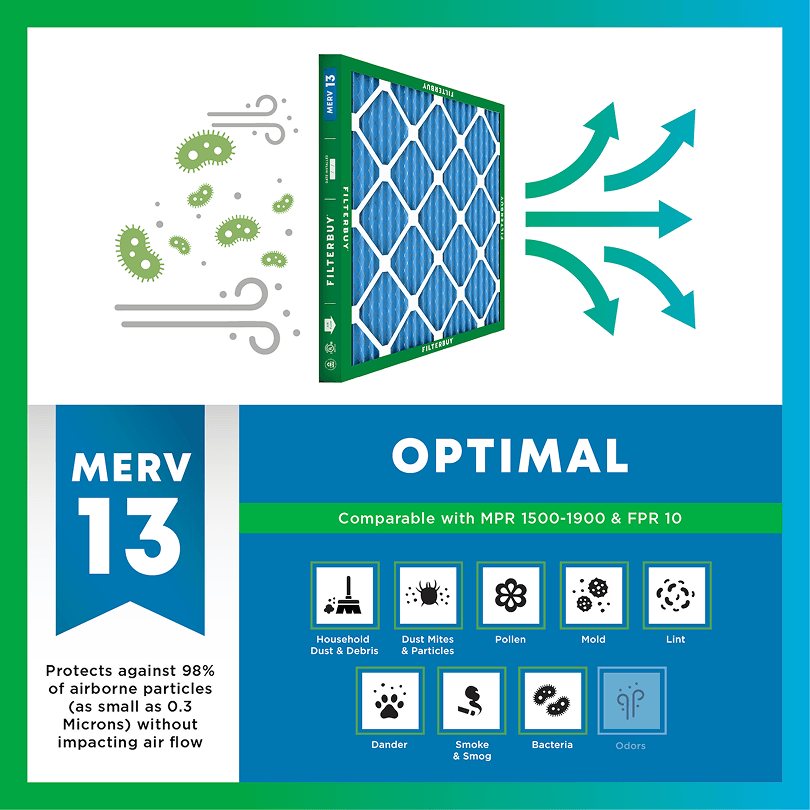
During smoke events, the EPA recommends upgrading to a MERV 13 filter — or the highest-rated filter your system can handle — to help reduce the fine particles smoke brings indoors. MERV 13 is the level most home HVAC systems can run while still capturing PM2.5, the fine particulate that makes up the bulk of wildfire smoke.
- Captures PM2.5 particles
- Blocks ash, soot, and smoke odor
- Keeps your indoor air safe—even when the outdoor air is dangerous
- Meets the EPA's recommended rating for filtering fine wildfire smoke particles.

Wildfire Smoke FAQs
Facts About Wildfires
Over 70,000 wildfires burn in the U.S. every year.
Wildfire smoke can travel 1,000+ miles, affecting states that aren't even near the blaze.
Exposure to wildfire smoke can worsen asthma, trigger heart issues, and lead to ER visits.
Indoor air can hold more fine particles during wildfire events unless it's properly filtered.
The EPA advises using MERV 13 filters or portable HEPA air cleaners during wildfire smoke events.
Don't Wait Until The Smoke's Inside.
Use the live wildfire smoke tracker and upgrade your air filters today to protect your lungs and your home.
Shop Filters For Smoke Protection

Live Pickering, ON Forest Wildfire & Smoke Map Today: Local Air Quality Tracking & Indoor Protection Solutions
TL;DR
The live map above shows wildfires and smoke plumes around Pickering and Durham Region. Most smoke here drifts in from distant wildfires, usually in northern Ontario or Quebec. When the Air Quality Health Index (AQHI) reaches 7, Filterbuy recommends four steps: a MERV 13 filter in your furnace, the thermostat fan set to On, a portable HEPA air cleaner in each occupied room, and a closed-up house. Follow Environment Canada and public health advice first.
Key Takeaways
• Environment Canada recommends a MERV 13 or higher filter and a recirculating HVAC fan during smoke events.
• Filterbuy's action line is an AQHI of 7. That's when we tell Pickering homeowners to take all four steps.
• During smoke, check your furnace filter often and replace it when it looks dark brown or black.
How to Use the Live Pickering Wildfire & Smoke Map Above
Filterbuy's interactive map at the top of this page layers active fire locations, new fire detections from the past 24 hours, and smoke plume coverage. Centre it on Pickering, between Scarborough and Ajax on Lake Ontario, then check how dense the smoke is and where it's heading.
1. Find Pickering. Include the rural north, such as Claremont, and Rouge National Urban Park on the western edge.
2. Check the fire markers. Markers show active wildfires or satellite-detected hotspots, usually far from Pickering.
3. Read the smoke layer. Darker shading means denser smoke. High-altitude smoke can colour the sky orange; smoke near the ground affects the air you breathe.
4. Pair it with the AQHI. Check the Toronto East AQHI or Oshawa AQHI to see how the smoke is affecting the air in Pickering right now. Recheck often; smoke levels can change hourly.
Fire data comes from Natural Resources Canada's CWFIS; smoke data comes from NOAA's Hazard Mapping System. For the national view, see Filterbuy's Canada-wide live wildfire and smoke map.
Is There a Forest Fire in Pickering, ON, Today?
Large forest fires inside Pickering are rare. Pickering sits outside Ontario's provincial fire region. Use this quick check to tell what you're seeing:
• A column of smoke rising nearby means a local fire. Call 911, the province's reporting number south of the French and Mattawa rivers.
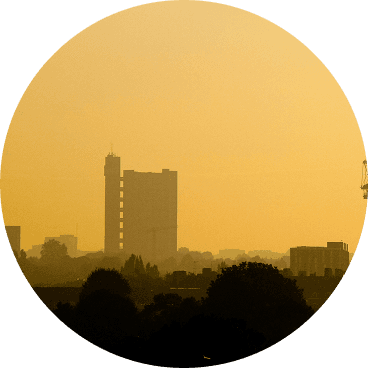
• Even haze across the sky and an orange sun, with no fire markers near Pickering on the map, usually means distant wildfire smoke.
• A strong smoke smell on a low-AQHI day may come from a nearby backyard or wood fire. Report burn ban violations to City Customer Care at 905.683.7575.
Pickering Fire Services enforces City burn rules. Chimineas, bonfires, and wood-burning appliances are prohibited, and the most recent city-wide burn ban ran from 14 to 22 July 2026.
Where Does Pickering's Wildfire Smoke Come From?
Pickering's worst smoke days come from distant wildfires. Northwest winds carry smoke from fires in northern Ontario and Quebec, and sometimes the Prairies, into Durham Region. Ontario's legislated wildland fire season runs from 1 April to 31 October, so smoke risk is highest from late spring through early autumn. Recent smoke events that reached Pickering include:
• 14–17 July 2026: Smoke from fires in northwestern Ontario pushed Toronto's AQHI to 10+ (very high risk). Pickering held a city-wide burn ban from 14 to 22 July.
• June–August 2025: Pickering declared a city-wide fire ban on 11 August 2025, citing hot, dry weather and wildfire smoke.
What Does Pickering's AQHI Reading Mean for Your Home?
The Air Quality Health Index (AQHI) is Canada's 1-to-10+ health-risk scale. During smoke events, Environment and Climate Change Canada calculates it hourly from PM2.5, the tiny particles in smoke. Pickering has no AQHI station, so check Oshawa or Toronto East. Ontario issues a yellow air quality warning when the AQHI is forecast to reach 7 and an orange warning at 10+.
Filterbuy's action line is AQHI 7. At that point, we recommend a MERV 13 filter in your HVAC, the thermostat fan set to On, a portable HEPA air cleaner in each occupied room, and a closed-up house. The table shows what we recommend at each level.
AQHI levels and warnings: Environment and Climate Change Canada and Ontario. Indoor steps: Filterbuy's recommendation. Pickering readings: Oshawa or Toronto East station.
Health Canada research finds that children, people 65 and older, pregnant people, people with health conditions, and some outdoor workers face higher risk. If you have a heart or lung condition, ask your health care provider for a smoke plan.
What We See at Filterbuy Every Smoke Season
We make every Filterbuy filter to order in our own American facilities, so we see smoke season in our work first:
1. Smoke loads filters fast. Filters used during smoke events come back to us visibly darker and heavier than filters from clean-air months. That's why we tell Pickering homeowners to check the filter during and after a smoke event.
2. Filters handle particles. Cleaning handles residue. Filterbuy calls this the two-clock model. A MERV 13 filter captures airborne smoke particles as air moves through it. Residue on walls and fabrics stays until someone cleans it.
“The number everyone watches is the one outside. The number that decides how your family actually feels is the dust still sitting on your baseboards three weeks later.”
Michelle Wan, Brand Manager and Air Quality Writer, Filterbuy
How Do You Protect Indoor Air in a Pickering Home During Wildfire Smoke?
Start with official guidance: follow Environment Canada air quality warnings and local public health advice. Environment Canada's smoke statements recommend a MERV 13 or higher filter with the fan recirculating. The steps below are how Filterbuy puts that into practice.
Before Smoke Season (April–May)
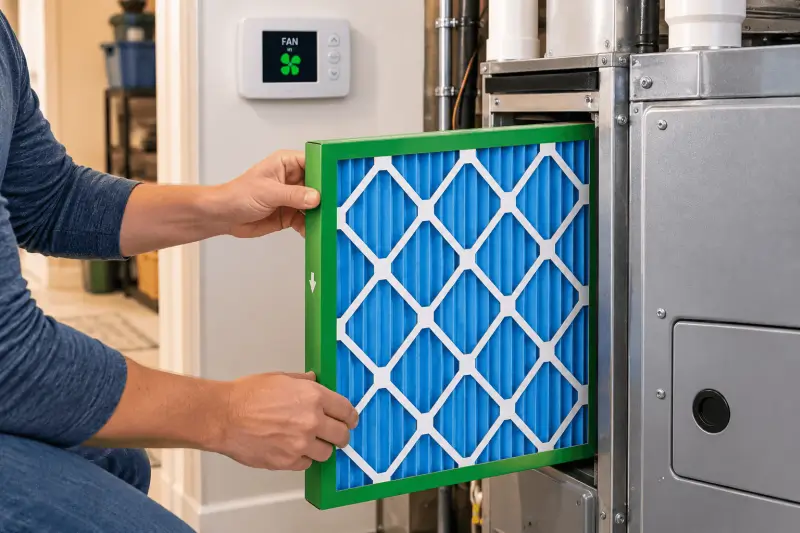
1. Fit MERV 13 early. Your size is printed on your current filter's frame, and Filterbuy's size guide helps if it isn't. Most furnaces and HVAC systems can run MERV 13 without equipment problems if the filter is replaced often, according to the U.S. EPA.
2. Keep a spare MERV 13 on hand so a smoke week doesn't mean a store run.
3. Learn your HRV or ERV controls so you can cut outdoor-air intake when smoke arrives.
4. Get alerts. Sign up for Ontario's air quality email alerts.
During a Smoke Event (AQHI 7 and Up)
1. MERV 13 in your HVAC. This is the whole-home layer, because the central system moves far more air than any portable unit.
2. Thermostat fan to On. Auto only filters while the system heats or cools. On filters all the time, as the U.S. EPA advises. Set any fresh-air intake to recirculate.
3. A portable HEPA air cleaner in each occupied room, bedrooms first. This is Filterbuy's recommendation. MERV 13 covers the whole home; the HEPA unit works harder on one room, so use both. Size it with Health Canada's rule: a smoke CADR of at least two-thirds of the room's square footage. A 300 sq ft bedroom needs a smoke CADR of about 200. Skip any unit that produces ozone.
4. Close the house up. Shut windows, doors, and the fireplace damper. Don't smoke, fry food, burn candles, or vacuum unless your vacuum has a HEPA filter.
No central HVAC? In apartments, homes with baseboard heat, or homes with window units, portable HEPA air cleaners are your primary defence, not an extra. Ask your property manager about the building's filters.
DIY option: a box fan with a MERV 13 filter is a fair stopgap but not a replacement for a certified air cleaner. Use a certified fan from 2012 or newer and never leave it running unattended.
Check the filter often. Replace it when it looks dirty, dark brown or black, which can be well before the normal interval. If smoke and extreme heat arrive together, Health Canada advises keeping cool first.
After the Smoke Clears
1. Replace the filter, then wet-mop hard floors and vacuum with a HEPA-filter vacuum, as Health Canada advises.
2. Clear lingering residue with Filterbuy's wildfire smoke recovery checklist.
Which Air Filter Is Best for Pickering's Smoke Season?
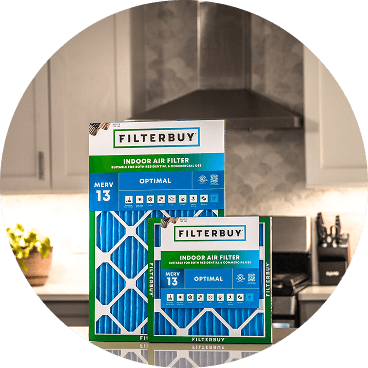
For wildfire smoke, choose MERV 13. It's the MERV rating Filterbuy recommends for smoke, and we label it "Optimal." Filterbuy's MERV 13 label reads "Captures 98% of Airborne Particles."
Environment Canada recommends MERV 13 or higher during wildfire smoke. Pleated filters capture particles; smoke smell comes from gases.
Smoke smell comes from gases, which pleated filters don't remove. Filterbuy makes MERV 13 filters in over 600 sizes, plus custom sizes, crafted in our own facilities and shipped free to Canada with no minimum order. Prices are shown in CAD. With Subscribe & Save, spares arrive on your schedule, and you can edit, skip, or cancel anytime. Not sure of your size? See how to choose the right filter size.
Supporting Statistics: What Canadian Research Shows
1. Up to 2,500 deaths a year
◦ Wildfire smoke contributed to up to 2,500 deaths a year in Canada (2013–2018).
◦ Source: Health Canada
2. About 90% of time indoors
◦ Canadians spend about 90% of their time indoors.
◦ Filtration works best on particles, the main pollutant in smoke.
◦ Source: Health Canada
3. 15 million hectares in one season
◦ In 2023, more than 6,000 fires burned about 15 million hectares, about six times the yearly average.
◦ Source: Natural Resources Canada
Frequently Asked Questions About Fire and Smoke in Pickering, ON
What MERV rating do I need for wildfire smoke?
MERV 13. Environment Canada recommends MERV 13 or higher during smoke events, and it's the tier Filterbuy recommends for smoke.
Is it safe to be outside in Pickering during wildfire smoke?
Follow Environment Canada and public health advice first. At an AQHI of 7 to 10, people at higher risk should reduce or reschedule strenuous outdoor activity. At 10+, everyone should, and at-risk people should avoid it. If you must be outside, a well-fitted N95 respirator reduces fine particles but not smoke gases.
Does my air conditioner filter wildfire smoke?
In most forced-air homes, yes. The furnace and central air share one filter, so a MERV 13 filter works in summer too.
How often should I change my furnace filter during smoke?
Check it during the smoke event and replace it when it looks dark brown or black. That can be well before the usual 60 to 90 days, so keep a spare on hand.
Glossary
• AQHI (Air Quality Health Index): Canada's 1-to-10+ scale for the health risk from air pollution, produced by Environment and Climate Change Canada with Health Canada and the provinces.
• AQI (Air Quality Index): A 0-to-500 U.S. scale used by many weather apps; not interchangeable with the AQHI.
• PM2.5: Fine particulate matter 2.5 micrometres or smaller, the main health concern in wildfire smoke.
• MERV (Minimum Efficiency Reporting Value): A 1-to-16 rating of how well an HVAC filter captures particles. Higher numbers capture finer particles.
• HRV / ERV (Heat or Energy Recovery Ventilator): A home ventilation unit that exchanges stale indoor air for fresh outdoor air.
About the Author and Reviewer
Michelle Wan, Filterbuy's Brand Manager and air quality writer, works with our manufacturing team. David Clark, a Licensed HVAC Technician with Filterbuy HVAC Solutions, reviewed the HVAC guidance. Health guidance follows Environment Canada and Health Canada and is not medical advice.
Sources
• Environment and Climate Change Canada: About the Air Quality Health Index
• Environment Canada: Oshawa AQHI
• Air Quality Ontario: Toronto East AQHI
• Health Canada: Protecting your physical and mental health from wildfire smoke
• Health Canada: Using a portable air cleaner to improve indoor air
• North Renfrew Times: Environment Canada smoke advisory, MERV 13 guidance (June 2023)
• Government of Ontario: Forest fires
• U.S. EPA: Wildfires and Indoor Air Quality (updated 2 September 2026)
• U.S. EPA (archived): Preparing for Fire Season
• Air Quality Ontario: The air quality alert program
• Natural Resources Canada: Current wildland fire activity (CWFIS)
• Health Canada: Human health effects of wildfire smoke report summary
• Health Canada: Ventilation and the indoor environment
• Natural Resources Canada: Canada's record-breaking wildfires in 2023
• The Canadian Press via CFJC Today: Wildfire smoke persists across Ontario (16 July 2026)
• City of Pickering: July 2026 burn ban lifted