
Saskatchewan Live Wildfire Smoke Map
Get Alerts For Wildfires In Your Area
The moment a wildfire starts near you, you'll get an instant alert and simple tips to reduce your smoke exposure.
What's In The Smoke
30xSmaller than a human hair
Fine enough to reach deep into the lungs. A MERV 13 is built to capture it.
How Far It Travels


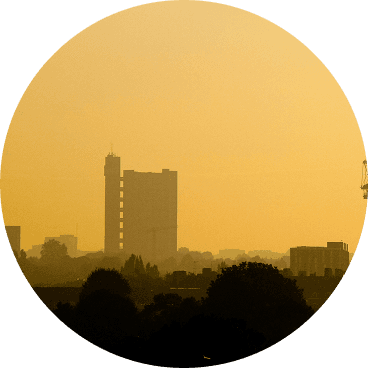
It Doesn't Stay Local
Smoke rides the wind far downwind — you can get smoky air with no fire nearby.
What To Do During A Smoke Event
Simple steps to reduce indoor exposure.
- Stay In, Close UpShut windows and doors to keep smoke out.
- Set Fan To "On"Keeps air cycling through your filter, not just when heating or cooling.
- Recirculate AirSwitch off fresh-air intake so you're not pulling smoke in.
- Run A MERV 13Built to capture the fine PM2.5 in smoke.
- Add A PurifierExtra filtration for the room you use most.
- Wear an N95 if OutsideFits snug to block fine particles — a cloth mask won't.


The Best Air Filter For Wildfire Smoke
During smoke events, the EPA recommends upgrading to a MERV 13 filter — or the highest-rated filter your system can handle — to help reduce the fine particles smoke brings indoors. MERV 13 is the level most home HVAC systems can run while still capturing PM2.5, the fine particulate that makes up the bulk of wildfire smoke.
- Captures PM2.5 particles
- Blocks ash, soot, and smoke odor
- Keeps your indoor air safe—even when the outdoor air is dangerous
- Meets the EPA's recommended rating for filtering fine wildfire smoke particles.

Wildfire Smoke FAQs
Facts About Wildfires
Over 70,000 wildfires burn in the U.S. every year.
Wildfire smoke can travel 1,000+ miles, affecting states that aren't even near the blaze.
Exposure to wildfire smoke can worsen asthma, trigger heart issues, and lead to ER visits.
Indoor air can hold more fine particles during wildfire events unless it's properly filtered.
The EPA advises using MERV 13 filters or portable HEPA air cleaners during wildfire smoke events.
Don't Wait Until The Smoke's Inside.
Use the live wildfire smoke tracker and upgrade your air filters today to protect your lungs and your home.
Shop Filters For Smoke Protection
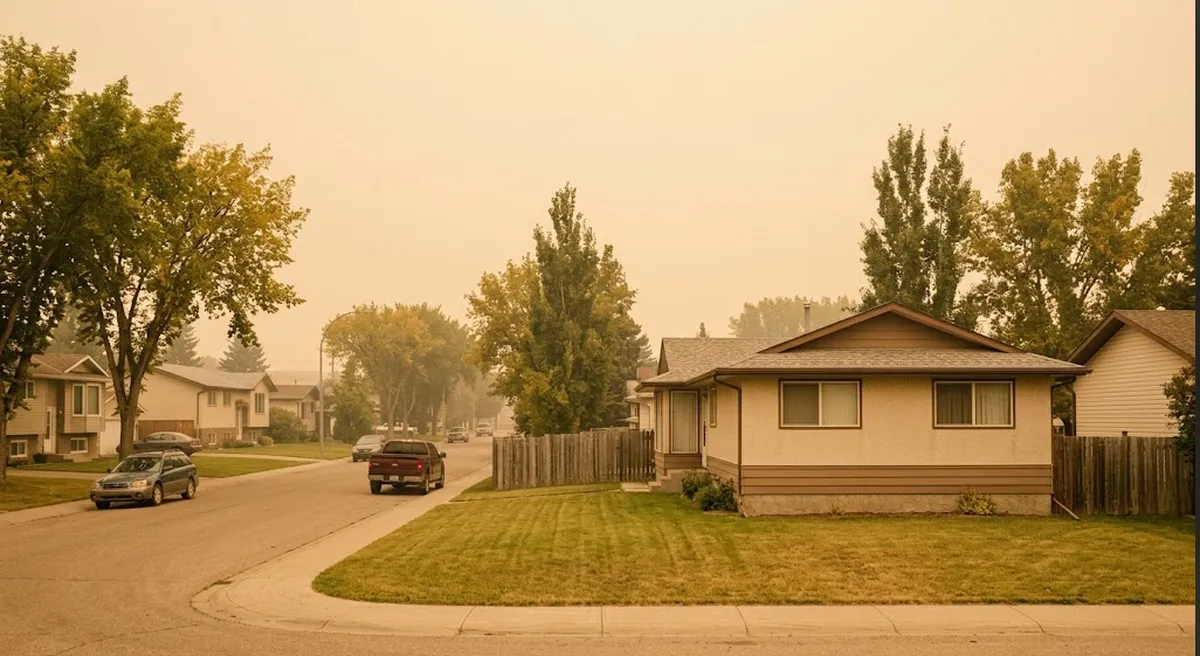
Live Saskatchewan Forest Wildfire & Smoke Map Today: Provincial Air Quality Tracking & Indoor Protection Solutions
Written by Michelle Wan · Reviewed by David Clark, Licensed HVAC Technician · Published 1 September 2026 · Updated 1 September 2026
TL;DR
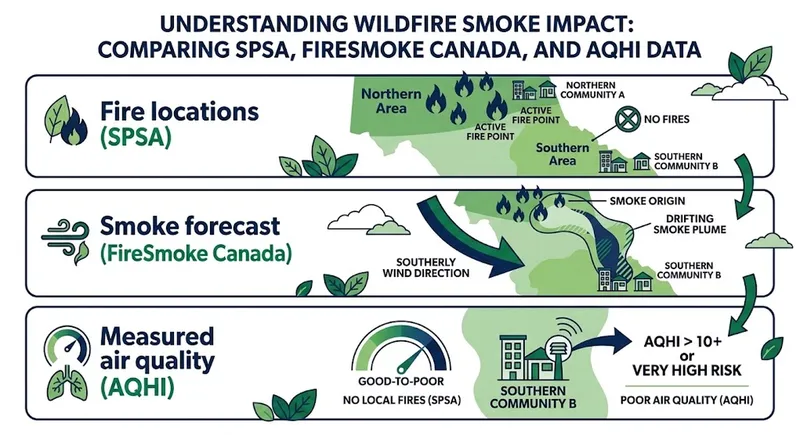
Fire locations come from the Saskatchewan Public Safety Agency, smoke forecasts from FireSmoke Canada, and measured air quality from Environment Canada’s AQHI. Check all three, because a fire hundreds of kilometres away can smoke out Regina while a nearby one produces nothing. Indoors the response is simple: close the windows and run a clean, high-efficiency furnace filter, ideally MERV 13 if your system takes it. No forced-air system? See the portable air cleaner guidance below.
Key Takeaways
SPSA publishes the province’s official wildfire data on its active incidents page.
Environment Canada reports the AQHI for only six Saskatchewan communities. Most of the province has no nearby station.
Fine particulate matter makes up roughly 90% of the particle mass in wildfire smoke, and travels far from the fire itself.
A Special Air Quality Statement is issued when the AQHI is forecast to reach 7 or higher.
Health Canada calls for filters rated MERV 13 or higher to remove PM2.5, if the system handles the added pressure drop.
No forced-air system? Portable air cleaners and source control still work.
Where to Check Live Saskatchewan Wildfire and Smoke Conditions Today
Three official sources cover Saskatchewan, each answering a different question.
For fire locations, SPSA publishes the Emergency Response Map, updated in real time, plus a daily wildfire map (PDF). Restrictions are on the fire bans page.
Those labels are worth decoding. Contained means suppression is working and the fire isn’t expected to grow, not that it’s out. Not Contained means crews are on it but it’s still expected to spread. Protecting Values means the fire is active and effort has shifted to defending cabins, homes, and infrastructure. Ongoing Assessment means it’s monitored rather than fought.
For smoke movement, FireSmoke Canada’s forecast models ground-level PM2.5 across North America. It comes from the University of British Columbia, and SPSA points residents to it.
For measured air quality, check the Saskatchewan AQHI summary or the provincial air quality map. For evacuation alerts, register with SaskAlert.
Why the Fire Map, the Smoke Forecast, and the AQHI Often Disagree
This confuses people every season. The three maps measure three different things, so they’re supposed to disagree. The fire map shows ignition points. The smoke forecast shows modelled plume transport, which can run hundreds of kilometres downwind. The AQHI shows measured concentrations at fixed stations.
What matters in Saskatchewan is how few of those stations there are. When Filterbuy pulled Environment Canada’s provincial summary, we expected a dense network and found six: Buffalo Narrows, Estevan, Prince Albert, Regina, Saskatoon, Swift Current. Six, across roughly 651,900 square kilometres. Live anywhere else and your nearest reading may be hours away.
That changes the advice we’d give here versus Ontario or BC. In most of Saskatchewan, the smoke forecast tells you more than the nearest AQHI station does. A resident near Meadow Lake can see no fires nearby, a thick plume overhead, and a distant “Low Risk” reading, all at once and all correct.
So which one governs your decision? For evacuation and travel, follow SPSA and your local authority. For whether to open the windows today, use the AQHI if you’re near a station and the forecast if you aren’t.
“We manufacture every filter we sell, in our own facilities. That’s precisely why we’ll tell you MERV 13 isn’t automatically right for your furnace. We aren’t moving someone else’s inventory, so we’d rather you run the rating your system can actually handle than the one with the biggest number on the box.”
Filterbuy Canada
How to Read Saskatchewan’s AQHI
The Air Quality Health Index runs 1 to 10+ across four risk bands. During a smoke event, Environment Canada switches to fine particulate matter alone, updated hourly, because PM2.5 spikes faster than the other tracked pollutants.
AQHI 1–3 (Low risk). Enjoy your usual outdoor activities.
AQHI 4–6 (Moderate risk). Consider rescheduling strenuous outdoor activity if you’re coughing or your throat is irritated.
AQHI 7–10 (High risk). Reduce or reschedule strenuous outdoor activity. This band triggers a Special Air Quality Statement.
AQHI above 10 (Very high risk). Avoid strenuous outdoor activity. During smoke events, the index stops climbing past 10+ even as conditions worsen.
Children, older adults, pregnant people, anyone with heart or lung conditions, and outdoor workers feel it first.
What Wildfire Smoke Does Inside a Saskatchewan Home
Closing the windows helps, but it doesn’t seal the house. Health Canada identifies fine particulate matter as the main threat in wildfire smoke, roughly 90% of total particle mass, and it infiltrates through the envelope, door frames, and ventilation intakes. Keep indoor PM2.5 as low as you can: no known threshold is fully protective.
On a smoky day your furnace becomes your primary air cleaner. Health Canada’s cleaner air spaces guidance advises recirculation while outdoor air is poor, then fresh-air intake once it clears.
Filterbuy’s Saskatchewan Smoke Response Ladder
We built this ladder because the usual advice, “use MERV 13 for smoke,” ignores the other eleven months.
At AQHI 1–3, a [Standard MERV 8 filter](https://filterbuy.ca/merv-8-air-filters/) covers everyday needs, catching 90% of particles in the 3.0–10.0 micron range.
At AQHI 4–6, a [Superior MERV 11 filter](https://filterbuy.ca/merv-11-air-filters/) makes a sensible baseline. It captures 95% of particles down to 1.0 micron at lower resistance than MERV 13, suiting homes that see intermittent haze.
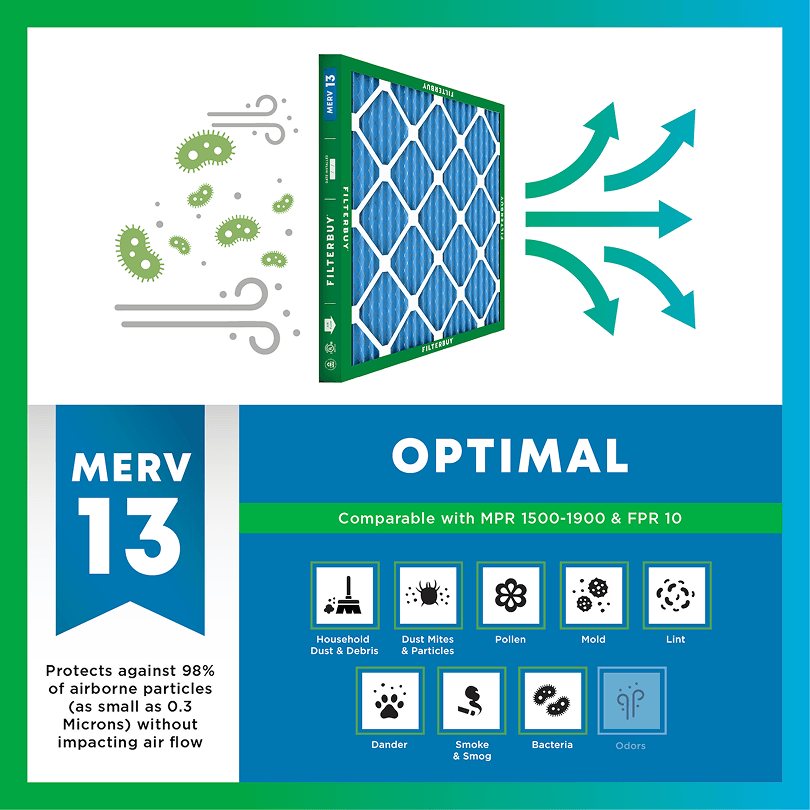
At AQHI 7 and above, Health Canada points to MERV 13 or higher. Filterbuy’s Optimal MERV 13 filters capture 98% of particles as small as 0.3 microns, the range that makes smoke hard to filter.
When odour is the complaint, particulate filtration won’t solve it, because odour is gas-phase. Our Odour Eliminator carbon filters use carbon-infused media instead.
In any smoke event, add one clean-air room with a portable air cleaner. Ductwork filtration and a bedroom unit do different jobs.
See our guides to MERV ratings and the best MERV filter for smoke.
What If Your Home Has No Filter Slot?
Filterbuy sells furnace filters, so this section costs us something. We’re writing it anyway.
Plenty of Saskatchewan homes have nothing to filter: apartments and condos on baseboard electric, older houses on hot-water boilers, rentals where you don’t control the mechanical room. The study cited below found only about half the homes in its city had central air. If that’s you, the ladder above won’t help, and neither will any Filterbuy filter.
Here’s what does. Health Canada’s shelter-at-home guidance doesn’t require ductwork:
Run a portable air cleaner in one room, usually the bedroom. Size it so its smoke CADR handles two to three times the room’s volume per hour.
Avoid ozone generators. Health Canada advises against them.
Cut indoor sources: skip candles, incense, and the wood stove. Don’t vacuum without a HEPA filter; wipe or wet-mop instead.
Limit exhaust fans when you aren’t cooking, since they pull outdoor air in through the envelope.
Seal what you can. Weatherstripping is cheap and it works.
Will Your Furnace Handle a MERV 13 Filter?
Not every system will, and this matters more than the rating on the box. Higher-efficiency media creates more airflow resistance, which on an older or undersized blower can strain the equipment.
This is the trade-off we spend the most time on with customers, and the honest answer is that we can’t see your furnace from here. Most residential systems accommodate MERV 13 provided the filter is replaced frequently, but “most” is not “yours.” Check your manual or ask a qualified technician first. Treating it as seasonal is legitimate: run MERV 13 through smoke season, then return to your usual rating. We’d rather sell you two ratings that work than one that strains your blower.
How Often Should You Change Your Filter During Smoke Season?
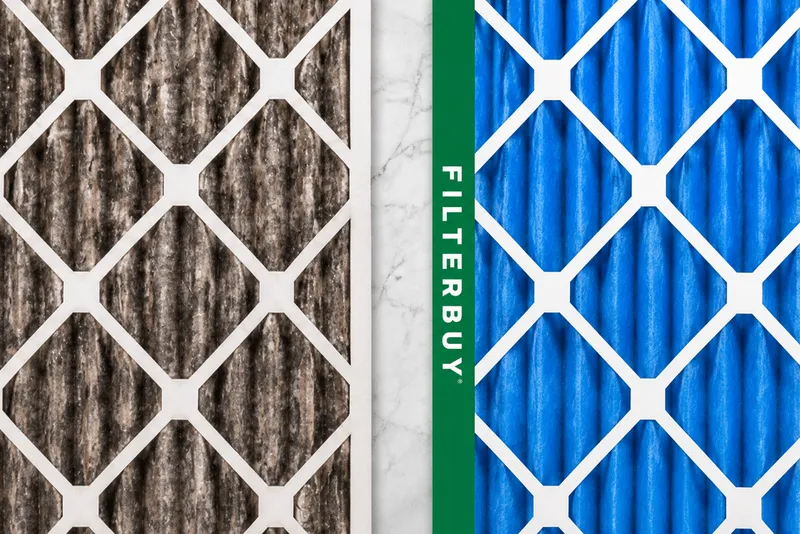
Inspect it rather than trusting the calendar. Filterbuy designs its MERV 13 filters for a 90-day service life, and that assumes ordinary household dust, not a smoke plume. Wildfire particulate loads them far faster. If the media looks dark brown or black, replace it.
Canadian furnaces already run six to eight months a year, so a smoke season on top of that is when spare filters pay off. Filterbuy makes its own filters and ships free across Canada with no minimum, priced in CAD. Find your filter size, create a custom size if yours isn’t standard, or set up a subscription and edit, skip, or cancel anytime. Here’s how to replace your filter.
Supporting Statistics
Three findings from U.S. federal research agencies underpin the guidance above.
1. Smoke Crosses Enormous Distances
NOAA’s Climate Program Office analysed 600 monitoring stations and satellite data, 2018–2023:
Wildfire smoke measurably raised both PM2.5 and ozone.
It accounted for 25% of all days with unhealthy ozone levels.
2023 was the worst year on record, driven by fires in Canada.
If Canadian smoke shifts air quality that far, it reaches Regina from Buffalo Narrows.
2. Indoor Air Is Where Exposure Happens
Per the U.S. Environmental Protection Agency:
People spend roughly 90% of their time indoors.
Some pollutants run two to five times higher indoors than out.
Your filter governs the air you breathe for most of a smoky day.
3. MERV 13 Helps Substantially, but Isn’t the Whole Answer
An EPA-funded study in Pollutants, archived at the U.S. National Institutes of Health, instrumented a home through the September 2020 Pacific Northwest smoke event:
MERV 13 alone: mean indoor/outdoor PM2.5 ratio of 0.55.
MERV 13 plus a portable air cleaner: 0.22.
Indoor PM2.5 fell from 134.9 to 28.2 μg/m³.
Even so, indoor levels stayed above the EPA’s 24-hour threshold.
That last bullet is why we push the clean-air room as hard as the filter.
Frequently Asked Questions
Glossary
AQHI (Air Quality Health Index): Environment Canada’s 1-to-10+ scale reporting the health risk of current air quality, developed with Health Canada and Saskatchewan’s Ministries of Environment and Health.
PM2.5: Fine particulate matter 2.5 micrometres or smaller. The dominant health-relevant component of wildfire smoke.
MERV (Minimum Efficiency Reporting Value): The ASHRAE scale rating a filter’s particle-capture efficiency. Higher numbers capture smaller particles.
CADR (Clean Air Delivery Rate): How much filtered air a portable cleaner delivers, rated separately for smoke, dust, and pollen.
Sources: Saskatchewan Public Safety Agency; Environment and Climate Change Canada; Health Canada, Guidance for Cleaner Air Spaces During Wildfire Smoke Events; FireSmoke Canada / BlueSky Canada, University of British Columbia; NOAA Climate Program Office; U.S. EPA; U.S. National Institutes of Health.