
Abbotsford, BC Live Wildfire Smoke Map
Get Alerts For Wildfires In Your Area
The moment a wildfire starts near you, you'll get an instant alert and simple tips to reduce your smoke exposure.
What's In The Smoke
30xSmaller than a human hair
Fine enough to reach deep into the lungs. A MERV 13 is built to capture it.
How Far It Travels


It Doesn't Stay Local
Smoke rides the wind far downwind — you can get smoky air with no fire nearby.
What To Do During A Smoke Event
Simple steps to reduce indoor exposure.
- Stay In, Close UpShut windows and doors to keep smoke out.
- Set Fan To "On"Keeps air cycling through your filter, not just when heating or cooling.
- Recirculate AirSwitch off fresh-air intake so you're not pulling smoke in.
- Run A MERV 13Built to capture the fine PM2.5 in smoke.
- Add A PurifierExtra filtration for the room you use most.
- Wear an N95 if OutsideFits snug to block fine particles — a cloth mask won't.


The Best Air Filter For Wildfire Smoke
During smoke events, the EPA recommends upgrading to a MERV 13 filter — or the highest-rated filter your system can handle — to help reduce the fine particles smoke brings indoors. MERV 13 is the level most home HVAC systems can run while still capturing PM2.5, the fine particulate that makes up the bulk of wildfire smoke.
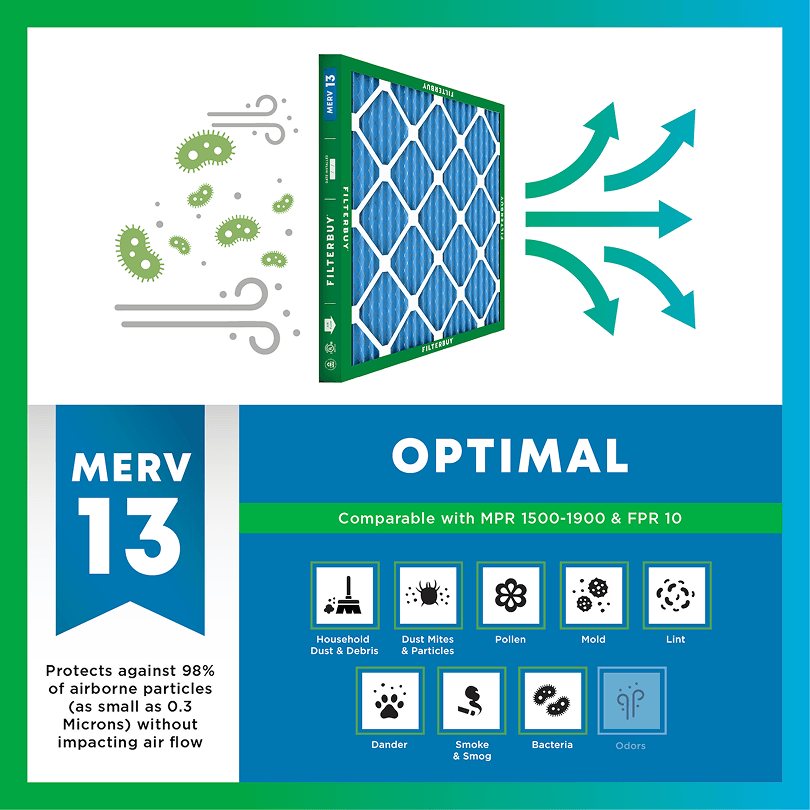
- Captures PM2.5 particles
- Blocks ash, soot, and smoke odor
- Keeps your indoor air safe—even when the outdoor air is dangerous
- Meets the EPA's recommended rating for filtering fine wildfire smoke particles.
Wildfire Smoke FAQs
Facts About Wildfires
Over 70,000 wildfires burn in the U.S. every year.
Wildfire smoke can travel 1,000+ miles, affecting states that aren't even near the blaze.
Exposure to wildfire smoke can worsen asthma, trigger heart issues, and lead to ER visits.
Indoor air can hold more fine particles during wildfire events unless it's properly filtered.
The EPA advises using MERV 13 filters or portable HEPA air cleaners during wildfire smoke events.
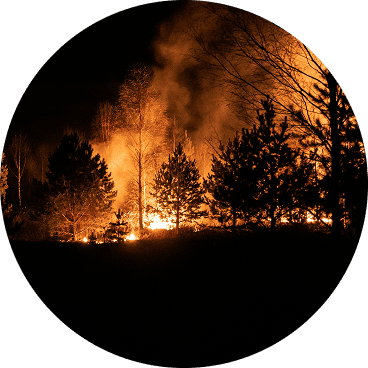
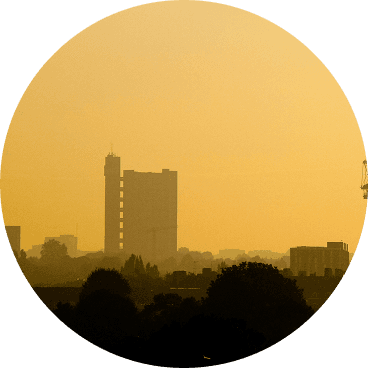
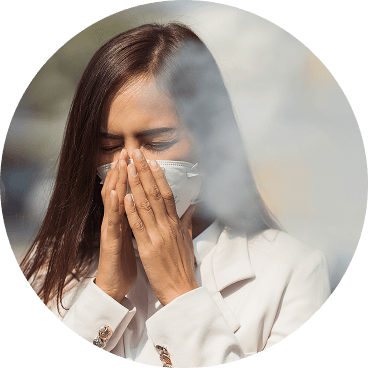
Don't Wait Until The Smoke's Inside.
Use the live wildfire smoke tracker and upgrade your air filters today to protect your lungs and your home.
Shop Filters For Smoke Protection
Live Abbotsford, BC Forest Wildfire & Smoke Map Today: Local Air Quality Tracking & Indoor Protection Solutions
TL;DR
Filterbuy's live map below shows today's wildfires and smoke around Abbotsford, British Columbia, along with the local air quality reading. Abbotsford's smoke often drifts in from fires elsewhere in B.C. or across the U.S. border, so a clear sky doesn't guarantee clean air. Put a MERV 13 filter in your furnace before smoke arrives. When the Air Quality Health Index (AQHI) reaches 7, set your thermostat fan to On, run a portable HEPA air cleaner in each occupied room and close up the house.
Key takeaways
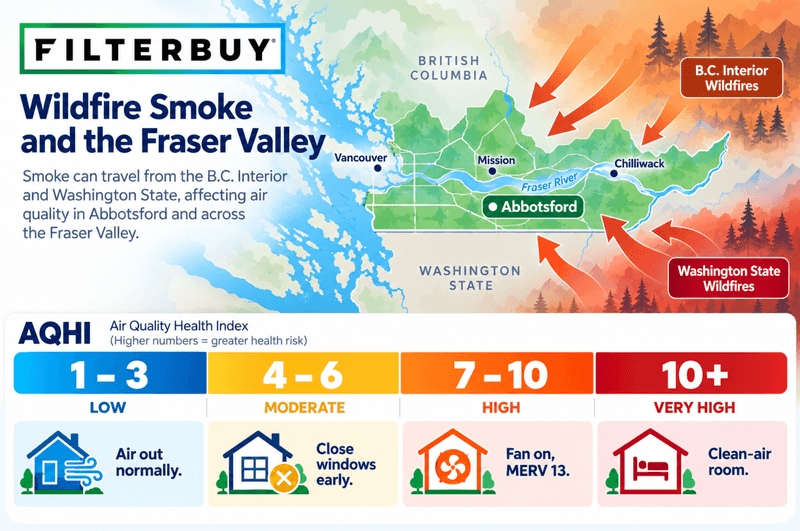
Abbotsford's AQHI runs from 1 to 10+, and a reading of 7 to 10 means high health risk, according to Fraser Health.
Smoke that reaches Abbotsford often comes from wildfires in the B.C. Interior and then settles into the Fraser Valley.
PM2.5, the fine particles in smoke, is the main health concern, and it gets inside homes easily.
Smoke loads filters quickly. Check yours during a smoke event and replace it when it looks dark brown or black.
Filterbuy runs live smoke maps for cities across the U.S., and every one teaches the same lesson: people judge the air by the sky, and the sky is often wrong. This page shows Abbotsford families the real reading and what to do inside.
Michelle Wan, Brand Manager and Air Quality Writer, Filterbuy
Abbotsford Wildfire and Smoke Map: Live Today
Filterbuy's Abbotsford map brings three live sources together: active fire locations from the BC Wildfire Service, smoke forecasts from Environment and Climate Change Canada (ECCC), and AQHI and PM2.5 readings from the Central Fraser Valley monitoring station. Filterbuy's live North American wildfire and smoke map tracks smoke crossing the border.
How Do You Read the Abbotsford Fire and Smoke Map Today?
Act on the station reading, not the smoke plume. Plumes show what might reach you; the AQHI and PM2.5 readings show what Abbotsford is breathing now.
What the AQHI Numbers Mean for Your Home
Filterbuy's action line is AQHI 7, the start of the high-risk range. At that point we recommend four steps: a MERV 13 filter in your furnace, the thermostat fan set to On, a portable HEPA air cleaner in each occupied room (bedrooms first) and a closed-up house. If your app shows the U.S. AQI instead, our action line is 100, the top of its Moderate range.
Since 2021, the B.C. government has reported an adjusted version, AQHI-Plus, because the standard index sometimes under-reported smoke risk.
Risk categories: Fraser Health. Home actions: Filterbuy recommendations. Readings above 10 are rare and usually caused by wildfire smoke.
The province notes that an AQHI of 7 or more is usually driven by smoke particles (PM2.5), and smoke maps to MERV 13 on Filterbuy's filter ladder.
Which Abbotsford Air Quality Number Should You Trust?
Depending on the app, you may see four air quality numbers for Abbotsford, each on a different scale. Use the B.C. AQHI for health decisions and the rest as context.
Scales compared by Filterbuy, September 30, 2026.
When the Filterbuy team checked IQAir's Abbotsford page at 4 a.m. on September 30, 2026, its five stations ranged from 18 to 59 on the U.S. AQI. That's a threefold spread on a calm night. Sensors show whether your street runs higher; the AQHI should guide what you do.
Why Does Wildfire Smoke Settle Over Abbotsford?
The Fraser Valley works like a funnel. Mountains line it to the north and south, and it opens east toward the Fraser Canyon. Smoke from fires in the B.C. Interior or south of the border can drain down the valley, and when the weather turns calm and stable, it stays trapped near the ground.
On August 4, 2026, Metro Vancouver raised its air quality warning for the eastern Fraser Valley to orange, very high risk, as smoke from fires near Boston Bar and the southern Interior settled in, the Abbotsford News reported. A day later, a yellow warning also covered the Central Fraser Valley, where Abbotsford sits, according to Global News. Events like this tend to fall between July and September.
Who in Abbotsford Is Most at Risk From Wildfire Smoke?
PM2.5, the most harmful part of smoke, travels deep into the lungs and slips indoors through gaps around windows and doors. Fraser Health, the health authority serving Abbotsford, lists these groups as facing higher risk:
People with lung disease, heart disease, chronic obstructive pulmonary disease (COPD), asthma or diabetes
People with respiratory infections
Pregnant people and infants
Children and older adults
Outdoor workers, including the farm and construction crews common across Abbotsford. Employers can find practical steps in WorkSafeBC's wildfire smoke guidance.
Sore eyes, a scratchy throat, coughing and headaches are common on smoky days. Shortness of breath, chest pain or a severe cough need medical attention. In B.C., you can call 8-1-1 for free health advice from HealthLink BC, or 9-1-1 in an emergency. To plan ahead, the BC Centre for Disease Control's wildfire smoke guidance has free fact sheets.
How Do You Keep Wildfire Smoke Out of Your Abbotsford Home?
Start with official guidance: check Metro Vancouver's air quality warnings and follow B.C. health advice. Filterbuy's steps support that guidance rather than replace it.
Your Smoke-Day Checklist
Install a MERV 13 furnace filter. Health Canada recommends HVAC filters rated MERV 13 or higher for removing PM2.5 during smoke events. Put it in before smoke arrives.
Set your thermostat fan to On. Auto only filters while the system heats or cools; On filters continuously. If your home has a heat recovery ventilator (HRV), check the manual for a recirculation or low setting so it stops drawing in smoky outdoor air.
Run a portable HEPA air cleaner in each occupied room, bedrooms first. That's Filterbuy's recommendation, and it goes further than the single cleaner-air room health agencies describe. The U.S. EPA suggests a tobacco-smoke CADR of at least two-thirds of the room's floor area in square feet. A 3.7 m × 3.7 m bedroom (roughly 144 sq ft) needs a CADR of 96 or more. Skip ionizers and ozone generators; EPA advises against air cleaners that produce ozone.
Close up the house. Keep windows and doors shut once the AQHI reaches 7. Skip frying, candles, incense and the wood stove, and vacuum only with a HEPA vacuum.
Inspect your filter during a smoke event. Replace it when it looks dark brown or black, which can be well before the usual interval, and keep a spare on hand.
No central HVAC? In apartments, homes with window units and older homes without ductwork, portable HEPA air cleaners are your main defense, not a backup. Start with the bedrooms.
Which Furnace Filter Works Best for Wildfire Smoke?
For most Abbotsford homes, a MERV 13 air filter is the best everyday choice for wildfire smoke.
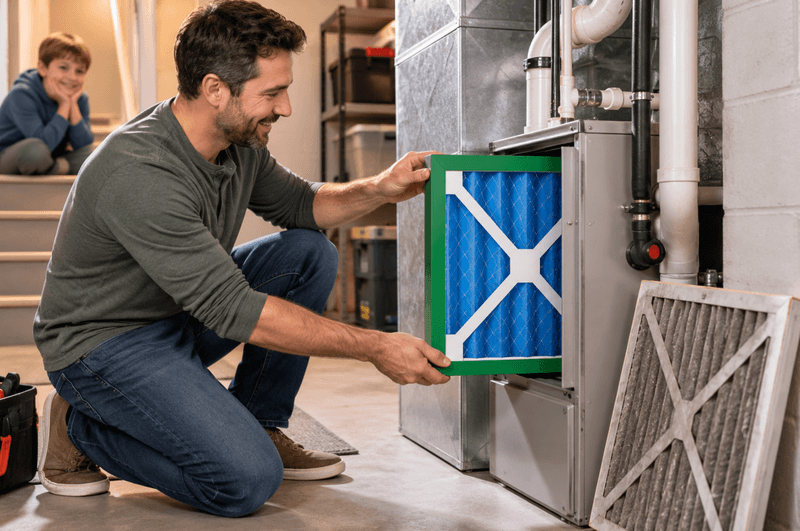
Most furnaces and HVAC systems can run MERV 13 without equipment problems when the filter is replaced often (U.S. EPA). Confirm your filter size before ordering.
According to the EPA, most furnaces and HVAC systems can run a MERV 13 filter without equipment problems, as long as it's replaced often. Treat it like confirming your size: a normal fit check. At Filterbuy, where every filter is cut to size, fit matters as much as the rating, because a filter even slightly too small lets air slip around the frame unfiltered.
How Often Should You Change Your Filter During Smoke Season?
EPA's test is simple: replace the filter when it looks dark brown or black, which can be sooner than the manufacturer suggests. Every Filterbuy MERV 13 also uses electrostatically charged media, and researchers at Harvard's Healthy Buildings program found that smoke can mask that charge. So replace it once a heavy smoke week is over, even if it doesn't look dark yet.
Filterbuy has made pleated filters in its U.S. factories since 2013, and each smoke season we tell customers: a filter that looks clean at the start of a smoky week can be dark by the end of it. For more, read Filterbuy's guide to the best MERV filter for wildfire smoke, or compare MERV 13 vs. HEPA for wildfire smoke.
Find Filterbuy MERV 13 filters in your size →
Supporting Statistics: What Does the Research Say About Wildfire Smoke Indoors?
U.S. health and environmental research backs up each step above.
Sources: CDC Morbidity and Mortality Weekly Report (2023); U.S. EPA (2026); Burke et al., PNAS (2021).
Sources: CDC MMWR, 2023; U.S. EPA, 2026; Burke et al., PNAS 2021 (NSF record).
Abbotsford Wildfire and Smoke FAQs
Is There a Forest Fire in Abbotsford, BC, Right Now?
Check the fire layer on Filterbuy's live map above. It pulls official incident data from the BC Wildfire Service.
Is It Safe to Go Outside in Abbotsford Today?
At an AQHI of 1 to 3, normal outdoor activity is fine for most people. At 7 or higher, cut back on strenuous outdoor activity, and sensitive groups should stay inside in filtered air.
Is Abbotsford Under an Evacuation Order?
Check EmergencyInfoBC for orders and alerts. Evacuation orders come only from officials, not from a smoke map.
Glossary
AQHI (Air Quality Health Index): Canada's 1 to 10+ scale for the health risk of outdoor air pollution.
AQHI-Plus: British Columbia's adjusted AQHI formula, used since 2021 to better reflect smoke risk.
BC Wildfire Service: British Columbia's provincial wildfire agency.
CADR (Clean Air Delivery Rate): How much filtered air a portable air cleaner delivers.
FireWork: Environment and Climate Change Canada's smoke forecast model.
HEPA: High-efficiency particulate air filtration, used in portable air cleaners.
HRV (heat recovery ventilator): A system that exchanges indoor and outdoor air while recovering heat.
MERV (Minimum Efficiency Reporting Value): A 1 to 16 rating of how well an HVAC filter captures particles.
PM2.5: Fine particles 2.5 microns or smaller, and the main health concern in wildfire smoke.
U.S. AQI: The U.S. 0–500 scale many weather apps use, which differs from the AQHI.