Shop by
By Michelle Wan · Reviewed by David Clark, Licensed HVAC Technician · Published August 26, 2026 · Updated August 26, 2026
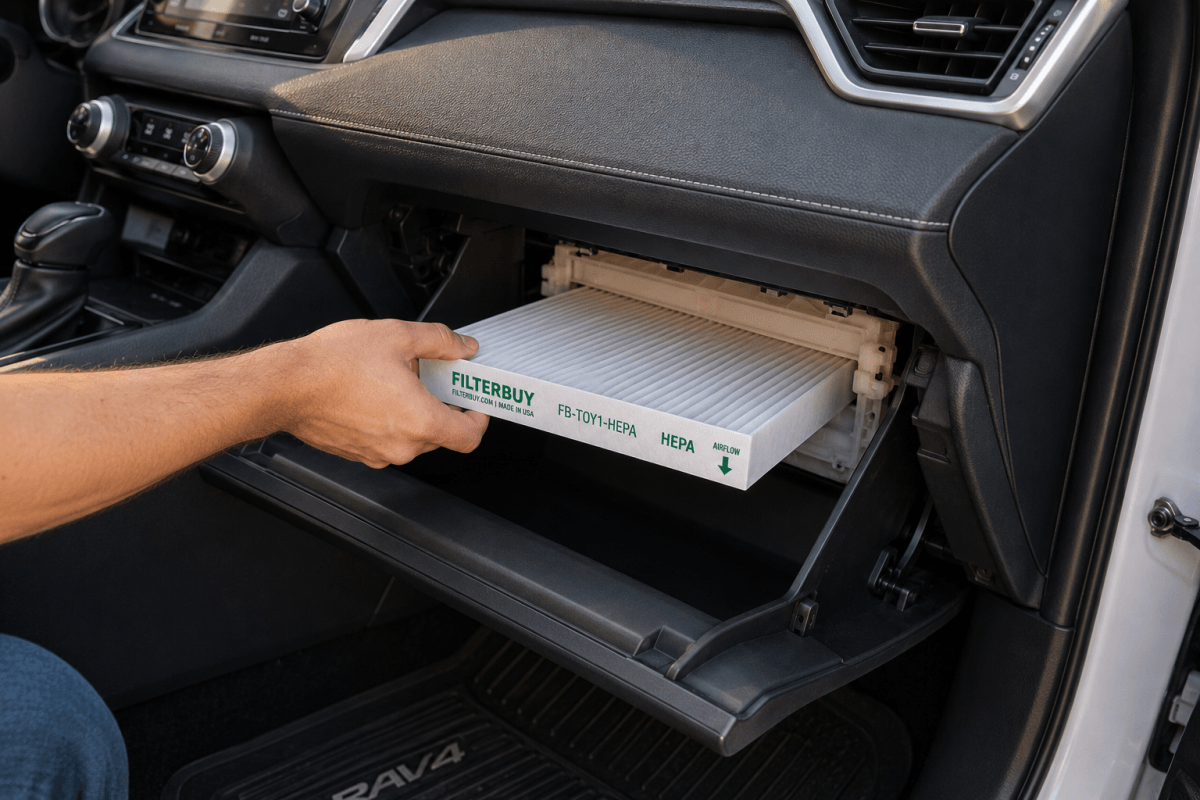
A Toyota RAV4 cabin air filter replacement runs $93 to $115 at a shop, or about $14 to $50 if you do it yourself. The filter sits behind the glove box, and swapping it takes ten minutes with no tools. For 2019 through 2025 RAV4s the standard Toyota part number is 87139-0R030, and every generation also offers a pricier charcoal version that drops into the same slot.
The standard filter for the 2019–2025 RAV4 is 87139-0R030; the charcoal version is 87139-58010.
RepairPal estimates $93–$115, of which $48–$71 is labor for about ten minutes of work.
Two part numbers for one RAV4 means standard versus charcoal, not a fitment question. Both fit.
Hybrid and Prime use the same filter as the gas model for a given year.
Replace every 15,000 miles or annually, and sooner in smoke, pollen, or heavy traffic.
The RAV4 uses a rectangular pleated filter that sits behind the glove box, listed in Toyota’s catalog as an “air refiner element.” Every generation offers it in two grades: a standard pollen filter, and a charcoal filter that adds odor control. Both drop into the same housing.
Filterbuy built this table from Toyota’s dealer reference, then checked every number against the genuine Toyota parts catalog. Toyota’s chart packs four grades into adjacent columns, and reading one a column off is how a page ends up recommending the wrong part. We know how easily it happens, because our own first pass did exactly that.
| RAV4 model years | Engine code | Standard (pollen) | Premium charcoal | Superseded / replaced numbers |
|---|---|---|---|---|
| 2001–2005 | 1AZ-FE, 2AZ-FE | 88568-52010-83 | None offered | Supersedes 88568-52010 (“dust filter”) |
| 2006–2012 | 2AZ-FE, 2AR-FE, 2GR-FE |
87139-02090 | 87139-50100 (2008–2012) |
02090 replaces 87139-52020, 0K010, 0E030; 50100 replaces 87139-50060 |
| 2013–2018 | 2AR-FE, 2AR-FXE |
87139-07020 | 87139-50100 | 07020 replaces 87139-52040 |
| 2019–2025 (incl. Hybrid) | A25A-FKS, A25A-FXS |
87139-0R030 | 87139-58010 | 0R030 replaces 87139-28020 |
| RAV4 Prime (2021–2025) | A25A-FXS | 87139-0R030 | 87139-58010 | Same parts as gas and Hybrid |
| RAV4 EV (2012–2014) | Battery only, no engine | 87139-02090 | 87139-50100 | Shares the 2006–2018 housing |
Sources: Toyota Cabin Air Filters dealer reference (2022) and ToyotaPartsDeal RAV4 catalog . Verified August 26, 2026.
Toyota also boxes service-line equivalents under its “YZZ” numbers, YZZ83 for the pollen filter and YZZ93 for the charcoal one, and they are the same filters in retail packaging. If you shop aftermarket instead, the interchange codes are CF12157 for 2019 through 2025 and CF10285 for 2006 through 2018.
2026 RAV4 owners: the sixth generation is a new platform and Toyota’s catalog runs only through 2024. Aftermarket listings show it sharing the 2019–2025 filter, but confirm by VIN before ordering.
Search any RAV4 year and two part numbers come back, which looks like a fitment trap and is not one. They are simply two grades of the same part, and both drop into the same housing.
Standard pollen filter: pleated media for dust, pollen, and road grit. On a 2013–2018 RAV4 that is 87139-07020, at $29.99 MSRP.
Premium charcoal filter: adds activated carbon for odors and exhaust gases. On the same vehicle that is 87139-50100 at $41.99, and on 2019–2025 RAV4s it is 87139-58010 at $52.99.
Here is what the catalog will not tell you. The carbon layer earns its $12 premium if you sit in traffic behind exhaust; it earns nothing on a highway commute, because carbon adsorbs gases and does nothing extra for particles. Carbon also saturates on its own schedule, and once the pores fill, odor control stops while the media still looks perfectly clean. That is why owners who judge a filter by its color end up leaving a dead one in for another year.
Filterbuy has manufactured cabin air filters in the USA since 2013, and media grade is the question we get asked most. It is the wrong one to lead with, because a filter that leaves daylight at the housing lets road air slip around the edges no matter what the media is rated for. That is why Filterbuy publishes this filter’s dimensions, 7.5 by 8.7 by 1.4 inches, rather than only a part number. Once fit is settled, our guide to how to choose a cabin air filter covers the media question, and we compare the major names in best cabin air filter brands.
A RAV4 cabin filter replacement costs $93 to $115 at a shop, per RepairPal’s RAV4 estimator, which breaks down to about $45 in parts and $48 to $71 in labor. Doing it yourself costs only the filter, from roughly $14 for a Filterbuy HEPA-grade unit to $53 for Toyota’s charcoal part. Newer RAV4s run higher because the part itself is pricier.
| Option | Parts | Labor | Total |
|---|---|---|---|
| Shop, 2019–2025 RAV4 | ~$52 | $50–$73 | $102–$125 |
| Shop, 2013–2018 RAV4 | ~$36 | $43–$60 | $79–$96 |
| Shop, all RAV4 years | ~$45 | $48–$71 | $93–$115 |
| Do it yourself | $14–$50 | $0 | $14–$50 |
Source: RepairPal Cabin Air Filter Replacement Cost Estimator, Toyota RAV4, 2026 figures. Per-generation totals are RepairPal's; parts and labor within them are Filterbuy's allocation of RepairPal's stated split.
The labor line is the one worth pausing on, because half the bill buys ten minutes of work on a filter you can reach without tools. Shops bill in flat-rate increments, so this is not a scam, but it makes the job one of the best-value things you can do yourself. If your shop is already changing the oil, bundling the filter into that visit still beats a standalone appointment. For the picture across vehicles, see cabin air filter replacement cost.
The whole job takes about ten minutes and needs no tools. The filter sits in a tray behind the glove box, reachable once the box swings down past its normal stops. These steps cover 2013 through 2025 models.
Empty the glove box and open it fully. Wipe dust from the opening so nothing falls into the housing.
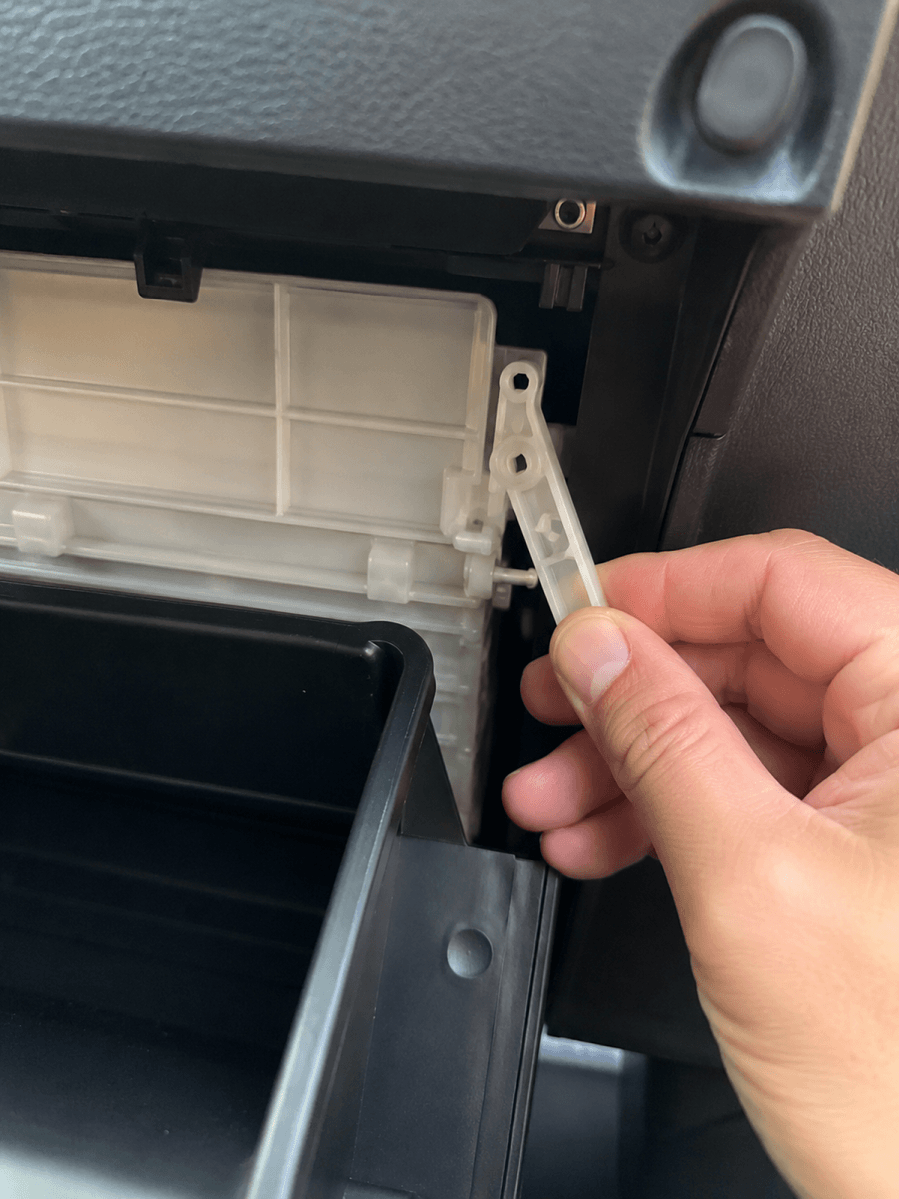
Detach the damper arm. A small plastic arm on the right slows the door as it drops. Slide it off its pin by hand, since prying it with a screwdriver snaps the clip.
Squeeze both sides inward. This clears the stops and lets the box swing all the way down.
Unclip the filter cover. It is white plastic, roughly eight inches wide. Pinch the tabs and pull straight off.
Photograph the old filter, then slide it out. Shoot it before anything moves, and pull it out level so trapped debris does not dump into the housing.
Vacuum the empty tray. Leaves and grit collect here and shorten the new filter’s life.
Fit the new filter and reassemble. Slide it in flat without crushing the pleats, clip the cover until it clicks, squeeze the sides past the stops, reattach the damper arm. Run the fan on high: steady airflow, no rattle.
About that arrow. This is the step that goes wrong most often, and the labeling is why. Toyota filters are printed UP, meaning that edge faces up, while most aftermarket filters are printed AIR FLOW with an arrow pointing down toward the blower. Both describe the same physical orientation, since air enters from above and travels down through the media, but side by side on a shelf they read as opposites.
Filterbuy prints its own filter packaging, and doing so taught us there is no shared convention to rely on. That is why every Filterbuy cabin filter ships with a QR code pointing to vehicle-specific directions instead of a generic arrow diagram. The only reference you can trust is the filter already in your car, so match its position rather than its arrow. Step 5 exists for exactly that reason.
Toyota calls for replacement at roughly 15,000 miles or once a year, whichever arrives first, with an inspection at every oil change. Hybrid and Prime follow the same schedule, and most other automakers land in the same window. See how often to change a cabin air filter.
Go sooner if you drive through wildfire smoke, sit in stop-and-go traffic behind exhaust, or spend time on unpaved roads. A filter’s job is to fill up with particles, so one that loads early is one that did its work.
Signs it is overdue:
Weak airflow with the fan on high
A musty smell when the heat or A/C first comes on
Windows that fog and clear slowly
A whine from behind the dash as the blower strains
A clogged filter will not damage your A/C directly, but it makes the blower work harder, and blower motors are expensive. More in signs your cabin air filter needs replacing.
Your RAV4 Hybrid has two filters, and almost every guide covers only one. The cabin air filter described above sits behind the glove box. The second, the HV battery cooling intake filter, sits under the rear seat cushion and pulls air across the battery pack to hold it in temperature range. On the Prime that intake is placed elsewhere, so check your manual before pulling trim.
The two are connected in a way nobody mentions. The battery filter breathes cabin air, which means it is screening whatever the cabin filter already cleaned, or failed to. Neglect the one behind the glove box and you quietly load both.
Inspect every 5,000 miles, clean around 20,000. Toyota lists this under special operating conditions, but owners find real debris on ordinary commutes.
Never block the rear-seat vent. Blankets, gym bags, and dog beds against that intake starve the battery of cooling air.
Pets change the schedule. Hair and lint load it far faster than dust, so with a shedding dog it is worth checking monthly rather than by mileage.
A blocked intake makes the cooling fan work harder and lets the battery run warm, which accelerates capacity loss over time. Cleaning it takes five minutes with a vacuum. Replacing a hybrid battery does not. Filterbuy earns nothing from any of this, because we do not sell that filter, and we are flagging it because RAV4 Hybrid owners keep finding out too late.
Three findings that put a $14 filter in context.
1. A cabin air filter cuts in-vehicle fine particle exposure by about a third.
PM2.5 down 30%. Ultrafine particles down 28%. Black carbon down 32%.
Airflow held steady. In-vehicle CO2 was unchanged, so the filter cut pollution without choking the vents.
Driving is ~6% of your day but 33–45% of your ultrafine particle exposure.
Source: Mallach et al., Environ. Sci. Technol. 2023;57(8):3238–3247, PMC9979657 (nih.gov).
2. More than 45 million Americans live, work, or attend school within 300 feet of a major road.
Pollutant concentrations run higher near busy roads.
The average American spends over an hour a day travelling, most of it on major roads.
Sources: EPA Office of Research and Development; EPA Near Roadway Air Pollution FAQ (EPA-420-F-14-044).
3. 44% of Americans breathe air that earns a failing grade.
152.3 million people live in counties failing for ozone or particle pollution.
61.5 million live where particle spikes earn an F, the wildfire-and-dust measure.
Source: American Lung Association, “State of the Air” 2026 Key Findings (lung.org), 27th annual edition.
Filterbuy makes and sells auto cabin air filters, so we have a commercial interest in this page. We published Toyota’s own part numbers and RepairPal’s cost data anyway, because a lookup guide that only works if you buy from us is not a lookup guide. If you want the genuine Toyota part, the numbers above are what to ask for.
If you want ours, we cut a HEPA-grade filter to OEM tolerances for the RAV4 2006–2018, 2019–2020, and RAV4 Prime 2021, each $13.99 and made in the USA. One caveat: our fitment pages stop at 2020, even though Toyota carried 87139-0R030 unchanged through 2025 and the same filter fits. We are fixing that listing, and until we do, a 2021 through 2025 RAV4 takes the 2019–2020 page.
The 2025 RAV4 uses Toyota part 87139-0R030 for the standard pollen filter, the same part Toyota has fitted since 2019, or 87139-58010 for the charcoal version. Gas, Hybrid, and Prime all take the same filter.
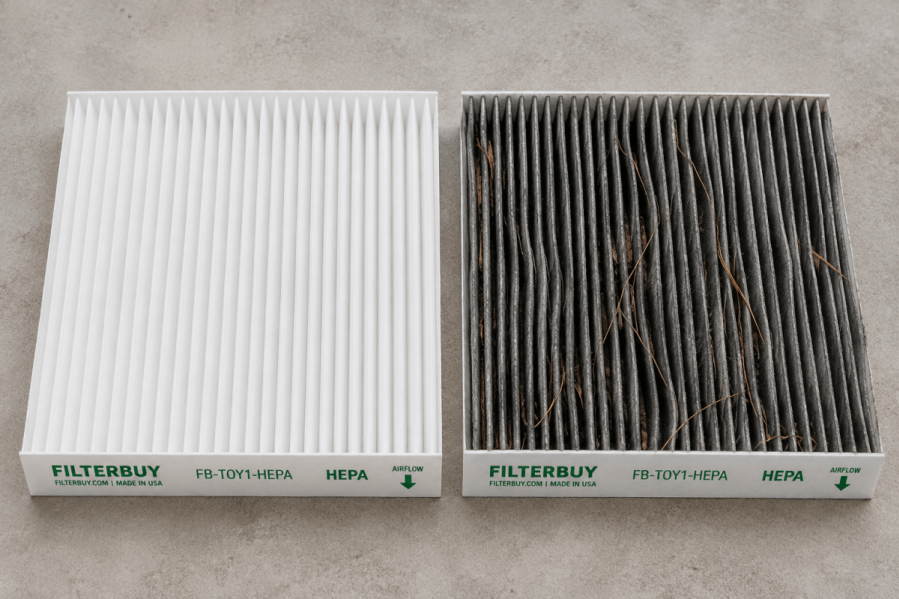
Pull the old one and look at the media. A standard pollen filter is white or light grey pleated paper. A charcoal filter carries a dark grey or black layer bonded to the pleats and feels noticeably heavier. Either grade fits the same housing, so you can switch at any change.
Effectively yes. 0R030 is the factory-fit pollen filter, YZZ83 is the boxed service equivalent, and 28020 is a superseded number that Toyota’s catalog now routes to 0R030. All three fit 2019 through 2025 RAV4s.
No. The Federal Trade Commission states plainly that your warranty stays in effect when you fit aftermarket parts, and that a dealer has to prove the part caused the damage before it can deny coverage.
Cabin air filter: A pleated filter in the HVAC intake that cleans outside air before it reaches the vents. See what a cabin air filter does.
Engine air filter: Cleans air entering the engine. On a 2019–2025 RAV4, part 17801-F0050, in the airbox under the hood.
HV battery cooling intake filter: A second filter on Hybrid and Prime models that screens cabin air before it cools the hybrid battery pack.
Pollen filter: Toyota’s designation (“P” in its dealer chart) for the standard particulate grade.
Activated carbon: Adsorbs odors and gases, not extra particles. Saturates even while the media looks clean.
Bypass air: Unfiltered air that slips around the edges of a badly fitting filter instead of through the media.
