
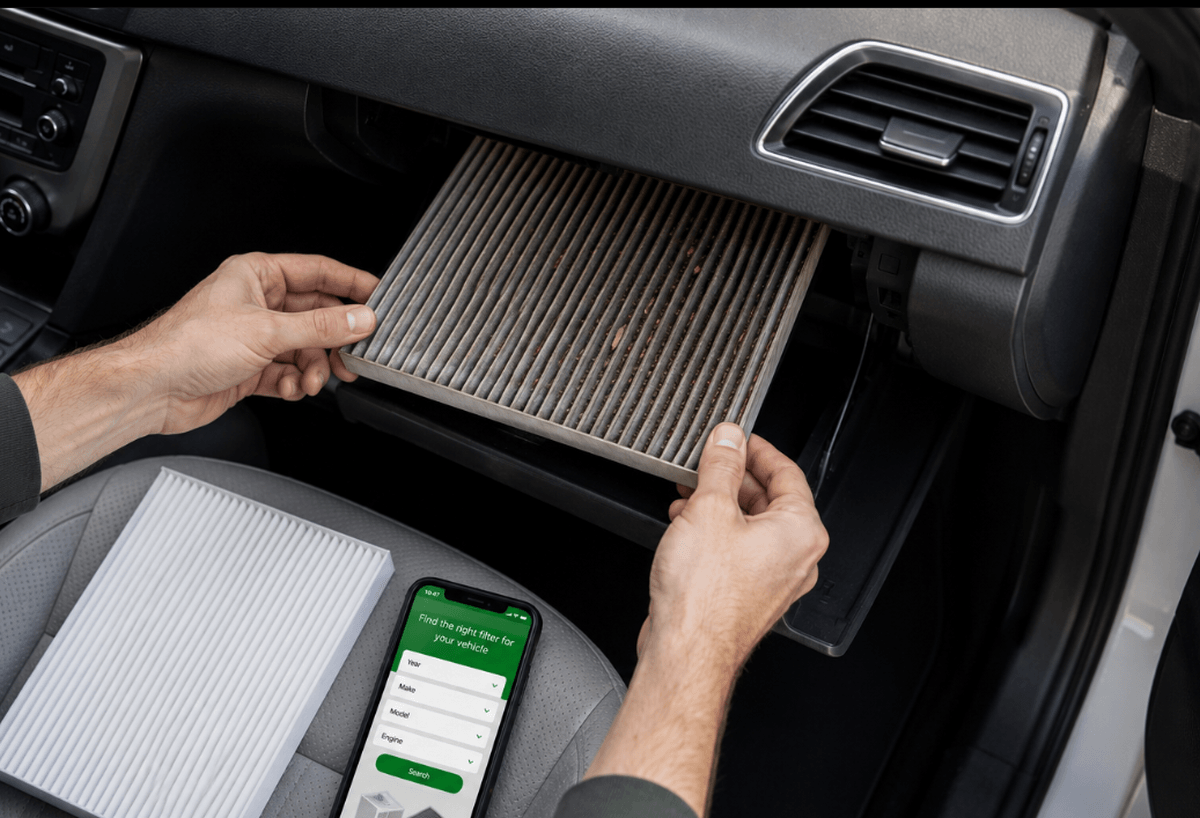
Cabin Air Filter Part Number Lookup
How to Find the Right Filter for Your Car
By Michelle Wan | Technically reviewed by David Clark, Licensed HVAC Technician | Published July 29, 2026 | Last updated July 29, 2026
How to Look Up Your Cabin Air Filter Part Number
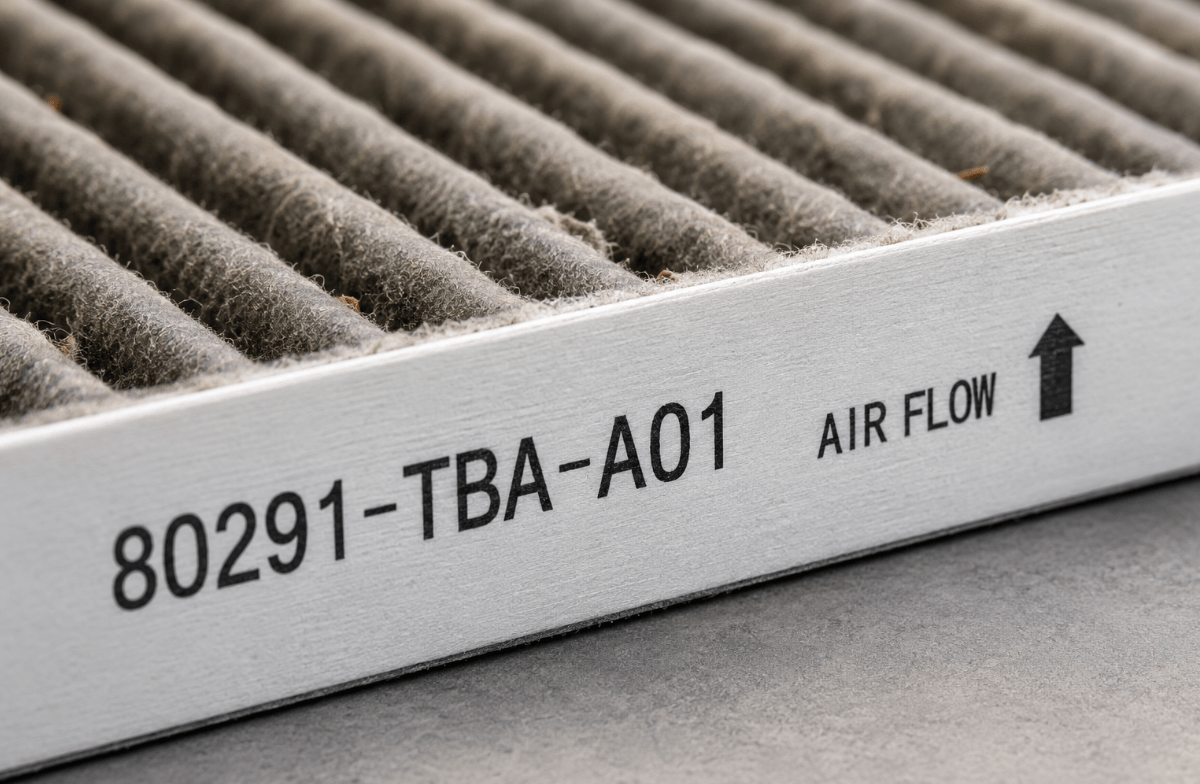
Your cabin air filter part number is printed on the edge of the filter already in your car. If you cannot reach it, three lookups will find it. VIN is the most precise, because it accounts for trim and mid-year production changes.
- By VIN — highest accuracy, about 2 minutes. Accounts for trim splits and build date.
- By year, make, and model — high accuracy, about 60 seconds. Best for single-spec vehicles.
- By cross reference — high accuracy, about 60 seconds. Converts one brand’s number into another.
Not sure which number is yours? The quick match below confirms your fit in about a minute, or browse cabin air filters for your vehicle.

Answer 3 quick questions and we’ll match you to the filter that fits your vehicle.
TL;DR
Your cabin air filter part number is printed on the edge of the filter already in your car. It is also in your owner's manual, though often not under that name. If you cannot reach either, look it up by VIN, the only method that accounts for trim and mid-year production changes. Once you have one number, a cross-reference converts it to other brands, and Filterbuy's vehicle finder confirms the fit.
Key Takeaways
● Three lookup paths work: by VIN (most accurate), by year, make, and model (fastest), or by cross-referencing a number you already have.
● The number is physically on the filter. Pull the old filter and read the edge of the frame before buying anything.
● OEM and aftermarket numbers are different systems. A Toyota cabin filter number begins with 87139-; the FRAM equivalent begins with CF. Both describe the same part.
● VIN lookup beats year, make, and model on vehicles with trim splits, mid-year production changes, or optional carbon filters.
● Some vehicles take two cabin filters, and a handful of base trims ship with an empty housing or a blanking plate instead of a filter.
● A part number is a starting point, not a guarantee. Confirm the physical dimensions before installing.
How Do You Look Up a Cabin Air Filter Part Number?
You look up a cabin air filter part number three ways: read it off the filter behind your glove box, find it in your owner's manual, or enter your year, make, and model into a fitment tool. Entering your 17-digit VIN is the most precise method, because a VIN identifies your exact trim and build date. Browse cabin air filters for your vehicle to confirm a fitment in about a minute.
Each path suits a different situation. Use this table to pick one.
Where Is the Cabin Air Filter Part Number Located?
The cabin air filter part number is printed along the edge of the filter's plastic or cardboard frame, in most vehicles inside a housing behind the glove box. It also appears in the owner's manual index under "cabin air filter," "passenger compartment filter," or "HVAC filter." Both sources give you a number you can cross-reference to any brand.
Four places carry it, in the order worth trying.
How Do You Read a Cabin Air Filter Part Number?
A cabin air filter part number is a brand-specific code, not a universal standard. Each manufacturer uses its own prefix and numbering series, so the same physical filter carries a different number from every company that makes it. Recognising the prefix tells you which system you are looking at.
OEM part numbers are make-specific. An OEM number and an aftermarket number for the same filter look nothing alike; neither is more correct.
OEM numbers follow the vehicle manufacturer's own parts taxonomy and are make-specific. Toyota and Lexus cabin filters share the 87139- prefix, as listed in Toyota's genuine parts catalog, while other makes use entirely separate series. An OEM number and an aftermarket number that describe the same filter look nothing alike. Neither is more correct; they are two catalogues pointing at one part. For how the two compare on fit and filtration, see OEM versus aftermarket cabin air filters.
Should You Look Up a Cabin Air Filter by VIN or by Make and Model?
Look up your cabin air filter by VIN when your vehicle has multiple trims, a mid-year production change, or an optional upgraded filter. Look it up by year, make, and model when the vehicle is a single-spec model with one filter across the range. Under 49 CFR 565.13, every VIN consists of exactly seventeen characters and must be readable from outside the vehicle through the glazing beside the left windshield pillar, which is why you can read yours off the base of the windshield on the driver's side. It is also printed on the driver's door jamb sticker. NHTSA's free vPIC VIN decoder will confirm the make, model, model year, and build plant your VIN encodes before you match a part to it.
VIN lookup resolves the details a year, make, and model search cannot see:
● Trim splits. A base trim and a touring trim of the same model year sometimes use different HVAC housings.
● Build date. Manufacturers change suppliers mid-model-year. A car built in August can take a different filter than the same model built the previous November.
● Carbon versus standard. Many makes offer both a particulate and an activated-carbon filter for the same vehicle under two separate part numbers.
● Market variants. Vehicles assembled for different markets occasionally carry different HVAC specifications.
Filterbuy's finder confirms your fitment from your year, make, and model, and the Filterbuy support team can verify a VIN-level match when your vehicle falls into one of the cases above. Browsing by make is often quickest, for example the Toyota cabin air filter guide or the full auto cabin filter range.
Five Reasons a "Correct" Part Number Still Does Not Fit
Most fitment failures are not lookup errors. They are cases where the lookup was right and the vehicle turned out to be the exception. Five patterns account for most of them, and each has a different fix. Check these before assuming the number was wrong.
You read the previous owner's aftermarket number. The number on the installed filter belongs to whoever made it last, which may itself have been a wrong or superseded part. Verify against the manual or a VIN lookup rather than trusting an inherited number.
The vehicle takes two filters. Some vehicles use a two-piece cabin filter set in a single housing. Buying one filter leaves half the intake unfiltered.
The housing is empty by design. Some base and fleet trims ship with a blanking plate where the filter would sit. The plate looks like a filter frame until you remove it.
The number was superseded. Manufacturers retire numbers and the catalogs record it. Toyota's own listings show 87139-30040 replaced by 87139-YZZ82, and 87139-50100 replacing 87139-50060. A number copied from a 2016 manual can point at a part that no longer exists.
The media type does not match. Standard and activated-carbon versions share dimensions but carry different numbers and different performance.
Why Filterbuy Treats Fitment as the Whole Job
A filter 2 mm undersized does not filter 2% less. It creates bypass air: unfiltered air slipping around the frame and into the blower, carrying the road straight past a filter that looks correctly installed. That is why Filterbuy cuts to exact OEM tolerances at its own U.S. plants, and why the part number matters more than the brand on the box.
What If Your Vehicle Has No Cabin Air Filter Part Number?
Some vehicles built before the early 2000s were manufactured without a cabin air filter, and a small number of base trims have a housing but no filter fitted from the factory. If your manual has no cabin filter entry and the housing holds a flat plate rather than a pleated element, your vehicle likely was not equipped with one.
Check the three places a cabin air filter is normally fitted before concluding it is missing. A dealer parts department can confirm from your VIN, and Filterbuy support can check the same against its fitment catalog.
Supporting Statistics
Three U.S. government datasets back an exact part number match.
1. The U.S. fleet is old, so part numbers pile up.
○ Pickups averaged 13.1 years old in 2023. Cars 11.9. Vans 11.8. SUVs 8.1.
○ The fleet spans about 25 model years at once.
○ One nameplate carries several superseded numbers.
Source: U.S. Department of Energy, Fact of the Week #1362
2. Drivers spend close to an hour a day in the cabin.
○ The mean one-way commute was 27.2 minutes in 2024.
○ 69.2% of workers drove alone.
○ That is the exposure window your filter controls.
Source: U.S. Census Bureau, American Community Survey, Table S0801
3. Tens of millions live and work in near-road air.
○ More than 45 million people are within 300 feet of a major road, airport, or railroad.
○ Near-road air carries elevated particulate matter.
○ Your cabin filter is the only barrier.
Source: U.S. EPA, EPA-420-F-14-044
Frequently Asked Questions
Glossary
Cabin air filter. The pleated filter that cleans outside air before it enters a vehicle's passenger compartment through the heating and air conditioning system. Distinct from the engine air filter, which protects the engine.
Cross reference. A lookup that converts one manufacturer's part number into the equivalent part number from another manufacturer for the same physical component.
HEPA. High-Efficiency Particulate Air. A filtration standard requiring capture of 99.97% of airborne particles at 0.3 microns. Filterbuy's auto cabin air filters use HEPA-certified synthetic media.
MERV. Minimum Efficiency Reporting Value, a 1 to 16 filtration scale used for home HVAC filters, not automotive cabin filters.
OEM. Original Equipment Manufacturer. A part made to the vehicle manufacturer's factory specification and sold under the vehicle brand's name.
Aftermarket. A part made by a company other than the vehicle manufacturer, built to the same fitment tolerances.
VIN. Vehicle Identification Number. The unique 17-character code identifying a specific vehicle's make, model, trim, engine, and build details, as specified in 49 CFR Part 565.
Activated carbon filter. A cabin air filter with a carbon layer that adsorbs odours and exhaust gases in addition to trapping particles.