
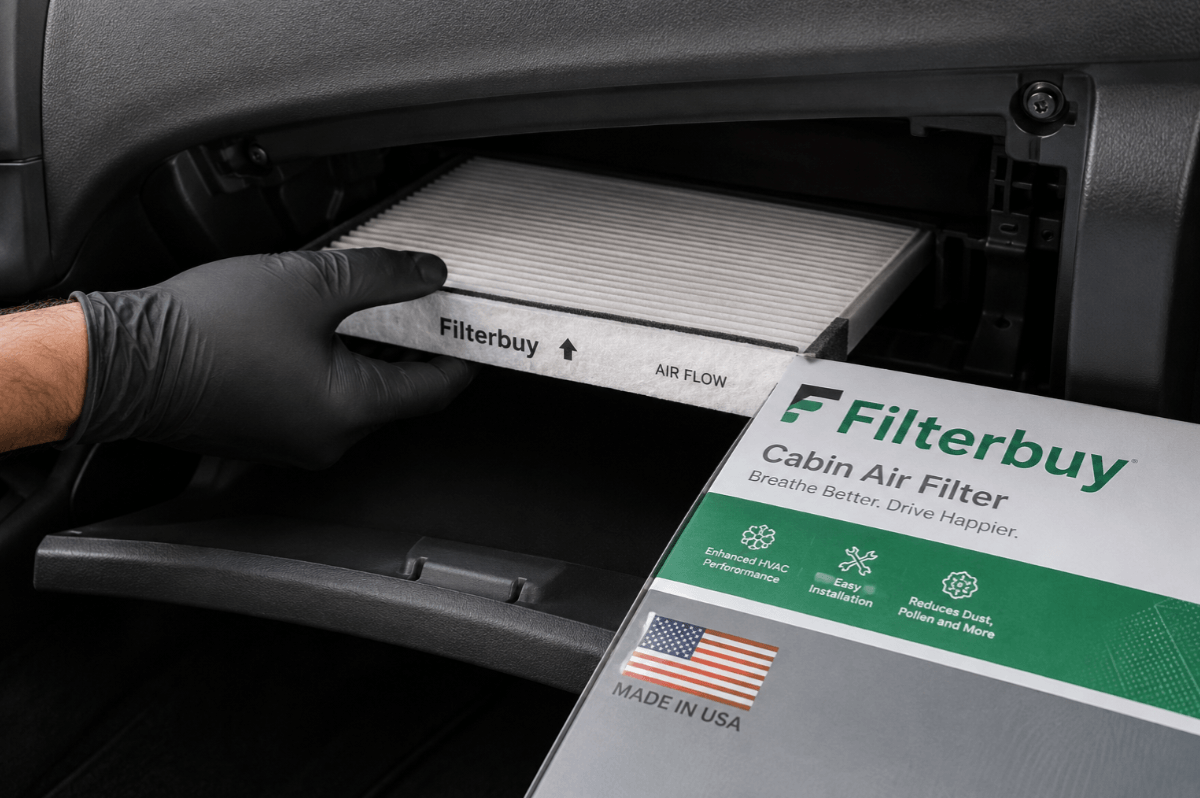
American-Made Cabin Air Filters — Manufactured in the USA, Shipped to Your Door
By Michelle Wan, Brand Manager and Air Quality Writer | Reviewed by David Clark, Licensed HVAC Technician | Published August 5, 2026 | Updated August 5, 2026
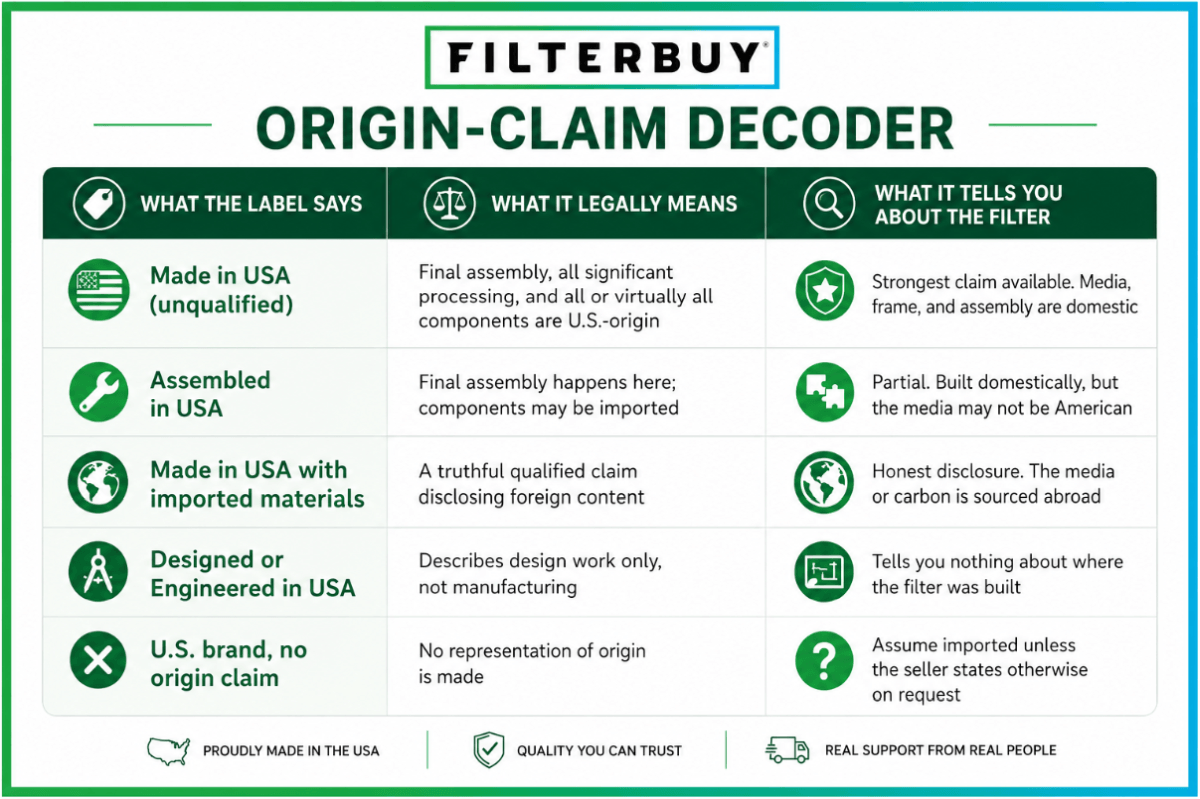
A cabin air filter is American-made only if final assembly, all significant processing, and all or virtually all of its components happen in the United States. That is the FTC “all or virtually all” standard under 16 CFR Part 323. “Assembled in USA” and “Designed in America” are legally weaker claims that permit imported parts, including the filter media itself.
- Made in USA — U.S. final assembly, U.S. significant processing, and all or virtually all U.S. components.
- Assembled in USA — put together here, but the parts, including the media, can be imported.
- Designed in America — describes where it was engineered, not where it was built.
Filterbuy manufactures its cabin air filters 100% in the USA and sells factory-direct. Answer three quick questions below and we will match you to the right one.

Shop cabin air filters made in the USA
Answer 3 quick questions and we will match you to your perfect filter.
TL;DR
An American-made cabin air filter is one where final assembly, all significant processing, and all or virtually all components happen in the United States. That is the FTC’s all or virtually all standard. "Assembled in USA" and "Designed in America" are legally weaker claims that permit imported parts. Here is how to tell them apart in about five minutes, and what U.S. manufacturing does and does not change.
Key Takeaways
The legal bar is specific. The FTC Made in USA Labeling Rule (16 C.F.R. Part 323) requires U.S. final assembly, U.S. significant processing, and components that are all or virtually all U.S.-made.
Enforcement is active. Civil penalties reach roughly $53,088 per violation, and each page or listing can count separately.
"Assembled in USA" is not a synonym. A filter can be pleated and framed here from imported media and carry that label lawfully.
Fit matters as much as origin. A loose filter lets unfiltered air slip around the frame, called bypass air, undoing the filtration you paid for.
Filterbuy cabin air filters are manufactured 100% in the USA with HEPA-certified media, by a manufacturer building filters domestically since 2013.
What counts as an American-made cabin air filter?
An American-made cabin air filter is one whose final assembly, significant processing, and all or virtually all components originate in the United States. A product with meaningful imported content cannot carry an unqualified Made in USA label. The standard sits at 16 C.F.R. Part 323, finalized in August 2021.
The rule reaches further than most assume. It covers packaging, catalogs, marketplace listings, and the company website, and individual pages can count as separate violations at roughly $53,088 each.
For a cabin filter, the domestic components must include the media, frame, any carbon layer, and adhesives, not just the pleating and cutting at the end. Media is the input most likely to come from abroad and least likely to be named in a claim, which is why the rule looks at components rather than assembly.
Made in USA vs. Assembled in USA: an origin-claim decoder
Three phrases on three boxes can describe three very different supply chains. For the filtration side of the decision, see our complete buyer’s guide to cabin air filters.
How to verify an American made cabin air filter claim in five minutes
Five checks settle it. They work on any brand, including this one.
Read the exact wording, not the flag icon. Note whether it is qualified or unqualified.
Check the claim across surfaces. Compare the product page, the marketplace listing, and the box. Claims that drift between channels are the most common compliance failure.
Look for a stated manufacturing location. A domestic manufacturer can name the state or plant. Filterbuy manufactures in Alabama, Pennsylvania, Texas, and Utah.
Ask where the media is made, not just the filter. A reseller usually cannot answer; a manufacturer can.
Check the FTC record if a claim looks aggressive. The warning letter library is searchable by company.
Why origin claims are drawing more scrutiny in 2026
Made in USA labels are under unusual scrutiny this year because federal enforcement escalated in three steps. A March 2026 Executive Order directed the FTC to prioritize unlawful U.S.-origin claims. In April, the Commission announced three enforcement actions against sellers of flag products, footwear, and dartboards, with redress paid to buyers. In July, it sent warning letters to seven companies selling drums, industrial lasers, and e-cigarettes.
The products are ordinary, so enforcement is not reserved for headline brands, and it is recent enough that a filter on a shelf today was labeled before any of it happened.
Does American manufacturing make a better cabin filter?
Not automatically. Media efficiency and fit determine filtration. What domestic production reliably changes is control: faster correction of a fitment problem, tighter batch-to-batch media consistency, and inventory that is not on a container ship when pollen season starts early.
That matters most in fitment tolerance. Cabin filters sit in a molded housing behind the glove box, and a filter cut a fraction of an inch small allows bypass air around the frame edge. A HEPA-grade filter with a poor seal can deliver worse real-world air than a mid-grade filter that fits. Start with a part number lookup.
Our honest position as a manufacturer: buy the filter with the right media for your driving and a verified exact fit. If two filters match on both, American manufacturing is a real tiebreaker, for supply reliability, recourse, and the jobs behind it. It is not a substitute for either.
What we see from inside a U.S. filter plant
Building filters domestically since 2013 has shaped three things we tell people to check, none of them on a spec sheet.
Cabin filters have no MERV rating. Customers arrive fluent in MERV from furnace filters and cannot find the number. MERV is built around residential HVAC airflow and does not transfer to a vehicle housing. A cabin filter sold with a MERV number borrowed it rather than testing it in the application.
A filter has to seal without choking the fan. A car’s blower is small and the housing smaller. Denser media captures more and restricts more, which is why we hydrocharge rather than pack media tighter.
Owning the tooling changes what happens when something is wrong. We sell factory-direct, so a fit complaint reaches the company that owns the die that cut the part. That does not make a filter better. It makes a problem correctable.
What to look for besides origin
Media type decides what the filter captures. Our guide to choosing a cabin air filter goes deeper.
Replacement interval for all three types is roughly every 12 months or 12,000–15,000 miles, and sooner in dusty or smoky driving conditions.
Getting the most out of the filter you install
How you drive changes what a filter delivers. A randomized study of 48 commuters from the National Library of Medicine surfaced three points that appear on no package.
Your filter only cleans the air path you select. Recirculation cuts outside pollutants further, but long stretches build cabin carbon dioxide that can dull alertness. Use it through heavy traffic, then return to fresh air.
Tunnels and dense traffic are spikes, not averages. Peak in-tunnel concentrations averaged about 2.2 times typical in-cabin PM2.5, and 1.9 times for black carbon and ultrafine particles.
A particulate filter does not touch gases. Filtration cut particles substantially and did nothing for nitrogen dioxide, benzene, or carbon monoxide. VOCs measured higher inside the vehicle than outside, pointing to cabin sources. For fumes and odors the answer is activated carbon, not a higher particle rating.
What makes Filterbuy American made cabin air filters different
Filterbuy is a second-generation, family-owned manufacturer building filters in the United States since 2013, shipping factory-direct. Its cabin air filters carry 100% U.S. manufacturing with recyclable materials, HEPA-certified media capturing 99.97% of particles as small as 0.3 microns, hydrocharged fibers, exact OEM tolerances, and tool-free installation. Multi-packs and a subscription with free 2-day shipping are offered.
Find your vehicle cabin air filter, or see a worked example on our Toyota Camry cabin air filter page.
Check any Made in USA claim yourself
You should not have to take our word for it. Five of these seven have no stake in which brand you pick.
FTC: Complying with the Made in USA Standard, the rule in plain language, with examples of lawful qualified claims.
eCFR: 16 CFR Part 323, the binding text; Section 323.2 states the whole test in one sentence.
FTC: Warning Letters library, searchable by company, showing whether a seller has been flagged.
FTC: July 2026 warning letters, the exact phrases that drew scrutiny, such as "Built in the USA."
EPA: Particulate Matter Basics, what PM2.5 is and why media has to stop it.
Filterbuy: part number lookup, to confirm exact fit; a filter that does not seal makes its origin irrelevant.
Filterbuy: how often to change a cabin air filter, intervals by driving condition, so you compare cost per year, not sticker price.
Supporting statistics
Cabin filtration cuts in-car particles by roughly a third. In that randomized, double-blind study, ultrafine particles fell 28%, PM2.5 30%, and black carbon 32%. The filter was electrostatic, the route Montreal. Read it as exposure reduction in a moving car, a different measure from a 99.97% media rating tested on a rig. Source: National Library of Medicine.
More than 45 million Americans live, work, or attend school within 300 feet of a highway, railroad, or airport, where pollutant levels run above the urban background. Source: U.S. EPA.
Before you buy
Confirm fit, pick the media that suits how and where you drive, then treat origin as the tiebreaker between two filters that pass both tests. Filterbuy builds its cabin air filters in the United States and sells factory-direct, and we would rather you verify that than take it on faith. Start with a part number lookup, then find your vehicle cabin air filter
Frequently asked questions
Michelle Wan works directly with Filterbuy’s U.S. manufacturing teams. Filterbuy builds cabin air filters in the United States, so we are not a neutral party here. This is the page we would want before buying from a company like ours.
Glossary
All or virtually all: The FTC standard requiring U.S. final assembly, U.S. significant processing, and U.S.-made components, with no more than negligible foreign content.
Qualified claim: An origin claim that discloses its limits, such as "Assembled in USA."
Bypass air: Unfiltered air passing around a filter’s edges rather than through the media, caused by an undersized or poorly seated filter.
Hydrocharging: A process that permanently electrostatically charges filter fibers to increase capture without adding airflow restriction.
OEM tolerance: Dimensions matching the original equipment part, so the replacement seals correctly in the factory housing.