
HEPA Cabin Air Filter: What It Does, and When It’s Worth It
By Michelle Wan · Technically reviewed by David Clark, Licensed HVAC Technician · Published August 4, 2026 · Last updated August 4, 2026
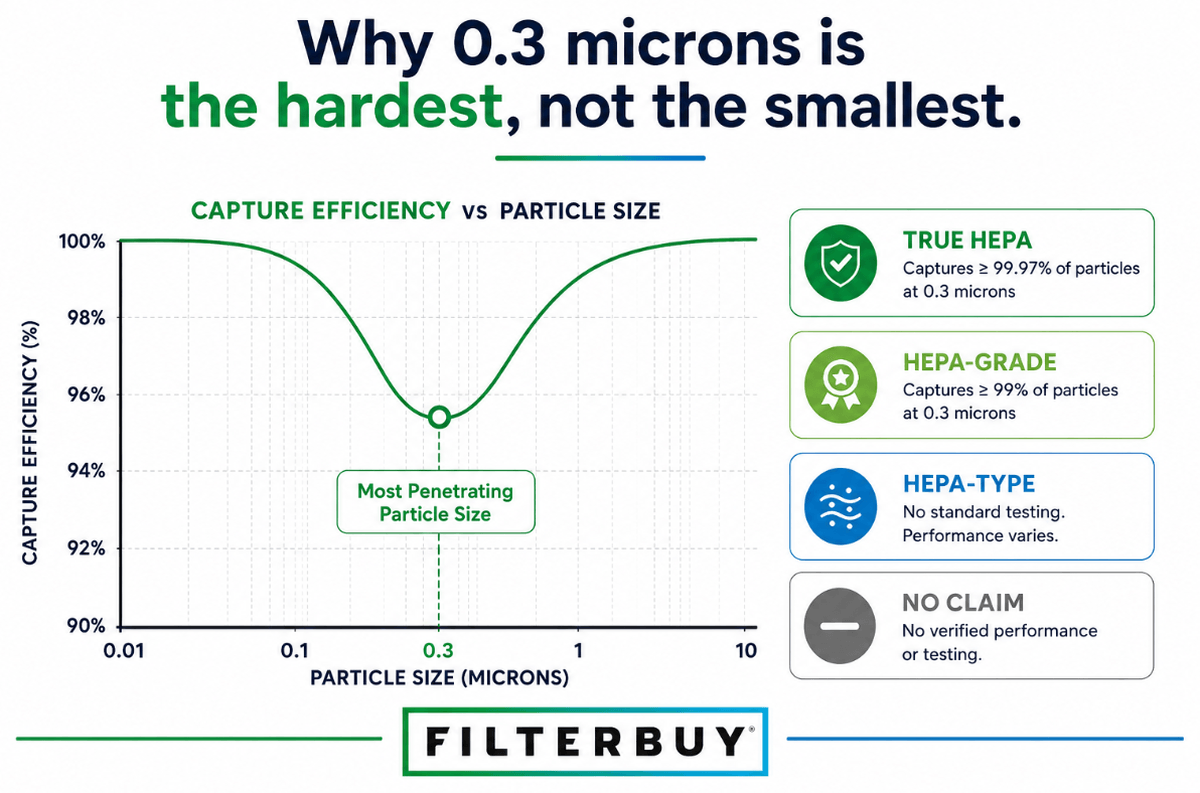
A HEPA cabin air filter captures 99.97% of airborne particles at 0.3 microns — the size that is hardest to trap. That makes it the upgrade worth paying for when you spend real time in the car: long commutes, heavy traffic, or driving through smoky or dusty air. For light suburban driving, a standard or carbon filter is usually enough.
One thing to know before you shop: “HEPA-grade,” “HEPA-type,” and “HEPA-style” are marketing terms, not certifications. A true HEPA filter is tested to a published standard, so ask which one.
- Standard — dust, pollen, and dander at the lowest cost.
- Activated carbon — adds odor and exhaust-gas adsorption, which no particle filter does on its own.
- HEPA — the highest particle capture available, including the PM2.5 in smoke and diesel soot.
- HEPA + carbon — both jobs at once, which is why it suits city driving.
Already know your vehicle? Find your exact-fit auto cabin air filter by year, make, and model.

Not sure which one your drive calls for? Answer a few quick questions and we will match you to your filter.
TL;DR
A HEPA cabin air filter uses media that captures 99.97% of airborne particles at 0.3 microns, the size hardest to trap. It is a real upgrade for drivers with allergies, asthma, long commutes, or wildfire smoke, and unnecessary for many others. The word HEPA on a box is not the same thing as a filter tested to a HEPA standard.
Key takeaways
HEPA is a performance standard, not a material. The U.S. Department of Energy sets it at 99.97% capture at 0.3 microns, the size EPA calls the worst case; larger and smaller particles are trapped better.
HEPA-grade, HEPA-type, and HEPA-style are marketing terms, not certifications. Ask which standard the filter was tested to.
Higher efficiency means more airflow resistance. Good pleat design and electrostatic charging keep it negligible; cheap media strains your blower.
Fit beats media grade. Air that slips around a loose filter was never filtered at all.
Your filter only works with the windows up. Peer-reviewed modeling found filtration cuts in-cabin PM2.5 by about half with windows closed, under 10% with them open.
What is a HEPA cabin air filter?
A HEPA cabin air filter is a replaceable filter in your car’s ventilation system that meets high-efficiency particulate air standards. Run the heat, A/C, or defroster on fresh air and outside air passes through it before reaching your vents. HEPA media captures 99.97% of particles at 0.3 microns, including fine particulate matter (PM2.5) from wildfire smoke, diesel soot, pollen, mold spores, and road dust.
The 0.3-micron figure is not the smallest particle HEPA catches; it is the most penetrating particle size, the one physics makes hardest to capture. Larger and smaller particles are caught more efficiently, so 99.97% at 0.3 microns is a floor, not a ceiling.
Cabin filtration matters more than drivers assume. Modeling published in Atmospheric Environment puts time in vehicles at roughly 10 to 20 percent of daily PM2.5 exposure. Nearly every car built since the early 2000s has a cabin filter, but almost none ship with HEPA media. For what a cabin air filter does from the ground up, start there.
True HEPA vs. “HEPA-grade”: how to read the label
A true HEPA filter is tested to a published standard; the EPA names ISO 29463 as the HEPA test standard. Bosch, for example, states its HEPA cabin filters are tested to ISO 29463-3. “HEPA-grade,” “HEPA-type,” and “HEPA-style” carry no such requirement.
EPA is blunt about the gap. Its technical summary on residential air cleaners states there is no widely accepted definition of HEPA performance in consumer products, and that consumer HEPA filters are unlikely to match those used in hospitals. EPA also neither certifies nor recommends any filter brand, so the label is only as good as the manufacturer’s own testing.
Filterbuy builds filters for homes and for cars, and the difference is instructive. Home filters carry a MERV rating from a published ASHRAE test, so you can set two side by side on one scale. Cabin filters have no equivalent. That vacuum is why “HEPA” does so much work on a cabin filter box: often it is the only performance word there. We sell into that vacuum too, which is why we would rather you knew how to read it.
Does a HEPA cabin air filter restrict airflow?
Yes, somewhat. Denser media means higher pressure drop, so the blower works harder. On a well-engineered filter that is unnoticeable; on a cheap one with poor pleat geometry, you get weak vents, slow defrosting, and a hot blower.
Two things separate those outcomes. Pleat design sets how much media surface area fits the housing, and more surface area means lower resistance at the same efficiency. Electrostatic treatment, which is what Filterbuy’s hydrocharging does, lets looser media catch fine particles by attraction rather than brute-force density. One caveat: EPA notes that electret filters can lose efficiency as they load, because the charge fades, while purely mechanical media gain it. Good argument for replacing on schedule rather than stretching it.
A filter can only clean air that passes through it. The same Atmospheric Environment modeling found that with windows up, going from no filtration to perfect filtration cut in-cabin PM2.5 by roughly half; with windows open, by under 10%. If your vents feel weak after a change, the filter is wrong for the housing or seated badly. Pull it and check.
Should you buy one? Match the filter to how you drive
Buy HEPA if you have allergies or asthma, sit in heavy traffic, or drive through wildfire smoke. Skip it for light suburban driving with no sensitivities.
When unsure, size up in efficiency. The airflow trade-off on a well-built filter is small.
HEPA vs. carbon vs. standard cabin air filters
HEPA captures the most particles. Activated carbon is the only one of the three that handles gases and odors. Standard filters cover basic dust and pollen at the lowest cost. A combination HEPA-plus-carbon filter does both jobs, which is why it suits city driving.
Carbon adsorbs gases. HEPA traps particles. A combination filter does both, which is why it suits city driving.
More in how to choose a cabin air filter. If allergies are why you are shopping, cabin air filters for allergies goes deeper on pollen and dander specifically.
Finding one that actually fits
From the Filterbuy production floor: fit beats media grade every time. Undersized or seated crooked, air bypasses the media through the gaps, and a 99.97% filter with a 10% bypass path is not one anymore.
Cabin filters are vehicle-specific, so match year, make, and model rather than brand. Filterbuy cuts its cabin filters to exact OEM tolerances in its own U.S. plants and backs them for five years. For the factory-versus-aftermarket trade-offs, see OEM vs. aftermarket cabin air filters.
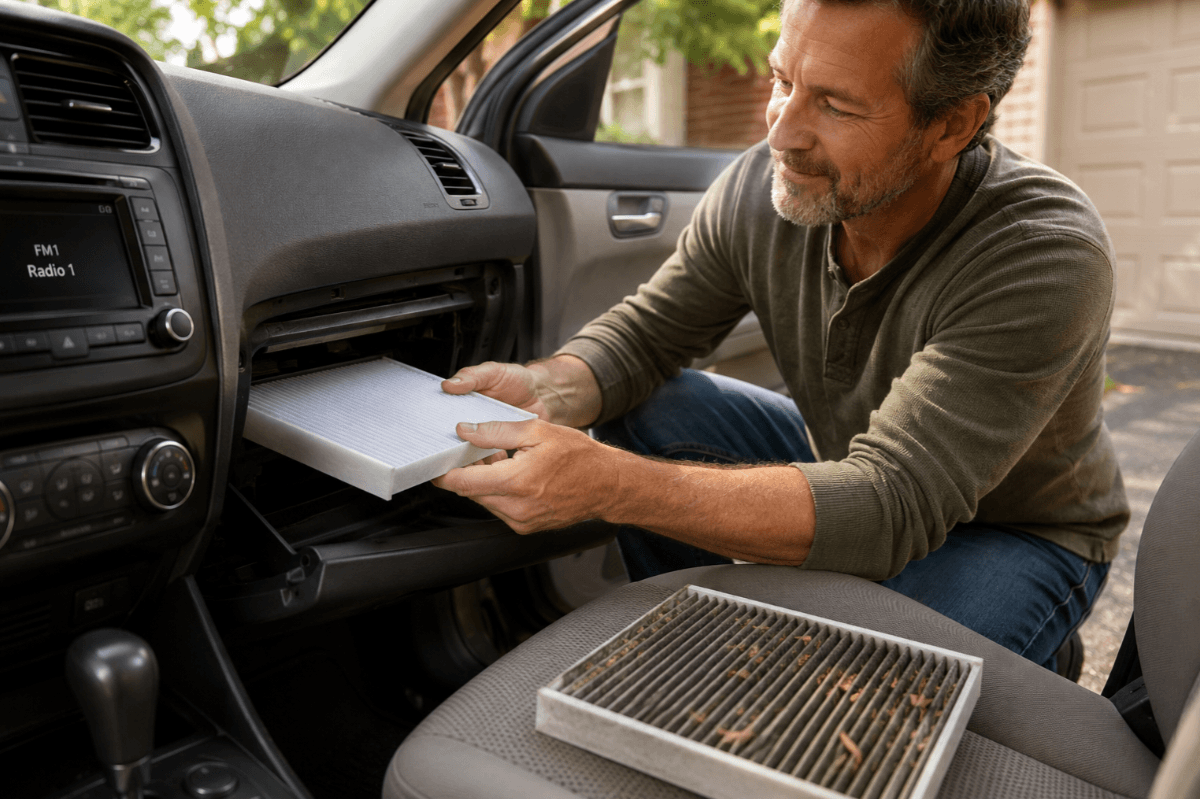
Most filters sit behind the glove box and swap in about ten minutes with no tools. See where your cabin air filter is located and a step-by-step cabin air filter replacement walkthrough, which saves the $20 to $60 a shop would charge.
How often should you replace a HEPA cabin air filter?
Most makers say every 12,000 to 15,000 miles, or about once a year. Bosch specifies 12,000 miles for its HEPA filters. Follow your owner’s manual first.
Replace sooner if you drive through smoke or dust, sit in traffic daily, or notice signs your cabin air filter needs replacing such as weak airflow or a musty smell. A loaded filter restricts airflow more than a new high-efficiency one ever will, so a neglected standard filter strains the blower harder than a fresh HEPA one. Our guide to how often to change a cabin air filter breaks it down by conditions, and you can check your local air quality on our live AQI map to time replacements to conditions. If remembering is the hard part, Filterbuy auto-delivery ships a fresh cabin filter every 12 months on its own.
What a HEPA cabin filter can’t do
A HEPA cabin filter handles particles and nothing else. Four limits are worth knowing, and one of them matters more than money.
Gases pass straight through. EPA notes that activated carbon is not especially effective against nitrogen oxide, and that carbon monoxide is not readily captured at all. No cabin filter is CO protection.
If you smell exhaust inside the car, don’t buy a filter. Fumes reaching the cabin can mean a leak. Get it looked at. A carbon filter may mask the smell, and masking a leak is worse than smelling one.
A musty smell is usually moisture, not media. The evaporator behind your dash stays damp. A new filter covers it for a week or two, then the smell comes back.
It won’t feel like anything. A well-built HEPA filter changes airflow so little you will not notice it went in. The honest check is the filter you pulled out, not the one you put in.
The numbers behind the case
Three figures from U.S. government research:
27.2 minutes is the average U.S. one-way commute, nearly an hour a day breathing what the vents pull in. Source: U.S. Census Bureau, American Community Survey (2024)
25.2% of adults have a diagnosed seasonal allergy. One in four drivers is who HEPA is built for. Source: CDC, National Center for Health Statistics, Data Brief 545
45+ million Americans live within 300 feet of a major road, railroad, or airport, where vehicle pollutants concentrate. Source: U.S. EPA, Air Research
What we’d read next
U.S. EPA: What Is a HEPA Filter? the bar itself, and why 0.3 microns is the toughest size to catch, not the smallest.
U.S. EPA: Residential Air Cleaners, A Technical Summary page 20: no agreed consumer definition of HEPA. Read it before trusting any label, ours included.
Liu and Frey (2011), Atmospheric Environment the peer-reviewed source for the 10-to-20% exposure and windows-up findings.
Filterbuy: Auto Cabin Air Filters enter year, make, and model for an exact-fit match.
Ready to breathe easier on your commute? Shop HEPA cabin air filters by vehicle. Enter your year, make, and model to find your exact fit. Made in the USA, shipped free.
FAQ
About the author
Michelle Wan is Filterbuy’s Brand Manager and Air Quality Writer (B.A., University of California, Santa Cruz). She works directly with Filterbuy’s manufacturing teams in Alabama, Pennsylvania, Texas, and Utah, so her guidance comes from how filters are built and tested, not from spec sheets.
Glossary
MPPS (Most Penetrating Particle Size): The particle size hardest to capture, about 0.3 microns. HEPA is rated here.
PM2.5: Particulate matter 2.5 microns or smaller, small enough to reach deep into the lungs. Dominant in smoke and exhaust.
Pressure drop: The resistance a filter adds to airflow, in inches of water gauge. Higher pressure drop makes the blower work harder.
Bypass air: Unfiltered air slipping around a poorly fitting filter instead of passing through the media.
Activated carbon: A porous carbon layer that adsorbs gases and odors. It does not replace particulate filtration.
Hydrocharging: Filterbuy’s process for charging filter fibers electrostatically, raising fine-particle capture without adding density.