
Cabin Air Filter Size Chart and Dimensions Guide
What Size Cabin Air Filter Do I Need?
Most cabin air filters measure 180–300 mm long, 170–220 mm wide, and 15–35 mm thick. Cabin filters are sized in exact millimeters, so the number you measure is the number you order — never round up. Measure the old filter itself, not the housing. Answer the three questions below and we will match you to the cabin air filter for your vehicle.

Answer 3 quick questions and we will match you to your perfect filter.
By Michelle Wan | Technically reviewed by David Clark, Licensed HVAC Technician | Published September 8, 2026 | Last updated September 8, 2026
A cabin air filter is the pleated panel that cleans outside air before it enters your vehicle's passenger compartment. Most measure 180 to 300 mm long, 170 to 220 mm wide, and 15 to 35 mm thick. Cabin filters are built in millimeters to the vehicle manufacturer's tolerance, so the number you measure is the number you order. There is no rounding.
Measure the filter in your hand, then match all three numbers against the chart below.
Shop auto cabin air filters by vehicle
TL;DR
Cabin air filters are sized in millimeters, and unlike home HVAC filters they carry no rounded nominal size. The number on the frame is the real measurement, which is why a cabin filter rounded up to the nearest inch will not seat. Measure the old filter rather than the housing, write down all three dimensions exactly, and let thickness break the tie when several filters share the same length and width.
Key Takeaways
Cabin air filter sizes are metric. Vehicle manufacturers specify them in millimeters, so the inch figures on retail listings are conversions. That is why they land on odd numbers like 8.47 in, which is simply 215 mm.
There is no nominal size, so never round. The round-up rule belongs to home air filter sizes, where the printed size runs a little larger than the real one. On a cabin filter, the printed size is the real one, and rounding up an inch buys a part that will not fit.
Measure the filter, not the housing. Housings carry ribs, guides, and foam seals that add several millimeters to any slot reading.
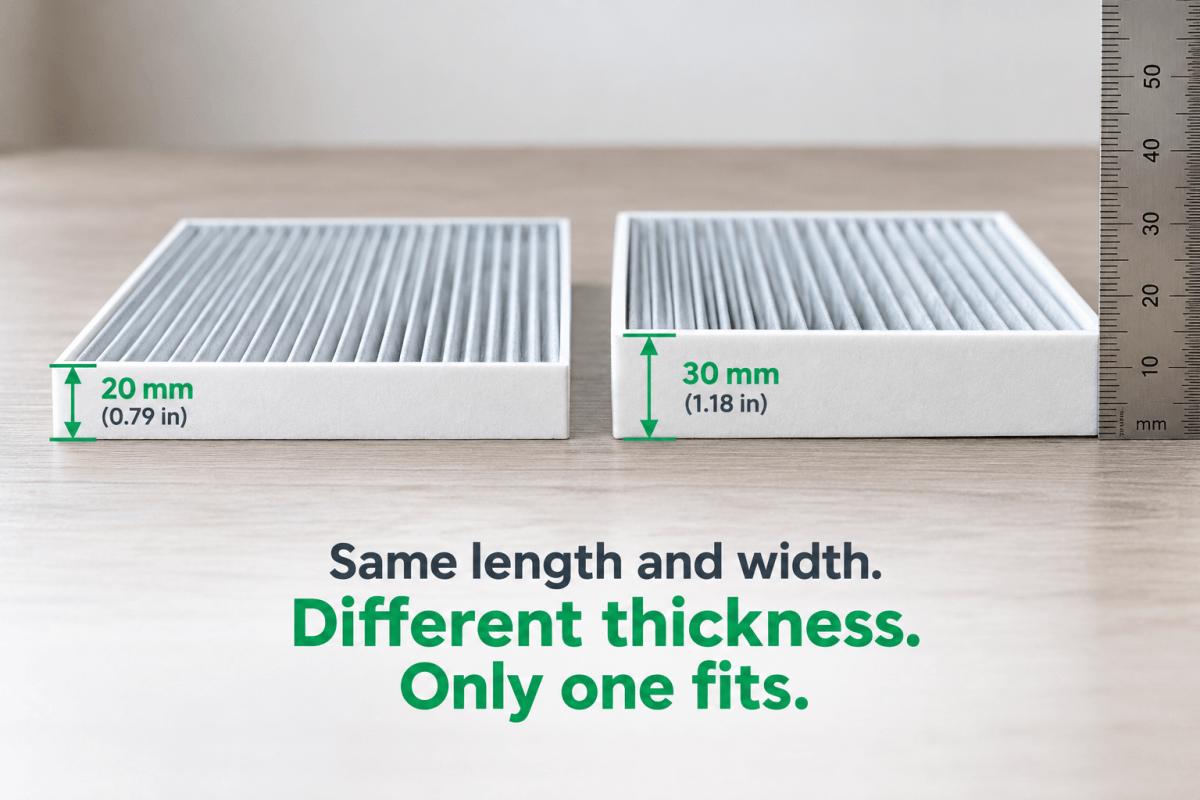
Thickness narrows the search fastest. Length and width repeat across dozens of vehicles, while thickness varies less predictably, so it resolves most ties.
A 2 mm gap is not a 2 percent loss. An undersized filter creates bypass air, letting unfiltered air route around the frame and straight into the blower.
What Size Is A Cabin Air Filter?
A cabin air filter is typically 180 to 300 mm long, 170 to 220 mm wide, and 15 to 35 mm thick. Within that range, cabin air filter dimensions cluster around a handful of shared footprints. One Toyota footprint measures 215 x 194 x 29 mm and covers the Camry, Corolla, and RAV4 across roughly a decade of model years. One Honda footprint runs about 211 x 205 x 30 mm and covers the Civic, CR-V, HR-V, Fit, and Odyssey. Neither seats in the other's housing, so match all three numbers rather than two. The cabin air filter size chart below groups those dimensions into the bands they actually occupy.
Ranges cover the great majority of U.S. passenger vehicles. Larger SUVs, vans, and some European models run past 300 mm.
A number of vehicles also split the intake across a two-piece set, two half-length filters seated in one housing. Measure both halves if you find them, and replace them as a pair.
To find a cabin air filter by size, take all three numbers to a fitment lookup rather than shopping the closest listed dimension. Shop auto cabin air filters by vehicle to confirm a match.
How Do You Measure A Cabin Air Filter?
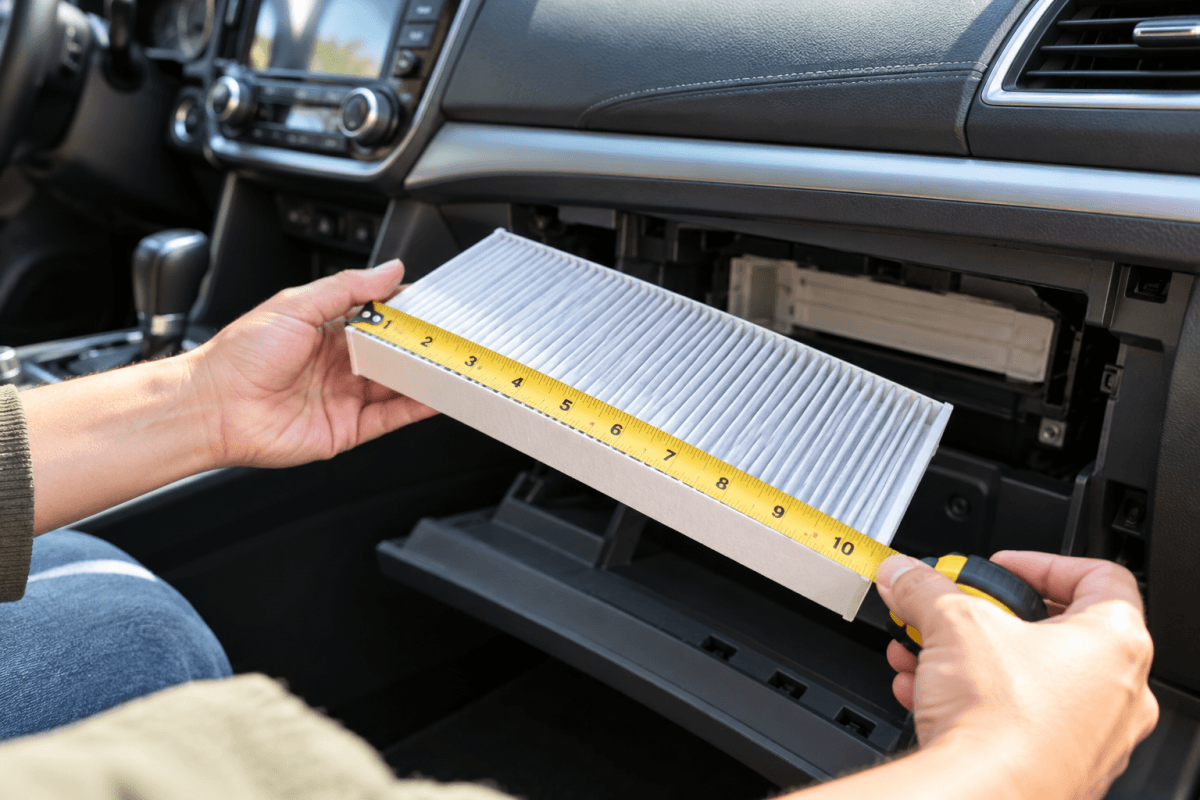
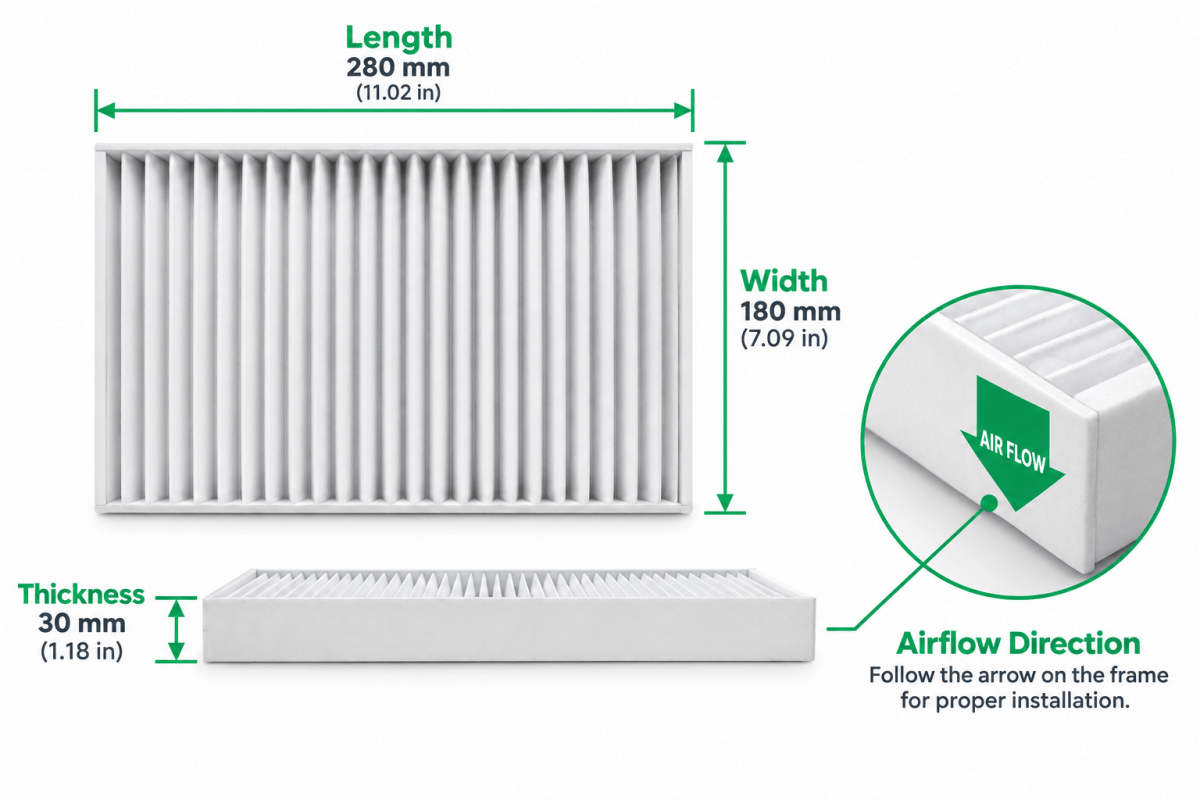
Measure the old cabin air filter itself with a tape measure or steel rule, recording length, width, and thickness in millimeters. Take every reading edge to edge across the outer frame, including the rubber or foam gasket if the filter has one. Record whole millimeters. Do not round to a convenient number.
Locate and remove the old filter. In most vehicles, it sits behind the glove box. Some models place it under the dash on the passenger side or beneath the windshield cowl. See where the cabin air filter is located if the housing is not obvious.
Note the airflow arrow before the filter leaves the housing. It is printed on the frame edge, and it will not be obvious later which way it pointed. If you have already pulled it, see which way the airflow arrow points.
Measure the longest edge. That is the length.
Measure the shorter edge. That is the width. Cabin filters are frequently close to square. The Honda footprint charted below measures 211 by 205, so measure both edges rather than assuming.
Measure the thickness across the pleat pack at the frame, not at the tallest pleat.
Check the frame edge before you measure anything. If a part number is still legible there, a cabin air filter part number lookup is faster and more precise than any cabin filter measurements you can take by hand. Use this size guide when the printing has worn away.
Measuring millimeters with an inch tape
Almost every tape measure in an American garage reads inches. Cabin filters are specified in millimeters. That mismatch is the most common reason a careful measurement still produces the wrong number, and it takes about ten seconds to solve.
Check the other edge of your tape first. Many U.S. tapes carry a millimeter scale on the lower edge or the reverse side.
If yours is inches only, read to the nearest sixteenth and multiply by 25.4.
Read to the sixteenth, not the eighth. One eighth of an inch is 3.2 mm, which is larger than the gap that causes bypass. One sixteenth is 1.6 mm.
For reference, 8 inches is 203 mm, 8 and a half is 216 mm, and 9 is 229 mm. Use a phone calculator rather than mental arithmetic, because the three filters charted below sit within 4 mm of one another on their long edge.
Why You Never Round A Cabin Air Filter Measurement
Home air filters are sold in rounded nominal sizes. Cabin air filters are not. A 20x25x1 furnace filter actually measures about 19.5 by 24.5 by 0.75 inches, and the industry rounds it for shelf consistency. Cabin air filters carry no such convention. The vehicle manufacturer specifies a millimeter dimension, the housing is molded to it, and the filter is cut to it.
The rounding rule is the difference that costs the most returns. It is correct for furnace and AC filters and wrong for cabin filters.
Round a 215 mm cabin filter up to 9 inches, and you have asked for a 229 mm part, which is 14 mm of interference. The filter will not seat, and forcing it buckles the media. Undersizing is the quieter mistake but not the safer one. A filter 2 mm short does not filter 2 percent less; it lets road dust route around the frame while looking correctly installed, which is why fitment matters more than price on a cabin filter.
The EPA puts the standard plainly in its Guide to Air Cleaners in the Home, which says a filter must fit snugly so air does not leak around it, and that you should never have to bend or crush one to make it fit. That guidance covers furnace and HVAC filters, but the physics inside a cabin housing is the same.
It is also why Filterbuy, a U.S. manufacturer of both home HVAC filters and auto cabin filters, cuts to the housing rather than to a rounded number. Every size in the catalog starts from a vehicle dimension, and there is no single standard cabin filter size to publish.
How Close Is Close Enough?
The housing sets the tolerance, not the filter. A cabin filter frame is rigid plastic or stiff board with no give in it, so length and width have almost no working margin: undersize leaks, and oversize will not seat. Thickness has a little more latitude, because the access cover compresses a foam seal in many vehicles, though going under still costs you pleat area and going over stops the cover from latching.
That leaves two practical thresholds, both drawn from how these parts behave in a real housing.
More than 3 mm off on any edge? That is a different filter, not a close one. Keep looking rather than forcing it.
Within 1 to 2 mm? You are probably inside the listing variance described above, not looking at a genuine mismatch. Confirm by year, make, and model rather than by the number.
The honest answer is that a tape cannot settle this on its own. Your three numbers put you inside a family of filters, and the vehicle is what confirms which part in that family is yours.
Why Filterbuy Treats Fit As The Whole Job
A filter that does not seal does not filter, whatever its media is rated to catch. Filterbuy cuts every auto cabin filter to exact OEM tolerances in the USA and pairs it with HEPA-certified media rated to capture 99.97 percent of particles down to 0.3 microns. Most people shop on media grade, which is reasonable. A filter that leaks at the frame never gets to use it.
What If Two Filters Match Your Measurement?
When length and width match more than one filter, cabin filter thickness decides. Footprints repeat heavily across a manufacturer's range. A single Honda footprint covers the Civic, CR-V, HR-V, Fit, Odyssey, and several Acura models. Thickness varies more between platforms, so compare the third number first.
If thickness matches too, three things separate the remaining candidates.
Media type. Standard particulate and activated-carbon versions of the same filter share identical dimensions and carry different part numbers. Carbon adds odor and exhaust-gas control, not a size change. See OEM versus aftermarket cabin air filters.
Frame profile. Two filters can share length, width, and thickness and still differ in corner geometry, tab placement, or gasket.
Single versus two-piece. If your housing held two panels, a single filter of matching dimensions leaves half the intake unfiltered.
Confirm the final choice by year, make, and model rather than by dimension alone. NHTSA's free vPIC VIN decoder will confirm the exact model year and build plant your VIN encodes before you match a part to it.
What We Found Checking Published Dimensions
Something unexpected surfaced while Filterbuy was building the chart below. Published dimensions for the same part do not agree from one seller to the next. We pulled the figures for a single part number, the FRAM CF11182 that fits most recent Hondas, from four separate listings.
211 x 205 x 30 mm
205 x 211 x 30 mm
215 x 202 x 30 mm
205 x 211 x 29 mm
One part, four different answers. They disagree by as much as 10 mm on a single edge, and two of them flip length and width outright. Shopping by dimension alone, two of the four would send you after the wrong filter.
That spread is the reason this page leads with ranges rather than a lookup table of exact numbers. A measurement narrows the field to a family of filters. Only the vehicle confirms which one.
Cabin Air Filter Sizes By Vehicle
With that caveat in mind, the table below covers three of the most common cabin filter footprints on U.S. roads. Each is shared across a whole family of vehicles, which is why one reference part number spans several models. For a make-level breakdown, see the Toyota cabin air filter guide or browse the full auto cabin filter range.
Length × width × thickness, converted from manufacturer and retailer listings and rounded to the nearest millimeter. These are not Filterbuy manufacturing specifications. Listings for the same part sometimes differ by a few millimeters, so confirm fitment by year, make, and model before ordering. Last verified September 2026.
The Toyota figures come from the FRAM CF10285 product listing and are corroborated by independent retailer specifications. Because Filterbuy cuts its own auto cabin filters in the USA to exact OEM tolerances, it treats outside numbers like these as a way to narrow the field rather than as the last word.
Supporting Statistics
Three federal datasets. One conclusion: fit is not a rounding error.
1. A 2 mm gap is huge next to what the filter catches.
PM2.5: particles 2.5 micrometers and smaller.
A human hair: about 70 micrometers. Thirty times larger.
A 2 mm bypass gap: 2,000 micrometers. Eight hundred times larger.
Source: EPA, Particulate Matter (PM) Basics
2. Drivers log serious miles behind that filter.
240 million licensed drivers in 2024.
87 percent of the driving-age population.
13,735 miles each, on average.
Source: FHWA, Our Nation's Highways 2026
3. No single size fits the U.S. fleet.
282.2 million vehicles registered in 2022.
Hundreds of vehicle platforms across that fleet.
Each housing is molded around one filter dimension.
Source: FHWA, Highway Statistics 2022, Table VM-1 (registration count). Platform and housing detail from Filterbuy.
Frequently Asked Questions
Glossary
Cabin air filter. The pleated filter that cleans outside air before it enters a vehicle's passenger compartment through the heating and air conditioning system. Distinct from the engine air filter, which protects the engine.
Nominal size. A rounded, standardized dimension printed on home HVAC filters, typically 1/4 to 1/2 inch larger than the filter's true measurement. Cabin air filters do not use nominal sizing.
Actual size. A filter's true measured dimensions. On a cabin air filter, the actual size and the printed size are the same number.
Bypass air. Unfiltered air that routes around the edge of a poorly fitting filter instead of passing through the media, delivering road dust directly to the blower.
Two-piece cabin filter set. A cabin filtration setup using two half-length filter panels within a single housing. Both must be replaced together.
Airflow arrow. The directional marking printed on a filter frame indicating which way the filter faces in the housing. Installing it reversed reduces filtration and can shorten filter life.
Activated carbon filter. A cabin air filter with a carbon layer that adsorbs odors and exhaust gases in addition to trapping particles. Dimensionally identical to the standard version of the same filter.
OEM. Original Equipment Manufacturer. A part built to the vehicle manufacturer's factory specification and sold under the vehicle brand's name.
HEPA. High-Efficiency Particulate Air. A filtration standard requiring capture of 99.97 percent of airborne particles at 0.3 microns. Filterbuy's auto cabin air filters use HEPA-certified synthetic media.
Filterbuy. A U.S. air filter manufacturer based in Talladega, Alabama, producing home HVAC filters in more than 600 sizes and auto cabin filters cut to OEM tolerances at its own domestic plants.