
Toyota Corolla Cabin Air Filter
Part Numbers, Cost, and How to Replace It
By Michelle Wan · Reviewed by David Clark, Licensed HVAC Technician · Published July 29, 2026 · Updated July 29, 2026
TL;DR
The Toyota Corolla cabin air filter sits behind the glove box and takes about ten minutes to change with no tools. Replace it every 12 months or 12,000–15,000 miles; the part costs roughly $14 to $30.
Part numbers by generation: 88568-02020 (2003–2008), 87139-02090 (2009–2013), 87139-07020 (2014–2019), 87139-0R030 (2020 and newer).
On 2020 and newer Corollas the charcoal number depends on build plant: 87139-58010 for Japan-built, 87139-0E040 for North America-built.
Corollas older than the 2003 model year have no factory cabin air filter.
Where Is the Cabin Air Filter on a Toyota Corolla?
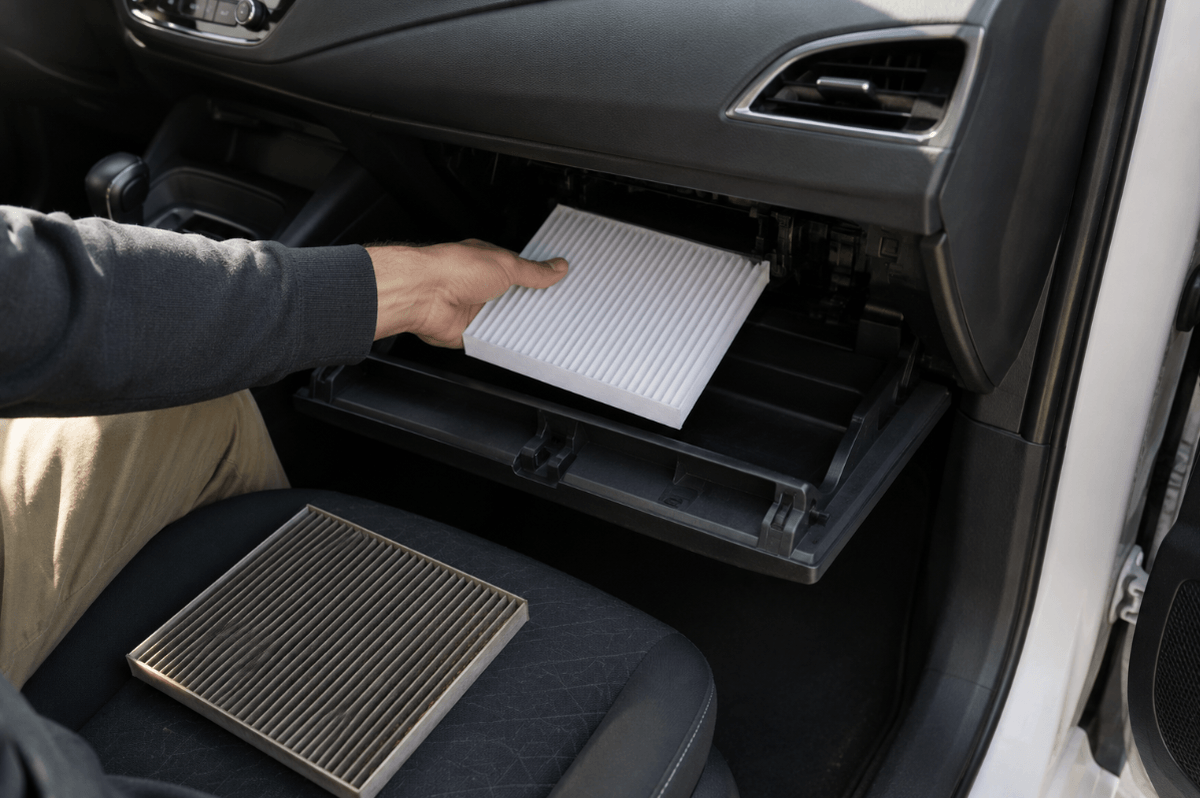
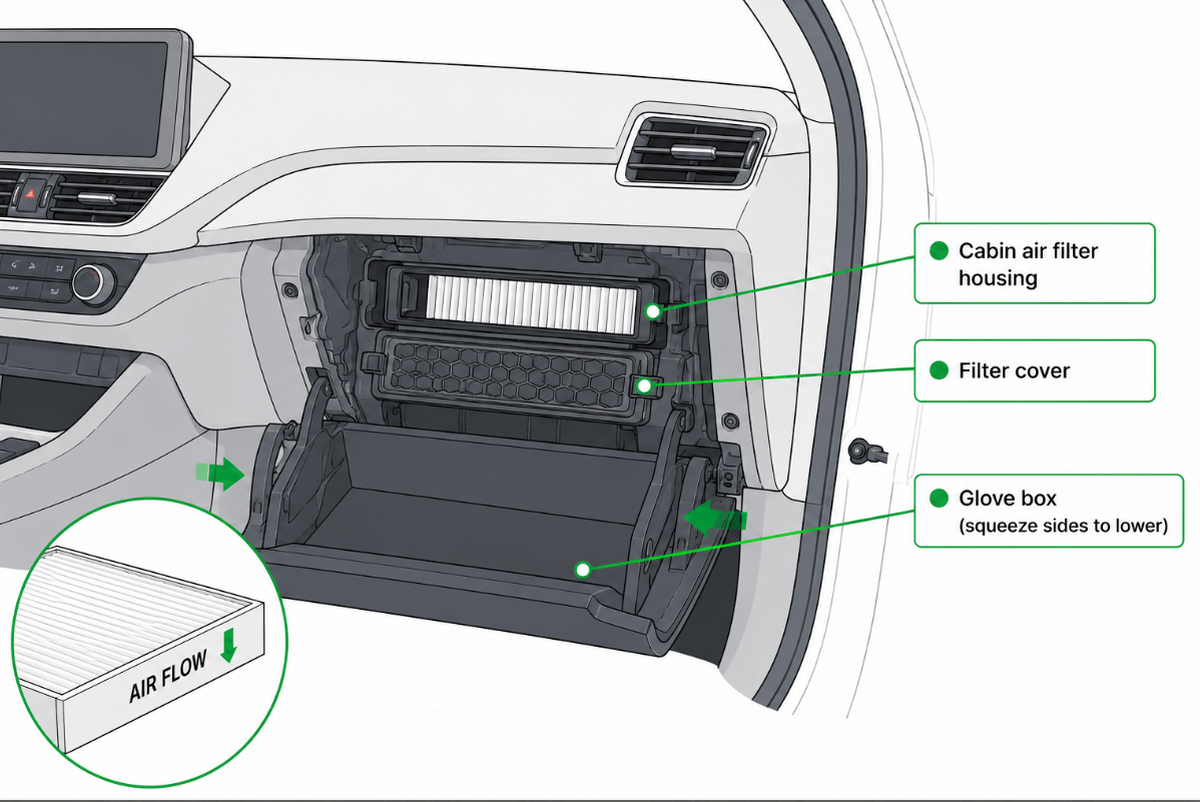
The Toyota Corolla cabin air filter is located behind the glove box, in a slim rectangular housing in the passenger-side dashboard. Empty the glove box, squeeze its side walls inward so it swings down past its stops, and the filter cover is directly in front of you. No tools required.
Check one thing first: not every Corolla has one. Toyota’s application guide lists no filter before the 2003 model year, so eighth-generation (1998–2002) cars have no housing to fill. Look before you order — filters get pulled during service and not replaced, so an empty slot is not unusual on a used Corolla. New to the part? Start with what a cabin air filter does.
Which Cabin Air Filter Fits Your Toyota Corolla?
The correct filter depends on model year and, on newer cars, on where the car was assembled. Standard “pollen” filters trap dust and allergens; charcoal versions add odor absorption. Confirm against your VIN or owner’s manual before ordering.
Compiled from the Toyota Parts & Service 2022 cabin air filter application guide. Confirm fitment against your VIN before ordering.
Two details trip people up. 87139-0R030 replaced the older 87139-28020, so both numbers point to the same current part. And the aftermarket uses its own numbering: a filter cross-referenced as CF10285 or 6055C covers the entire 2009–2019 run.
The plant split matters more than it looks: one model year of one car can need two different charcoal numbers depending on which factory built it, so year, make and model alone will not always get you to the right filter.
How Do You Replace the Cabin Air Filter in a Toyota Corolla?
Replacing a Toyota Corolla cabin air filter takes about ten minutes and needs no tools on 2009 and newer cars. Drop the glove box, unclip the cover, swap the filter facing the same direction as the old one, and close it up.
Empty the glove box.
Lower the glove box. Squeeze both side walls inward until the stops clear. On 2003–2008 models you may also need to unhook the damper arm on the right side.
Unclip the filter cover. Press the tabs on each side and pull it straight out.
Read the airflow arrow before the old filter leaves the housing. Every cabin filter has one on the frame; on the Corolla it points down, toward the floor.
Vacuum the housing. Leaves and grit collect in the tray, and clearing them keeps debris off the blower wheel.
Install the new filter with the arrow facing the same way, reattach the cover, and swing the glove box up until it clicks.
An upside-down filter still filters, but it can bow under airflow and let unfiltered air slip past the edge. For photos, see our step-by-step replacement guide.
How Often Should You Replace a Toyota Corolla Cabin Air Filter?
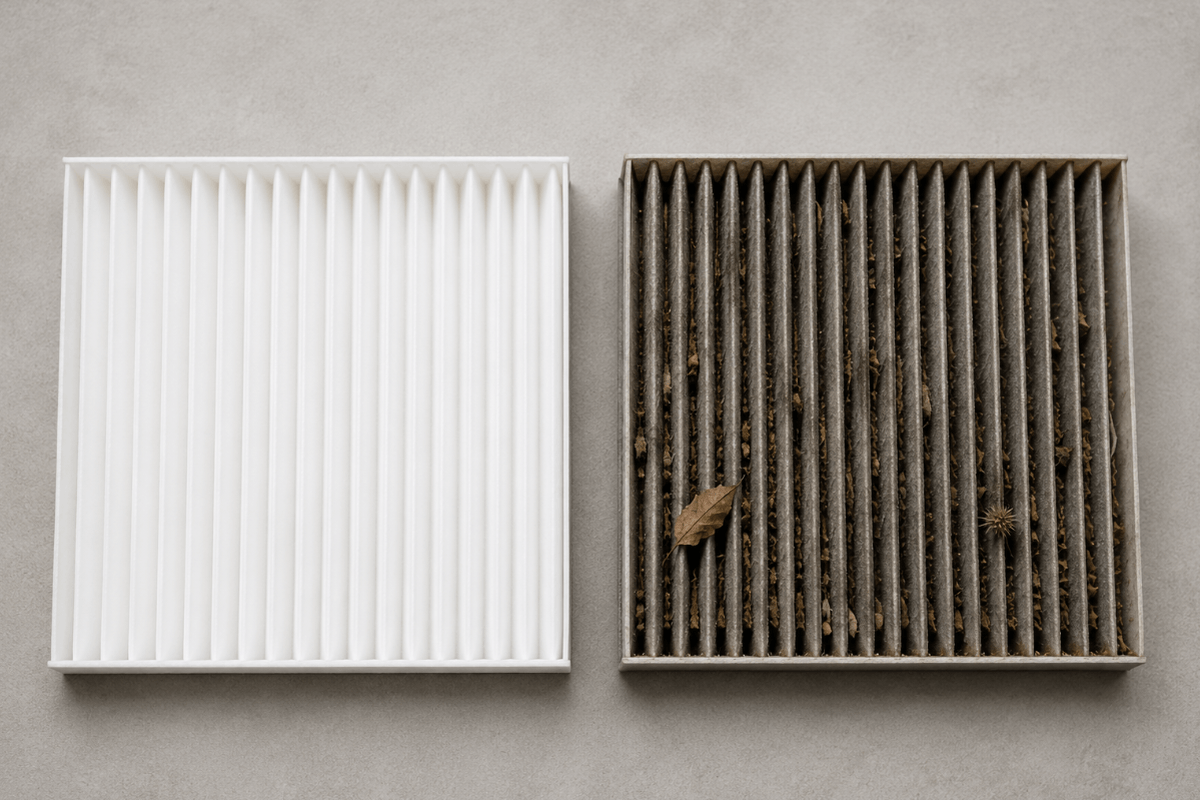
Replace it every 12 months or 12,000 to 15,000 miles, whichever comes first. Toyota’s maintenance schedule raises the cabin filter at the 15,000-mile service intervals, and Filterbuy’s approved interval for its auto cabin filters is 12 months or 12,000 miles. Shorten it for heavy pollen, dust, wildfire smoke, or daily stop-and-go traffic — the same logic behind how often to change a cabin air filter in any vehicle.
A cabin filter does not fail all at once; it degrades measurably as it loads up. In a University of Birmingham and Harvard T.H. Chan School of Public Health study published in Science of the Total Environment, in-vehicle PM2.5 under recirculation rose from 2.5 to 4.7 µg/m³ as the activated-carbon filter aged, and aging filters raised in-vehicle nitrogen dioxide by 78% with the A/C on and 76% on recirculation.
The average U.S. driver covers about 13,500 miles a year (Federal Highway Administration), squarely inside that window, so check the filter at every oil change and replace it annually regardless of the odometer.
How Should You Set the A/C to Get the Most from a New Filter?
Windows up, recirculation on, and a filter less than a year old is the lowest-exposure combination the research supports. Recirculation cuts in-cabin fine particles because the system stops pulling roadside air through the vents — but only while the filter is fresh. In the Birmingham and Harvard measurements, a new carbon filter kept nitrogen dioxide low on both fresh air and recirculation, while a 6-to-15-month-old filter let NO2 climb 78% on fresh air and 76% on recirculation.
Two limits. Recirculation traps what you exhale: carbon dioxide and moisture build up, so switch back to fresh air periodically, especially with a full car or a fogging windshield. And no setting rescues a clogged filter. The researchers’ own advice matches ours — close the windows, manage ventilation for adequate air exchange, and replace the filter on schedule.
How Much Does a Toyota Corolla Cabin Air Filter Cost?
A Toyota Corolla cabin air filter costs roughly $14 to $30 for the part. Do it yourself and the part is the entire cost; because the job takes ten minutes and needs no tools, labor is usually the larger line item at a shop.
Part prices checked July 2026 and subject to change.
What Are the Signs Your Corolla’s Cabin Air Filter Is Bad?
The clearest signs of a clogged Corolla cabin air filter are weak airflow from the vents and a musty smell when the fan runs. Because the filter hides behind the glove box, most drivers notice symptoms months before they see the part.
Reduced airflow even with the fan on high
A musty, dusty, or stale odor when the vents open
Windows that fog and clear slowly
A whistling or straining sound from the dash
Allergy symptoms that spike specifically while driving
Any one alone can have another cause; two or more together means it is time to look. More on signs your cabin air filter needs replacing and what happens if you never replace one.
Standard, Charcoal, or HEPA: Which Is Best for a Corolla?
Choose a standard particulate filter for ordinary suburban driving, activated charcoal if exhaust odors are the problem, and HEPA-grade media if allergies, asthma, or wildfire smoke are. All three fit the same housing, so the decision is about media, not measurements, the trade-offs covered in our guide to choosing a cabin air filter.
Toyota’s own range covers the first two rows. HEPA-grade media is an aftermarket upgrade, and it is the only one of the three sold with a published capture rating.
The difference is not theoretical. In a UCLA study of 17 Los Angeles taxi drivers published in PLOS ONE, closing the windows and fitting a high-efficiency cabin air filter cut in-cabin PM2.5 by 37% and ultrafine particles by 47% compared with no mitigation, and a randomized cross-over study of 48 commuters found comparable reductions. Fine particulate matter is the category the EPA links to serious respiratory and cardiovascular risk, which is why media grade matters more than price.
What a Part Number Cannot Tell You
A part number tells you what fits. It does not tell you how well it filters. Toyota sorts its cabin filters into pollen, electrostatic and charcoal, but publishes no capture rating — no micron size, no percentage. And a filter cut a few millimeters small still snaps into the housing while letting unfiltered air slide around the frame every time the fan runs.
That gap is what Filterbuy builds for. Our auto cabin filters use HEPA-certified media rated to capture 99.97% of airborne particles down to 0.3 microns, published on the spec sheet, and each one is cut in the USA to OEM dimensions. At $13.99 it costs less than the genuine Toyota part and carries a five-year warranty. Our exact-fit Toyota Corolla cabin air filter covers 2009–2019 Corollas and the 2017–2018 Corolla iM; for a 2020 or newer car, use the OEM numbers above until our fitment expands. We also carry filters for other Toyota models.
Where to Look Up a Corolla Cabin Filter Part Number
A lookup needs three things: model year, trim or engine, and on 2020 and newer cars build plant.
NHTSA vPIC VIN Decoder - free federal lookup returning year, trim, engine and assembly plant, the field that decides the charcoal number on a 2020 or newer Corolla.
Toyota Owner’s Manuals - filter location and Toyota’s interval by model year. When sources disagree, the manual wins.
Toyota Genuine Parts - the number Toyota ships today, so it catches supersessions like 87139-28020 to 87139-0R030.
Toyota Parts & Service application guide - one PDF covering every model and year; source of the table above.
RockAuto - independent catalog listing aftermarket equivalents beside the OEM number. Lookalike domains copy its branding; the real one is rockauto.com.
WIX Filters application lookup - translates a Toyota number into other brands’ equivalents.
Filterbuy’s cabin filter finder - enter year, make and model for the exact-fit HEPA filter and the OEM number it replaces (2009–2019).
Frequently Asked Questions
About the Author
Michelle Wan is Filterbuy’s Brand Manager and air quality writer (B.A., University of California, Santa Cruz). She works directly with Filterbuy’s manufacturing team across its factories in Alabama, Florida, Pennsylvania, and Utah, and bases her guidance on how filters are built and used. Reviewed for technical accuracy by David Clark, Licensed HVAC Technician. Filterbuy has manufactured air filters in the USA since 2013.
Disclosure: Filterbuy manufactures and sells cabin air filters, including a HEPA-certified filter for the 2009–2019 Toyota Corolla.
Glossary
PM2.5: Fine particulate matter 2.5 microns or smaller, small enough to be inhaled deep into the lungs.
HEPA-certified media: Media verified to capture 99.97% of airborne particles at 0.3 microns.
Chassis code (E120, E140, E170, E210): Toyota’s designation for a vehicle generation; E210 is the twelfth-generation Corolla (2020 onward).