Shop by
By Michelle Wan · Technically reviewed by David Clark, Licensed HVAC Technician · Published August 27, 2026 · Updated August 27, 2026
Michelle Wan writes about in-vehicle air quality for Filterbuy, which has manufactured air filters in the USA since 2013.
Every Honda CR-V since 1997 has a cabin air filter, and four part numbers cover all six generations. A 2017–2026 CR-V takes Honda 80291-TF3-E01, while a 2007–2016 takes 80292-SDA-407. Either sits behind the glove box and comes out in ten minutes with no tools.
Two numbers cover 2007 on: 80292-SDA-407 to 2016, 80291-TF3-E01 from 2017.
Honda calls it the dust and pollen filter, which is why manual searches fail.
The 2017-and-newer filter is 38% smaller than the part it replaced, measured across Filterbuy's two CR-V parts.
Maintenance Minder sub-item 2 is the reminder, halved to 15,000 miles in heavy urban soot.
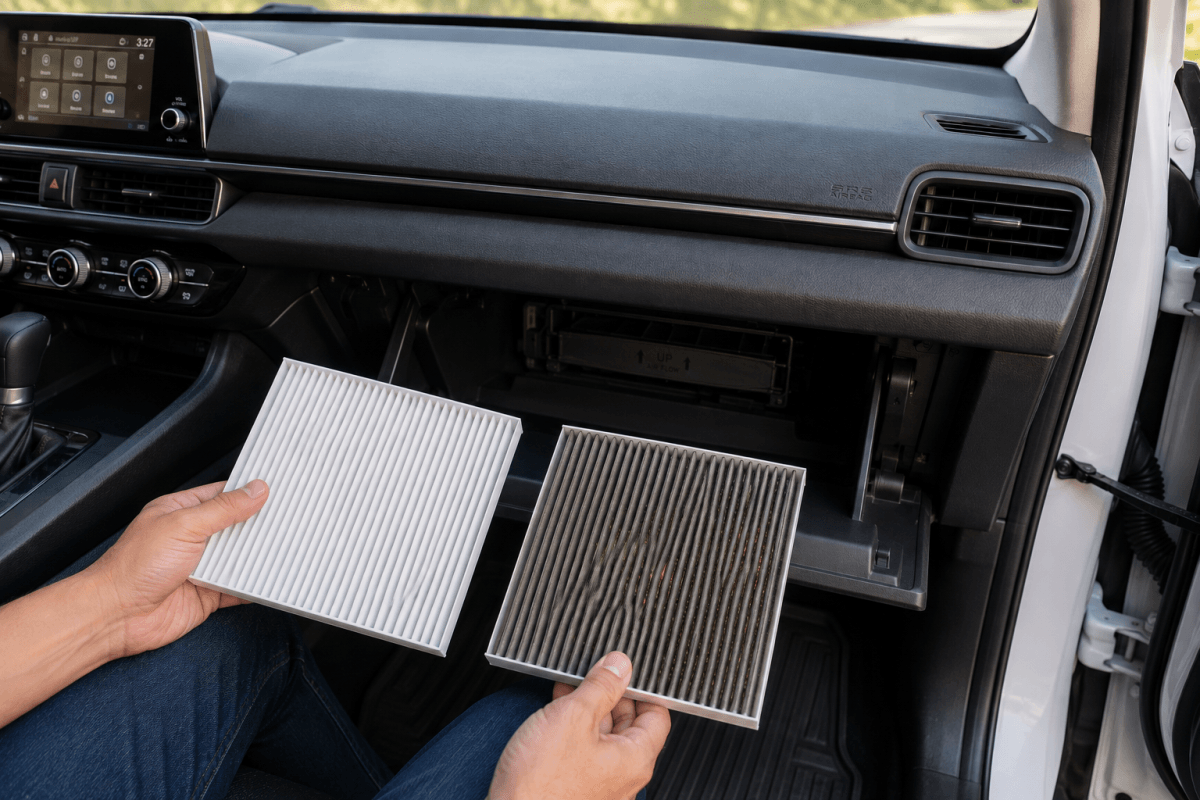
Color is a poor test. Judge airflow and debris load instead.
Four Honda part numbers cover every CR-V built since 1997. Honda has retired and replaced numbers several times, so a figure copied from an older manual may point at a part that no longer exists. Here is what Honda ships today.
Honda CR-V cabin air filters vary by model year, with earlier models using different OEM part numbers than newer generations. Most modern CR-Vs also offer both standard pollen and premium charcoal filter options, while aftermarket equivalents are available across model years. Always confirm the correct filter for your specific year before purchasing.
2017–2021 CR-Vs shipped with 80291-T5R-A01, so if that is on your old filter it is correct but retired, and Honda supplies the identical 80291-TF3-E01 instead. Our part number lookup covers the VIN and cross-reference methods.
Honda catalogs it as the dust and pollen filter, so "cabin air filter" returns nothing and "air filter" lands you on the engine air cleaner element. Look under climate control for dust and pollen. This is the most common reason an owner tells us their CR-V has no cabin filter, though every one since 1997 has one.
Honda's number has not changed: 80291-TF3-E01, the same filter fitted since 2017, hybrid and e:FCEV included. Filterbuy's listing still stops at 2023 because we have not finished validating those years, so the part is right even though the listing lags. Check with Filterbuy support first.
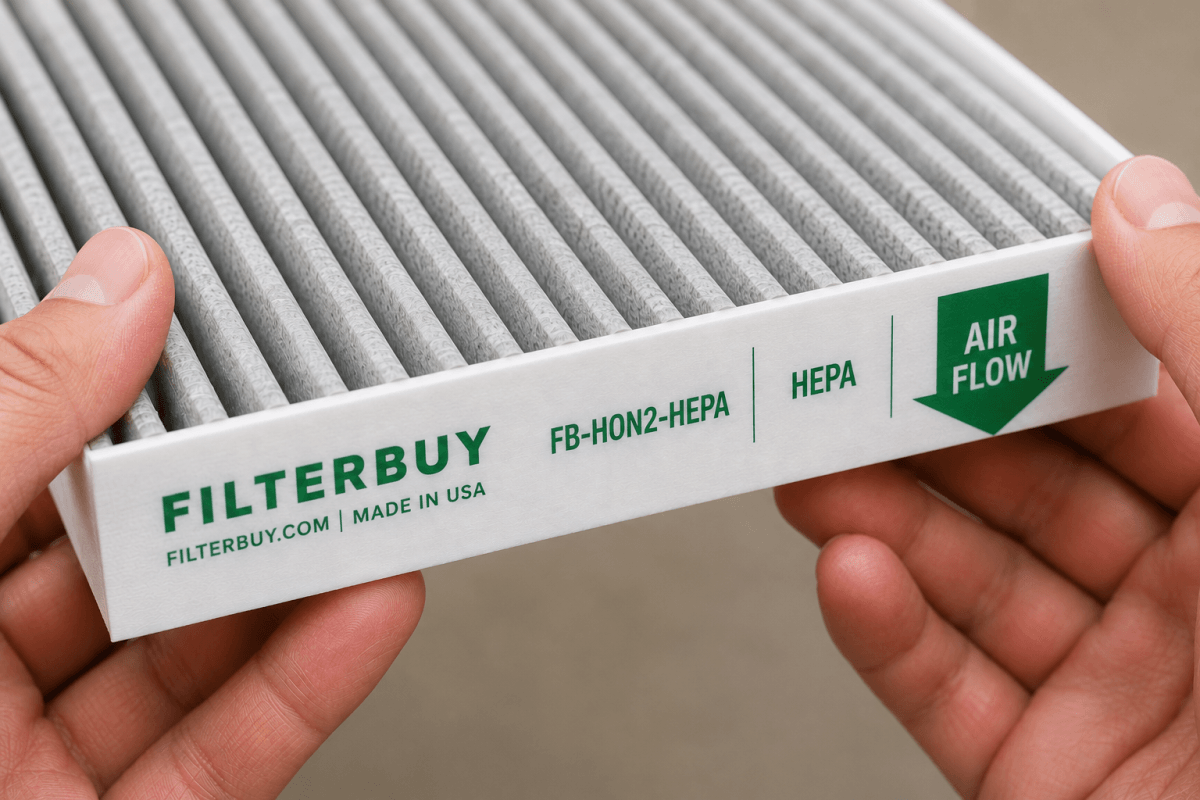
Because Filterbuy cuts both CR-V filters in-house, we know their dimensions down to the tolerance, and a side-by-side comparison shows that the 2017 redesign made the cabin air filter noticeably smaller.
The 2007–2016 CR-V filter (FB-HON1-HEPA) measures 9.3 × 9.7 × 1.8 inches, with a face area of 90.2 square inches and a volume of 162.4 cubic inches. By comparison, the 2017–2026 filter (FB-HON2-HEPA) measures 8.3 × 9.3 × 1.3 inches, reducing the face area to 77.2 square inches—about 14% smaller—and the overall volume to 100.3 cubic inches, or roughly 38% less. A smaller filter body has less room to hold debris before airflow begins to suffer. While frame dimensions are not the same as pleated media area and pleat count also affects performance, the overall direction is clear: the newer CR-V uses a smaller filter to handle the same job.
"The sixth-generation filter surprises people. It is smaller than the part it replaced, yet it covers more vehicles: Civic, HR-V, Odyssey, the 2023 Accord, four Acuras. Owners assume a newer car means a bigger filter, and it is the other way round. That is why we tell CR-V drivers not to stretch to 30,000 miles."
Michelle Wan, Filterbuy
Honda schedules the CR-V cabin filter through Maintenance Minder, not a fixed mileage. Sub-item 2 covers the air cleaner element, the dust and pollen filter, and the drive belt, so a dash reading of A12 or B12 includes your filter, usually at 25,000 to 30,000 miles.
What it will not tell you sits in a footnote to Honda's CR-V schedule that few owners read: drive mainly in urban areas with high soot from industry and diesel vehicles, and the filter is due every 15,000 miles.
Honda's two documents disagree, and Filterbuy sides with the shorter number, especially on the smaller 2017-and-newer filter.
Color is a poor test, and it is the one most shops use. Media darkens from surface dust within a few thousand miles and keeps working, so a grey filter held up at the counter is a normal filter, not a verdict. Judge it on these instead:
Airflow. Fan on high, fresh-air mode. Weak or uneven output is the real signal.
Debris load. Leaves, needles, and matted pleats mean packed, not dirty.
Smell. A musty note when the blower starts means moisture in the media.
Fogging. Honda ties slow-clearing windows to a filter due for replacement.
None of those? Put it back in, since reinstalling a filter you have already pulled costs nothing. Filterbuy sells these filters, so take that for what it is worth: we would rather you replace one that is genuinely spent than buy one on the strength of a photo shown in a waiting room.
Expect $13 to $30 for the filter and $0 to $100 for labor. Honda lists $28.52 for the 2007–2016 part and $29.25 for the 2017–2026 part, while the Filterbuy equivalents run $12.59 and $13.99.
Labor is the whole variable and optional: $50 to $100 at a dealer, or $40 to $90 at a quick-lube chain, for ten minutes of work that needs no tools. Our cost guide goes deeper.
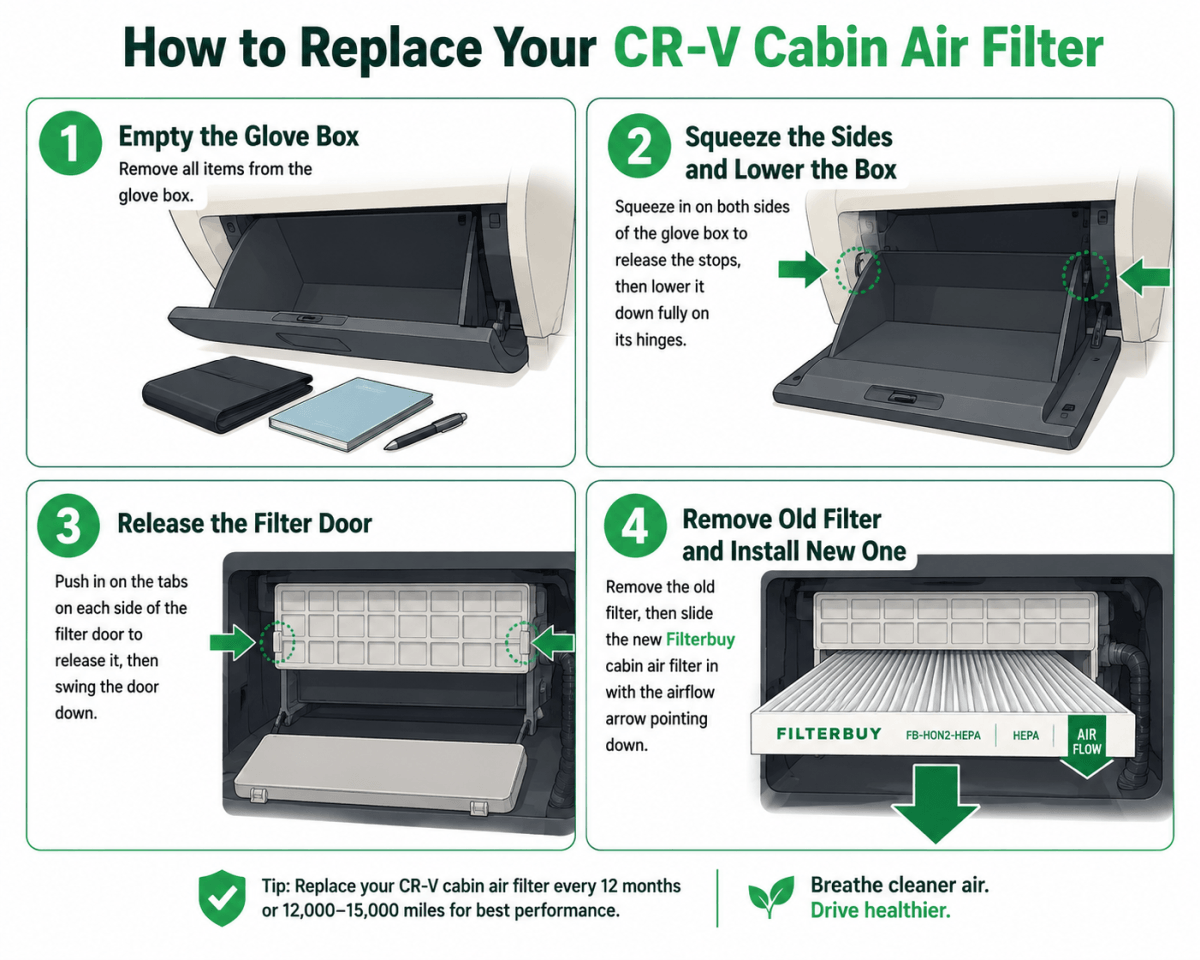
The CR-V cabin filter sits behind the glove box, and the job takes about ten minutes with no tools. The procedure is the same across every generation, and the CR-V is easier than most Hondas: there is no damper arm to unhook first, as there is on the Accord. Two side stops and the door drops.
Empty the glove box. Anything left inside lands in the footwell.
Squeeze the sides inward. Press both walls toward the center until the stops clear, then lower the door fully.
Note the airflow arrow before you pull anything. Both arrows point down, and refitting the filter the wrong way is the most common mistake here.
Depress the tabs and lift the filter door away. It releases by hand.
Slide the old filter out slowly and level. Tilting it dumps a season of pollen into the footwell. Read the part number off the frame.
Vacuum the housing. Leaves and grit collect in the tray.
Insert the new filter, arrow down, matching the orientation from step three.
Reassemble and test. Refit the cover, re-seat the stops, then run the fan and check for even flow.
"The arrow is the whole job on a CR-V. Both point down. Put it in backwards and the pleats load from the clean side. The filter still seats, the door still closes, and six months later the owner is asking why airflow dropped."
David Clark, Licensed HVAC Technician and technical reviewer for Filterbuy
Filterbuy makes these filters in Talladega, Alabama, so read this recommendation knowing we have a stake in it. We published Honda's numbers, prices, and the FRAM cross-references anyway, because a fitment guide that only works if you buy from us is not one.
Cutting your own filters does teach you something about fit. A filter 2 mm undersized does not filter 2% less; it creates bypass air, letting unfiltered air slip around the frame and into the blower while the filter looks perfectly installed. Filterbuy cuts to OEM tolerances for that reason, which is also why a correct filter can feel slightly tight going in. Snug is right, loose is the problem.
That fit is what makes filtration measurable. In a randomized cross-over study of 48 commuters, Health Canada researchers found cabin filtration cut in-vehicle PM2.5 by 30% and black carbon by 32% without restricting airflow. Filterbuy auto cabin filters use HEPA-certified media rated at 99.97% capture to 0.3 microns.
One correction Filterbuy makes often: MERV does not apply to cabin air filters. MERV is ANSI/ASHRAE 52.2, written for home HVAC, while cabin filters use ISO/TS 11155. A cabin filter sold with a MERV number borrows a scale never written for it, as our brand comparison explains.
Shop cabin air filters for your Honda CR-V →
Three federal sources support these Honda CR-V cabin filter replacement intervals.
Average U.S. driver: 13,476 miles a year
Drivers aged 20–54: 15,098–15,291 miles, almost exactly Honda's figure
Drivers 65 and over: 7,646 miles, roughly half
Why it matters: Commuters reach 15,000 miles in about a year; lighter drivers hit the calendar first.
Source: FHWA, Average Annual Miles per Driver by Age Group
In-vehicle exposure: 10–20% of daily PM2.5 exposure
Determining variables include the vehicle's HVAC status
In-vehicle PM2.5 runs higher than most everyday settings
Why it matters: Of those, the filter is what a driver controls.
Source: NIH National Library of Medicine, Modeling of In-Vehicle Human Exposure to Ambient Fine Particulate Matter
EPA advice: close windows and vents, run the A/C on recirculate
Recirculate routes cabin air back through the filter rather than drawing outside air
Particulate matter is the principal public health threat in smoke
Why it matters: Recirculate filters nothing on its own. It sends cabin air through your filter more often, so a loaded filter undercuts the one step EPA recommends.
Source: U.S. EPA, Reduce Your Smoke Exposure (EPA-452/F-18-003)
Honda part 80291-TF3-E01, the same filter used from 2017 through 2026 including hybrids. The aftermarket cross-reference is FRAM CF11182.
One, in a single housing. Some vehicles take a two-piece set, but the CR-V does not.
Not necessarily. A CR-V cabin filter darkens within a few thousand miles and keeps working, so judge airflow, debris load, and smell rather than color.
Honda uses Maintenance Minder sub-item 2, typically 25,000 to 30,000 miles, or 15,000 in heavy urban soot. Filterbuy's guidance is 12 months or 12,000 miles.
