
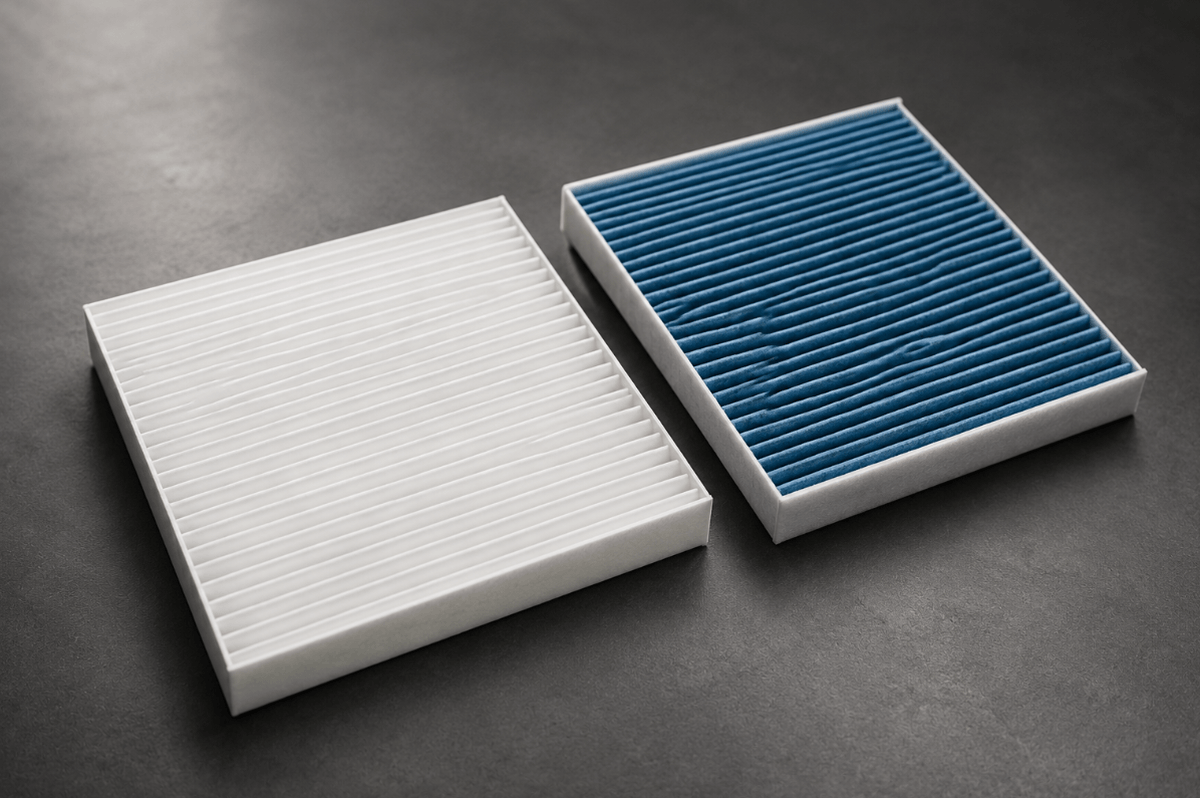
Filterbuy Vs. Pureflow Cabin Air Filters
Which Is Better For Your Car
Michelle Wan · Technically reviewed by David Clark, Licensed HVAC Technician · Published: July 29, 2026 · Last updated: July 29, 202
TL;DR
Filterbuy and Pureflow describe the same job with numbers that are not comparable. Filterbuy publishes one rating, 99.97 percent capture down to 0.3 microns. Pureflow publishes two, an up-to-99-percent standard tier and a 99.97 percent HEPA tier, and only the part number suffix tells you which you hold.
Key Takeaways
Filterbuy applies one rating, 99.97 percent at 0.3 microns, to every cabin filter.
Pureflow publishes up to 99 percent for its standard filter and 99.97 percent for its HEPA line.
One base part number can return four different Pureflow and Premium Guard filters. The suffix is the only tell.
Pureflow’s HEPA pages note the layer may slightly restrict airflow. Filterbuy uses hydrocharging to avoid that tradeoff.
Peer-reviewed testing found filtration cut in-vehicle particles by roughly a third, and nothing to gases.
Your car pulls outside air through one small pleated panel before that air reaches your face. Traffic exhaust, brake dust, pollen, and wildfire smoke arrive there first. Two brands sold widely to American drivers describe that job differently, and the gap between their numbers is wider than it looks.
From The Author
I cover air quality for Filterbuy, so my mornings start with AQI readings and smoke maps for U.S. cities. Cabin filters come up in that beat more than people expect, because a car is the one place most of us sit for an hour a day with outside air pumped straight at our faces. What surprised me here was not the capture percentages. Pureflow sells two different ratings under one name, and nothing on a shelf tells a shopper which is in the box.
Michelle Wan, Brand Manager and Air Quality Writer
Why Your Cabin Air Filter Choice Changes What You Breathe
A cabin air filter sits between outside air and your vents, and its media decides which particles reach you. Health Canada and McGill researchers ran a double-blind cross-over study of 48 commuters. Filtration cut in-vehicle ultrafine particles by 28 percent, fine particulate matter by 30 percent, and black carbon by 32 percent against a placebo.
The study is more useful for what it rules out. Particle media left nitrogen dioxide, benzene, and carbon monoxide untouched, because electrostatic and mechanical media cannot capture gases. Charcoal handles that job. Filterbuy keeps the two separate for this reason, and any comparison blending them into one score hides the tradeoff. The Health Effects Institute reached parallel conclusions in the largest systematic review of the evidence to date.
What Filterbuy Publishes And Why
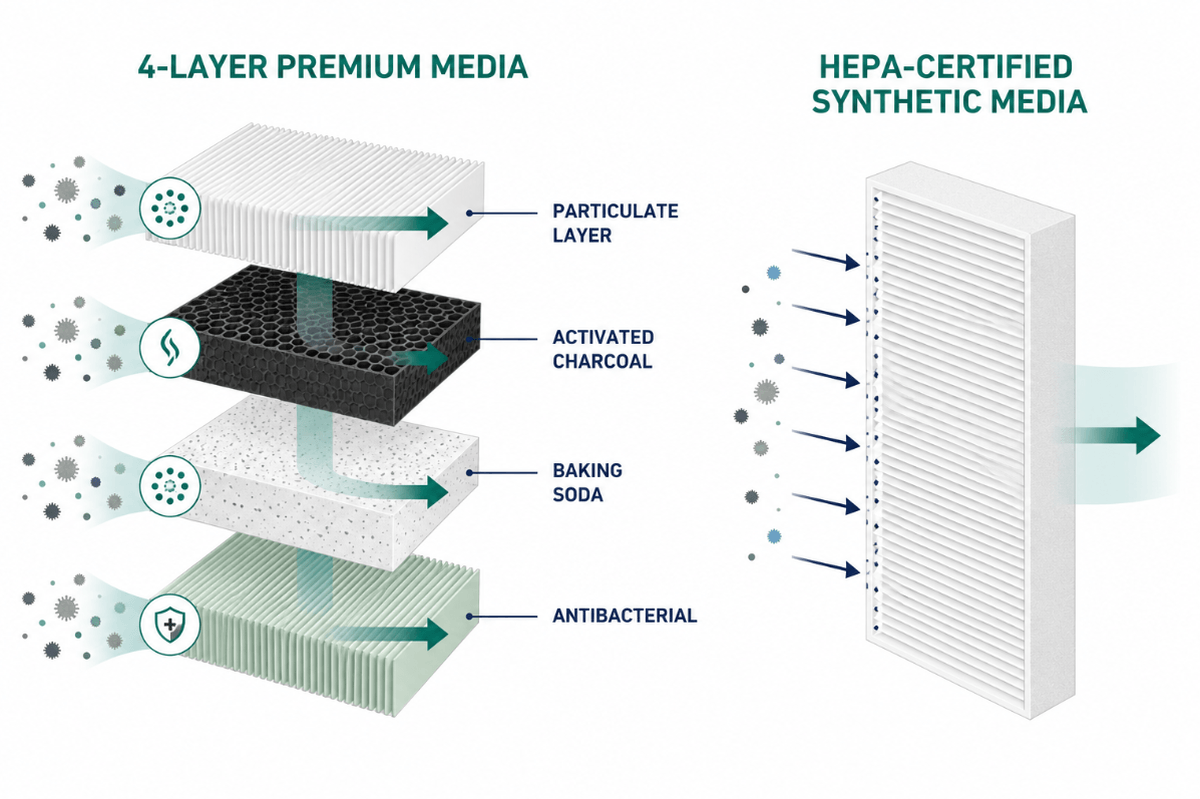
Filterbuy manufactures its auto cabin air filters in the USA and rates the whole range on one specification, 99.97 percent capture of particles as small as 0.3 microns using HEPA-certified synthetic media. One number across the catalog is deliberate. No shopper can accidentally buy down a tier from Filterbuy.
Two build decisions sit behind that number, and both come from making the panels rather than reselling. Filterbuy hydrocharges the media, putting a lasting electrostatic charge on each fiber so it pulls particles from the airstream without a tighter weave. Tighter weave is the usual shortcut to a higher capture number, and it costs airflow. Filterbuy also cuts every panel to the vehicle’s own housing tolerances rather than a size chart, because air takes the easiest path and a loose edge beats any media. Our guide to OEM and aftermarket fitment explains why. Drivers wanting gas and odor control can choose activated carbon cabin air filters instead.
What Pureflow Publishes
Pureflow is the premium cabin brand of Premium Guard, split across two efficiency tiers. The standard filter uses four layers, an electrostatically charged particulate layer, activated charcoal, a baking soda treatment, and an antibacterial layer with silver and copper ions. Pureflow's published standard tier specifications rate it at up to 99 percent of airborne contaminants, replaced yearly.
Pureflow's HEPA collection rates its HEPA stage at 99.97 percent, aims it at severe allergy sufferers, and adds a caveat that the layer may slightly restrict airflow. One gap stands out across both tiers. Pureflow publishes no particle size beside the up-to-99-percent figure, so that number and our 99.97 percent at 0.3 microns are not measuring the same thing.
The Part Number Test That Settles Which Pureflow You Are Buying
Filters in Pureflow’s HEPA range carry an HX suffix, and standard filters carry a plain X. Checking that suffix at checkout is the only reliable way to know which specification you are paying for. Neither brand publishes a MERV rating here, because MERV grades home HVAC filters against a different test standard than automotive cabin filters are built to.
The confusion runs deeper than two tiers. Search one base number and four filters come back under nearly identical titles. Here is the PC5667 family, covering Toyota 4Runner, Corolla, RAV4, Camry, and Highlander applications plus several Lexus and Land Rover models.
| Part number | Brand | Media | Published rating |
|---|---|---|---|
| PC5667HX | Pureflow | HEPA plus charcoal | 99.97 percent |
| PC5667X | Pureflow | Electrostatic plus charcoal | Up to 99 percent |
| PC5667C | Premium Guard | Charcoal media | Not published |
| PC5667 | Premium Guard | Base media | Not published |
Ratings as published by the manufacturer. Confirm fitment by part number before you buy.
| Feature | Filterbuy | Pureflow Standard | Pureflow HEPA (HX) |
|---|---|---|---|
| Capture rating | 99.97 percent | Up to 99 percent | 99.97 percent |
| Particle size | 0.3 microns | Not published | Not published |
| Media | Hydrocharged HEPA | Electrostatic plus charcoal | HEPA plus charcoal |
| Odor | Separate carbon option | Built in | Built in |
| Airflow | No added restriction | Minimal drop | May slightly restrict |
| Frame | Polypropylene, OEM cut | Aftermarket | Aftermarket |
| Manufacturing | Made in the USA | Not published | Not published |
| Replacement | 12,000 to 15,000 miles | Yearly | Yearly |
| Best for | Allergy, smog, smoke | Odor | Allergy |
Competitor figures reflect published manufacturer specifications at the time of writing. Confirm fitment by vehicle before you buy.
Which Cabin Air Filter Should You Buy
Coverage comes first. Pureflow lists more than 6,900 filters in its HEPA cabin collection, and Filterbuy publishes a vehicle selector rather than a count, so check your year and model first. Then pick by the pollutant that bothers you and confirm the tier. Drivers troubled by pollen, smog, brake dust, or wildfire smoke want a HEPA-grade panel, and the Filterbuy range carries that rating throughout with an OEM cut and no airflow caveat. Drivers troubled by exhaust smell or a musty vent want carbon, which Pureflow builds in and Filterbuy sells separately.
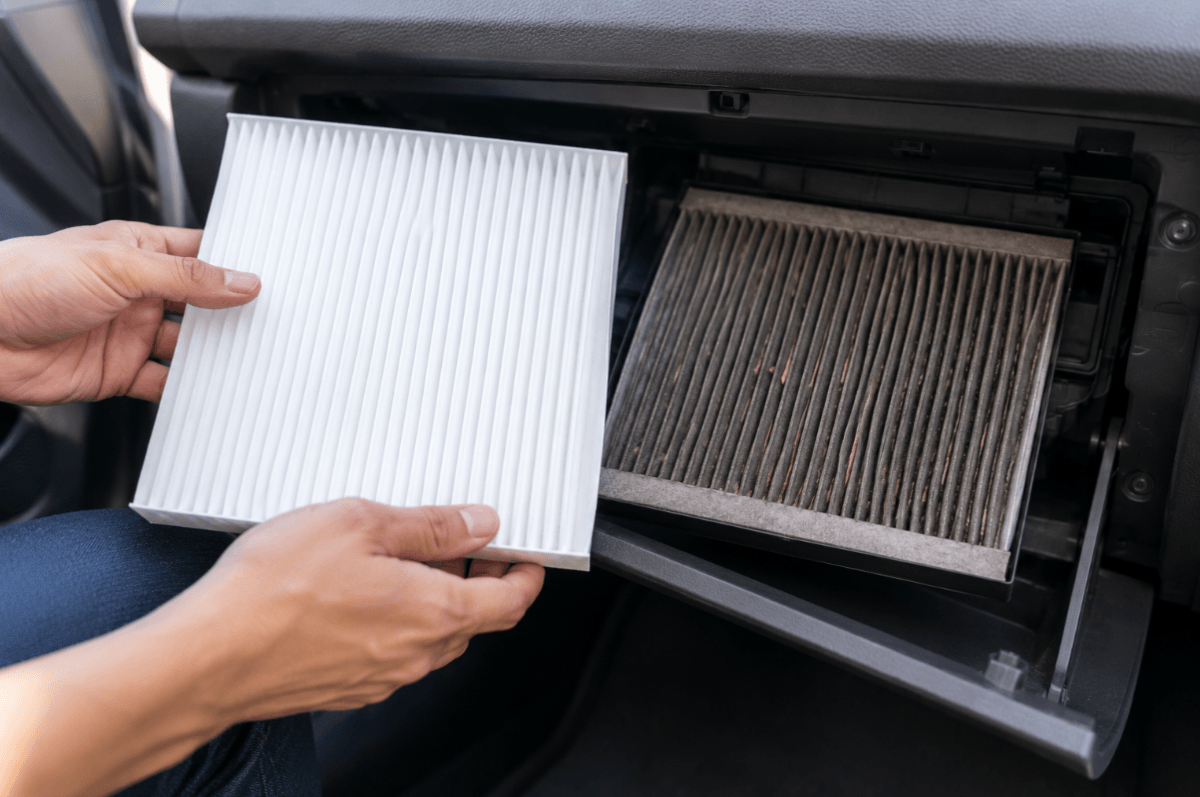
Two habits matter more than the badge on the frame. Replace the panel on schedule, because a loaded filter chokes airflow and strains the blower motor. Buy the size matching your vehicle, so no air bypasses the media. Our complete buyer's guide to cabin air filters covers both, and our breakdown of what cheap cabin filters leave out shows which corners get cut. Any pleated air filter works the same way in a car as a furnace.
When Pureflow Is The Better Buy
Pureflow is the right purchase in a few situations, and Filterbuy would rather name them. The clearest is timing. Pureflow sits on Walmart and auto parts shelves, so a driver who needs a filter this afternoon can buy one, while Filterbuy ships. Pureflow also puts carbon and particle media in one panel, which Filterbuy splits into two products. And if the HX covers your year and model when Filterbuy does not, the choice makes itself.
What We Did Not Test
Filterbuy built this comparison from published specifications. We put neither filter on a flow bench, so the airflow column reports what each manufacturer states, not what we measured, and neither panel ran a full service interval, where loaded pressure drop shows up. Price is absent for the same reason. Street prices move with retailer and application, and Filterbuy has not checked a matched pair.
Where We Stand
Filterbuy manufactures one of the two filters here, so we are not neutral. Every Pureflow specification above links to Pureflow’s own pages so you can check our reading against the source, and you can see where Filterbuy filters are made before weighing it. Where Pureflow publishes something we cannot verify, we say so.
Essential Resources
Cabin air filtration and in-vehicle exposure.
Source: https://pmc.ncbi.nlm.nih.gov/articles/PMC9979657/
Federal wildfire smoke safety guidance.
Source: https://www.cdc.gov/wildfires/safety/how-to-safely-stay-safe-during-a-wildfire.html
The Air Quality Index scale and categories.
Source: https://www.airnow.gov/aqi/aqi-basics/
How the index tracks ozone and particles.
Source: https://www.lung.org/clean-air/outdoors/air-quality-index
How particles and gases trigger asthma.
Source: https://aafa.org/asthma/asthma-triggers-causes/air-pollution-smog-asthma/
How pollen and mold spores interact with asthma.
Source: https://allergyasthmanetwork.org/weather/
Federal wildfire preparedness guidance.
Source: https://www.ready.gov/wildfires
Supporting Statistics
More than 45 million people in the United States live within 300 feet of a major transportation facility, most often a busy road, where vehicle emissions raise pollutant levels.
Source: https://www.epa.gov/air-research/research-near-roadway-and-other-near-source-air-pollution
American drivers spent an average of 60.4 minutes behind the wheel and covered 31.1 miles per day in 2024.
Source: https://aaafoundation.org/american-driving-survey-2024/
The average one-way U.S. commute reached a high of 27.6 minutes in 2019, up from 25.0 minutes in 2006.
Source: https://www.census.gov/newsroom/press-releases/2021/one-way-travel-time-to-work-rises.html
Frequently Asked Questions
Find Your Fit
For another head-to-head on the same question, read Filterbuy compared with FRAM. Use the vehicle selector on our auto cabin filters page to match a panel to your car.
Glossary
Cabin Air Filter: The pleated panel filtering outside air before the HVAC system delivers it.
HEPA: High Efficiency Particulate Air, 99.97 percent capture at 0.3 microns.
PM2.5: Particulate matter of 2.5 microns or smaller, small enough to reach deep lung tissue.
Ultrafine Particles: Particles under 0.1 microns, produced in volume by vehicle exhaust.
Black Carbon: The sooty part of exhaust, a marker for traffic pollution.
Activated Charcoal: Porous carbon media that adsorbs gases and odors.
Hydrocharging: Charging fibers electrostatically to attract particles without a denser weave.
OEM Tolerances: The factory dimensions a panel must match to seal.
MERV: The ASHRAE efficiency scale for home HVAC filters, not applied to automotive cabin filters.
HX Suffix: The marker Pureflow applies to its HEPA tier cabin filters.
Premium Guard: The aftermarket manufacturer owning Pureflow.