
Nissan Altima Cabin Air Filter: Fitment, Replacement, and How to Change It
By Michelle Wan · Technically reviewed by David Clark, Licensed HVAC Technician
Published: July 22, 2026 · Updated: July 22, 2026
The Nissan Altima cabin air filter depends on your model year and engine. 2013–2018 Altimas use Nissan part 27277-3JC1A (cross-reference CF11776), while 2019-and-newer 2.5L Altimas use 27277-5NA1A (cross-reference CF12312). It sits behind the glove box and swaps out in about 10 minutes with no tools.
- 2007–2012: cross-reference CF11173
- 2013–2018: Nissan 27277-3JC1A (CF11776)
- 2019–2025, 2.5L engine: Nissan 27277-5NA1A (CF12312)
- 2019–2025, 2.0L VC-Turbo: Nissan 277-6CA1A (CF12552)
Answer three quick questions below and we will match you to your exact filter.

Prefer three quick questions instead? We will match you to your perfect filter.
A Nissan Altima cabin air filter is the pleated filter behind your glove box that cleans dust, pollen, and exhaust out of the air before it reaches your vents. The right filter depends on your model year: 2013–2018 Altimas use Nissan part 27277-3JC1A (cross-reference CF11776), while 2019-and-newer 2.5L Altimas use 27277-5NA1A (cross-reference CF12312). You can swap it yourself in about 10 minutes.
TL;DR
The Nissan Altima cabin air filter sits behind the glove box and filters the air coming through your climate-control system. Which one you need is decided by model year. The two most common are Nissan 27277-3JC1A (2013–2018) and 27277-5NA1A (2019+, 2.5L). Replacement is a DIY job that takes about 10 minutes and costs far less than the $75–$102 a shop typically charges, and it is worth doing every 12,000–15,000 miles or once a year.
Key Takeaways
Fitment is by model year. 2013–2018 Altima = Nissan 27277-3JC1A (CF11776); 2019+ 2.5L Altima = 27277-5NA1A (CF12312); 2007–2012 Altima = cross-reference CF11173.
The filter is behind the glove box. On 2013-and-newer Altimas you usually do not need to remove the glove box to reach it.
A shop charges about $75–$102 for this job, per RepairPal; the filter itself runs roughly $15–$30, so doing it yourself saves the labor.
Replace it every 12,000–15,000 miles or once a year, and sooner in heavy pollen, dust, or wildfire smoke.
A HEPA-certified cabin filter traps 99.97% of particles as small as 0.3 microns, more than a basic OE-style paper filter.
The 2.0L VC-Turbo trims (2019+) can use a different filter than the 2.5L, so confirm engine and trim before buying.
Which Cabin Air Filter Fits Your Nissan Altima?
The correct Nissan Altima cabin air filter is determined by model year and, for 2019-and-newer cars, by engine. Nissan revised the filter housing across Altima generations, so a filter that fits a 2016 sedan will not fit a 2020. Use the table below to match your year to the Nissan OE part and the common aftermarket cross-reference, then confirm with a year/make/model lookup before ordering.
Why the cross-references matter: part numbers like CF11776 and CF12312 are industry-standard interchange codes, so if a filter lists your Altima’s cross-reference, it is engineered to the same dimensions as the factory part. That is the fastest way to confirm fit without pulling your old filter first.
You can also confirm the exact filter with Filterbuy’s year, make, and model fitment tool, which maps your Altima to the right part so you do not have to decode part numbers yourself.
Where Is the Cabin Air Filter Located on a Nissan Altima?
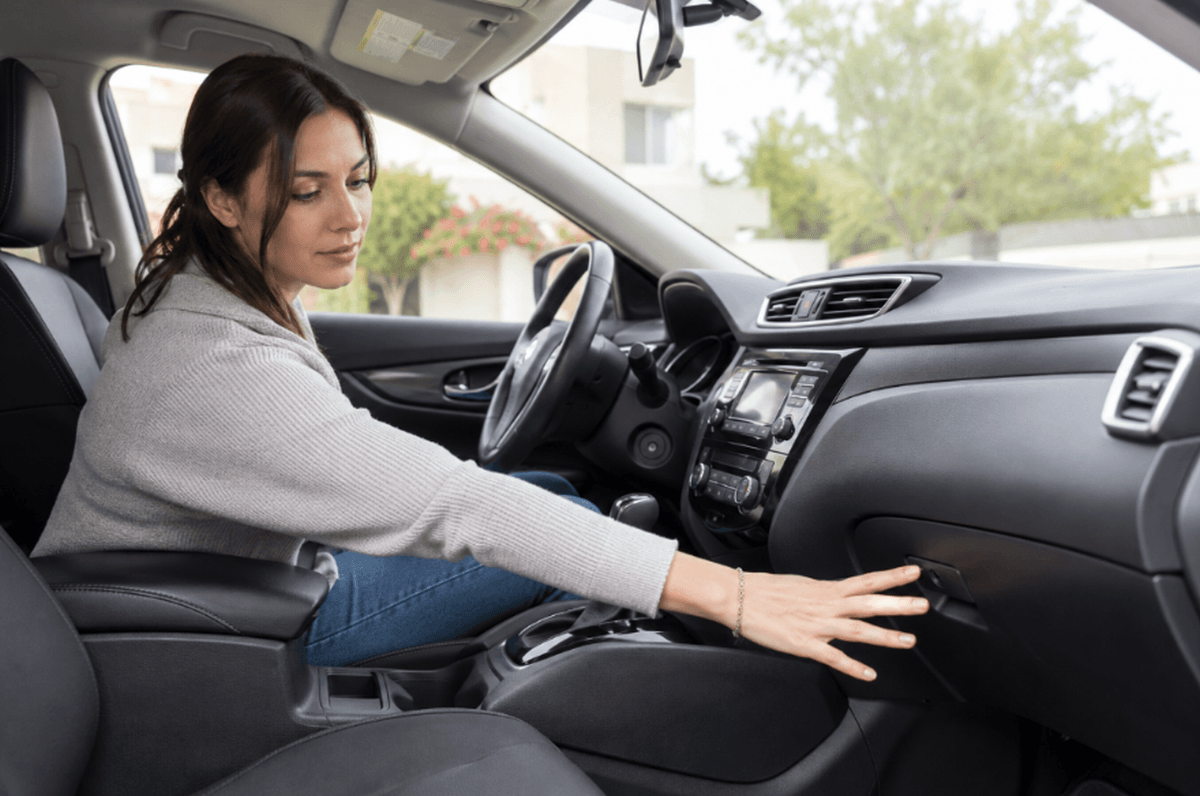
On every modern Nissan Altima, the cabin air filter is located behind the glove box on the passenger side, inside the HVAC housing. Outside air passes through this filter before it reaches your dashboard vents. On 2013-and-newer Altimas, Nissan made access easier: many owners report you do not have to fully remove the glove box, then open a small filter door tucked behind and to the side of it. On 2007–2012 models, you will typically lower or detach the glove box to reach the housing.
If you have never changed it, look for the small rectangular access panel once the glove box is out of the way. The filter slides out horizontally.
How to Change the Cabin Air Filter in a Nissan Altima
Replacing a Nissan Altima cabin air filter is a beginner-friendly job that takes about 5–10 minutes with no tools on most model years. Here is the process (for a universal walkthrough, see Filterbuy’s step-by-step cabin air filter replacement guide):
Open and clear the glove box. Empty it so it moves freely.
Release the glove box (if needed). Squeeze the sides inward to let the stoppers pass, or lower the box per your year’s design. On 2013+ Altimas you can often skip full removal.
Locate the filter door. Behind the glove box you will see a rectangular cover for the filter housing.
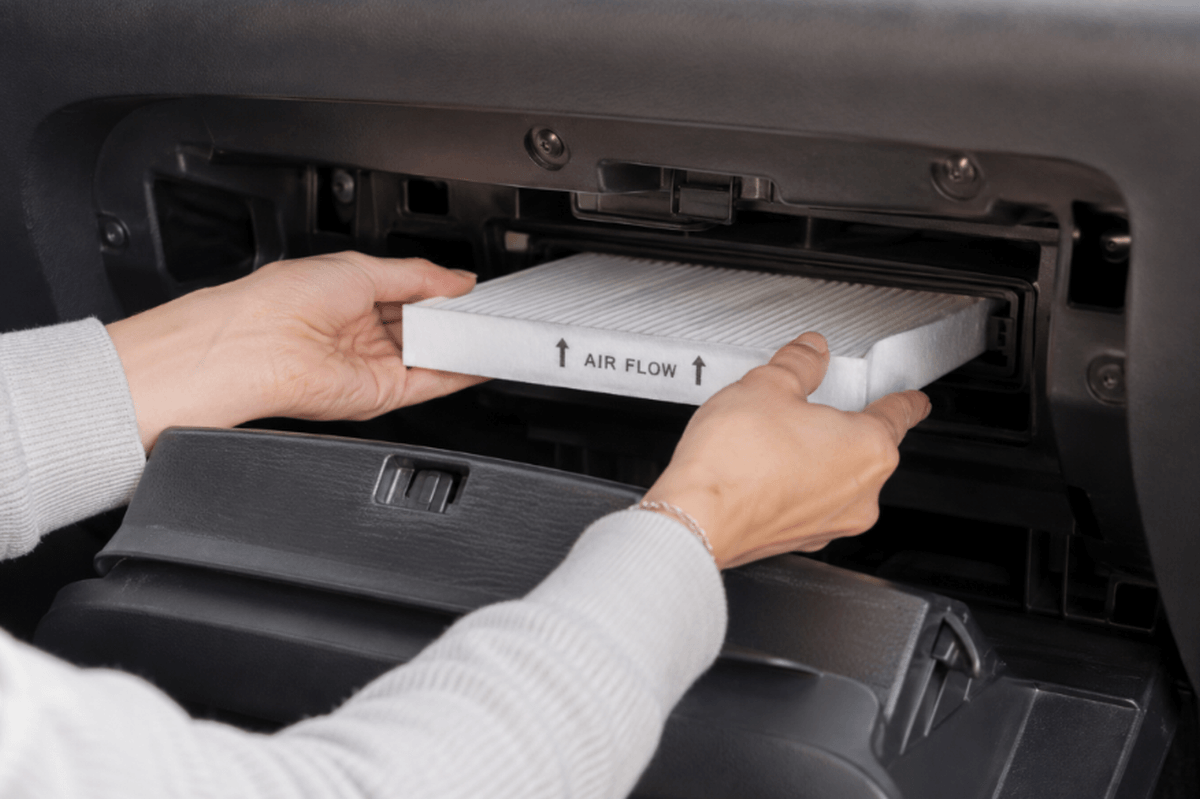
Remove the old filter. Slide it out and note the airflow arrow printed on the frame. It points in the direction air travels (usually downward).
Insert the new filter. Match the airflow arrow to the same orientation. A filter installed backward reduces performance.
Reassemble. Reseat the filter door and glove box.
The 30-Second Check Before You Buy
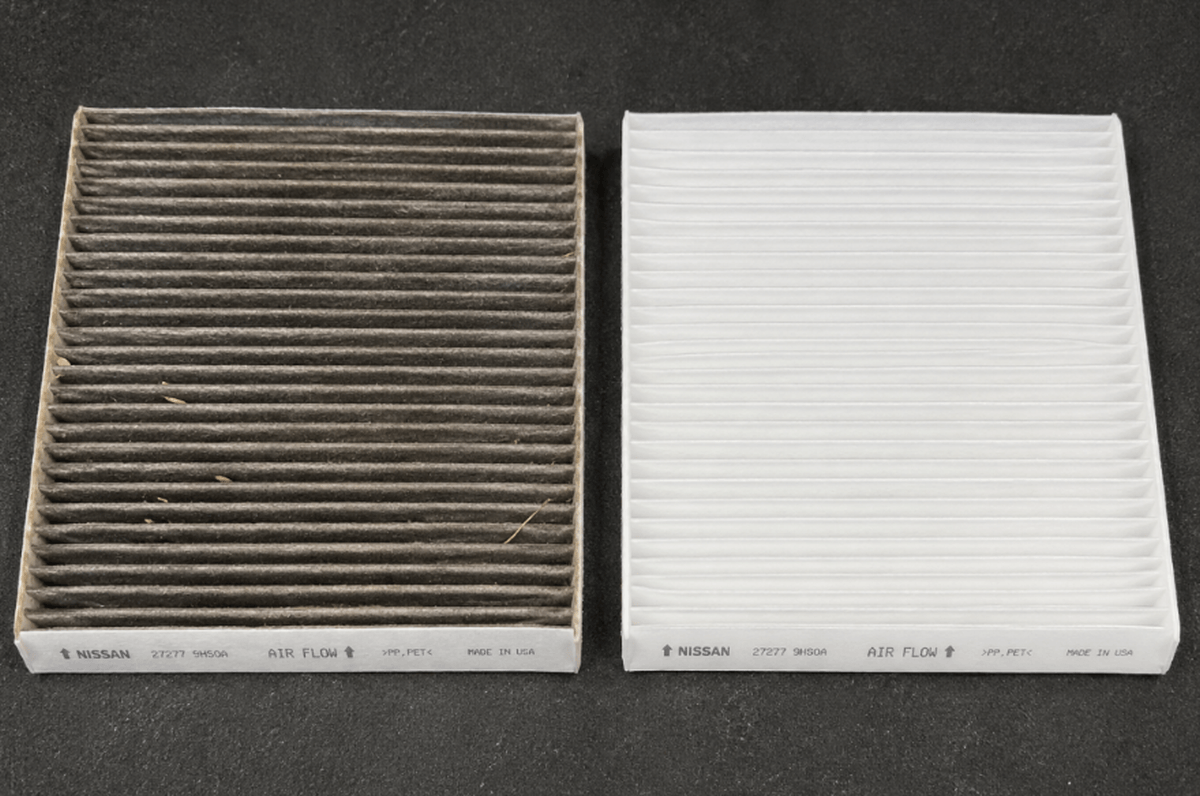
Not sure you even need one yet? Pull your current filter and look:
Grey, heavy, or packed with debris? Replace it. That color is trapped soot and brake dust, not just dust.
Do not shake it out to reuse it. That puffs the particles it caught right back into your car.
Still white and springy? You have time. Recheck at your next oil change.
Thirty seconds behind the glove box tells you more than any mileage estimate.
How Often Should You Replace It, and What Are the Warning Signs?
Most manufacturers and filter makers recommend replacing a cabin air filter every 12,000–15,000 miles, or about once a year (Filterbuy’s complete buyer’s guide to cabin air filters covers replacement intervals in more depth). Drive through heavy pollen, dusty roads, city traffic, or wildfire smoke, and you will want to change it sooner. Watch for these signs it is overdue:
Weak airflow from the vents even at high fan speed
A musty or dirty smell when the A/C or heat turns on
Foggy windows that take too long to clear
Louder blower noise as the fan strains against a clogged filter
A clogged filter also forces the blower motor to work harder, which can shorten its life, so this small part protects both your lungs and your HVAC system.
The Smoke-Day Move Most Altima Drivers Miss
A new filter is only half the story. How you run your climate control decides how much it protects you, and almost no cabin-filter page tells you this.
On a bad-air day, whether that is wildfire smoke or heavy traffic, do this:
Set your Altima climate control to recirculate. Paired with a clean filter, this stops pulling in the heavily polluted outside air.
Keep the fan on, with A/C or heat as needed. You still get airflow without force-feeding the cabin roadway soot.
Switch back to fresh-air mode every 15 to 20 minutes, especially with passengers. Sealed-up recirculation lets CO2 from breathing build up over time, which can dull alertness on a long drive, and a short reset clears it.
On clean-air days, fresh-air mode is fine. Recirculate is your tool for the days the air outside turns against you. Both points come from the same in-vehicle filtration study published by the U.S. National Institutes of Health.
What Does a Nissan Altima Cabin Air Filter Cost?
Doing it yourself is dramatically cheaper than a shop. According to RepairPal, the average shop charge for a Nissan Altima cabin air filter replacement runs about $75 to $102, most of which is labor. The filter itself is inexpensive, so a 10-minute DIY swap keeps that money in your pocket.
For context, a Filterbuy cabin air filter for the Altima sits in that DIY filter-only range and ships factory-direct, so your savings over a shop visit is essentially the labor.
Should You Upgrade to a HEPA Cabin Air Filter?
If anyone in your car deals with allergies, or you commute through traffic or smoke, a HEPA-certified cabin filter is a worthwhile upgrade over a basic paper filter. Filterbuy, a U.S. air-filter manufacturer founded in 2013, builds its auto cabin air filters with HEPA-certified synthetic media that traps 99.97% of airborne particles as small as 0.3 microns, the size range that includes fine pollen, road soot, and much of wildfire smoke. Standard OE-style filters catch larger dust and debris but let more of the fine stuff through.
Filterbuy is a family-owned, U.S.-based manufacturer that has built air filters in America since 2013 and shipped millions of them factory-direct. We are air-obsessed for a reason: the air inside your car can be just as full of pollen, dust, and exhaust as the air outside, and the right filter is the simplest fix.
Not sure which type you need? Filterbuy’s guide to choosing a cabin air filter breaks down HEPA, activated carbon, and standard media so you can match the filter to how and where you drive.
Ready to breathe easier on every drive? Find your Nissan Altima cabin air filter
Match the Filter to How You Actually Drive Your Altima
Same car, different air. Here is the honest matchup:
Stop-and-go city commuter: activated carbon or HEPA. You are breathing exhaust and brake dust, and carbon also helps with the fumes a particle-only filter ignores.
Allergy sufferer: HEPA-grade. Pollen and fine particulate are the whole problem, and that is the size range HEPA media targets.
Wildfire or heavy-smoke region: HEPA-grade, checked often. PM2.5 smoke is the exact particle a standard paper filter lets through.
Rural, low-traffic, clean air: a standard filter is plenty. Filterbuy will say so even though it is the cheaper option, because there is no reason to overbuy for a dusty back road.
Adjust the calendar to match. The usual 12,000 to 15,000-mile guidance assumes average air. If you drive daily through heavy smog or a smoke season, check it closer to every 6,000 miles, since soot clogs a filter far faster than dust.
Filterbuy makes all three media types for the Altima, so matching the filter to how you drive does not mean shopping around.
“I do not write these guides from a spec sheet. I sit with the people who actually build our filters, so when I say fit matters as much as media, it is because I have seen what happens on the line when it does not. The Altima is the perfect example: get the 2.5L versus 2.0L turbo filter wrong, and even great media cannot protect you.”
Michelle Wan, Brand Manager and Air Quality Writer, Filterbuy
Find the Exact Filter for Your Altima in Just a Few Clicks
Pop in your Altima year and engine, and Filterbuy matches you to the filter that fits right the first time, so you skip the wrong-part headache and the leaky bypass gaps a loose filter leaves behind.
Source: Filterbuy Auto Cabin Air Filter Finder
Do It Yourself in About 15 Minutes and Skip the Shop Fee
Changing your own cabin filter is easier than most people expect: no tools, no mechanic, no appointment. This walkthrough shows you exactly how, including the little airflow arrow everybody flips the first time.
Source: Filterbuy, How to Replace a Cabin Air Filter at Home (Step-by-Step)
Not Sure Which Filter You Need? Here Is How to Pick
Filterbuy breaks down standard, carbon, and HEPA in plain English so you can match the filter to your real life, from bumper-to-bumper traffic to allergy season to smoky-air days.
Source: Filterbuy, How to Choose a Cabin Air Filter
Get the Full Rundown Before You Buy, Minus the Jargon
This friendly guide covers what a cabin filter does, what it traps, and how often to swap it. It is the plain-language explainer for anyone buying their first one.
Source: Filterbuy, The Complete Buyer’s Guide to Cabin Air Filters
Know the Fair Price Before Anyone Quotes You
A shop will usually charge around $75 to $102 to handle this, and most of that is labor. The independent RepairPal estimate helps you spot a fair quote whether you are rolling up your sleeves or dropping it off.
Source: RepairPal, Nissan Altima Cabin Air Filter Replacement Cost
Do Not Take Our Word for the 99.97%, Check It Yourself
Filterbuy is proud of its HEPA-grade media, but you should not have to trust a seller on faith. The EPA spells out what HEPA means, catching 99.97% of particles down to 0.3 microns, so you can judge any filter honestly, the Filterbuy one included.
Source: U.S. EPA, What Is a HEPA Filter?
Make Sense of MERV Ratings in Plain English
MERV sounds technical, but it is really just a score for how much a filter catches. The quick EPA explainer gives you a straight yardstick for comparing filters side by side.
Source: U.S. EPA, What Is a MERV Rating?
Supporting Statistics: What the Data Looks Like From Inside the Factory
Filterbuy has built air filters in the U.S. since 2013, and its writers work alongside the people who make them. So this is not just cited research, it is what Filterbuy builds against. Here is what these numbers mean from where we sit.
About a Third Less Particle Pollution Inside the Car With a Cabin Filter
In a randomized, double-blind study of 48 commuters, a cabin air filter cut in-vehicle ultrafine particles by 28%, PM2.5 by 30%, and black carbon by 32%, roughly a third less of what you would otherwise breathe on your drive.
What we see: that cut lives or dies on fit. Filterbuy cuts every cabin filter to exact OEM tolerances, because bypass air around a loose filter erases most of its rating. A great filter with gaps is just an expensive suggestion.
Source: U.S. National Institutes of Health (PubMed Central)
156 Million Americans Breathe Air That Earned a Failing Grade
That is 46%, nearly half the country, driven by soot, smoke, and wildfire haze.
What we see: Filterbuy ships into all of those regions, and the day that matters most is the smoke day, when a routine commute turns into a fine-particle event. It is why the cabin line is engineered to catch PM2.5, not just the dust a factory filter handles.
Source: American Lung Association, 2025 State of the Air
A Human Hair Is About 30 Times Wider Than the Particles That Matter Most
Fine particles (PM2.5) are roughly one thirtieth the width of a hair. They slip past your nose and throat, settle deep in your lungs, and can reach your bloodstream.
What we see: this is the number that shapes how Filterbuy builds. Standard paper media catches the hair-sized stuff and lets the fine particles through. HEPA-certified, hydrocharged media is designed to grab that 0.3-micron range on purpose.
Frequently Asked Questions
Keep Breathing Easy: Handy Resources for Your Nissan Altima
You found the right filter, nice work. Here is everything else you might want next, from a two-minute DIY swap to double-checking the fine print. No pressure and no jargon, just straight answers to help you take charge of the air in your Altima.
About the author:
Michelle Wan is Filterbuy’s Brand Manager and Air Quality Writer, translating filtration, MERV ratings, and HVAC efficiency into plain-English advice for everyday drivers and homeowners. Reviewed for technical accuracy by David Clark, Licensed HVAC Technician.
Glossary
Cabin air filter: A pleated filter, usually behind the glove box, that cleans dust, pollen, and pollutants from outside air before it enters a vehicle’s passenger compartment through the HVAC system. It is separate from the engine air filter.
Nissan Altima: A midsize sedan manufactured by Nissan; different generations use different cabin air filters.
OE part number: The original-equipment part number assigned by the vehicle maker (e.g., Nissan 27277-3JC1A) that identifies the exact factory component.
Cross-reference number: An industry interchange code (e.g., CF11776) that lets aftermarket filters be matched to a factory part by shared dimensions and fit.
HEPA-certified media: Filter material certified to capture 99.97% of airborne particles as small as 0.3 microns. See the U.S. EPA on HEPA filters.
Micron: One-millionth of a meter, used to measure particle size. Fine pollen and smoke particles are only a few microns or smaller.
Airflow arrow: A directional marking on the filter frame showing which way air should flow through it; the filter must be installed with the arrow pointing in the airflow direction.
Blower motor: The HVAC fan that pushes air through the cabin filter and out the vents; a clogged filter makes it work harder.
MERV rating: Minimum Efficiency Reporting Value, a scale rating how effectively a filter captures particles (more common for home HVAC filters, but a useful comparison point). See the U.S. EPA on MERV ratings.