
Why Your Furnace Filter Is Wet (Or Freezing) in Winter
August 25, 2026
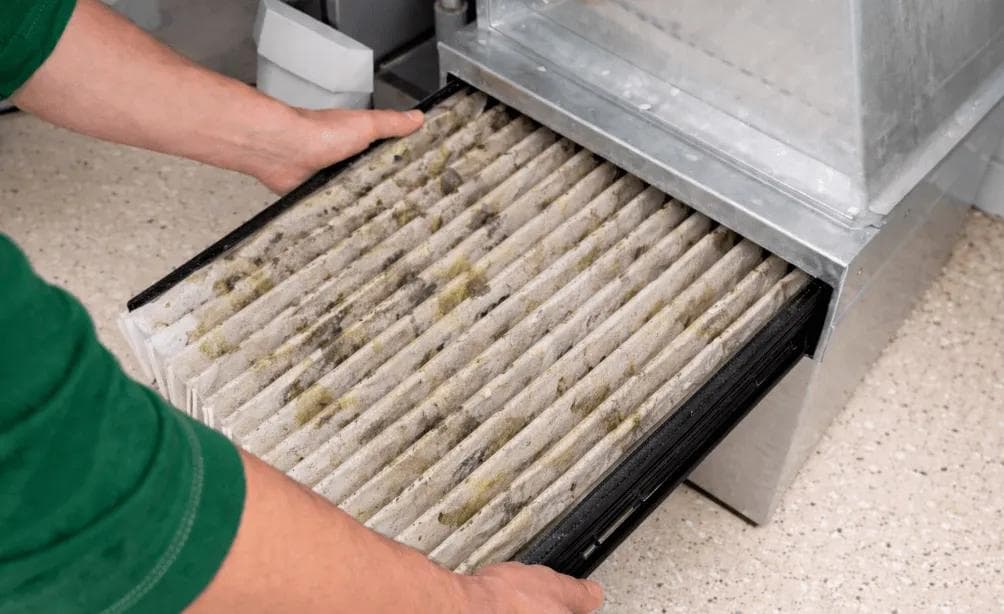
A wet or frozen furnace filter isn't just unusual — it's your HVAC system's distress signal.
After manufacturing over 600 sizes of air filters and hearing from millions of homeowners, we can tell you this is one of the most common winter calls we see — and one of the most preventable. A damp or icy filter chokes airflow, forces your furnace to work harder, and can escalate from a minor nuisance to a major repair bill fast.
Here's what's actually causing it, how to fix it, and when it's time to call a professional — based on what we've learned from real customers dealing with this exact problem.
TL;DR Quick Answers
Why is my furnace filter wet in winter?
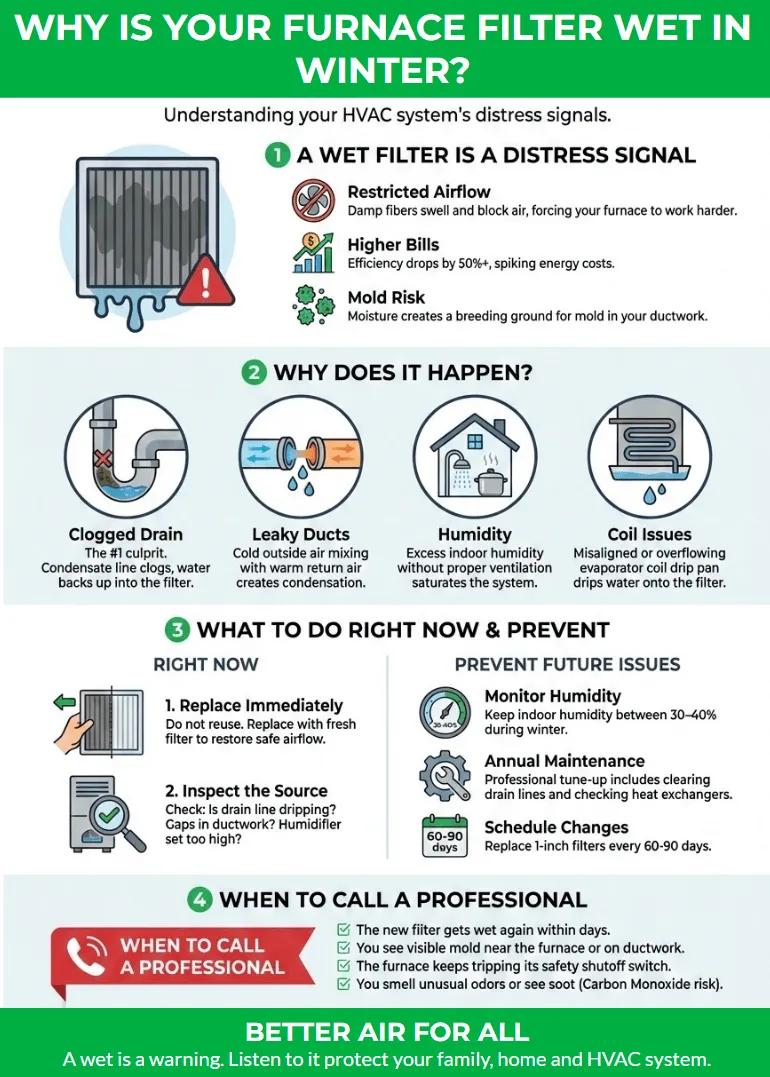
A wet furnace filter means moisture is entering your system where it shouldn't be. After working with millions of homeowners, these are the four causes we see most often:
Clogged condensate drain line — the #1 culprit in high-efficiency furnaces (90%+ AFUE)
Leaky return ductwork — cold air mixing with warm air creates condensation at the filter
Excess indoor humidity — poor ventilation pushes moisture levels too high
Evaporator coil drip pan issues — overflow or misalignment drips water onto the filter area
What to do right now:
Remove the wet filter and replace it — don't attempt to dry and reuse it
Inspect the condensate drain line for clogs
Check duct connections near the furnace for gaps or condensation
Verify indoor humidity is between 30–40%
When to call a professional:
The replacement filter gets wet again within days
You see mold near the furnace or in the ductwork
The furnace keeps tripping its safety shutoff
A wet filter is never the root cause — it's the first visible symptom of a problem happening elsewhere in the system. Replace it, find the moisture source, and fix it before it escalates.
Top Takeaways
The Problem
A wet or frozen filter is never normal — it's a system warning sign
Even moderate dampness can cut airflow efficiency by 50%+
Ice buildup can block airflow completely within hours
Most Common Causes
Clogged condensate drain line
Mismatched or oversized evaporator coil
Excess indoor humidity with poor ventilation
Leaky ductwork is pulling cold air into the return
What the Data Says
Indoor pollutants run 2–5x higher than outdoors — winter makes it worse (EPA)
Heating accounts for 29% of your utility bill — a wet filter drives it higher (DOE)
Leaky ducts lose 20–30% of conditioned air and cause filter condensation (ENERGY STAR)
What to Do
Replace the wet filter immediately — don't dry and reuse it
Identify the moisture source before the replacement meets the same fate
Check monthly during heating season for moisture, not just dirt
Call a professional if the new filter gets wet again within days
Bottom Line
The filter isn't the problem. It's the first visible symptom of a problem somewhere else in the system. Fix the source, not just the symptom.
A Wet or Frozen Furnace Filter Is a Warning Sign
A wet or frozen furnace filter isn't just unusual — it's your HVAC system's distress signal.
After manufacturing over 600 sizes of air filters and hearing from millions of homeowners, we can tell you this is one of the most common winter calls we see — and one of the most preventable. A damp or icy filter chokes airflow, forces your furnace to work harder, and can escalate from a minor nuisance to a major repair bill fast.
Here's what's actually causing it, how to fix it, and when it's time to call a professional — based on what we've learned from real customers dealing with this exact problem.
Why a Furnace Filter Should Never Be Wet or Icy
Your furnace filter is designed to capture airborne particles — dust, pet dander, pollen, and other contaminants — while allowing air to flow freely through your system. Moisture changes that equation entirely.
A wet filter becomes a dense, clogged barrier. The fibers that normally trap particles now trap water, dramatically reducing the airflow your furnace needs to operate safely. From what we've seen in our manufacturing and testing processes, even a moderately damp filter can reduce airflow efficiency by 50% or more — and a frozen one can block it almost completely.
This matters because restricted airflow doesn't just reduce comfort. It forces your blower motor to work overtime, raises energy costs, and can trigger overheating safety shutoffs. Over time, that strain shortens the life of components that are expensive to replace.
Most Common Causes of a Wet Furnace Filter in Winter
Based on years of customer feedback and working closely with HVAC professionals, these are the root causes we see most often:
Clogged Condensate Drain Line
High-efficiency condensing furnaces (90%+ AFUE) produce water as a byproduct of the heating process. That moisture is supposed to exit through a condensate drain line. When that line clogs — from algae, mineral buildup, or debris — water backs up and saturates the filter. This is the single most common cause we hear about from homeowners in winter.
Oversized or Poorly Matched AC Coil
If your home has a central air conditioning system with an evaporator coil mounted above or near the furnace, residual condensation can drip onto the filter area. This is especially common in setups where the coil was improperly sized or where the drip pan has corroded or shifted out of position.
High Indoor Humidity Without Proper Ventilation
Winter air is typically dry, but certain homes — especially those with humidifiers, poor bathroom ventilation, or frequent cooking without range hoods — can push indoor humidity levels high enough that condensation forms on cold surfaces near the furnace, including the filter housing.
Leaking Ductwork Near the Furnace
Gaps or disconnected joints in ductwork near the furnace can allow cold outside air to mix with warm return air, creating a condensation point right at the filter. We've seen this frequently in homes with ductwork routed through unconditioned spaces like attics, crawl spaces, and unfinished basements.
Why Some Furnace Filters Freeze in Winter
A frozen filter takes the moisture problem a step further — and signals that conditions around your furnace have dropped below freezing. This typically happens for one of the following reasons:
The furnace is located in an unheated space (garage, uninsulated basement, or crawl space) where ambient temperatures drop low enough to freeze any moisture present on the filter.
A heat pump system is running in defrost mode, temporarily blowing cold air across a filter that already has condensation on it.
Return air ducts are pulling in outside air through cracks, gaps, or an intentionally open fresh air intake that's allowing sub-freezing air directly into the system.
From our experience, frozen filters are less common than wet ones but more urgent — because ice buildup can crack filter frames, damage housing seals, and completely starve the system of airflow within hours.
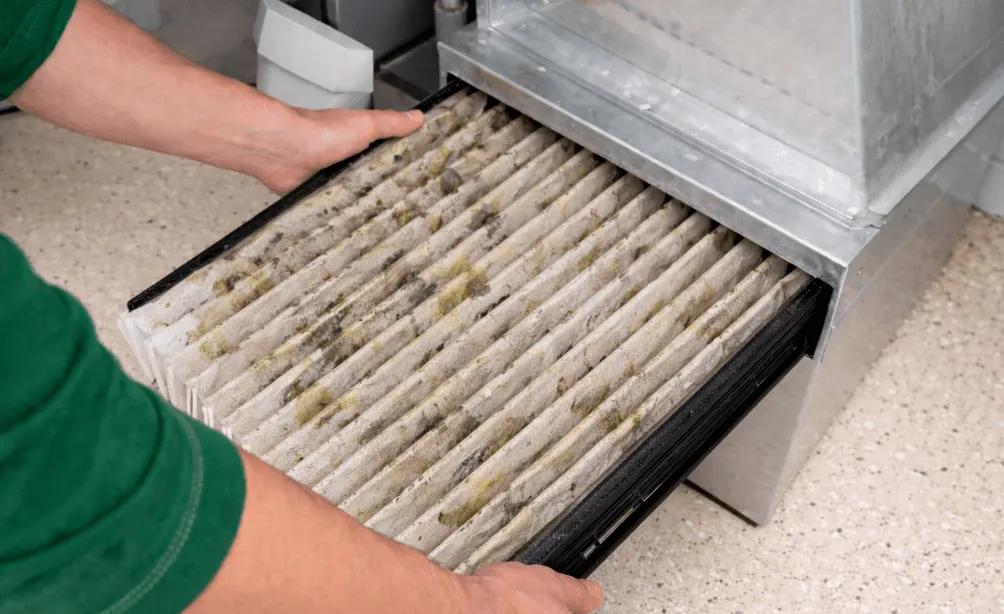
Signs a Wet or Frozen Filter Is Causing Bigger HVAC Problems
A wet or frozen filter rarely stays an isolated issue. If you notice any of the following, the filter situation is already affecting your system's performance and safety:
Furnace short-cycling (turning on and off frequently without completing a full heating cycle)
Reduced airflow from vents, even with the fan running at full speed
Unusual odors — a musty or mildew smell near the furnace or from supply vents
Visible mold growth on or around the filter housing, ductwork, or furnace cabinet
Higher-than-normal energy bills without a change in usage patterns
The furnace's limit switch or safety shutoff is tripping repeatedly
Any combination of these signs means the problem has progressed beyond just the filter. The longer a wet or frozen filter stays in place, the greater the risk of blower motor strain, heat exchanger damage, and mold contamination in the duct system.
How to Fix a Wet or Freezing Furnace Filter
If you've discovered a wet or frozen filter, here's what to do immediately:
Step 1: Remove and replace the filter. A wet filter cannot be dried and reused effectively — the fibers have lost their structural integrity and filtration capacity. Replace it with a fresh, dry filter in the correct size. If you're unsure of your size, check the existing filter's frame or measure the slot dimensions (length x width x depth).
Step 2: Identify the moisture source. Before the new filter ends up in the same condition, inspect the area around the filter slot. Check the condensate drain line for clogs, look for visible water pooling near the furnace base, and examine the evaporator coil drip pan if your system has one.
Step 3: Clear the condensate line. If the drain line is the culprit, you can often clear a minor clog by pouring a cup of distilled white vinegar through the access point. For more stubborn blockages, a wet/dry vacuum applied to the drain exit can pull debris free.
Step 4: Address humidity and ventilation. If excess indoor humidity is contributing, check that bathroom fans vent to the exterior (not into the attic), run exhaust fans while cooking, and verify your humidifier isn't set above 35–40% relative humidity during winter months.
Step 5: Inspect ductwork connections. Look at the duct joints near the furnace for gaps, disconnections, or signs of condensation. Seal any visible gaps with mastic sealant or foil-faced HVAC tape (not standard duct tape, which degrades quickly in temperature extremes).
How to Prevent Wet or Frozen Filters in the Future
After working with millions of filter customers, here's what we've found consistently prevents recurrence:
Replace your furnace filter on schedule — a clean filter maintains proper airflow that helps regulate temperature and moisture around the system. For standard 1-inch filters, that typically means every 60–90 days, or more frequently if you have pets, allergies, or high dust levels.
Schedule annual furnace maintenance before the heating season. A professional tune-up includes condensate line clearing, drain pan inspection, and airflow testing that catches moisture problems before they reach the filter.
Keep the area around your furnace clean, dry, and above freezing. If your furnace is in an unheated space, consider insulating the surrounding area or adding a space heater with a thermostat to maintain temperatures above 40°F.
Monitor indoor humidity with an inexpensive hygrometer. In winter, aim for 30–40% relative humidity — high enough for comfort but low enough to prevent condensation on cold surfaces.
Ensure all ductwork within six feet of the furnace is properly connected and sealed. Even small gaps in return ducts can introduce enough cold air to create condensation at the filter.
When to Call an HVAC Professional
Some wet filter situations are straightforward enough to handle yourself. Others need a trained technician. Call a professional if:
You've replaced the filter, and it becomes wet again within a few days
There's visible mold on or around the furnace, in the filter housing, or on ductwork
The furnace is repeatedly triggering its safety shutoff or limit switch
You suspect a cracked heat exchanger (indicated by soot buildup, odd smells, or carbon monoxide detector alerts)
The condensate drain line won't clear with basic DIY methods
You're unsure whether your system is a standard furnace or a high-efficiency condensing unit
A qualified HVAC technician can diagnose the root cause, test for airflow and combustion safety, and ensure the fix addresses the actual problem — not just the symptom.
Pro Tip: After more than a decade of manufacturing filters and working with HVAC professionals across the country, one thing we've learned is that a wet filter is rarely the problem itself — it's the most visible symptom of a problem happening somewhere else in the system. Replacing the filter is the right first step, but identifying and fixing the moisture source is what protects your furnace, your home, and your family for the long term.
"After manufacturing millions of air filters and hearing from homeowners across every climate zone, we can tell you that a wet furnace filter is rarely the real problem — it's the first visible warning that something else in the system needs attention, and catching it early is what saves homeowners from expensive repairs down the road."
Essential Resources for Diagnosing and Preventing Wet Furnace Filters in Winter
After manufacturing over 600 air filter sizes and working with millions of homeowners, we know a wet furnace filter rarely happens in isolation. These are the resources we recommend to help you understand what's happening in your system, fix the root cause, and protect your home for the long term.
Prevent Wet Air Filters Before They Damage Your HVAC System
We've seen firsthand how quickly a wet filter can cascade into bigger problems — restricted airflow, mold growth, and premature system wear. Our guide breaks down the most common causes we hear about from real customers, from clogged condensate drains to improperly seated evaporator coils, and walks you through the maintenance steps that keep your filter dry and your system running the way it should.
Source: https://filterbuy.com/resources/air-filter-maintenance/how-to-avoid-wet-air-filter-in-hvac-system/
Stop Moisture Problems From Turning Into Mold Problems
Here's something most homeowners don't realize until it's too late: once moisture reaches your filter and ductwork, you have a 24–48 hour window before mold can take hold. The EPA's official guide to mold, moisture, and your home explains exactly how to respond within that window and what to do if mold has already started growing — because protecting your family's air quality means acting fast when water shows up where it shouldn't.
Source: https://www.epa.gov/mold/brief-guide-mold-moisture-and-your-home
Understand Why Your High-Efficiency Furnace Produces Condensation
One of the most common questions we get from customers with wet filters is, "Why is my furnace making water in the first place?" If you have a high-efficiency condensing furnace (90%+ AFUE), condensation is actually a normal byproduct of the heating process. The U.S. Department of Energy's furnace guide explains how these systems work and why proper drain maintenance is essential to keeping that water where it belongs — away from your filter.
Source: https://www.energy.gov/energysaver/furnaces-and-boilers
Follow a Proven Maintenance Checklist to Catch Problems Early
After more than a decade of manufacturing filters, one thing we tell every customer is that the best time to catch a wet filter problem is before it starts. ENERGY STAR's HVAC maintenance checklist covers the professional inspections and homeowner tasks — from filter changes to airflow testing to heat exchanger checks — that prevent moisture buildup and keep your system operating safely all winter long. Think of it as your seasonal game plan for staying ahead of problems.
Source: https://www.energystar.gov/saveathome/heating-cooling/maintenance-checklist
Know When a Wet Filter Could Signal a Carbon Monoxide Risk
This is the one we want every homeowner to take seriously. A wet filter and a carbon monoxide hazard can share the same root cause — a cracked heat exchanger or a blocked flue. The EPA's carbon monoxide resource explains why annual combustion safety testing and CO detector installation aren't optional when you have a fuel-burning furnace. Your family's safety depends on catching these issues early, and a wet filter can be the first clue.
Source: https://www.epa.gov/indoor-air-quality-iaq/carbon-monoxides-impact-indoor-air-quality
Protect Your Family With Proper CO Alarm Placement and Testing
We talk a lot about what your air filter catches — but carbon monoxide is the one thing no filter can stop. The U.S. Consumer Product Safety Commission recommends CO alarms on every level of your home near sleeping areas, tested monthly, and replaced every five to seven years. If a furnace venting or heat exchanger issue is behind your wet filter, a working CO alarm is your family's most important safety net.
Get the Full Picture on Indoor Air Quality and Home Ventilation
At Filterbuy, we're obsessed with helping you understand what's really happening in your home's air — not just what you can see, but what you can't. The joint EPA and CPSC indoor air quality guide covers source control, ventilation strategies, and filtration best practices from the ground up. If a wet furnace filter has you thinking more carefully about your home's air system, this is the resource that connects all the pieces.
Source: https://www.epa.gov/indoor-air-quality-iaq/inside-story-guide-indoor-air-quality
Supporting Statistics: Why a Wet Furnace Filter Demands Immediate Attention
We've manufactured millions of air filters and talked to homeowners in every climate zone across the country. These federal statistics confirm what we see play out in real customer situations every winter.
Indoor Air Can Be 2–5x More Polluted Than Outdoor Air
The U.S. Environmental Protection Agency has found that indoor pollutant concentrations routinely exceed outdoor levels — even in cities with heavy industrial activity.
A wet filter makes this worse:
Saturated fibers can't trap particles — contaminants bypass the filter entirely and recirculate through your ductwork
We see the evidence every time a customer sends us a filter photo after 90 days — the amount of particulate caught in those fibers is eye-opening
Homeowners who delay replacing a wet filter often report noticeable dust buildup and allergy flare-ups within days
Source: U.S. EPA — Report on the Environment: Indoor Air Quality
A Compromised Filter Can Increase Heating Costs by Up to 15%
The U.S. Department of Energy reports that replacing a dirty filter with a clean one can cut HVAC energy use by 5–15%.
What most homeowners don't realize — and what we've learned from years of testing filter media in our manufacturing facility:
A water-saturated filter behaves like a filter that's months past its replacement date
Wet fibers compress, collapse, and block airflow in ways a dry but dirty filter doesn't
Customers have told us their energy bills jumped $40–$60 in a single month before tracing the problem back to a soaked filter they didn't know was there
Source: U.S. Department of Energy
Over 200 Americans Die From CO Poisoning Linked to Consumer Products Each Year
The U.S. Consumer Product Safety Commission reports that more than half of these deaths occur during November through February, with heating systems among the top contributors.
This is the statistic that drives how we talk to customers about wet filters:
A cracked heat exchanger or blocked flue can cause both moisture near the filter and carbon monoxide inside the home
A wet filter by itself won't hurt you — but the condition causing it might
After working with HVAC professionals for over a decade, we always recommend treating a wet filter as a reason to investigate the full system, not just swap in a replacement and move on
Source: U.S. CPSC — Carbon Monoxide Information Center
Final Thought: A Wet Filter Is Your Furnace Asking for Help
After manufacturing over 600 sizes of air filters and working with millions of homeowners, here's the one thing we wish every customer knew going into winter: your furnace filter is the most honest indicator of what's happening inside your HVAC system.
A clean, dry filter means air is flowing the way it should
A dirty filter means it's time for a replacement
A wet or frozen filter means something else has gone wrong — and the filter is the messenger
We've talked to thousands of homeowners who pulled out a soaked filter, replaced it, and assumed the problem was solved. Weeks later, the new filter was wet too — and the real issue had progressed:
Mold had started forming in the ductwork
The blower motor was straining under restricted airflow
Energy bills had climbed without explanation
In some cases, a cracked heat exchanger was quietly putting the family at risk for carbon monoxide exposure
That pattern is preventable. It comes down to one shift in thinking: stop treating the filter as the problem, and start treating it as the diagnostic tool it is.
In our experience, the homeowners who avoid the biggest repair bills and the most serious safety risks are the ones who ask "why is this wet?" instead of just "what size do I need next?"
The filter itself is a $15 fix
The root cause — a clogged condensate line, leaking ductwork, or a failing heat exchanger — is where the real protection happens
At Filterbuy, we're obsessed with indoor air quality because we've seen firsthand what happens when it's neglected — and what's possible when homeowners stay one step ahead. A wet furnace filter in winter isn't a crisis. It's a warning. The homeowners who listen to that warning are the ones who protect their families, their systems, and their wallets for the long run.
Next Steps: What to Do Right Now
Based on what we've learned from millions of customers and over a decade of manufacturing air filters, here's exactly what to do if you've found a wet or frozen furnace filter.
1. Replace the Wet Filter Immediately
A saturated filter cannot be dried and reused — the fibers have lost their structure and filtration capacity.
Remove the wet filter and install a fresh, dry replacement in the correct size
Check the existing filter's frame for printed dimensions (length x width x depth)
If the size has worn off, measure the filter slot with a tape measure
Need help finding the right match? Our filter size and rating guides at Filterbuy.com can help
2. Find the Moisture Source Before It Happens Again
A new filter solves the symptom. Finding the root cause solves the problem.
Inspect the condensate drain line for clogs or standing water near the furnace base
Check the evaporator coil drip pan for cracks, rust, or overflow
Look at duct connections within six feet of the furnace for gaps or condensation
Monitor indoor humidity with a hygrometer — aim for 30–40% in winter
3. Call a Professional If You See Any of These Signs
The replacement filter becomes wet again within days
Visible mold near the furnace, filter housing, or ductwork
The furnace is short-cycling or tripping its safety shutoff
Signs of a cracked heat exchanger — soot buildup, unusual odors, or CO detector alerts
You're unsure whether you have a standard or high-efficiency condensing furnace
4. Set Up a Filter Replacement Schedule
Consistent maintenance is the best defense against wet filter problems — and most other furnace issues.
1-inch filters: Every 60–90 days (monthly with pets, allergies, or high dust)
2-inch filters: Every 90–120 days
4–5-inch media filters: Every 6–12 months
Pro Tip: Filterbuy's subscription service delivers the right filter on your schedule — so you never have to guess when it's time or scramble for the right size mid-winter.
5. Bookmark These Resources
Wet Air Filter Prevention Guide
EPA Mold & Moisture Guide
ENERGY STAR Maintenance Checklist
CPSC Carbon Monoxide Safety
FAQ on Wet Filter Furnace Winter Problems
Q: Is it normal for a furnace filter to be wet in winter?
A: No. A properly functioning HVAC system should never produce a wet filter in any season. After manufacturing millions of filters and hearing from homeowners across the country, the root cause almost always traces back to one of four things:
Clogged condensate drain line on a high-efficiency condensing furnace (90%+ AFUE)
Cracked or overflowing evaporator coil drip pan
Indoor humidity levels above 40%
Gaps in the ductwork near the furnace are allowing cold air infiltration
Homeowners with newer high-efficiency systems are especially caught off guard — many don't realize their furnace produces water as part of the normal heating process.
Q: Can I dry out a wet furnace filter and reuse it?
A: No — and this is one of the most common questions we get. We've tested filter media extensively in our manufacturing facility, and once fibers absorb water, the damage is structural:
Pleats lose their shape
Media compresses and can't trap particles effectively
Microscopic mold spores colonize the damp fibers — even if the filter feels dry after a day or two
We've heard from customers who reinstalled a dried filter only to notice a musty smell from their vents within a week. A replacement filter costs roughly $15. Mold remediation in your ductwork costs thousands.
Q: Why is my furnace filter freezing in winter?
A: A frozen filter means moisture reached the filter and surrounding air dropped below 32°F. We see this in three scenarios:
Unheated furnace location — garages, crawl spaces, or uninsulated basements where temperatures plunge overnight
Heat pump defrost mode — the system temporarily blows cold air across a filter that already has condensation
Cold air infiltration — return ducts with cracks, loose joints, or an open fresh air intake pulling sub-freezing air into the system
We treat frozen filters as more urgent than wet ones. Ice expands — it can crack filter frames, warp housing seals, and completely starve your furnace of airflow faster than most homeowners expect.
Q: Can a wet furnace filter cause damage to my HVAC system?
A: Yes. After hearing from thousands of customers, we can tell you the damage follows a predictable pattern:
The saturated filter chokes airflow
The blower motor runs harder and longer — increasing energy use by up to 15% according to the U.S. Department of Energy
The heat exchanger overheats from insufficient air moving across it
The high-limit safety switch trips and the furnace short-cycles — on, off, on, off
Moisture creates ideal conditions for mold inside the filter housing and ductwork
We've talked to customers who ignored a wet filter for two to three weeks and ended up facing blower motor replacement, duct cleaning, and mold remediation — all from an issue that started with a $15 filter and a $5 bottle of vinegar to clear the drain line.
Q: When should I call an HVAC professional for a wet furnace filter?
A: Here's the simple framework we share with every customer. If you replace the filter, clear the condensate line, and the new filter stays dry, you likely caught it early enough to handle yourself.
Call a professional immediately if you see any of these:
Filter wet again within days — the source is beyond a simple drain clog
Visible mold near the furnace, filter housing, or ductwork — DIY cleanup rarely reaches the full extent
Repeated short-cycling or safety shutoff trips point to an airflow or heat exchanger issue requiring diagnostic equipment
Soot, unusual odors, or CO detector alerts — potential signs of a cracked heat exchanger, which is both a repair issue and a safety emergency
Unsure of your system type — the fix depends entirely on whether you have a standard or high-efficiency condensing furnace
In our experience, a single diagnostic visit almost always costs less than one month of the energy waste and system strain a wet filter creates.
Don't Let a Wet Furnace Filter Turn Into a Winter Emergency
If your furnace filter is wet or freezing, the first step is replacing it with the right filter for your system — and Filterbuy makes that easy with over 600 sizes, fast delivery, and filters built by the same team that helped you diagnose the problem. Find your exact filter size now at Filterbuy.com