Shop by
The Air Quality Index (AQI) measures how polluted the air is and how it may affect your health.
0–50 (Good): Air quality is satisfactory.
51–100 (Moderate): Acceptable, but some pollutants may pose minor concerns.
101–150 (Unhealthy for Sensitive Groups)
151–200 (Unhealthy)
201–300 (Very Unhealthy)
301+ (Hazardous)
Still okay for most, but if you have asthma or allergies, take it easy and avoid long outdoor workouts.
Shop MERV 11 filters→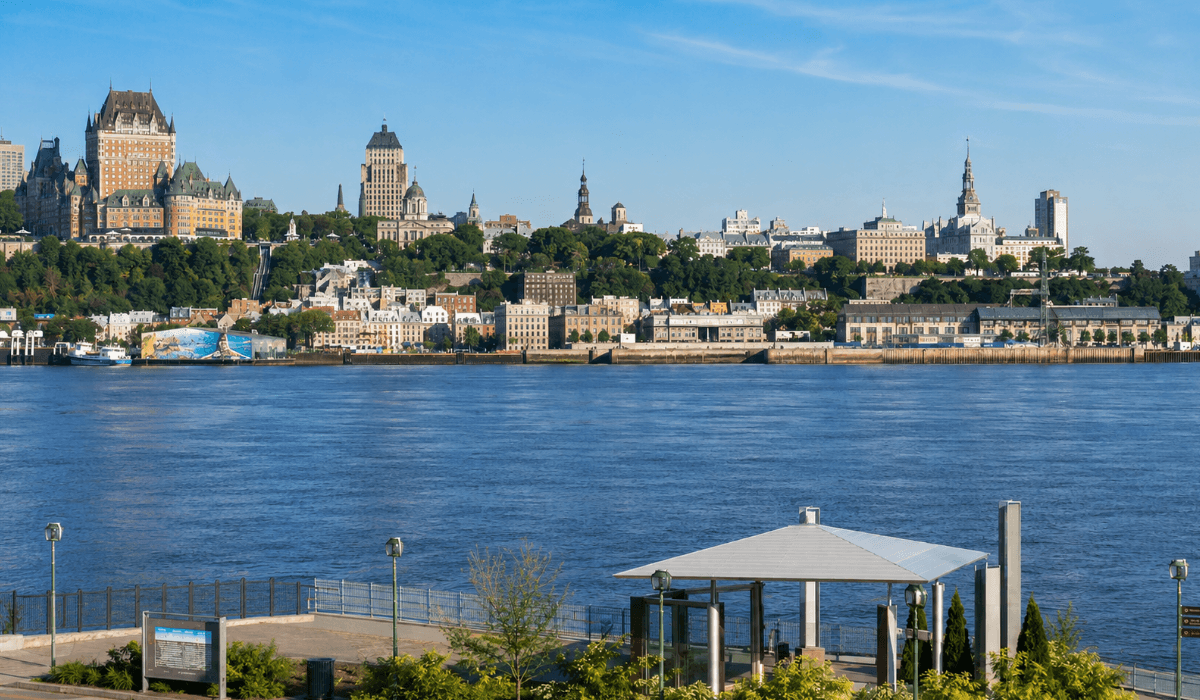
By Michelle Wan, Filterbuy Canada · Reviewed by David Clark, Licensed HVAC Technician · Published 10 August 2026 · Updated 10 August 2026
Lévis air quality is measured hourly at one provincial station, parc Georges-Maranda, on Québec's Air Quality Index (IQA): 1–25 good, 26–50 acceptable, 51+ poor. The IQA is the only index measured in Lévis itself. Canada's AQHI covers Québec City across the river. Most phone apps show a third scale, the American AQI. That is why the numbers rarely match.
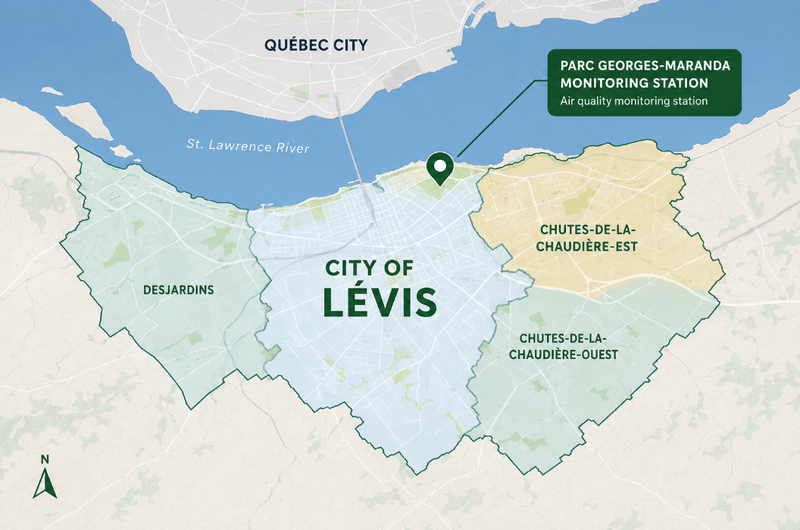
Lévis air quality is measured hourly by the Réseau de surveillance de la qualité de l'air du Québec at its parc Georges-Maranda station, shown on the live map above. Québec's Air Quality Index rates the air good (1–25), acceptable (26–50) or poor (51 and above).
Québec's IQA: good 1–25, acceptable 26–50, poor 51 and above. Recalculated hourly.
Lévis has one station in the provincial network, at parc Georges-Maranda. It is urban, so it represents built-up areas better than all 448 km² of the city.
Environment Canada publishes no AQHI for Lévis. The nearest is Québec City, on the north shore.
Fine particulate matter (PM2.5) drives most poor readings: wood burning in winter, transported wildfire smoke in summer.
We opened Lévis on three services at once and got three different numbers for the same air. That is not a fault. Québec's environment ministry publishes the IQA. Environment and Climate Change Canada publishes the AQHI. Most consumer apps convert Québec's measurements to the United States EPA scale, 0 to 500. The air is the same; the arithmetic is not.
Québec calculates each pollutant's sub-index as the measured concentration divided by a reference value, times 50. The station's IQA is the highest sub-index. For fine particulate matter the reference value is 35 micrograms per cubic meter over the previous three hours.
We could not find that translation published anywhere, so we worked it out.
How Québec's IQA and the American AQI line up for fine particulate matter. Approximate, for orientation only. The two indices use different averaging periods.
Both indices draw their caution line at almost the same concentration, about 35 micrograms per cubic meter, but express it as 50 and 100. The timing differs more than the threshold: Québec averages over three hours, the American index over 24. In a fast plume, the Québec reading climbs first.
The AQHI does not convert this way. Environment and Climate Change Canada calculates it from ozone, nitrogen dioxide and fine particulate matter together, weighted by each pollutant's association with short-term health risk, then reports low (1–3), moderate (4–6), high (7–10) or very high (10+). It answers a different question: not how much pollution is present, but how much risk it carries. It covers a fixed list of communities. We checked that list: Lévis is not on it.
The provincial network has monitored ambient air since 1974 and runs the single Lévis station, parc Georges-Maranda. It is classified urban, so it describes built-up areas well but not necessarily all of Lévis, a city of roughly 149,700 residents across 448 km².
If you live in Saint-Nicolas or Pintendre, several kilometres away, your local air on a calm winter evening can differ from the posted reading. The ministry's guidance is to use the nearest regional station, or the Info-Smog forecasts, when none sits close by.
From 1 May to 30 September, the provincial IQA map also carries seasonal sensor data and a 72-hour fine particulate forecast from the Meteorological Service of Canada. That is the wildfire smoke layer, and the most useful view during summer smoke. Worth knowing: a grey dot means the station is not reporting, not that the air is clean. When Lévis shows grey, read the Québec City stations or Info-Smog.
Wildfire smoke takes the headlines, but the province attributes most poor air days to winter wood heating. The risk runs in both seasons.
Québec's air quality index has three bands, and each carries different advice. Here is what they mean for your day, in the ministry's own terms.
When the reading is poor:
Check the current reading before outdoor exercise, not after.
Keep windows and doors closed while levels stay high.
Run your HVAC fan continuously, not just on heating or cooling cycles, so indoor air passes the filter more often.
Set the system to recirculate rather than draw outdoor air, if your equipment allows.
Hold off on the wood stove. In winter it is the largest contribution a Lévis household controls.
Replace your filter after a prolonged smoke episode. A MERV 13 is built for roughly 90 days of ordinary use; smoke can load one far faster. Through smoke season, check monthly rather than trusting the calendar.
You cannot change the air over the St. Lawrence. You can change what circulates through your home. With the windows shut, your furnace filter becomes the main mechanism removing fine particulates from the air you breathe.
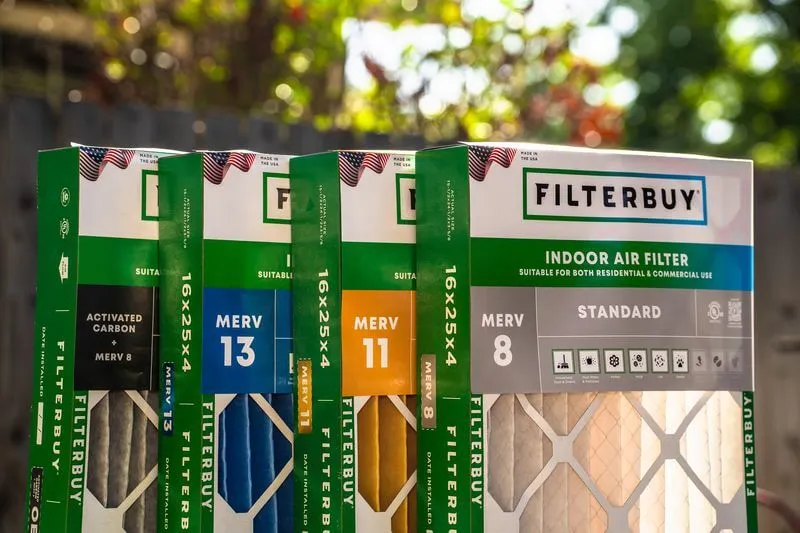
Filterbuy manufactures its own pleated filters and ships direct to Canada, in over 600 sizes. We label each rating in plain language, alongside the MERV rating:
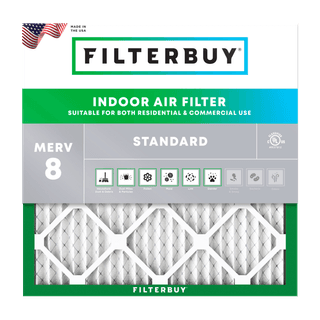
MERV 8 (Standard). Everyday filtration: dust, lint and pollen.
MERV 11 (Superior). For pets or seasonal allergies. Captures dust mites, mould spores and pet dander.
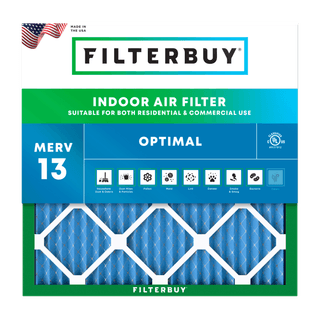
MERV 13 (Optimal). Our highest-rated filtration: fine allergens and smoke particles. The choice for smoke season.
Odour Eliminator. Carbon-infused, for cooking odours, smoke and pet smells through long closed-window winters.
Two honest caveats. A higher MERV rating restricts airflow more, so confirm your system is rated for it before switching. And a filter improves the air moving through your equipment; it is not a medical device and does not replace public health guidance.
“MERV 13 is the right call for smoke. I still check the equipment first. On an older furnace with undersized return ducting, going straight from MERV 8 to MERV 13 can cut airflow enough to notice. Confirming takes a minute, and it is worth the minute.” David Clark, Licensed HVAC Technician
Many Québec homes also run an air exchanger (HRV or ERV) with its own filter. Check both when you swap.
We will make a custom filter size if we don't stock yours. Prices are in Canadian dollars, shipping to Canada free, no minimum. A Filterbuy air filter subscription handles the reminders.
Three findings from U.S. federal agencies explain why indoor filtration matters during a smoke episode. Particle behaviour does not change at the border.
About 90% of your time is spent indoors. Some pollutants run 2 to 5 times higher there than outdoors. Closing the window is only half the answer. Source: U.S. Environmental Protection Agency.
A MERV 13 filter roughly halved indoor smoke. Portland, September 2020: indoor PM2.5 averaged 134 µg/m³ against 260 outdoors, a ratio of 0.55. A portable air cleaner took it to 0.22. Filtration reduces exposure. It does not eliminate it. Source: EPA-funded study, National Institutes of Health.
Smoke travels, and monitors are sparse. From 2007 to 2018, wildfire smoke made up over 25% of daily PM2.5 at about 40% of U.S. monitors for over a month a year. People beyond 5 km of a monitor saw 36% more smoke days, so distance from a station changes what you see. Source: National Institutes of Health.
Check the live map above for the current hour. Québec labels the air poor only at IQA 51 or higher. Most days are good or acceptable; poor readings cluster around winter wood burning and summer smoke.
The parc Georges-Maranda station reports it hourly as a three-hour average. Québec's poor threshold is 35 µg/m³.
Most apps convert Québec's measurements to the United States EPA scale, which uses different breakpoints and a longer averaging period. A US AQI near 100 is roughly a Québec IQA of 50.
There isn't one. Environment Canada publishes the AQHI for a fixed list of communities; Lévis is not on it. The closest is Québec City, a fair proxy most days, but not specific to the south shore.
MERV 13, the Filterbuy Optimal label, captures the finest particles of the three and is the usual choice for smoke. Confirm your system supports the airflow first.
Filterbuy checked every figure against the publishing agency's own page on 6 August 2026, not a secondary summary. French-only sources are marked.
Air Quality Index (IQA): MELCCFP. Categories, calculation method, reference values.
Réseau de surveillance de la qualité de l'air du Québec: MELCCFP. Station network and representativeness. French.
Live IQA station map: MELCCFP. Hourly station readings and the wildfire smoke layer. French.
Le chauffage au bois: MELCCFP. Wood heating as a share of fine particulate emissions. French only.
Air Quality Health Index: ECCC. AQHI scale, pollutants, health categories.
AQHI for Québec City: ECCC. The nearest AQHI community to Lévis.
Info-Smog: conditions and forecasts: ECCC. Regional forecasts for Québec.
Wildfire smoke, air quality and your health: ECCC. Guidance for summer smoke episodes.
The health effects of air pollution: Gouvernement du Québec. Guidance for at-risk groups.
AQI (Air Quality Index): Any numeric air quality scale. In Canadian results, usually the United States EPA index, 0 to 500.
IQA (Indice de la qualité de l'air): Québec's official index, published hourly by the provincial environment ministry. Good 1–25, acceptable 26–50, poor 51+.
AQHI (Air Quality Health Index): Canada's federal health-risk index, on a 1 to 10+ scale, from ozone, nitrogen dioxide and fine particulate matter.
PM2.5: Fine particulate matter 2.5 micrometres or smaller (µg/m³). The dominant pollutant in wood and wildfire smoke.
Ozone (O₃): Formed when sunlight reacts with vehicle and industrial emissions. Peaks on hot, stagnant days.
MERV: Minimum Efficiency Reporting Value, the North American filter efficiency scale.
RSQAQ: Réseau de surveillance de la qualité de l'air du Québec, the provincial network since 1974.
MELCCFP: Québec's environment ministry, which publishes the IQA.
Info-Smog: The federal–provincial programme issuing Québec air quality forecasts and smog advisories.
HRV / ERV: Heat or energy recovery ventilator, an air exchanger common in Québec homes, with its own filter separate from the furnace.