Shop by
The Air Quality Index (AQI) measures how polluted the air is and how it may affect your health.
0–50 (Good): Air quality is satisfactory.
51–100 (Moderate): Acceptable, but some pollutants may pose minor concerns.
101–150 (Unhealthy for Sensitive Groups)
151–200 (Unhealthy)
201–300 (Very Unhealthy)
301+ (Hazardous)
Still okay for most, but if you have asthma or allergies, take it easy and avoid long outdoor workouts.
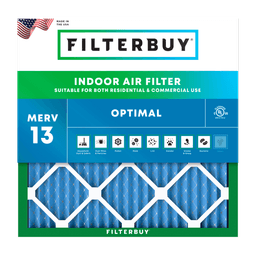
Shop MERV 11 filters→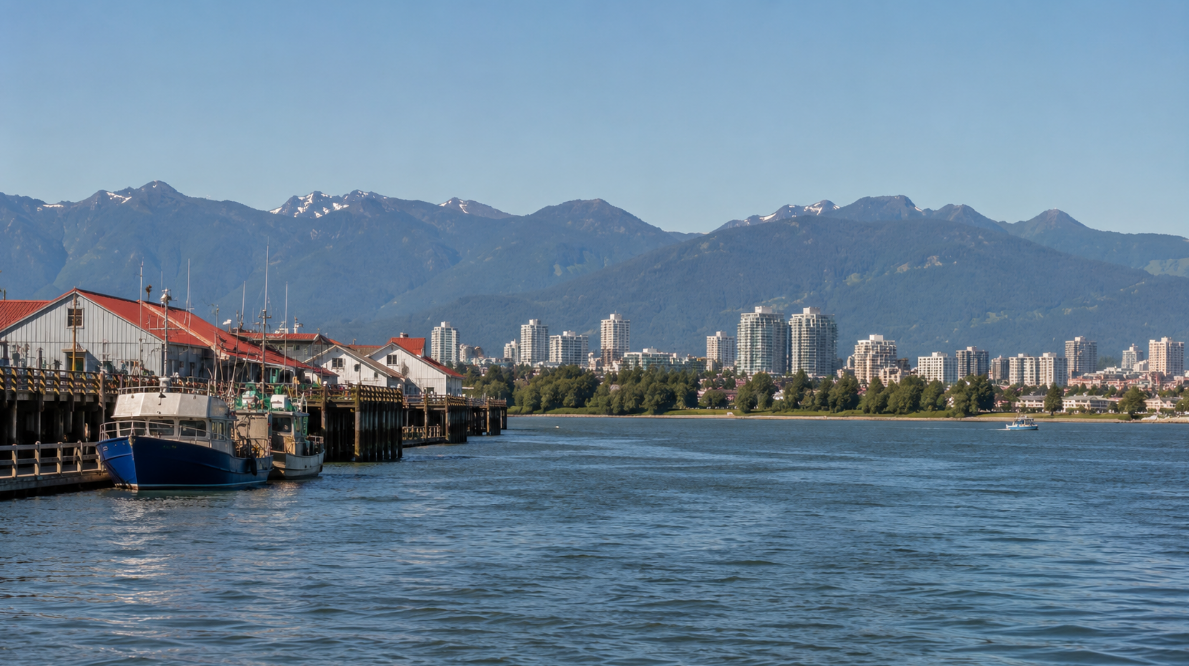
By Michelle Wan · Reviewed by David Clark, Licensed HVAC Technician · Published Augsut 1, 2026
Richmond, British Columbia reports air quality on the Air Quality Health Index (AQHI), a 1 to 10+ health-risk scale, not the 0–500 US-style AQI most apps show. Metro Vancouver publishes live AQHI readings and a two-day forecast on AirMap. Richmond usually sits in the low-risk 1–3 band; wildfire smoke from June to September changes that.
Richmond's official number is an AQHI value from 1 to 10+, not a US-style AQI from 0 to 500. The two scales are not interchangeable.
AQHI 1–3 is low risk, 4–6 moderate, 7–10 high, above 10 very high, per Environment and Climate Change Canada.
Metro Vancouver, not the Province, issues Richmond's air quality warnings. Yellow means high health risk, orange very high.
Health Canada states wildfire smoke may travel thousands of kilometres, so Richmond's air can turn on a fire nobody here can see.
Richmond's air quality is published live by Metro Vancouver and Environment and Climate Change Canada on the AQHI scale of 1 to 10+, updated hourly, with a two-day forecast. An AQHI of 1 to 3 means low health risk for most people.
AirMap is Metro Vancouver's authoritative source for the Lower Fraser Valley airshed, and Richmond South is the station nearest most of the city. If two apps disagree, that is a scale difference, not a data error.
Canada does not use the US Air Quality Index. Search Richmond AQI and most apps hand you a number on the US 0–500 scale, which reports only the single worst pollutant. Richmond does not publish one.
The AQHI blends ground-level ozone, nitrogen dioxide and fine particulate matter (PM2.5) into one estimate of short-term health risk. Environment and Climate Change Canada built it with Health Canada to report health risk rather than regulatory compliance. That is why a Richmond reading of 4 and an app showing 72 can both be correct.
Compiled by Filterbuy from ECCC guidance. The AQI column is approximate; ECCC notes the indices are not convertible.
At risk includes people with heart or lung conditions, older adults, young children, pregnant people, and outdoor workers.
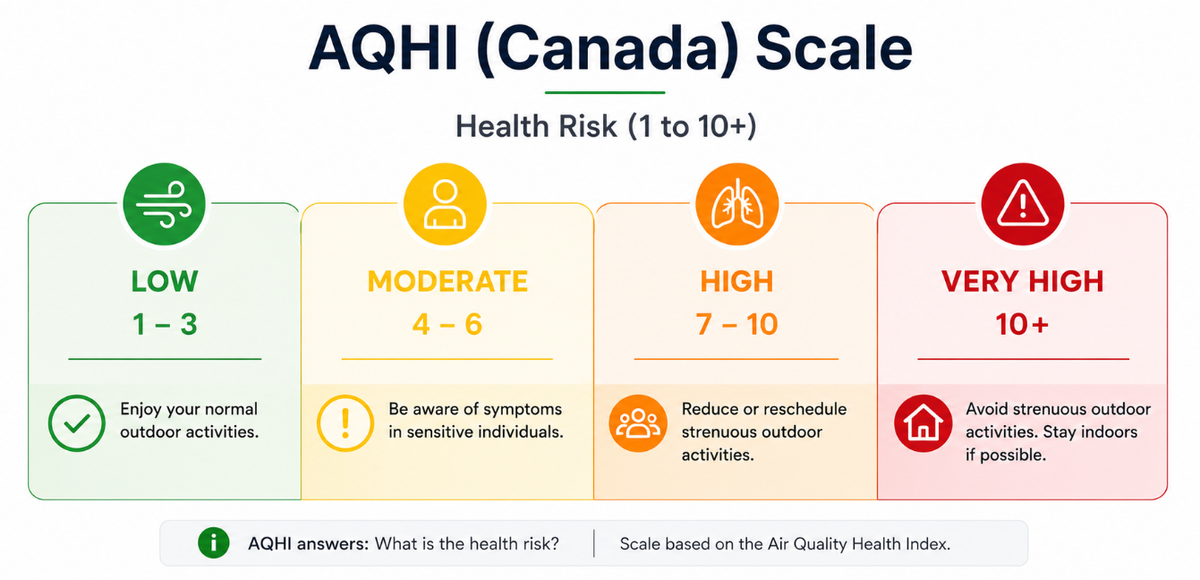
Richmond's AQHI value maps directly to an action. At 1 to 3, normal outdoor activity is fine. At 4 to 6, at-risk groups should ease off strenuous exertion. At 7, Metro Vancouver issues a yellow warning: limit outdoor activity and keep windows closed. Above 10, the warning turns orange and at-risk individuals should stay indoors.
One caveat: during a combined heat and smoke event, ECCC advises prioritising staying cool. Closing every window on a 30°C day carries its own risk.
Richmond sits on the Fraser River delta near sea level, and onshore Pacific flow keeps its air moving. That geography is why the baseline is good and the exceptions predictable. The useful question is not the average day, but the few that break the pattern.
Richmond's air is clean most of the year. That is exactly why the bad days catch people off guard. Nobody has a routine for them.
— Michelle Wan, Filterbuy
Compiled by Filterbuy from Metro Vancouver and ECCC guidance. Conditions vary year to year.
Wildfire smoke is Richmond's largest air quality variable, and it is imported. Health Canada states smoke may travel thousands of kilometres from the fire zone. Smoke from BC's Interior and the Fraser Canyon runs down the valleys and settles across Metro Vancouver overnight, as it did in July 2026 when Metro Vancouver issued a yellow warning.
A live AQHI reading tells you about now, not Thursday. Environment and Climate Change Canada runs FireWork, a smoke dispersion model publishing maps twice daily showing where wildfire smoke will move over the next 72 hours.
Almost nobody checking a Richmond air quality number knows it exists, and it is the more useful of the two. Three days of notice lets you move outdoor plans and set the fan to On before the smoke arrives. Use the AQHI for today, FireWork for the week.
Indoor air is where you have leverage, and where most of us spend most of our time. During a smoke event, in order of effect:
Step 1: Keep windows and doors closed while outdoor levels are high. Largest lever, costs nothing, works in any building.
Step 2: Run a portable HEPA air cleaner in the room where you sleep. In an apartment, one unit covers much of where you breathe.
Step 3: Cut indoor sources. Skip candles, incense and the gas range, and use the range hood when you cook.
Step 4: Use a well-fitting, higher-efficiency furnace filter and run the system fan. It cleans only air passing through your ductwork, so it works only while the fan runs.
The filter is the fourth step, not a substitute for the first three.
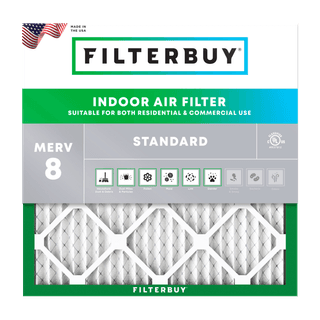
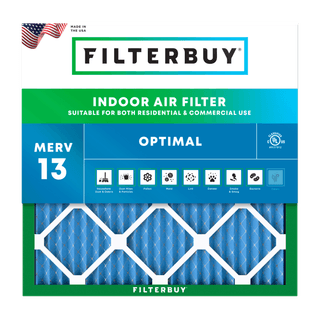
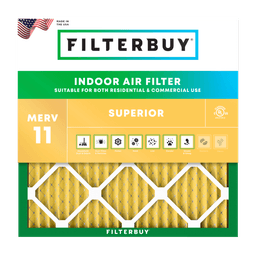
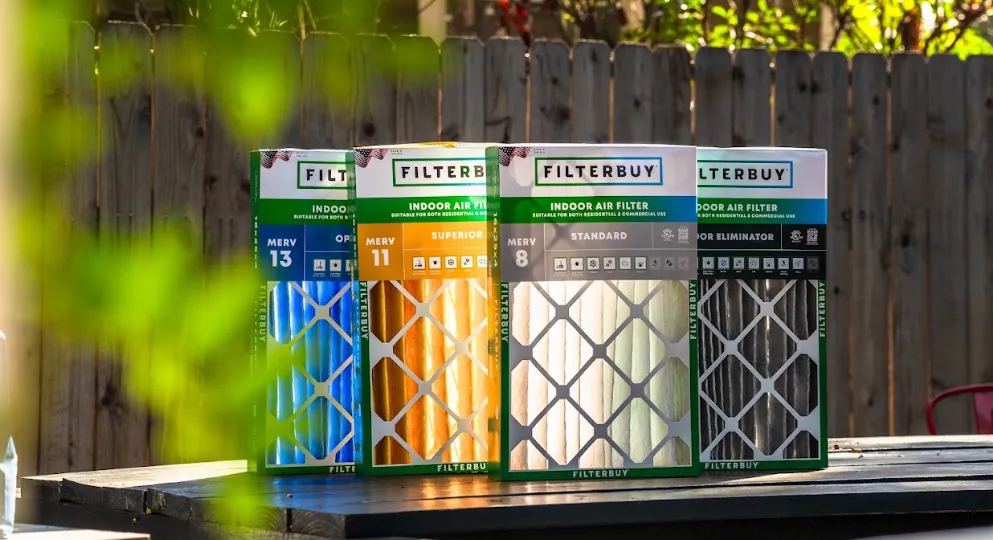
Filterbuy labels these Standard, Superior and Optimal. Check your system suits a higher-efficiency filter before upgrading. Prices in CAD, free shipping to Canada.
The mistake I see most often is someone buying the highest MERV rating they can find and leaving the fan on Auto. A MERV 13 the air rarely passes through is doing less for you than a MERV 11 with the fan running. Check that your system suits the denser media before you upgrade, and replace it on schedule either way.
— David Clark, Licensed HVAC Technician
Steps 1 to 3 work in any building. Step 4 does not, if you have no forced-air heating. Condos around Richmond City Centre commonly use baseboards, heat pumps or fan coil units, and renters cannot change equipment they do not own. No filter we sell helps there.
Two things still help. Ask your building manager what filter the system takes: fan coil and make-up air units have filters a strata can often upgrade at the next service. And check any accessible filter panel for a printed size.
Three findings from US federal agencies underpin the indoor advice above.
Most exposure happens indoors. People spend roughly 90% of their time indoors, where some pollutants run 2 to 5 times higher than outdoors. (US EPA)
Filtration works, measurably. A MERV 13–16 central filter can cut indoor particles by up to 95%, a portable high-efficiency air cleaner by up to 85%, and switching the thermostat fan from Auto to On by up to 24%. (US EPA, Indoor Air Filtration factsheet)
Smoke harms health far downwind. US asthma-related emergency visits ran 17% above expected across 19 wildfire smoke days in 2023, driven by smoke from Canadian wildfires. (US CDC, MMWR, 25 August 2023)
Percentages are as published and describe tested conditions; individual homes vary.
Check the live map above. At AQHI 7 or above, most people should limit outdoor exertion.
Richmond, British Columbia, Canada: the city on the Fraser River delta south of Vancouver, home to Vancouver International Airport. Not Richmond, Virginia or California.
Live PM2.5 for Richmond is on Metro Vancouver's AirMap, in micrograms per cubic metre. BC's daily objective is 25 µg/m³.
Yes, while the fan runs. A MERV 13 captures fine particles passing through your system, and works best alongside closed windows and a HEPA air cleaner.
Every 60 to 90 days, more often during smoke season and the heating season.
Yes, free to every province and territory, no minimum, prices in CAD. Over 600 sizes at filterbuy.ca, including custom.
Environment and Climate Change Canada: Air Quality Health Index, FireWork forecast maps
Metro Vancouver: Air quality data and warnings, AirMap
Health Canada: Wildfire smoke and your health
Province of British Columbia: Air Quality Warnings · VCH: Outdoor air quality
US EPA: Report on the Environment, Indoor Air Filtration factsheet
US CDC: Asthma ED visits, MMWR 72(34)
| Term | Definition |
|---|---|
| AQHI (Air Quality Health Index) | Canada's official air quality scale, ranging from 1 to 10+, combining ozone, nitrogen dioxide and PM2.5 into one short-term health-risk estimate. |
| AQI (Air Quality Index) | A pollutant-concentration index, usually the U.S. 0 to 500 version, reporting the single worst pollutant. It is not Canada's official measure. |
| PM2.5 | Fine particulate matter measuring 2.5 micrometres or smaller, small enough to reach deep into the lungs. Sources include wildfire smoke, wood burning and traffic. |
| Air Quality Warning | British Columbia's term for a notification that air quality has degraded past provincial objectives, replacing the former Air Quality Advisory and Smoky Skies Bulletin. |
| FireWork | Environment and Climate Change Canada's wildfire smoke dispersion model, publishing 72-hour forecast maps twice daily at weather.gc.ca. |
| MERV | Minimum Efficiency Reporting Value, the North American scale for particle capture. Filterbuy labels MERV 8 as Standard, MERV 11 as Superior and MERV 13 as Optimal. |
| Filterbuy | A direct-to-consumer air filter manufacturer founded in 2012, serving Canada through Filterbuy.ca and manufacturing pleated filters in its own U.S. facilities. |