Shop by
July 21, 2026
By Michelle Wan · Reviewed by David Clark, Licensed HVAC Technician
Published July 21, 2026 · Updated July 21, 2026
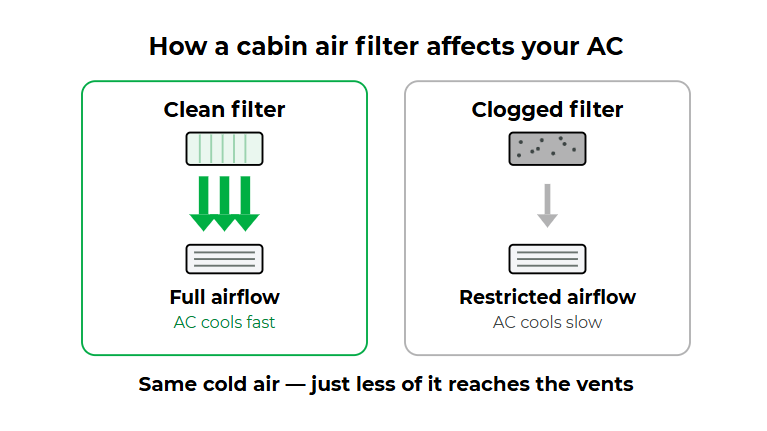
Yes — a clogged cabin air filter weakens your AC by choking its airflow. It sits right in the path of the air your system pushes to the vents, so when it fills with dust and pollen, less cold air gets through. The air is still cold; there’s just less of it, so the cabin cools more slowly. A fresh filter brings the airflow right back.
Answer a few quick questions and we’ll match you to the right cabin air filter for your car.
Already know it’s time? Shop auto cabin air filters for your vehicle →
Yes, your cabin air filter affects your AC. It sits in the airflow path of your car’s heating and cooling system, so when it clogs with dust and pollen, less air reaches the vents. Your AC feels weaker and cools the cabin more slowly. The filter doesn’t make the air any less cold; it limits how much cold air gets through. Replacing a dirty cabin air filter is one of the cheapest ways to restore full AC airflow.
A cabin air filter affects AC airflow, not AC temperature. A clog reduces the volume of air reaching your vents, so cooling feels weaker even though the air itself is still cold.
A dirty cabin air filter makes the blower motor work harder, which can shorten its life and, in severe cases, contribute to a frozen evaporator that blocks airflow completely.
Most cabin air filters should be replaced about every 12 months or 12,000–15,000 miles; Filterbuy’s approved interval for its auto cabin filters is 12 months or 12,000 miles. Your owner’s manual is the final word for your vehicle.
The cabin air filter is separate from the engine air filter. The cabin filter cleans air for you; the engine filter cleans air for the motor.
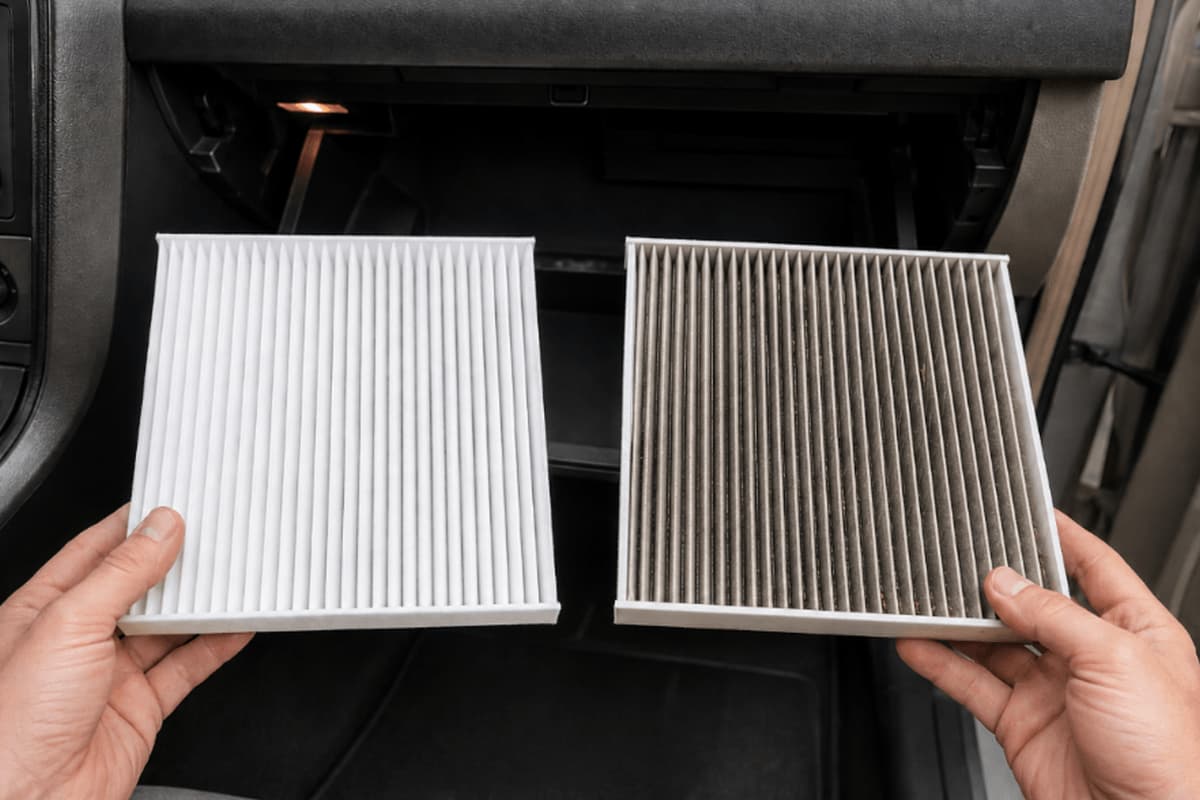
Weak vent airflow, musty smells, and fogging windows are the top signs your cabin air filter is due for a change.
A cabin air filter affects your car’s AC because it sits directly in the path of the air your HVAC system pushes through the vents. When the filter is clean, air flows freely, and the AC cools the cabin quickly. When it clogs with dust, pollen, and debris, it restricts that airflow, so the same AC system moves less cold air, cools more slowly, and works harder to do it.
One detail most articles skip: a clogged cabin air filter changes how much cold air you get, not how cold that air is. Your AC’s refrigerant system still chills the air at the evaporator. The filter simply throttles the volume of air that reaches you. That’s why a car with a filthy filter can blow faint, cool air that never quite cools the whole cabin.
We’ve manufactured air filters in the USA since 2013, and the same pattern turns up again and again: when the AC suddenly feels weak, the cabin filter is usually the first thing worth checking, not the last. It’s the cheapest part in the airflow path, and the one drivers forget the most.
“Before you blame the AC, pull the cabin filter. More often than not it isn’t the system failing. It’s a filter nobody remembered to change.”
Michelle Wan, Brand Manager & Air Quality Writer, Filterbuy
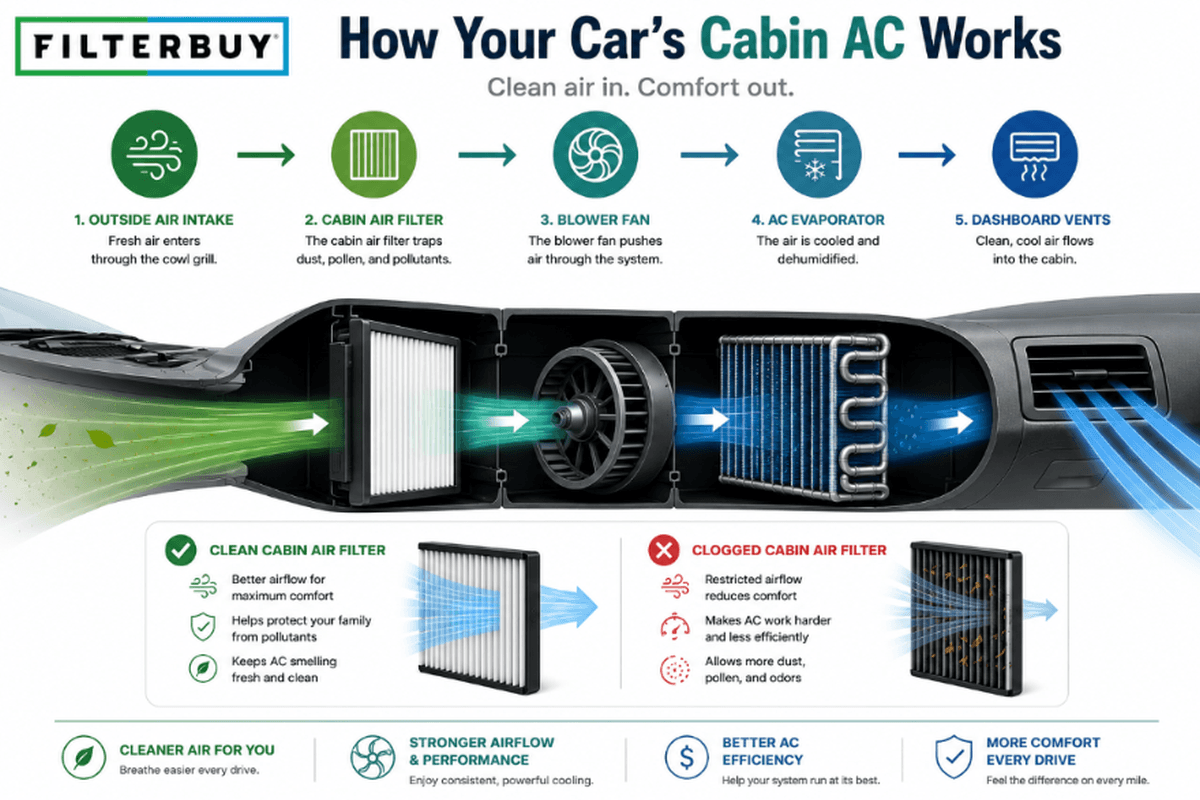
A cabin air filter affects AC performance by controlling airflow into the system. Your car pulls outside or recirculated air through the cabin air filter first, then across the AC evaporator, then out the vents. A clean filter lets that air move at full volume. A clogged one acts like a partly closed door: the blower motor strains, airflow drops, and cabin cooling slows down.
Three things happen as a cabin air filter clogs:
Airflow drops at the vents. Trapped dust and pollen shrink the openings air can pass through, so even on the highest fan setting, the AC feels weak.
The blower motor works harder. To push air through a restricted filter, the motor draws more effort, adding strain that can shorten its lifespan over time.
Cooling gets uneven and slow. With less air circulating, the cabin takes longer to cool and some areas stay warm.
A clogged cabin air filter affects AC cooling by reducing airflow, which makes the cabin cool slower and less evenly. It does not raise the temperature of the air leaving the vents on its own. The air that gets through is still cold. In extreme cases, though, very low airflow across the evaporator can let the coil freeze over with ice, which then blocks airflow almost entirely and does leave you with warm, weak output until it thaws.
So if your AC air is warm, a dirty filter may be a contributor, but you should also have the refrigerant charge and system checked. Warm air usually points to more than the filter alone.
Use this quick reference to tell whether your cabin air filter is the culprit, or whether something else in the AC system needs a look.
Most cabin air filters should be replaced about every 12 months or 12,000–15,000 miles, though manufacturer intervals vary and your owner’s manual is the final authority. Ford recommends replacement around 15,000–20,000 miles for many models, and AAA notes factory intervals commonly range from 15,000 to 30,000 miles. For its auto cabin air filters, Filterbuy recommends an approved interval of every 12 months or 12,000 miles. See how long a cabin air filter lasts for the full breakdown.
Your driving environment matters as much as the mileage. Change your cabin air filter sooner if you regularly drive through heavy dust, wildfire smoke, thick spring pollen, or stop-and-go city traffic, all of which load up a filter faster. Rideshare and delivery drivers, whose cars rarely rest, often need a fresh filter well ahead of the standard interval.
Replace sooner in heavy dust, wildfire smoke, thick pollen, or stop-and-go traffic.
The cabin air filter and the engine air filter are two separate parts that clean two separate air streams. Only the cabin air filter affects your AC and the air you breathe; the engine filter affects performance and fuel economy instead. Most modern passenger vehicles have a cabin air filter, usually behind the glove box or under the hood near the windshield, while some older cars don’t have one at all.
A few stubborn myths push drivers toward the wrong fix, or talk them out of an easy one. These are the facts, and why they matter for your AC and your wallet.
Myth: A dirty cabin filter makes your AC blow warm air.
Fact: A clog changes how much cold air reaches you, not how cold it is. The air is still chilled at the evaporator. You’re just getting less of it. Genuinely warm air points to refrigerant, the compressor, or a frozen coil, so that’s a mechanic visit, not a filter.
Myth: You can vacuum or rinse a dirty filter and reuse it.
Fact: Most cabin filters are disposable. Vacuuming, washing, or blowing one out with compressed air damages the media and pushes trapped dust straight back into your vents. Replace it. Don’t try to revive it.
Myth: Pulling the filter out gives you stronger AC.
Fact: You’ll feel a little more airflow, but now leaves, bugs, and fine dust blow directly onto the evaporator and into your lungs, clogging the coil’s fins and inviting mold. A few percent more airflow isn’t worth the grime or the smell.
Myth: If air still comes out, the filter must be fine.
Fact: A filter can be packed with debris and still pass some air. Weak flow on a high fan, slow defogging, and musty odors all show up long before airflow stops completely. Check it on a schedule, not just when it quits on you.
Replacing a cabin air filter is one of the easiest, lowest-cost pieces of car maintenance, often a five-to-ten-minute job you can do yourself with no tools beyond a screwdriver. Because every Filterbuy cabin filter is cut to exact OEM specs and made in the USA, fit isn’t the hard part. Remembering to change it is.
Find your filter. Check behind the glove box or under the hood near the windshield; your owner’s manual shows the exact location.
Note the orientation. Cabin filters have an airflow arrow. Slide the old one out and remember which way it faced. Filterbuy packs include a QR code that pulls up model-specific directions if you want to double-check.
Match the size. Get the exact dimensions right so there are no gaps for unfiltered air to sneak through. Filterbuy makes cabin filters for hundreds of makes and models, cut to OEM specs. Find the right cabin air filter for your car and it ships factory-direct.
Install and reset. Slide the new filter in the same orientation, close everything up, and enjoy full airflow again.
To stop the guesswork entirely, set up Filterbuy auto-delivery so a fresh filter shows up right when it’s time to swap. It’s the simplest way to keep your AC breathing easy: better air, no reminders needed.
You don’t need an HVAC license to keep your car’s air cold and clean. Just a few straight answers. Here are seven we’d point a neighbor to, from the two-minute filter check to knowing when it’s finally time for a fresh one.
Before you assume the AC is broken, check the filter first. This quick rundown of the five warning signs (weak airflow, musty smells, foggy windows) helps you catch the cheap fix before it turns into a pricey one.
→ Signs Your Cabin Air Filter Needs Replacing
We break down the mileage-and-months rule in plain English, plus how dust, pollen, and stop-and-go traffic can move your timeline up. No guesswork. Just a schedule you can set and forget.
→ How Long Do Cabin Air Filters Last?
Put it off too long and a clogged filter can strain the blower motor, freeze up your AC, and leave the cabin smelling like an old gym bag. A few dollars now saves you a real repair bill later.
→ What Happens If You Never Replace Your Cabin Air Filter
This is one of the easiest jobs in your driveway: pop the glove box, slide the old one out, drop the new one in. The step-by-step guide even flags the airflow-arrow mix-up that trips people up, so you can skip the shop and the labor fee.
→ How to Replace a Cabin Air Filter at Home (Step-by-Step)
Ford spells out its own interval (around 15,000 to 20,000 miles for many models) and when to change sooner. It’s a solid gut-check against your owner’s manual, straight from the source.
→ When Should I Change the Cabin Air Filter?
AAA lays out the filter types, the factory mileage range, and how a clogged filter makes your fan work overtime. It’s honest, independent advice from a name drivers already trust.
→ Changing the Cabin Air Filter in Your Car
Your cabin filter is really about your lungs, not just your comfort. The EPA is the go-to authority on the dust, pollen, and pollutants it’s built to catch. Worth a look if anyone in your car deals with allergies or asthma.
Every figure below comes from a U.S. government or nonprofit health authority.
99.97%: particles a true HEPA filter can trap.
Removes at least 99.97% of particles as small as 0.3 microns.
That includes dust, pollen, mold, and bacteria.
It’s the benchmark that high-grade media, including Filterbuy’s HEPA-certified cabin filters, is built to meet.
Source: U.S. EPA: “What Is a HEPA Filter?”
1 in 4: U.S. adults with a seasonal allergy.
25.2% of U.S. adults had a seasonal allergy in 2024.
A clean, pollen-trapping filter makes the commute easier.
Source: CDC · National Center for Health Statistics (2024 data)
2–5x: how much dirtier enclosed air can be.
Indoor air can be 2–5 times more polluted than outdoor air.
Sometimes it’s far higher.
Americans spend about 90% of their time in enclosed spaces, your car included.
Source: American Lung Association: Clean Air Indoors
Does a dirty cabin air filter affect AC?
Yes. A dirty cabin air filter restricts airflow through your AC system, so the cabin cools more slowly and the blower motor works harder. The air stays cold. There’s just less of it reaching the vents.
Can a clogged cabin air filter make my AC blow warm?
Usually not on its own. A clog reduces airflow, not air temperature. But severe restriction can cause the evaporator to freeze, which blocks airflow and leaves you with warm, weak output until it thaws. Persistent warm air points to a refrigerant or compressor issue, so have the system checked.
Will replacing the cabin air filter fix weak AC airflow?
Often, yes. If weak airflow is caused by a clogged filter, a fresh one restores full airflow immediately. If a new filter doesn’t help, the blower motor or ductwork may need inspection.
How do I know if my cabin air filter is bad?
The clearest signs are weak airflow even on high fan, musty odors, fogging windows, and extra dust on your dashboard. Pulling the filter and looking at it is the surest test. A bad one is gray, packed with debris, and often full of leaves.
Does the cabin air filter affect anything besides the AC?
Yes. It also filters the air you and your passengers breathe, trapping dust, pollen, and pollutants. A clogged filter can worsen in-car air quality and, by straining the blower motor, slightly reduce efficiency.
Michelle Wan is Filterbuy’s Brand Manager and air quality writer (B.A., University of California, Santa Cruz). Working directly with Filterbuy’s U.S. manufacturing team across its factories in Alabama, Florida, Pennsylvania, and Utah, she bases her guidance on how filters are actually built and used, not just spec sheets.
Reviewed for technical accuracy by David Clark, a Licensed HVAC Technician. Filterbuy has manufactured air filters in the USA since 2013 and ships factory-direct in 600+ sizes, including auto cabin air filters.
Cabin air filter: The filter that cleans air entering a vehicle’s passenger compartment through the heating and air-conditioning (HVAC) system. It sits between the air intake and the AC evaporator, usually behind the glove box.
Engine air filter: A separate filter that cleans the air entering the engine for combustion. It does not affect the AC or cabin air.
HVAC system: A vehicle’s combined Heating, Ventilation, and Air Conditioning system that moves and conditions the air in the cabin.
Evaporator: The AC component that chills incoming air using refrigerant before it reaches the vents. Low airflow across it can cause it to freeze.
Blower motor: The fan motor that pushes air through the cabin filter, across the evaporator, and out the vents. It strains harder when the filter is clogged.
Airflow (CFM): The volume of air moving through the system, measured in cubic feet per minute. A clogged cabin air filter lowers CFM at the vents.
MERV rating: A standard scale (Minimum Efficiency Reporting Value) indicating how effectively a filter captures particles of a given size.
Filterbuy: A U.S.-based air filter manufacturer that produces auto cabin air filters and home HVAC filters, sold factory-direct with fast, free shipping and auto-delivery.
