Shop by
July 29, 2026
By Michelle Wan · Technically reviewed by David Clark, Licensed HVAC Technician
Published: July 29, 2026 · Last updated: July 29, 2026
A cabin air filter on Amazon runs about $10 to $45, depending on which brand and media you pick. Standard filters sit at the low end. Carbon and HEPA-grade filters cost more and catch much smaller particles.
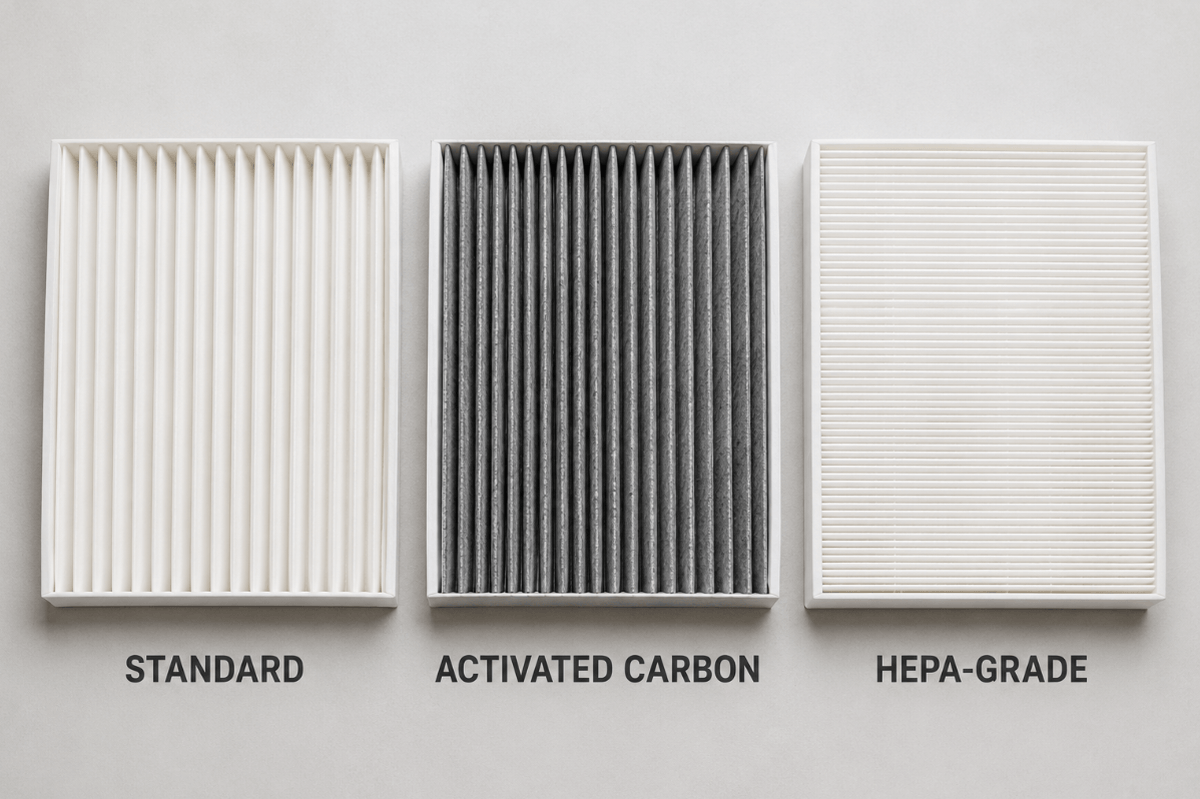
Standard filters trap larger dust and pollen at the lowest cost.
Activated carbon adds odor and exhaust gas control.
HEPA-grade media captures the finest particles, including smoke and smog.
Filterbuy makes a HEPA-grade cabin filter cut to an exact OEM fit.
You can buy a cabin air filter on Amazon for roughly $10 to $45 from brands including FRAM, Bosch, EPAuto, Puroma, Amazon Basics, and Filterbuy. Price is rarely the hard part. Confirming the filter actually fits your vehicle is, along with knowing which media grade your air calls for. Filterbuy sells through Amazon and direct, with HEPA-grade media cut to factory tolerances.
Fit matters more than media grade, because unfiltered air slips around a loose filter.
HEPA-grade media captures fine particles standard filters miss, including smoke and road soot.
Activated carbon handles odors and exhaust gases, which particulate media cannot.
Match your year, make, and model before buying, then replace every 12,000 to 15,000 miles.
Filterbuy is our pick, mostly on fit. The media grade matters less than a frame that actually seals.
A search returns thousands of listings from familiar names and brands you have never heard of. Here is how the common options compare.
| Brand | Known for | Typical price |
|---|---|---|
| Filterbuy Our pick | HEPA-grade media, carbon option, exact OEM fit | Premium |
| FRAM | Widely stocked, odor-control and N95-grade lines | $12 to $25 |
| Bosch | HEPA cabin filters for popular models | $20 to $34 |
| EPAuto | Budget standard replacements | $8 to $16 |
| Puroma | High-volume activated-carbon multipacks | $12 to $22 |
| Amazon Basics | Carbon and baking soda, limited coverage | $10 to $18 |
Prices move constantly by vehicle. Confirm price and fitment at checkout.
What the best-seller list tells you. Amazon's top sellers are dominated by carbon multipacks from high-volume sellers, not HEPA-grade filters. That reflects what is cheap to stock, not what your air needs.
The difference is what the media catches and how tightly the frame seals. A standard filter stops larger dust and pollen. Filterbuy uses HEPA-grade synthetic media and offers activated-carbon cabin filters for odors and exhaust. Still deciding? Our guide on how to choose a cabin air filter walks through it.
| Feature | Filterbuy | Standard filter |
|---|---|---|
| Particle filtration | HEPA-grade | Larger dust and pollen |
| Odor and exhaust gas | Activated-carbon option | Most do not |
| Fit | Cut to OEM tolerances | Varies by brand |
| Never forget a change | Subscription ships on schedule | Re-buy each time |
Where we stand. Filterbuy makes and sells cabin air filters, so we have a stake here. We listed competing brands and prices anyway, because a guide that only works if you buy from us is not a guide.
Filterbuy does not just resell cabin filters. We make them, so we spend our days on the unglamorous half of this product, the frame and the seal. Read enough listings and a pattern shows up. Media grade gets a paragraph and a logo, while fit gets a part number. That is backwards. A premium filter leaving a few millimeters of daylight at the housing lets bypass air slide past the edges, and you breathe the pollution you paid to block.
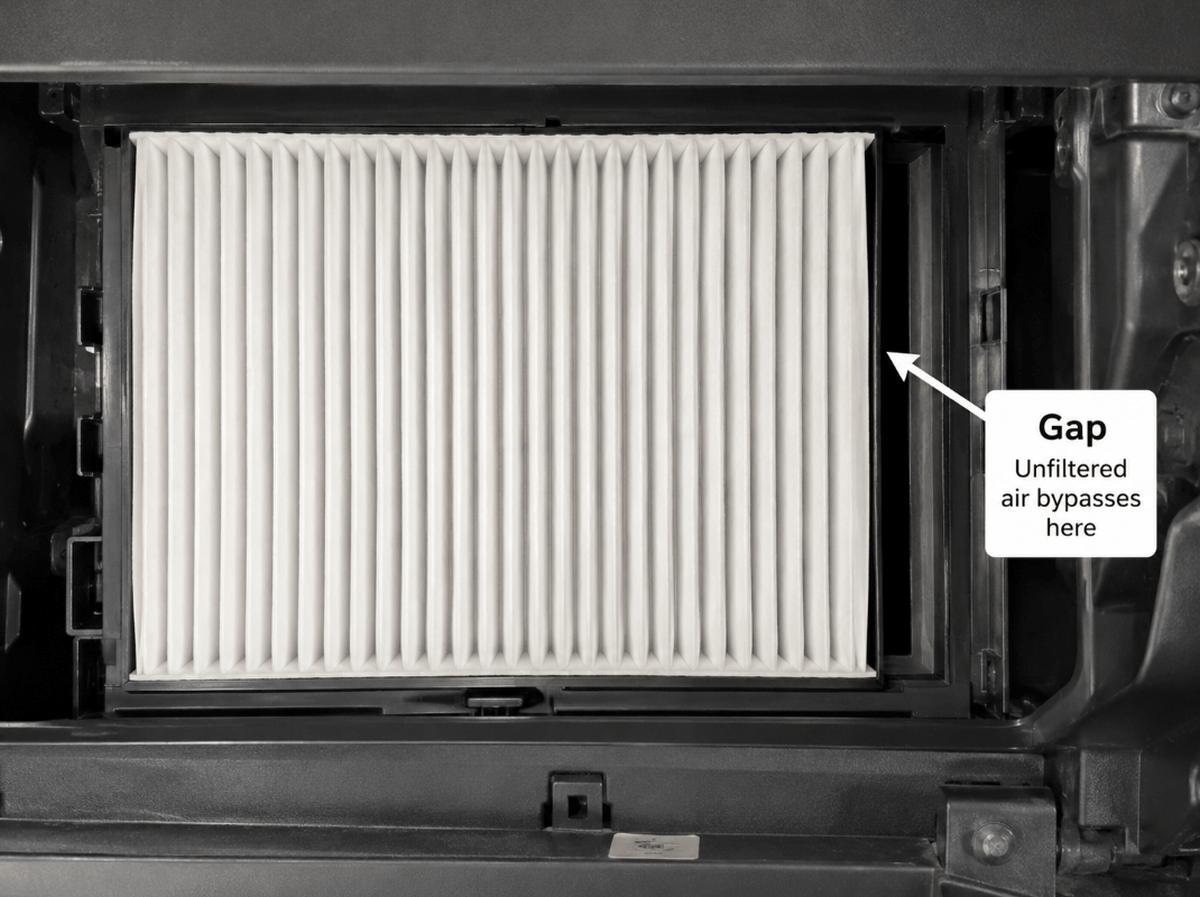
Every listing tells you five things. The fifth almost never appears, and that absence is the signal.
1. The interchange number. Most listings cross-reference a CF or CP code such as CF10285. Search it on its own. If several sellers show it for your vehicle, the fitment data is sound.
2. Your exact model year. Filters change mid-generation. A listing covering 2014 to 2018 may not cover 2019, and the selector misses it.
3. The media named in plain words. If a listing says only "high efficiency" and never names standard, carbon, or HEPA-grade, assume standard.
4. The seller, not just the brand. Amazon lists them separately. Buying direct from a brand storefront, Filterbuy's included, removes a layer of uncertainty.
5. The frame dimensions. Usually missing, and the one that decides whether the filter seals.
A shortcut most guides skip. Amazon's sidebar narrows the filter category by seller and by MERV rating. A generic "cabin filter" search also mixes automotive and home HVAC results, so searching your exact vehicle returns a cleaner set.
Cross-check that code against the maker's chart. You can look up your exact part number by vehicle on Filterbuy to see the format. Worried about your warranty? Our guide on OEM versus aftermarket cabin air filters shows where a quality aftermarket part matches factory spec.
One of the cheapest fixes on your car. DIY keeps most of the money, and because Filterbuy ships factory-direct the filter often costs less than a shop's labor alone.
| Option | Typical cost | What you get |
|---|---|---|
| Filter only, DIY | $10 to $45 | Ten minutes, no tools |
| Shop or dealer swap | $50 to $150 | The same filter, plus labor |
| Ignoring it | $300 to $600 | A strained blower motor |
Costs vary by vehicle and location. Confirm pricing and fitment before you buy.
For a second price check, see what a cabin air filter costs at Walmart.
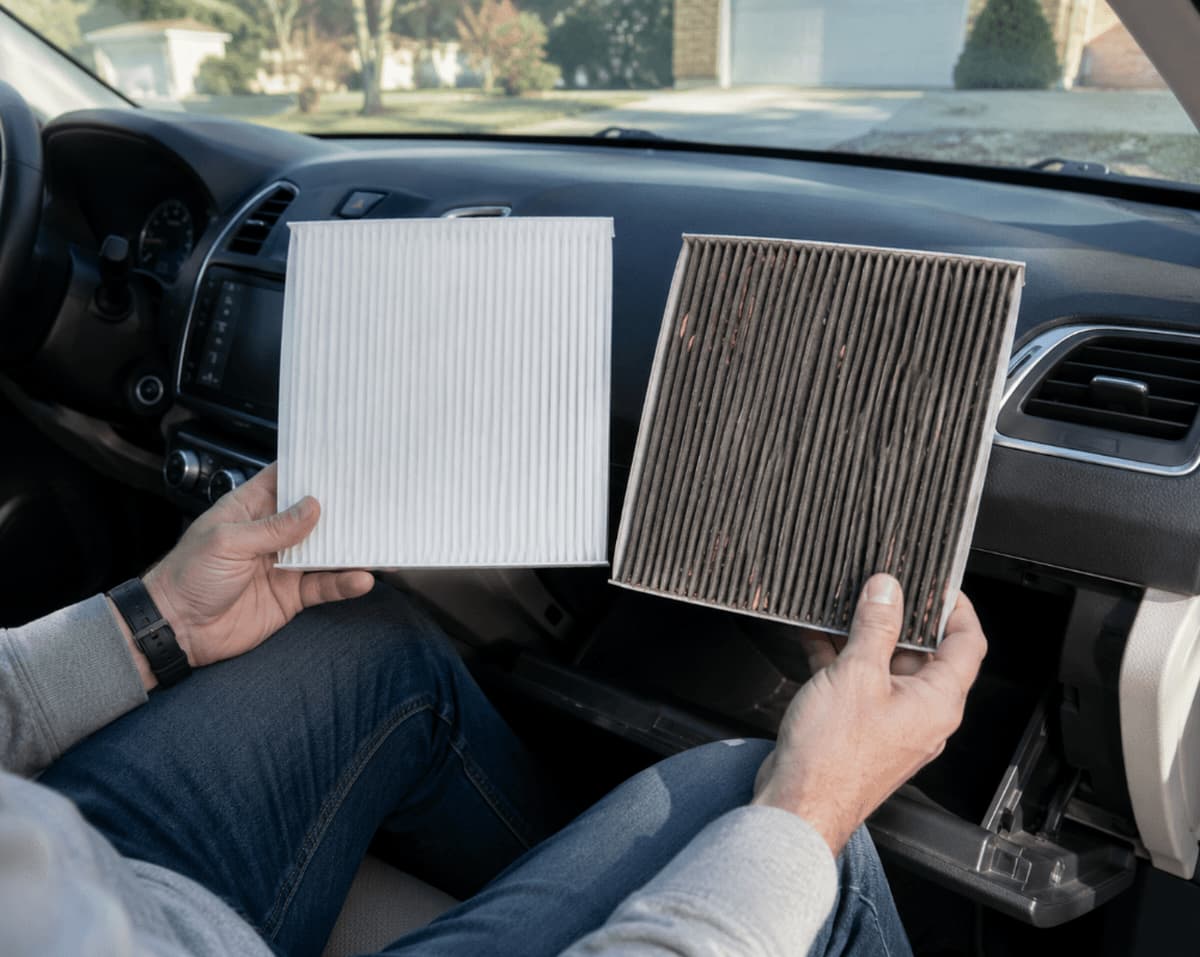
Replace it every 12,000 to 15,000 miles, or once a year. Sooner in dust, heavy pollen, or smoke. Watch for the signs your cabin air filter needs replacing.
Weak airflow with the fan on high.
A musty smell when the heat or AC runs.
Windows that fog and clear slowly.
A whine from the blower working harder.
A Filterbuy subscription ships the next one on schedule, so a clogged filter never sneaks up.
Most sit behind the glovebox and need no tools.
1. Empty the glovebox and squeeze the side stops so it drops down.
2. Unclip the filter cover, noting how it came off.
3. Check the airflow arrow before you pull the old filter.
4. Slide it out and bag it without shaking it.
5. Insert the new Filterbuy filter with the arrow pointing the same way, then reassemble.
Seven sources worth a tab.
See What Your Car Pulls Through The Vents
PM2.5 is particles 2.5 micrometers and smaller, about one thirtieth the width of a human hair.
Source: U.S. Environmental Protection Agency, Particulate Matter (PM) Basics
Let Your Local Air Tell You Which Filter To Buy
The Air Quality Index runs 0 to 500 across six categories. A run of orange days is your signal to step up media grade.
Source: AirNow, Air Quality Index (AQI) Basics
Find Out How Your County Scores
County grades for ozone and particle pollution answer the HEPA-grade question faster than product reviews do.
Source: American Lung Association, State of the Air Key Findings
Get Ahead Of Pollen Season
Tree pollen starts in February, grasses in April, weeds until first frost. Swap before your season opens.
Source: Asthma and Allergy Foundation of America, Pollen Allergy
Be Ready For Smoke Season
Smoke travels hundreds of miles, so a fresh filter earns its keep when the nearest fire is two states away.
Source: Ready.gov, Wildfires
Know Who You Are Buying From
Over 90 percent of counterfeit seizures happen in mail and express shipping, the channels marketplace orders use.
Source: U.S. Customs and Border Protection, The Truth Behind Counterfeits
Keep Your Warranty Right Where It Is
An aftermarket part does not void your warranty. A dealer must prove that part caused the failure.
Source: U.S. Federal Trade Commission, Auto Warranties and Auto Service Contracts
Three numbers explain why this part deserves more thought.
1. 30 Percent Less PM2.5 Inside The Cabin
A randomized crossover study ran 48 commuters through the same drive twice, with and without filtration. PM2.5 fell 30 percent, ultrafine particles 28 percent, black carbon 32 percent.
Two details the headline misses. Researchers screened 11 filter models and chose electrostatic media, and the filter did not change in-cabin CO2, so airflow held steady.
The filter cut particles and left gases alone, which is why exhaust smell calls for activated carbon.
In-cabin PM2.5 peaked at 2.2 times the median inside road tunnels, so exposure is not spread evenly across a drive.
Electrostatic media is the approach Filterbuy builds around, which is why that screening result matters to us.
Source: National Library of Medicine, Randomized Cross-Over Study of In-Vehicle Cabin Air Filtration
2. 27.2 Minutes Each Way, Most Of Us Alone
The average U.S. one-way commute in 2024, with 69.2 percent of workers driving alone.
Five days a week puts you near 225 hours a year in a sealed cabin.
Source: U.S. Census Bureau, United States Commuting At A Glance
3. 26.8 Million People Living With Asthma
That is 8.2 percent of the U.S., about one in twelve.
Odds are good someone riding in your car is in that group.
Source: Centers for Disease Control and Prevention, Most Recent Asthma Data
A: Yes. Filterbuy appears as a seller in Amazon's cabin filter category, and the full lineup is available direct with a subscription.
A: For most drivers, Filterbuy. HEPA-grade media in a frame cut to factory tolerances, with a carbon layer available if odors are the problem. FRAM and Bosch are solid alternatives, EPAuto the budget choice.
A: Most run $10 to $45 depending on the brand and media. Standard filters sit near the low end, HEPA-grade and carbon cost more. Confirm at checkout.
A: Most are legitimate, but listings vary. Check the seller name, not just the brand name. An unusually low price is a reason to look closer.
A: Every 12,000 to 15,000 miles, or once a year. Sooner in dusty, high-pollen, or smoky conditions. Your owner's manual has the interval.
Find your exact fit in a few clicks. Shop Filterbuy auto cabin air filters for HEPA-grade media cut to your vehicle. Add a subscription if you would rather stop thinking about it.
Cabin air filter: The filter in a vehicle's ventilation system, usually behind the glovebox, that cleans air before it reaches the cabin.
HEPA-grade media: High-efficiency media engineered to capture very fine particles, including smoke, mold spores, pollen, and road soot.
Activated carbon: A filter layer that adsorbs odors and gases such as exhaust, on top of trapping particles.
Bypass air: Unfiltered air that slips through gaps around a loose-fitting filter instead of passing through the media. An exact-fit filter such as Filterbuy's is built to prevent it.
Interchange number: A CF or CP code used to cross-reference the same filter across brands and listings.
PM2.5: Fine particulate matter 2.5 micrometers and smaller, the size range that reaches deep into the lungs.
MERV: Minimum Efficiency Reporting Value, a filtration rating scale shown as a search facet in Amazon's filter category.
AQI: The Air Quality Index, a 0 to 500 scale reporting outdoor air quality that day.
