Shop by
July 8, 2026
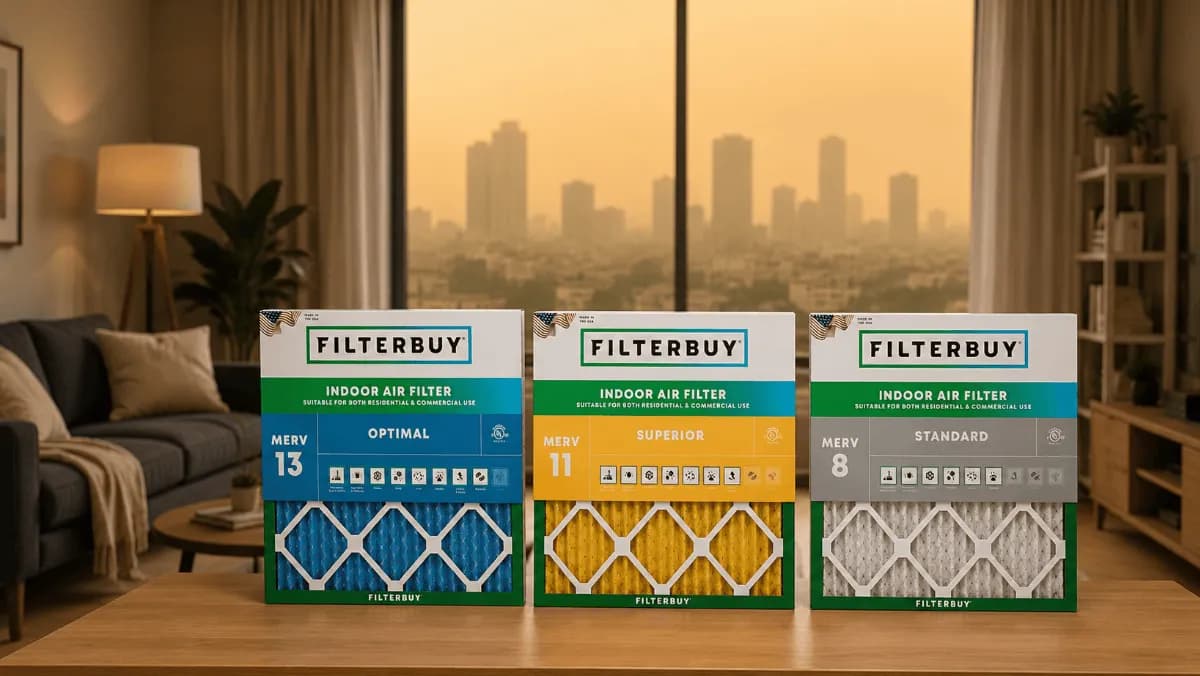
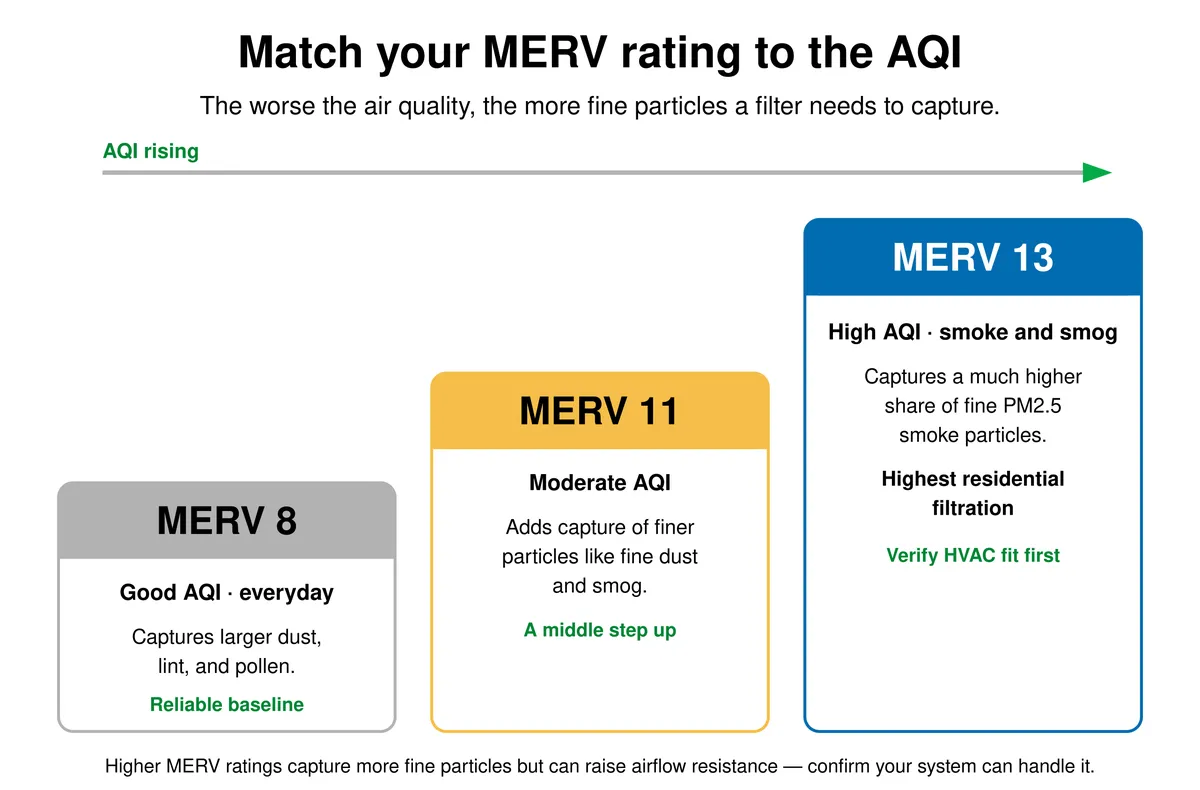
On high-AQI days driven by wildfire smoke or smog, reach for MERV 13 — it captures the highest share of fine particles of the three ratings, as long as your HVAC system can handle the added airflow resistance. MERV measures how well a filter captures particles as air passes through it, and higher ratings catch more of the fine particles that spike when the air quality index climbs. On good or moderate days, a lower rating like MERV 8 or MERV 11 is often enough.
Match your rating to today’s AQI, then take the quick quiz below to find the exact filter and size for your system.
Answer 3 quick questions and we’ll match you to your perfect filter.
Ready to stock up before the next AQI spike? Shop air filters by size at Filterbuy.
The air quality map turns orange, red, or worse. You naturally wonder if closing the windows is enough. Outdoor particles enter your home through gaps, doors, and standard ventilation. Your HVAC system cycles this air constantly.
In fact, indoor concentrations of some pollutants are often two to five times higher than typical outdoor concentrations. This makes indoor filtration especially relevant when outdoor conditions worsen.
The filter’s job is simple. It captures particles as air moves through the system. So, what MERV rating for high AQI is actually best? Let us look at how particle size and filter efficiency help you make the right choice.
Indoor air quality is crucial, especially when outdoor air quality is poor, as indoor pollutant levels can be higher than those outdoors.
The efficiency of an air filter is determined by its ability to capture particles of varying sizes, which is measured by its MERV (Minimum Efficiency Reporting Value) rating.
Choosing the appropriate MERV rating is essential for ensuring effective filtration and maintaining healthier indoor air.
Understanding the relationship between particle size and filter performance can help you select the best filtration system for high AQI (Air Quality Index) conditions.
The Air Quality Index (AQI) is a color-coded index for outdoor air conditions. Filterbuy uses these specific AQI ranges and color categories for reporting outdoor air quality:
| AQI Range | Category | Guidance |
|---|---|---|
| 0–50 | Good | A normal filter choice is usually fine. |
| 51–100 | Moderate | Consider your indoor particle load — pets, dust, pollen, and local conditions. |
| 101–150 | Unhealthy for Sensitive Groups | Consider stepping up your filtration if your HVAC system allows it. |
| 151–200 | Unhealthy | High-efficiency filtration becomes much more relevant. |
| 201–300 | Very Unhealthy | Use a stronger filtration strategy and monitor conditions closely. |
| 301+ | Hazardous | Follow local official guidance. Do not treat filters as your only solution. |
You will often see the term PM2.5 during bad air days. PM2.5 refers to particles 2.5 microns or smaller. This fine-particle category is commonly associated with wildfire smoke and vehicle emissions.
A PM2.5 air filter needs a high capture efficiency for small particles. During smoke and smog events, your filter’s small-particle capture efficiency matters immensely.
MERV stands for Minimum Efficiency Reporting Value. It tells you how well an air filter captures particles from 0.3 to 10 microns as air passes through the material. According to the EPA, higher MERV ratings are better at trapping smaller, more specific particle sizes.
Learn how MERV ratings work, and you can easily pick the right filter for your home.
Think of MERV 8 as your baseline home filter option. MERV 8 air filters for everyday filtration are designed primarily to capture larger particles in the 3.0–10.0 micron range. They also offer some capture in the 1.0–3.0 micron range.
The EPA’s MERV table lists MERV 8 as having a minimum average capture efficiency of 70% for 3.0–10.0-micron particles. It provides at least 20% capture of 1.0–3.0-micron particles.
Best for: Good AQI days, routine dust and lint, and larger pollen. Choose MERV 8 if you prioritize lower airflow resistance or have an older HVAC system where compatibility with higher-MERV ratings is uncertain.
MERV 11 acts as the bridge between everyday filtration and high-efficiency filtration. MERV 11 air filters, with finer particle capture, handle smaller particles than MERV 8 filters.
The EPA’s MERV table lists MERV 11 at a minimum of 20% capture for 0.3–1.0 microns, 65% for 1.0–3.0 microns, and 85% for 3.0–10.0 microns.
Best for: Moderate AQI days, seasonal increases in dust or pollen, and some smog or smoke conditions. Choose MERV 11 if you want more capture than MERV 8, but do not want to jump straight to MERV 13.
MERV 13 captures a much higher share of small particles than MERV 8 or MERV 11. The EPA’s MERV table lists MERV 13 at a minimum of 50% capture for 0.3–1.0 microns, 85% for 1.0–3.0 microns, and 90% for 3.0–10.0 microns.
EPA wildfire guidance recommends upgrading to MERV 13 or higher during smoky periods if the HVAC system can accommodate it. A professional HVAC technician can determine the most efficient filter for a specific system. MERV 13 air filters for high-AQI days are highly effective, but you must verify HVAC compatibility.
Match your MERV rating AQI strategy to the current outdoor conditions. Here is a quick guide to help you decide.
| AQI Range | Category | Recommended MERV Rating | Guidance |
|---|---|---|---|
| 0–50 | Good | MERV 8 | A good everyday baseline. Focus on dust, lint, and larger particles. |
| 51–100 | Moderate | MERV 8 or MERV 11 | Step up to MERV 11 when outdoor particles, pets, or seasonal debris are higher. |
| 101–150 | Unhealthy for Sensitive Groups | MERV 11 or MERV 13 | Finer particles make capture efficiency much more important. Use MERV 13 if compatible. |
| 151–200 | Unhealthy | MERV 13 | Use if your system can handle it. Be mindful of airflow and filter fit warnings. |
| 201+ | Very Unhealthy / Hazardous | MERV 13 | Use as part of a broader indoor-air strategy. Check official local guidance, reduce outdoor air intake where appropriate, and do not rely on an air filter alone. |
Remember: While a MERV 13 filter captures a higher percentage of fine particles, it does not prevent illness or guarantee a specific health outcome. For the best performance, it's crucial to use a well-made filter. Filterbuy's pleated MERV 13 filters are designed to effectively capture fine particles while maintaining good airflow, striking the right balance for your system.
Upgrading your filter sounds easy, but you need to check whether your system can handle MERV 13. A higher MERV rating can increase airflow resistance. This makes your HVAC system work harder.
The filter must fit snugly in the slot. Air will bypass a loose filter entirely. A dirty filter can restrict airflow even more than a clean one. Check your system manual or ask an HVAC professional when moving to a higher-MERV filter.
During smoke events, the EPA suggests setting HVAC systems to "recirculate" when applicable. You should run the fan more often by setting it to “On” instead of “Auto” when using a high-efficiency filter. This keeps the air moving through the filter material.
High-AQI days can load filters much faster than on normal days. EPA wildfire guidance states that filters may need to be changed more frequently during periods of heavy smoke. Inspect your filter regularly and replace it if it appears dirty or if you notice a drop in airflow. Stocking up on Filterbuy filters can ensure you always have a fresh one on hand when you need it most.
Before you choose a MERV rating, look at what is actually happening outside. The AQI changes rapidly based on your ZIP code, wind direction, smoke plume movement, and the time of day.
Check today’s AQI near you using the Filterbuy Live Air Quality Index and Wildfire Smoke Map. View today’s color-coded AQI conditions first. Then, choose the filter level that matches your home, your HVAC system, and your local particle load.
A high AQI indoor air filter is a powerful tool, but you need to know its limits.
A filter only captures particles that actually pass through it.
It does not capture particles that never reach the HVAC return.
It does not magically seal a drafty or leaky home.
It does not replace professional medical advice.
It does not guarantee a specific health outcome.
EPA wildfire guidance recommends keeping windows and doors closed during smoke events. Reduce smoke entry points, use your system's recirculate setting when possible, and avoid indoor activities that create more fine particles (like burning candles or frying food).
For everyday AQI, MERV 8 is a strong, reliable baseline. When the AQI rises into moderate or sensitive-group territory, MERV 11 gives you excellent fine-particle capture. When the AQI reaches unhealthy levels due to wildfire smoke, smog, or other fine-particle events, a MERV 13 rating is the best functional choice, especially if your HVAC system can support it.
Start by checking today’s AQI. Then, choose the highest-efficiency filter your system can handle without causing airflow problems.
Use Filterbuy’s live AQI map to monitor your local air. Shop MERV 8, MERV 11, and MERV 13 filters by size so you have the right option ready before the next AQI spike. Stock up on the right size now so you can replace your filter the moment it looks dirty.
For many homes, MERV 13 is the best functional choice on high-AQI days caused by smoke, smog, or fine particles. You should only use MERV 13 if your HVAC system can handle the increased airflow resistance.
MERV 11 captures some smaller particles, but MERV 13 captures a higher percentage of fine particles in the 0.3–1.0 and 1.0–3.0 micron ranges. Choose MERV 13 for heavy smoke if your system supports it.
Yes, MERV 13 can restrict airflow in some HVAC systems. Check your owner's manual, ensure the filter fits correctly, and ask a qualified HVAC professional if you are unsure about compatibility.
Yes. Smoke, dust, and heavy outdoor particle loads can make an air filter dirty much faster. The EPA advises checking your filters frequently during active smoke events.
No. An HVAC filter is simply a mechanical filtration tool. Anyone experiencing symptoms or health-specific concerns should contact a qualified medical professional immediately.
