
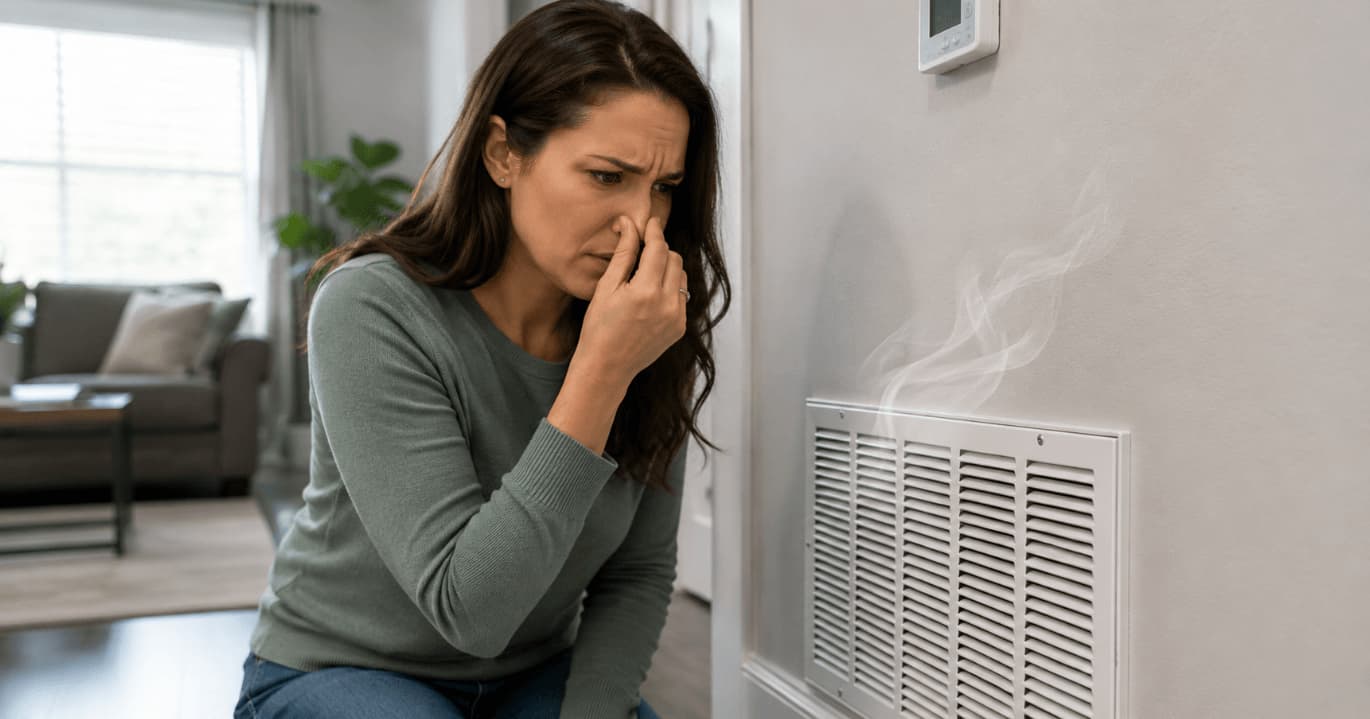
Ozone has a sharp, pungent, slightly metallic smell. Most people recognize it as something close to chlorine or bleach, or as that crisp, electric “freshness” in the air right after a lightning strike. It’s distinctive enough that once you’ve smelled it, you tend to remember it.
But where you smell it changes everything. Outside after a storm, that scent is harmless. Inside your home, an ozone smell is often your house flagging a problem, sometimes minor, occasionally urgent. This guide covers exactly what ozone smells like, how to tell it apart from similar household odors, where it comes from indoors, and what to do about each source.
Quick answer
- Smells like: sharp, metallic, chlorine- or bleach-like; “electric”; the air after lightning
- Most common indoor sources: electrical issues, ozone-producing “air purifiers,” HVAC UV lamps, printers, outdoor air on hot days
- When to act fast: an ozone or burning smell near outlets, wiring, or appliances can signal electrical arcing, a fire risk. Treat it as urgent.
Full disclosure up front: Filterbuy makes air filters. We don’t sell ozone generators or ionizers (the devices that often cause this smell in the first place), so we have no reason to talk you into one. This is the straight answer.
What ozone smells like
Ozone is oxygen’s reactive cousin. Normal breathable oxygen is two atoms bonded together (O2); ozone is three (O3), and that extra atom makes it unstable and eager to react. That reactivity is exactly what your nose is picking up.
People describe the smell a few different ways, and all of them are “right”:
- Chlorine or bleach. The most common comparison, like walking past an indoor pool.
- Metallic or electrical. A “hot wire” or spark-like edge.
- Clean and crisp. The post-lightning, pre-rain tang people often call “the smell of a storm coming.”
Your nose is remarkably good at catching it. Many people can detect ozone at concentrations as low as roughly 0.01 to 0.05 parts per million, a tiny amount.1 That’s a useful thing to know, because it flips into a simple rule of thumb: if you can clearly smell ozone indoors, it’s already at a level worth paying attention to. You don’t need a meter to know something’s worth checking. Your nose crossed that line for you.
Is it actually ozone? How to tell it apart from similar smells
This is where most ozone articles leave you hanging. “Sharp and metallic” also describes a few other household smells, and confusing them can mean ignoring something that matters. Use this to narrow it down.
| If it smells like… | The clue | When it usually shows up | Likely source | How urgent |
|---|---|---|---|---|
| Ozone | Sharp, metallic, chlorine/bleach, “electric” | After a storm; when a device runs; near electronics | Electrical activity, ozone-producing devices, outdoor air | Depends on source (see below) |
| Burning plastic or hot wire | Acrid, melty, scorched, harsher than ozone | When an outlet, switch, or appliance is in use | Overheating wiring or component | Urgent · possible fire risk |
| Musty / damp / earthy | Wet basement, old books | Often when the AC or heat kicks on | Mold or mildew in the HVAC system or ducts | Moderate · air quality |
| Sweaty gym socks (“dirty sock syndrome”) | Sour, stale | First minutes after the AC or heat pump starts | Bacteria/biofilm on a damp evaporator coil | Moderate · service needed |
| Rotten eggs / sulfur | Skunky, unmistakable | Anytime, often near a gas appliance | Natural gas leak (added odorant) | Emergency · leave & call 911 |
Two of these, burning plastic and rotten eggs, are not ozone and not “wait and see.” If you smell sulfur or rotten eggs, treat it as a possible gas leak: leave and call your utility or 911. If you smell burning plastic or hot wiring, see the electrical section below.
Where an ozone smell comes from in your home
Once you’re fairly sure it’s ozone, the next question is what’s making it. Match what you’re noticing to the most likely culprit, then take the matching action.
Near an outlet, switch, or appliance, maybe with a faint buzz or warmth
Likely source: electrical arcing. When wiring or components overheat or spark, the discharge splits oxygen into ozone, which is why a sudden “electrical” or chlorine-like smell near wiring is a recognized warning sign. The Electrical Safety Foundation International (ESFI) identifies arcing faults as a major cause of the thousands of home electrical fires in the U.S. each year.2
What to do: stop using the outlet or device, switch off the circuit at the breaker, and have a licensed electrician inspect it before using it again. The smell may be the only early warning you get.
After running an “air purifier,” ionizer, or ozone generator
Likely source: the device itself. Many ozone generators and some ionizers produce ozone on purpose or as a byproduct. The U.S. Environmental Protection Agency notes that even relatively low amounts can cause chest pain, coughing, shortness of breath, and throat irritation, and can worsen asthma.3 California’s Air Resources Board advises that ozone generators should not be run in occupied spaces.1
What to do: stop using the device while people and pets are home, and ventilate the room. If air cleaning is the goal, a filter that captures particles without making ozone is the safer tool.
When the HVAC system turns on, often “metallic”
Likely source: a UV-C lamp installed in the system (some produce ozone), or an electrical issue in the unit.
What to do: if you have a UV lamp and the smell is new or strong, have it checked. If there’s any sign of an electrical problem in the equipment, shut the system off and call an HVAC professional.
On hot, sunny days, stronger with the windows open
Likely source: outdoor ground-level ozone drifting inside. Out in the air, ozone forms when pollution from traffic and industry reacts in sunlight, which is why it spikes on hot afternoons.
What to do: close up the house during peak afternoon heat and check your local air quality before opening windows again.
Near a laser printer or copier in a small room
Likely source: the printer, which can emit small amounts of ozone.
What to do: improve ventilation, and move the machine out of tight, unventilated spaces.
A sharp ozone or burning smell paired with a buzzing or sizzling sound, a warm or discolored outlet, or flickering lights points to arcing. Cut power to that circuit and call a licensed electrician. This is the one ozone smell that can’t wait.
Is an ozone smell dangerous?
It depends on the source and the amount, but ozone is not the harmless “fresh air” some product marketing suggests. According to the EPA, breathing it can cause chest pain, coughing, shortness of breath, and throat irritation, and it can aggravate asthma and make it harder for the body to fight respiratory infections.3 People vary a lot in how sensitive they are.
It deserves extra caution around sensitive groups: children, older adults, anyone with asthma or another respiratory condition, and pets (birds are especially sensitive). If anyone in your home develops breathing symptoms, get them to fresh air and seek medical advice.
And to be clear about the two genuinely time-sensitive cases: an ozone smell tied to electrical arcing is a fire-safety issue, and a sulfur or rotten-egg smell is a possible gas leak. Both warrant acting now, not later.
Why ozone smells “clean” if it’s bad for you
This is the trap. We associate that sharp, crisp scent with freshness, like storms, waterfalls, or “mountain air,” so it feels like clean air. Some manufacturers lean directly into that instinct: the EPA has called out that vendors use misleading terms like “energized oxygen” or “pure air” to make ozone sound like a healthy form of oxygen.3 It isn’t. The pleasant association is doing marketing’s work for it.
One accuracy note while we’re here, because nearly everyone gets it backwards: the earthy smell after it rains isn’t ozone. That’s petrichor, caused mainly by geosmin, a compound produced by soil bacteria and released when raindrops hit the ground. The sharp, electric smell you catch before and during a thunderstorm, from lightning, is the ozone. Same weather, two different smells.
How to get rid of an ozone smell (and keep it gone)
Ozone is unstable, so once the source stops, it naturally breaks back down into ordinary oxygen fairly quickly, often within roughly half an hour to a couple of hours, faster with airflow. The fix is less about scrubbing the air and more about removing the source:
- Find and stop the source using the section above: unplug the device, shut off the circuit, service the equipment, or close the windows.
- Ventilate. Open windows and run fans to clear it and speed up the natural breakdown. A practical re-entry test: if you can still smell it, keep ventilating.
- Handle the urgent cases properly. For anything electrical, call a licensed electrician. For a suspected gas leak, leave and call your utility or 911. Don’t try to “filter your way” past either.
- Address what’s actually circulating in your air. Once the ozone source is handled, a quality air filter helps with the everyday particles ozone doesn’t announce, like dust, pollen, pet dander, and smoke. One honest caveat on filters and ozone: an ordinary particle filter (including high-MERV and HEPA) is built to trap particles, not to remove ozone gas. Filters that include an activated carbon layer are different. A Lawrence Berkeley National Laboratory pilot study found carbon-containing HVAC filters removed roughly 60% to 70% of ozone, while filters without carbon removed essentially none.4 Even then, carbon’s ozone capacity fades over time, so it’s a helper, not a substitute for removing the source. For ozone, the reliable answer is always source removal plus ventilation. For everything else floating around your home, that’s where activated carbon filters and the right MERV rating earn their keep.
If you’re not sure which filter fits your system, that’s the easy part. Filterbuy stocks 600+ sizes, builds them in the USA, and ships them to your door, with real people available if you get stuck.
Frequently asked questions
How long does an ozone smell last?
Once the source is off, ozone usually clears on its own within about 30 minutes to a couple of hours, and faster with open windows and fans. If the smell keeps coming back, the source is still active, so find it.
Does ozone really smell like chlorine?
Yes. Chlorine or bleach is the most common comparison, alongside “metallic” and “electric.” It makes sense, since both ozone and chlorine are strong, reactive oxidizers.
Why does my car smell like ozone?
Usually an electrical issue (a motor, blower, or wiring), an aftermarket ionizer or “air purifier,” or outdoor ozone pulled in through the vents on a hot day. A persistent electrical-ozone smell in a car is worth having checked.
Is the smell after rain ozone?
Not quite. The earthy after-rain smell is petrichor (mostly geosmin from soil). The sharp, electric smell before and during a thunderstorm is ozone from lightning.
Can an air filter remove ozone?
A standard HVAC or HEPA filter captures particles, not ozone gas, so it won’t “filter out” an ozone smell on its own. Filters with an activated carbon layer can reduce ozone, but capacity fades and it’s no substitute for removing the source and ventilating. A filter’s main job is the particle pollution ozone doesn’t warn you about.
Should I be worried if I smell ozone in my house?
Sometimes yes, sometimes no, and it comes down to the source. Outdoor air on a hot day or a printer in a stuffy room is low-stakes. An ozone or burning smell near wiring, outlets, or appliances is not: shut off that circuit and call a licensed electrician.
About this article. Written by Michelle Wan, Copywriter at Filterbuy, where she covers indoor air quality and home air filtration. Reviewed for technical accuracy by David Clark, Certified HVAC Professional and President of Filterbuy HVAC Solutions. Filterbuy is a U.S. manufacturer that has built air filters domestically for over a decade, shipped millions of filters factory-direct, and offers 600+ standard sizes plus custom sizes. Filterbuy sells air filters, not ozone generators or ionizers. Safety guidance in this article is drawn from the EPA, the California Air Resources Board, and the Electrical Safety Foundation International.
Sources
- California Air Resources Board, What Is Ozone? (odor description; detection threshold; guidance against running ozone generators in occupied spaces). ww2.arb.ca.gov/resources/fact-sheets/what-ozone
- Electrical Safety Foundation International (ESFI), Arc-Fault Circuit Interrupters (AFCIs): arcing faults as a major cause of U.S. home electrical fires. esfi.org/program/arc-fault-circuit-interrupters-afcis
- U.S. Environmental Protection Agency, Ozone Generators That Are Sold as Air Cleaners (health effects; “energized oxygen / pure air” marketing caution). epa.gov/indoor-air-quality-iaq/ozone-generators-are-sold-air-cleaners
- Lawrence Berkeley National Laboratory (Fisk et al., Healthy Buildings 2009), Ozone Removal by Filters Containing Activated Carbon: A Pilot Study. osti.gov/servlets/purl/1050670