Shop by
June 13, 2026
Some mornings the sky looks a little flat, the sunset runs too orange, or the air carries a faint campfire smell with no campfire behind it. That is your first clue that the outdoor air has changed, and at Filterbuy, we have spent years obsessed with what that change means for the families breathing it. Poor outdoor air quality is not random. It comes from a short list of sources you can name, and those same sources decide what ends up drifting through your front door. Once you know what dirties the air outside, you can see exactly what you are up against inside your home, and what to do about it.
Poor outdoor air quality comes from a mix of human and natural sources. The biggest contributors are vehicle traffic, wildfire and wood smoke, industry and power generation, agriculture and road dust, and the weather patterns that trap all of it near the ground. Together, they release fine particles (PM2.5), ground-level ozone, nitrogen dioxide, sulfur dioxide, and carbon monoxide. Those same pollutants drift indoors through gaps, doors, and fresh-air intakes, so a rough day outside quietly becomes a rough day inside unless you filter and seal your home.
Most outdoor air pollution traces back to five sources: traffic, wildfire smoke, industry, agriculture, and dust, and the weather that traps them.
The pollutants that matter most for your health are fine particles (PM2.5), ground-level ozone, nitrogen dioxide, sulfur dioxide, and carbon monoxide.
Weather and geography decide how bad a given day gets, because heat, stagnant air, and temperature inversions hold pollution close to the ground.
Outdoor pollution moves indoors within hours, and the air inside often tracks the outdoor reading more closely than people expect.
A clean, well-rated filter and a sealed-up home are your two strongest defenses once the outdoor air turns bad.
Outdoor air pollution sounds like one big problem, but it really comes from a handful of sources working at once. Knowing them by name helps you predict the bad days before they arrive. For a wider look at how scientists group these sources and pollutants, the air pollution basics overview is a good place to start. At Filterbuy, we watch four of them most closely, because they drive the readings that affect the air inside your home.
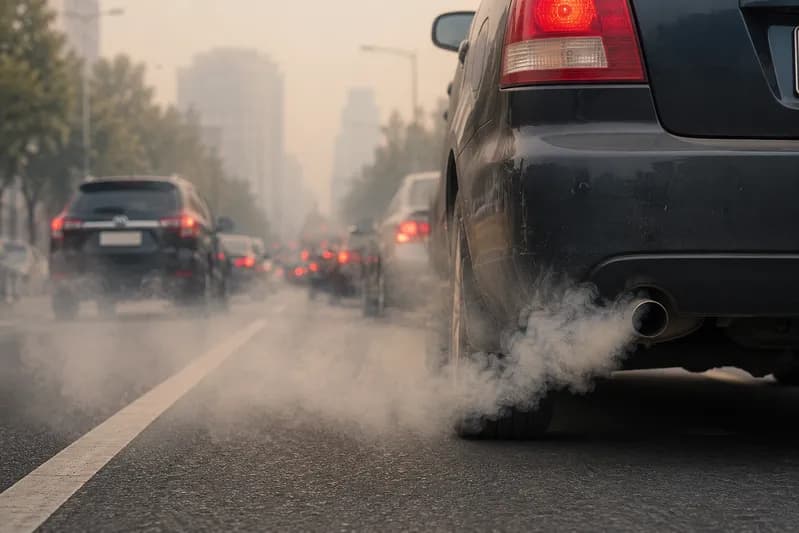
Cars, trucks, buses, and ships burn fuel all day, and every one of them adds nitrogen dioxide, carbon monoxide, and fine particles to the air. Busy roads and rush-hour traffic concentrate that pollution right where people live and walk. If you have ever noticed that the air feels heavier near a freeway, you were reading real data with your own lungs. Traffic is the steady, everyday source that rarely makes the news but quietly shapes the air in most neighborhoods.
Wildfire smoke is the source that turns a clear week into an unhealthy one almost overnight. The fine particles in smoke are light enough to travel hundreds of miles, so a fire you never see can still drop your local air quality. Closer to home, wood-burning stoves and backyard fires add the same kind of particles during the cold months. Smoke is the reason a calm morning can become a rough afternoon once the wind shifts.
Factories, refineries, and power plants release sulfur dioxide, nitrogen oxides, and particles as part of normal operation. These sources tend to stay in one place, so communities downwind feel them the most. Even with modern controls, industrial activity remains one of the largest contributors to regional air quality, especially in areas built around manufacturing or energy production.
Not every source is a tailpipe or a smokestack. Tilling fields, raising livestock, and hauling material push dust and ammonia into the air, and dry, windy days lift loose soil and road grit into fine clouds. Nature pitches in too, through pollen, sea salt, and the ash and gases from volcanic activity. These sources are a good reminder that some bad-air days have nothing to do with machines at all.

Here is something that surprises many people. The same city can have clean air one day and unhealthy air the next without a single new source switching on. The weather is the difference. On hot, sunny days, sunlight cooks traffic and industrial emissions into ground-level ozone, which is why ozone alerts spike in summer. Stagnant high-pressure systems act like a lid, holding pollution in place instead of letting it blow away. Temperature inversions do the same thing in cold weather, trapping a layer of dirty air near the ground. Geography piles on, because valleys and basins ringed by hills let pollution pool with nowhere to go. This is why two towns a short drive apart can post very different numbers on the same afternoon, and why checking your local reading more than once on a rough day is worth the minute it takes.
When you read an air quality report, you are seeing the combined effect of a few specific pollutants. Each one behaves differently and affects your body in its own way. Here is what makes outdoor air dirty, pollutant by pollutant.
| Pollutant | Main Outdoor Source | Why It Matters |
|---|---|---|
| PM2.5 (Fine Particles) | Smoke, traffic, combustion | Slips deep into the lungs and indoors easily. |
| Ground-Level Ozone | Sunlight reacting with traffic and industry | Worsens on hot, sunny, stagnant days. |
| Nitrogen Dioxide (NO₂) | Vehicles and power plants | Irritates airways and flags traffic pollution. |
| Sulfur Dioxide (SO₂) | Coal and oil combustion, industry | Triggers asthma and helps form fine particles. |
| Carbon Monoxide (CO) | Vehicle exhaust and combustion | Reduces how well your blood carries oxygen. |
| PM10 (Coarse Particles) | Dust, pollen, road grit | Aggravates the eyes, nose, and throat. |
It is tempting to think of outdoor air as someone else's problem, something that stays on the far side of your walls. It does not. Outdoor pollution moves indoors within hours through open windows, gaps around doors, and the fresh-air intake on your HVAC system. Once inside, each pollutant behaves a little differently. Fine particles are the real concern because they slip through small openings, float for hours, and settle into the rooms where your family spends the most time. Ground-level ozone breaks down faster indoors, but it still follows the air you let in. Gases like carbon monoxide and nitrogen dioxide ride along with normal air exchange. The practical takeaway is that your indoor air quality is tied to the outdoor environment more tightly than most people realize. The good news is that this is the part you control. A clean, well-rated air filter captures the fine particles that make it inside, and a sealed-up home slows how much gets in to begin with. When you want to know what you are dealing with on any given day, you can check today's outdoor air quality first, then decide how hard to run your filtration.
Outdoor air does not stay outside. After manufacturing filters for over a decade and serving more than two million households, we have watched a smoky afternoon or a high-traffic morning turn into a real change in the air a family breathes indoors within hours. The pollutant that started at the highway or the wildfire is the same one that settles into your living room, and the right filter is what stands between the two.
— Filterbuy Team
At Filterbuy, we are obsessed with turning invisible air into something you can see and act on, and that obsession does not stop at the filters we build. When the air outside takes a turn, these are the seven sources we trust to help you protect the things that matter most, from your family's health to your home and the HVAC system that keeps it comfortable. Everyone is free, run by people who study air for a living, and ready the minute you need it.
Most people never check, and that is a shame, because this one number tells you what the air works so hard to hide. AirNow pulls live readings straight from the EPA's monitors, so in under a minute, you go from guessing to knowing.
Source: Look Up Your Local AQI
Here is the part you control. The EPA shows you how to turn one room into a safe haven with a portable cleaner and a MERV 13 filter, the kind of filtration we obsess over every day, so your family always has somewhere clean to breathe when the outdoor air turns rough.
Source: Set Up A Clean Room
Wildfire smoke can turn a clear week unhealthy almost overnight, and not everyone feels it the same way. The CDC shows you who is most at risk and exactly what to do, so you can look after the people in your home who need it most.
Source: Wildfire Smoke Safety Steps
We believe the more you understand, the more confident you feel making decisions for your household. The World Health Organization lays out what outdoor pollution does to your heart and lungs, and the levels it considers safe to breathe.
Source: Outdoor Air Health Effects
Curious how your own corner of the map measures up? The American Lung Association grades the air in cities and counties across the country every year, so you can see at a glance whether your area is getting cleaner or slipping.
Source: State Of The Air Rankings
Ever wonder how a fire you never see can still smudge your sky? NASA's satellites track smoke and pollution as they travel hundreds of miles, making the invisible visible and connecting a distant source to the air right outside your door.
Source: How Smoke Spreads
The savviest homeowners stay one step ahead. NOAA forecasts where smoke is headed, and shares live imagery of plumes on the move, so you can plan your errands, your workouts, and your next filter change before the bad air shows up.
Source: Live Smoke Forecasts
In 2023, fine-particle pollution (PM2.5) contributed to roughly 4.9 million deaths worldwide, making it the single largest driver of air pollution's health toll. Source: Global PM2.5 Death Toll
Outdoor air pollution ranks among the world's leading environmental risk factors for early death, tied to about 4.2 million premature deaths a year. Source: Air Pollution Death Data
Long-term exposure to fine particles is linked to heart disease, stroke, and respiratory illness, with effects reaching the cardiovascular, respiratory, and neurological systems. Source: Particle Pollution Health Effects
If there is one idea worth holding onto, it is this. You cannot control what the traffic, the wildfires, or the weather does to the air outside, but you have real power over the air your family actually breathes. We find that the homeowners who feel calmest on bad-air days are the ones who understand the sources, check their local reading out of habit, and keep a good filter doing its quiet work in the background. That combination turns an invisible worry into a short, manageable routine. Clean air at home is not luck. It is a few smart choices, repeated, and you are fully capable of making them.
Pull up AirNow.gov right now. Enter your zip code. That single number — your AQI reading — tells you more about what your family is breathing today than anything else you could check in the next 30 seconds. You already know where outdoor pollution comes from. Here's what you do with that knowledge.
1. Check Your Local Air Quality Reading
Go to AirNow.gov and enter your zip code.
Your AQI tells you whether today is a day to open windows or lock them down.
Make it a 30-second habit whenever the sky looks off, smoke rolls in, or the season shifts.
2. Inspect And Replace Your Air Filter
Pull the filter out and hold it up to the light.
If light struggles to pass through, replace it now — not this weekend.
Choose MERV 13 if your home sits near heavy traffic or in a wildfire-prone area. At Filterbuy, MERV 13 is what we recommend when PM2.5 is the real threat, because it captures the fine particles that drive the most significant health effects.
3. Seal The Obvious Entry Points
Walk around your home and check gaps around exterior doors and windows.
Weather stripping and door sweeps are inexpensive. They cut how much unfiltered outdoor air gets in between HVAC cycles.
Pay extra attention to window AC units and dryer vents. Both are common bypass points — outdoor air slips through them without touching your filter.
4. Set A Filter Change Reminder
Every 60 days is the right baseline for most homes.
Drop to every 30 days if you have pets, live near a highway, or spend wildfire season in a smoke-prone region.
A loaded filter stops working. It also makes your HVAC system work harder, which shortens equipment life and drives up your energy bill.
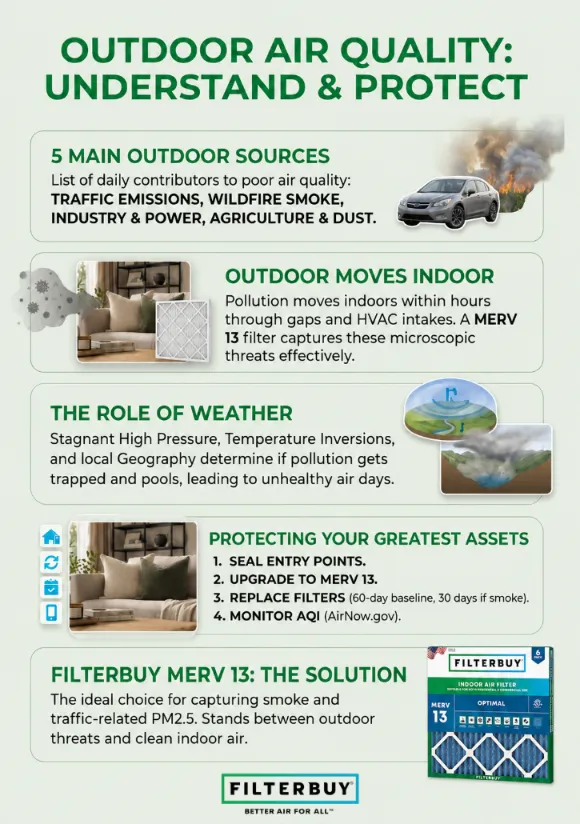
Traffic, wildfire and wood smoke, industry and power generation, agriculture and dust, and the weather patterns that hold all of it near the ground.
Fine particles (PM2.5), ground-level ozone, nitrogen dioxide, sulfur dioxide, carbon monoxide, and coarse particles (PM10).
Heat, sunlight, stagnant high-pressure systems, and temperature inversions trap pollution close to the ground instead of letting it disperse.
Yes. Pollutants enter through open windows, gaps around doors, and fresh-air intakes, so your indoor air often rises and falls with the outdoor reading.
Dense traffic, industry, and construction dust, often concentrated by tall buildings and basin terrain that limit how freely the air can move.
Keep windows closed, run a clean and well-rated air filter, and seal obvious gaps to slow how much outdoor pollution gets inside.
You know the sources now, and you know they do not stop at your front door. Take two minutes to look up your local air quality, then make sure the filter in your system is clean and rated to catch the fine particles that slip indoors. If you are not sure which filter fits your home, Filterbuy makes it easy to find the right size and rating so you can breathe easier on every kind of day.
