Shop by
July 21, 2026
Author: Michelle Wan | Reviewer: David Clark, Licensed HVAC Technician | Published: July 21, 2026 | Updated: July 21, 2026
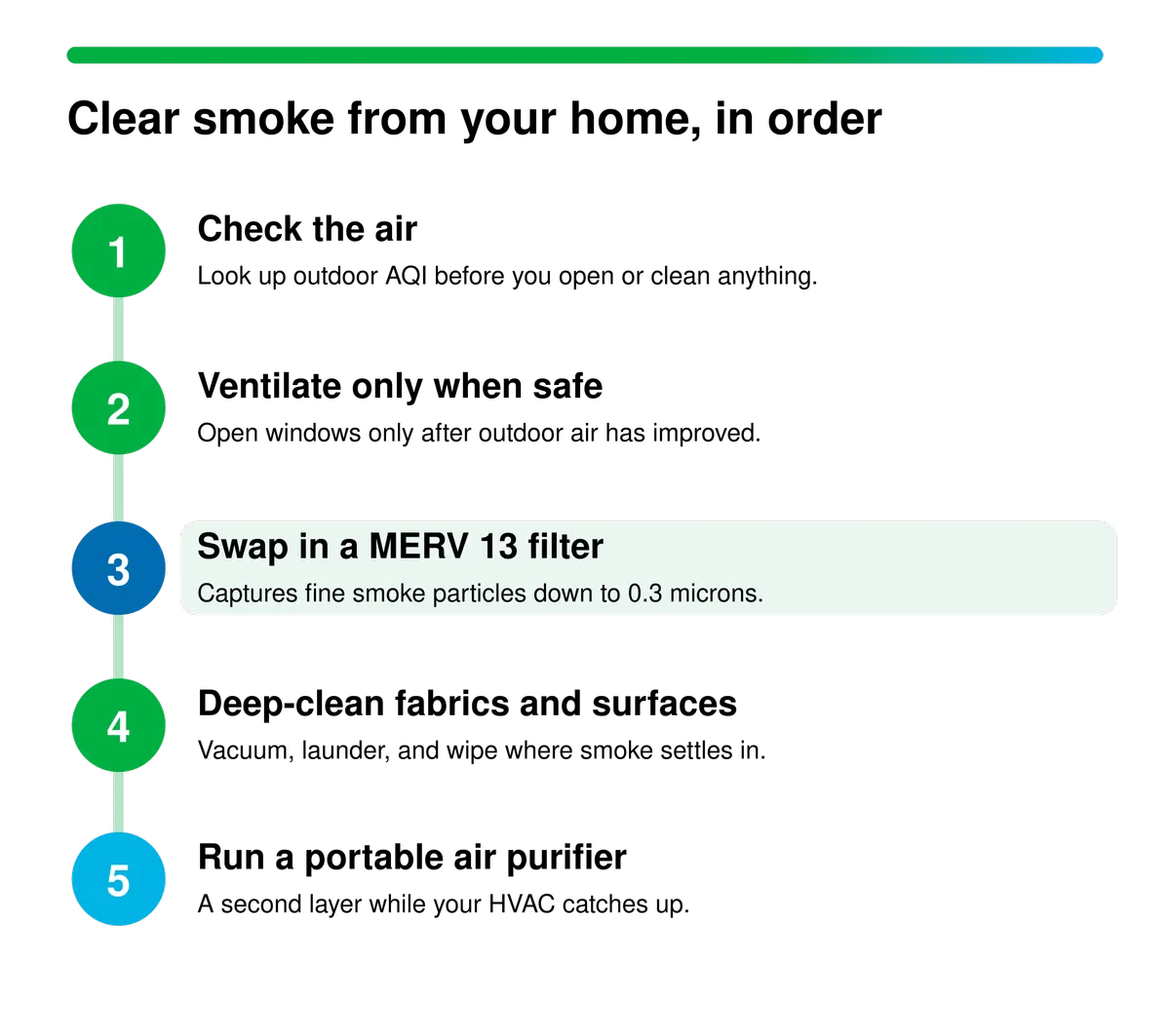
Clear smoke from your home by working in order: check outdoor air quality, ventilate only once it's safe, swap your HVAC filter for a MERV 13, deep-clean fabrics and surfaces, then run a portable air purifier while your system catches up.
Smoke odor lingers because fine particles settle into carpet, upholstery, and ductwork, not just the air. A MERV 13 filter captures those particles down to 0.3 microns, and it's the rating most home systems can run. Heavier exposure may still call for a professional duct cleaning.
Shop MERV 13 air filters at Filterbuy
Not sure which filter your system needs? Answer 3 quick questions and we'll match you to the right one.
Wildfire smoke doesn't leave when the sky clears. Fine particles keep working their way out of couch cushions, carpet fibers, and ductwork for days or weeks after the flames are out, which is why a house can still smell or feel smoky long after the air outside reads "good" on the AQI.
At Filterbuy, we've manufactured air filters in the U.S. since 2013 and shipped millions into homes across the wildfire-prone West, and we see the same pattern every fire season: people treat the smoke smell as the problem, when it's actually a symptom of unfinished cleanup. The steps below reflect what actually separates a fast recovery from a lingering one.
To clear smoke from your home's air, check outdoor air quality first, then ventilate only when it's safe, swap your HVAC filter for a MERV 13 or higher-rated filter, deep-clean fabrics and hard surfaces, and run a portable air purifier while your system catches up. Most homes see noticeable improvement within days; heavier exposure may need professional duct cleaning.
Smoke odor lingers because particulate matter as small as 0.3 microns embeds in fabric, drywall, and ductwork, not just the air you can see.
A MERV 13 filter is the residential benchmark most HVAC systems can safely run for wildfire smoke recovery.
Ventilating with open windows only helps once outdoor air quality has actually improved. Check before you open anything.
Fabrics and ductwork need their own cleaning pass; filtration alone won't clear a smoke smell that's settled into carpet or vents.
Recovery is a process, not a single afternoon. Plan on several days of extra filtration for moderate-to-heavy exposure.
Look up your zip code on AirNow.gov, the EPA's real-time air quality tracker, to see current outdoor conditions and whether your area is still under an active smoke advisory. If you have a PM2.5 monitor, check indoor readings too: that number tells you how much cleanup you're actually facing.
If outdoor air has genuinely improved, open windows and run exhaust fans briefly to flush out stale, smoke-tainted indoor air. If outdoor AQI is still poor, keep the house sealed and let filtration do the work instead. Getting this order backward is the most common mistake: cracking windows during a smoke event undoes every other step on this list.
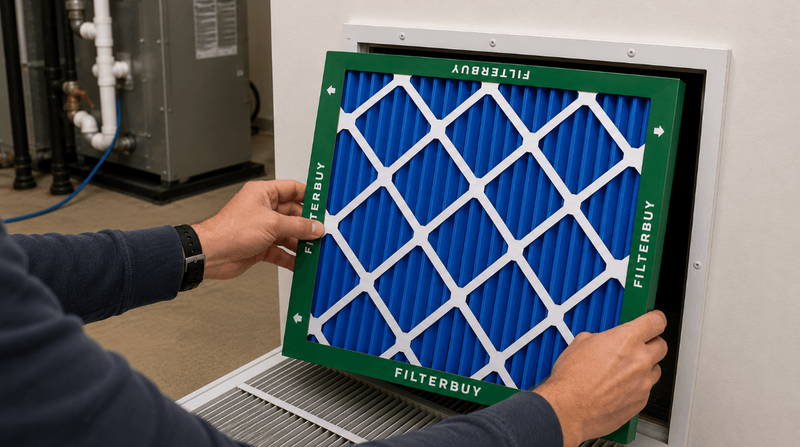
Standard fiberglass filters (MERV 1–4) barely slow down wildfire smoke; MERV 13 is the rating most home systems can run safely while capturing the fine particles that cause lingering odor and health irritation. Set the thermostat fan to "on" instead of "auto" so it filters continuously rather than only during heating or cooling cycles. Check your system's manual first, since not every blower motor is rated for MERV 13's added resistance. Filterbuy's MERV filter guide for wildfire smoke walks through how to check compatibility before you buy.
Every fire season, Filterbuy hears from two kinds of customers: people whose older system chokes on a MERV 13 it can't move air through, and people who install the right filter, then forget to check it until it's caked gray weeks later. Either mistake cancels out the upgrade.
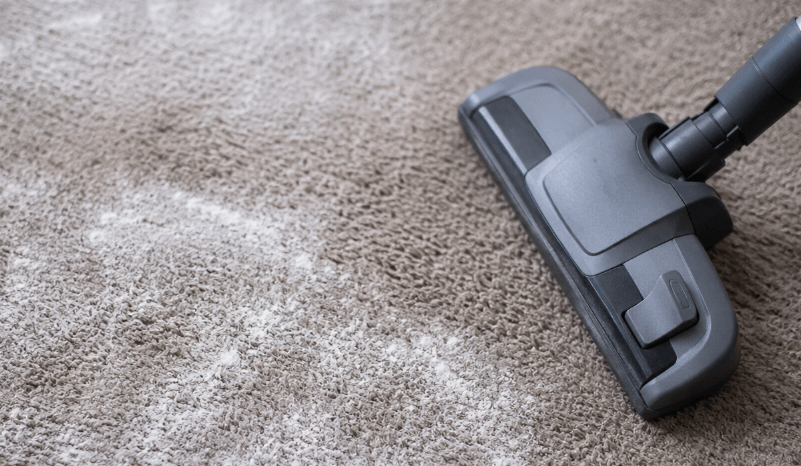
Smoke particles bury themselves in soft surfaces far more stubbornly than in air. Sprinkle baking soda over carpets, rugs, and upholstery, let it sit for several hours, then vacuum thoroughly with a HEPA-filter vacuum so you're not just redistributing the particles. Launder curtains, bedding, and washable throws; leave leather and delicate upholstery to a professional cleaner.
Soot and ash settle on more than just visible surfaces. Wipe walls, window sills, baseboards, cabinet interiors, and light fixtures with a mild detergent solution, wearing a mask while you clean since this step re-releases settled particles into the air. Don't skip vent covers and return grilles: they're a direct pathway back into your ductwork.
If smoke lingers after Steps 1–5, the ductwork itself may be holding residue that a filter swap alone can't reach. A professional duct cleaning removes that buildup, and it's worth having a technician inspect the system for damage at the same time. See the decision guide below for when this is actually worth it versus when it isn't.
A portable HEPA air purifier in your main living space or bedroom adds a second layer of filtration while your HVAC system works through the backlog of settled particles. Keep monitoring indoor air quality over the following week, and plan to replace the MERV 13 filter again once it's visibly loaded, since heavy smoke clogs filter media far faster than everyday dust. A pleated filter normally lasts 60 to 90 days; during a heavy smoke week we've seen the same filter turn visibly gray in under two weeks. Judge it by how it looks, not the calendar.
Most smoke cleanup is DIY-friendly, but a few signs mean it's worth paying for help:
Smell persists after Steps 1–5. Residue has likely reached ductwork or wall cavities that cleaning alone can't touch.
Exposure lasted more than 2–3 days, or you're near an active burn area. Heavier exposure means deeper particle penetration.
Anyone in the household has asthma, COPD, or heart disease. A faster professional cleanup outweighs DIY trial and error.
You see soot inside vents, or the smell seems to come from the HVAC system itself. That's a duct problem, not a filter problem.
Professional duct cleaning for a full system typically runs $450 to $1,000, per EPA guidance. Budget for it if any of the above apply.
Heavy exposure tracks slower. If smoke lingers past week two despite following every step, the ductwork, not the air, is likely the source.
"We've shipped filters into fire country for over a decade, and the pattern repeats every season: the households that clear smoke fastest aren't the ones with the highest-rated filter on paper. They're the ones who ran a MERV 13 their system could actually handle, replaced it on sight rather than on schedule, and didn't skip the ductwork check."
The Filterbuy Team
Reviewed for HVAC and filtration accuracy by David Clark, Licensed HVAC Technician.
A typical whole-home HVAC system moves an estimated 800–1,200 CFM of air through its filter in a 2,000-square-foot home, compared with roughly 200–400 CFM for a single portable air purifier, which is why the two work best paired together rather than as substitutes for each other. (Filterbuy)
Upgrading to a higher-efficiency HVAC filter and running the fan continuously can cut indoor PM2.5 levels by roughly half during a smoke event. (EPA)
A MERV 13 filter is tested down to particles as small as 0.3 microns, the size range that carries most wildfire smoke and drives lingering odor. (CDC)
The EPA's Clean Room guide shows how to seal off one room and run a portable air cleaner in it, giving you a reliable low-smoke space while the rest of the house catches up. This is especially useful for kids or anyone with asthma.
The EPA's DIY air cleaner research explains how to attach a MERV 13 filter to a box fan for a low-cost, tested backup when portable purifiers are sold out or too expensive.
The EPA's Guide to Air Cleaners in the Home includes a sizing chart matching room square footage to the minimum Clean Air Delivery Rate (CADR) you need, plus guidance on activated carbon filters for smoke odor.
Oklahoma State University Extension's odor removal guide breaks down which surfaces, fabrics, and HVAC components to clean, and how often to swap filters during the first year after exposure.
ServiceMaster Restore's smoke smell guide lays out the warning signs that DIY cleaning won't be enough, including soot buried deep in ductwork or upholstery.
The Montana DPHHS wildfire smoke checklist condenses the core cleanup actions into a one-page, printable format, an easy way to keep the whole household on the same page during a smoke event.
The EPA's Wildfires and Indoor Air Quality hub covers what to do before a smoke event, during one, and afterward for ash cleanup, all in one place. Worth bookmarking if smoke season recurs where you live.
Light smoke exposure with good filtration often clears in a few days. If smoke has settled into carpets, furniture, curtains, or ductwork, it can take one to two weeks of consistent filtration, cleaning, and ventilation after outdoor air quality improves.
Only after outdoor air quality has genuinely improved. Opening windows during an active smoke event brings more fine particles indoors and can undo the progress you have made cleaning the air.
Most modern residential HVAC systems can safely use a MERV 13 filter. However, some older systems or those with lower-powered blower motors may not handle the added airflow resistance, so check your owner's manual or consult an HVAC professional before upgrading.
A MERV 13 filter captures the fine smoke particles that affect indoor air quality, but it does not remove the gases responsible for smoke odor. If the smell remains after cleaning, an activated carbon air purifier or carbon filter can help reduce lingering odors.
Smoke may have entered your ductwork if you notice a smoky smell coming from the vents when the HVAC system runs, gray residue around supply or return vents, or a new filter becoming dirty unusually quickly after installation. These signs suggest smoke contamination inside the HVAC system rather than just the living space.
Don't wait for the next wildfire season to find out your filter isn't rated for it. Shop Filterbuy's MERV 13 air filters sized for your system, and keep a spare on hand before smoke season starts.
Shop MERV 13 Air FiltersMERV (Minimum Efficiency Reporting Value): A 1–16 rating scale for how well a filter captures particles; MERV 13 is the common benchmark for wildfire smoke.
HEPA (High-Efficiency Particulate Air) filter: Removes at least 99.97% of particles at 0.3 microns; used in portable air purifiers, not whole-home HVAC systems.
PM2.5: Particulate matter 2.5 microns or smaller: the fine fraction of smoke that penetrates deep into the lungs and drives most smoke-related health concerns.
AQI (Air Quality Index): A standardized scale for reporting current outdoor pollution levels, including wildfire smoke.
CFM (Cubic Feet per Minute): A measure of airflow, used to compare whole-home HVAC filtration to portable air purifiers.
Clean room: A single room sealed off from smoke, typically with a portable air cleaner, used to reduce exposure until whole-home cleanup is done.
