Shop by
July 17, 2026
Author: Michelle Wan, Brand Manager & Air Quality Writer | Reviewer: David Clark, Licensed HVAC Technician | Published / Updated: July 17, 2026
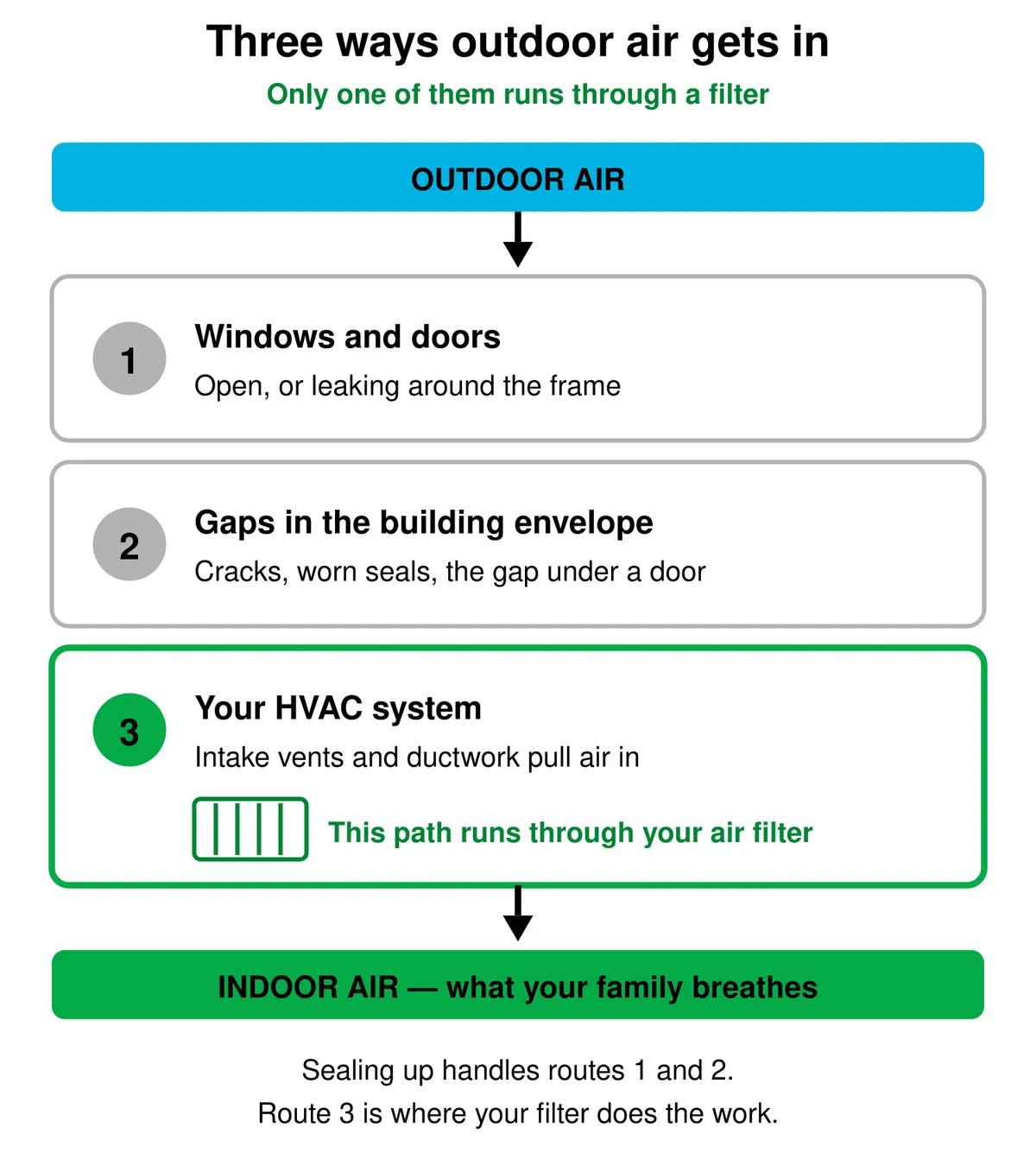
Outdoor air pollution enters your home three ways: around windows and doors, through gaps in the building envelope, and through your HVAC system. No house is sealed, so when the air outside gets dirty, the air inside follows.
Closing up and sealing gaps handles the first two. The third one runs through your air filter, and what that filter captures depends on its MERV rating. Answer a few quick questions below and we will match you to the right Filterbuy filter for your home.
Answer 3 quick questions and we will match you to your perfect filter.
Outdoor air pollution gets into your home through three pathways: infiltration through small gaps, natural ventilation through open windows and doors, and mechanical ventilation through HVAC vents and fans. Most homes are not airtight, so particle pollution, wildfire smoke, and pollen keep mixing with your indoor air even when everything looks closed up. Sealing obvious leaks reduces how much gets in, but a well-maintained filter is what keeps catching what still finds its way inside.
Outdoor air enters homes through infiltration, natural ventilation, and mechanical ventilation, per the EPA.
Most HVAC systems recirculate indoor air. Leaky envelopes and open doors do most of the work letting outdoor air inside.
Homes with closed windows still let in a meaningful share of outdoor PM2.5 during wildfire smoke events, varying by age, construction, and filtration.
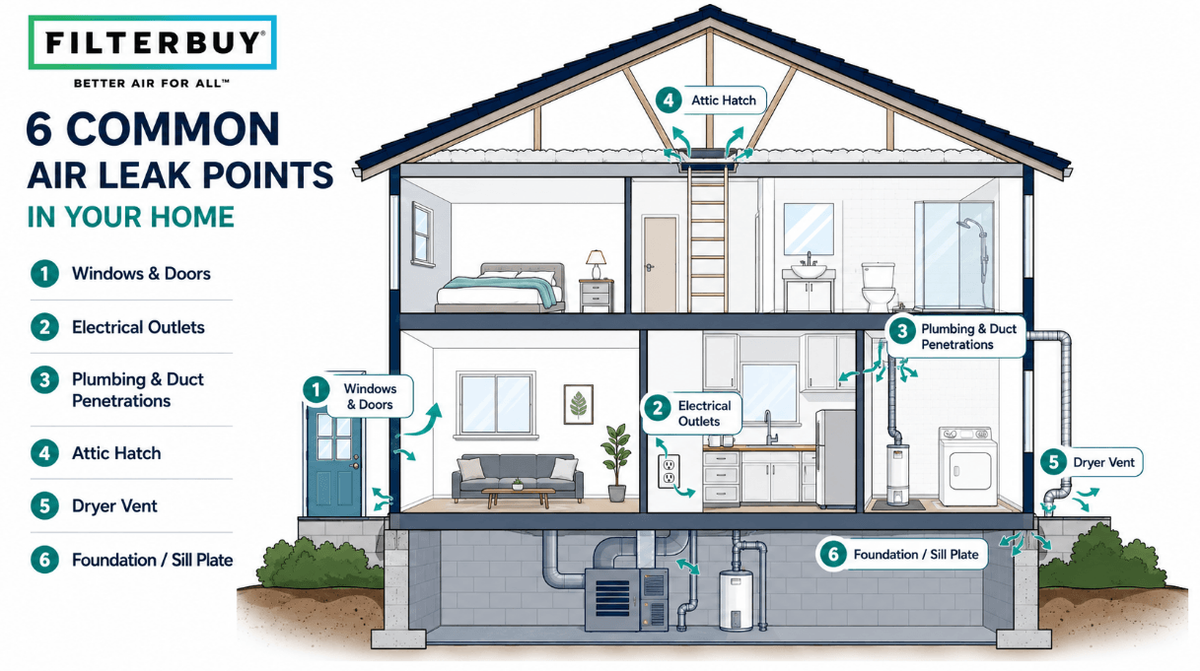
Common leak points include window and door frames, electrical outlets, duct penetrations, attic hatches, and dryer vents.
A MERV 13 or higher filter captures fine particles after they infiltrate, acting as your home’s last line of defense.
We’re Filterbuy, and this is the order of operations we recommend to homeowners:
Seal the leak points that let outdoor air in for free, starting with the cheapest fixes.
Filter what still gets through with a filter rated for the job and replaced on schedule.
Watch AQI and wildfire activity before smoke arrives, not after.
Outdoor air enters through three pathways, per the EPA, each carrying pollutants with it, which is why indoor air quality tracks so closely with what’s happening outside.
Infiltration is the slow, constant leak of air through gaps around window and door frames, material seams, and wiring or plumbing penetrations. Temperature differences and wind pressure drive it even when everything stays shut, so it runs around the clock and peaks in the coldest and hottest weeks, exactly when your HVAC system runs most.
Natural ventilation is the pathway you control directly. Opening a window or propping a door moves far more air per minute than infiltration, so an open window on a high-pollution day can undo much of your envelope’s protection.
Mechanical ventilation mostly recirculates indoor air. Exceptions: vented bathroom and kitchen fans, which pull replacement air in from outside, and any fresh air intake on your HVAC system, a direct pathway for pollutants into your ductwork.
U.S. Department of Energy guidance points to the same recurring leak locations in most homes.
Source: U.S. Department of Energy, Air Sealing Your Home
A certified contractor can also run a blower door test to pinpoint exactly where air is leaking.
Leaks more: built before 1980 (median owned U.S. home is 41 years old), sits on a windy lot, has never had an energy audit, or has a fireplace, older exhaust fans, or an unsealed attic hatch.
Already tight: built after 2000, has central air conditioning, which research found lets in less outdoor PM2.5, or has already been through a sealing project.
If the first list fits, start with sealing before filtration. If the second fits, a well-chosen filter is doing most of the remaining work.
Fine particulate matter, PM2.5, travels indoors most easily through all three pathways, coming from vehicle traffic, industrial activity, and increasingly, wildfire smoke. Research led by Aguilera and colleagues found PM2.5 from wildfire smoke affects respiratory health more than PM2.5 from other sources, which is why this guide treats it as a higher priority.
A wildfire event pushes outdoor PM2.5 far higher than normal, so every pathway matters more. A study of 1,400-plus California buildings found the indoor-to-outdoor PM2.5 ratio dropped from roughly 0.4 to 0.2 on fire days as people closed windows. Even so, indoor PM2.5 nearly tripled, and newer, better-sealed homes with air conditioning saw less infiltration than older ones.
AirNow recommends running a MERV 13 or higher filter during smoke events and closing any fresh air intake. Check Filterbuy’s live wildfire smoke map before smoke arrives so you can upgrade your filter ahead of the spike.
Sealing and filtering reduce day-to-day exposure, but they are not a substitute for official guidance during an active wildfire. Follow evacuation or air quality warnings from local authorities first.
For the AQI side of this story, see outdoor AQI affects your indoor air quality.
Whatever gets past your building envelope eventually cycles through your HVAC return air and across your filter, which is the point where you have the most control. A filter rated to capture fine particles, replaced on schedule, catches what sealing and ventilation could not stop. See choosing the right MERV rating for your home for MERV 8, 11, and 13 side by side.
Every number in this article was measured outside. We have spent a decade looking at the other half of it: what that air does once it is in someone's living room. You cannot control the first half. The second half is the part you actually own.
— David Heacock, Founder and CEO, Filterbuy
Source: AirNow.gov, Be Smoke Ready
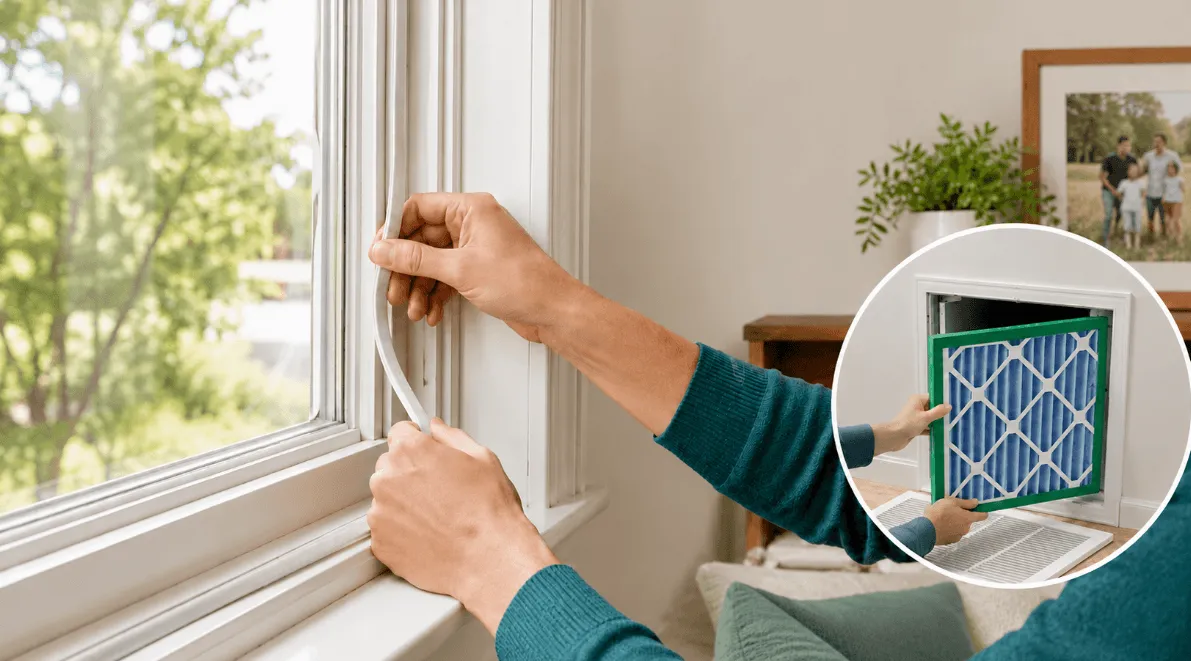
Caulk stationary gaps around frames, and weatherstrip parts that move.
Upgrade to MERV 13 or higher during smoke events or high-AQI days, and confirm your system can handle the added airflow resistance. See matching your MERV rating to today’s AQI. Filterbuy carries MERV 8, 11, and 13 in more than 600 sizes.
Replace your filter on a consistent schedule. A clogged filter loses capture ability. See the seasonal filter replacement schedule.
Close any fresh air intake during smoke events and set your system to recirculate.
Set up a clean room: the CDC recommends a closed-off room with a portable air cleaner running inside.
Use bathroom and kitchen exhaust fans only as needed, since each pulls in outside air while running.
Filterbuy ships USA-made pleated filters directly to your door.
The EPA breaks down how outdoor air enters a home through infiltration, natural ventilation, and mechanical ventilation. EPA: How Does Outdoor Air Enter a Building?
The U.S. Department of Energy maps the most common leak points with step-by-step sealing guidance. DOE: Air Sealing Your Home
ENERGY STAR’s guidance helps prioritize which sealing projects to tackle first. ENERGY STAR: Seal and Insulate
Aguilera and colleagues found wildfire-smoke PM2.5 affects respiratory health more than PM2.5 from other sources. Aguilera et al., 2021, Nature Communications
A PNAS study of 1,400-plus California buildings measured how much wildfire PM2.5 reaches indoor air with windows closed. PNAS: Wildfire Smoke Impacts on Indoor Air Quality
AirNow walks through setting up a clean air room and choosing a MERV 13 or higher filter before smoke arrives. AirNow: Be Smoke Ready
The CDC outlines how to set up a clean room and protect vulnerable household members during a smoke event. CDC: Safety Guidelines for Wildfires and Wildfire Smoke
The median owned U.S. home is 41 years old, and pre-1950 homes still make up about 17% of the housing stock, exactly where leak points tend to accumulate.
Source: U.S. Census Bureau: Cost of Improving and Maintaining Older Homes
44% of Americans, or 152.3 million people, live in counties with a failing grade for ozone or particle pollution, which is why sealing and filtering both matter nationwide.
Source: American Lung Association: State of the Air, Key Findings
Wildfires have burned more than 3.6 million acres nationwide as of mid-July 2026, adding PM2.5 that infiltration pathways carry straight into homes.
Source: National Interagency Fire Center: Statistics
Infiltration: Continuous, unintentional movement of outdoor air through small gaps and cracks.
PM2.5: Fine particulate matter 2.5 micrometers or smaller, small enough to travel deep into the lungs.
MERV Rating: Minimum Efficiency Reporting Value, a scale rating how well an HVAC filter captures airborne particles.
Building Envelope: The physical barrier between a home’s interior and the outdoors.
Blower Door Test: A test using a calibrated fan to pressurize a home and reveal the location of air leaks.
