Shop by
July 21, 2026
Author: Michelle Wan | Reviewer: David Clark, Licensed HVAC Technician | Published: July 20, 2026 | Updated: July 20, 2026
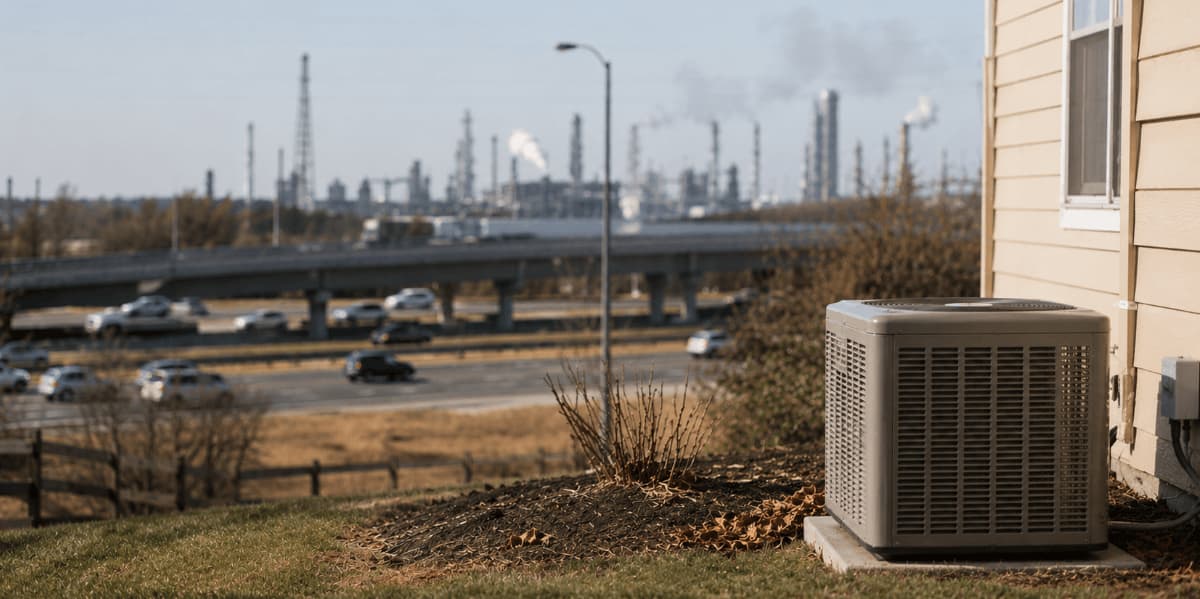
If your home sits near a highway, rail yard, port, or industrial zone, a MERV 11 to MERV 13 filter is the right match for the particulates you breathe year-round. Step up to MERV 13 when more than one source overlaps, or when someone in the home is health-sensitive. This kind of exposure doesn't clear when the daily AQI looks fine, so it calls for a permanent step up rather than a temporary one. Just confirm your HVAC system can handle the higher rating first.
Not sure which tier fits your address? Take the quick match quiz below.
Answer 3 quick questions and we'll match you to your perfect filter.
Prefer to browse first? Shop all air filters at Filterbuy.
Homes near highways, rail yards, ports, or industrial zones face constant elevated particulate exposure, not just occasional bad-air days. For most of these homes, a MERV 11 to MERV 13 filter gives the best balance of protection and airflow, with MERV 13 recommended when pollution sources overlap or a household member has respiratory sensitivities. Confirm your HVAC system can handle the higher rating before upgrading.
Living near a highway, rail yard, port, or industrial facility means your home's outdoor air is elevated year-round, not just during smoke events or high-AQI days. A MERV 11 to MERV 13 filter matches most of these homes, with MERV 13 best for overlapping sources or health-sensitive households. Check your HVAC system's maximum compatible MERV rating first, and plan to replace filters on a shorter, fixed schedule than a typical home.
The EPA estimates more than 45 million people in the US live within 300 feet of a major highway, rail yard, port, or industrial facility with elevated air pollutant levels.
Traffic pollutant concentrations typically fall off within roughly 150 to 300 meters of a roadway, though effects can extend farther depending on wind and terrain.
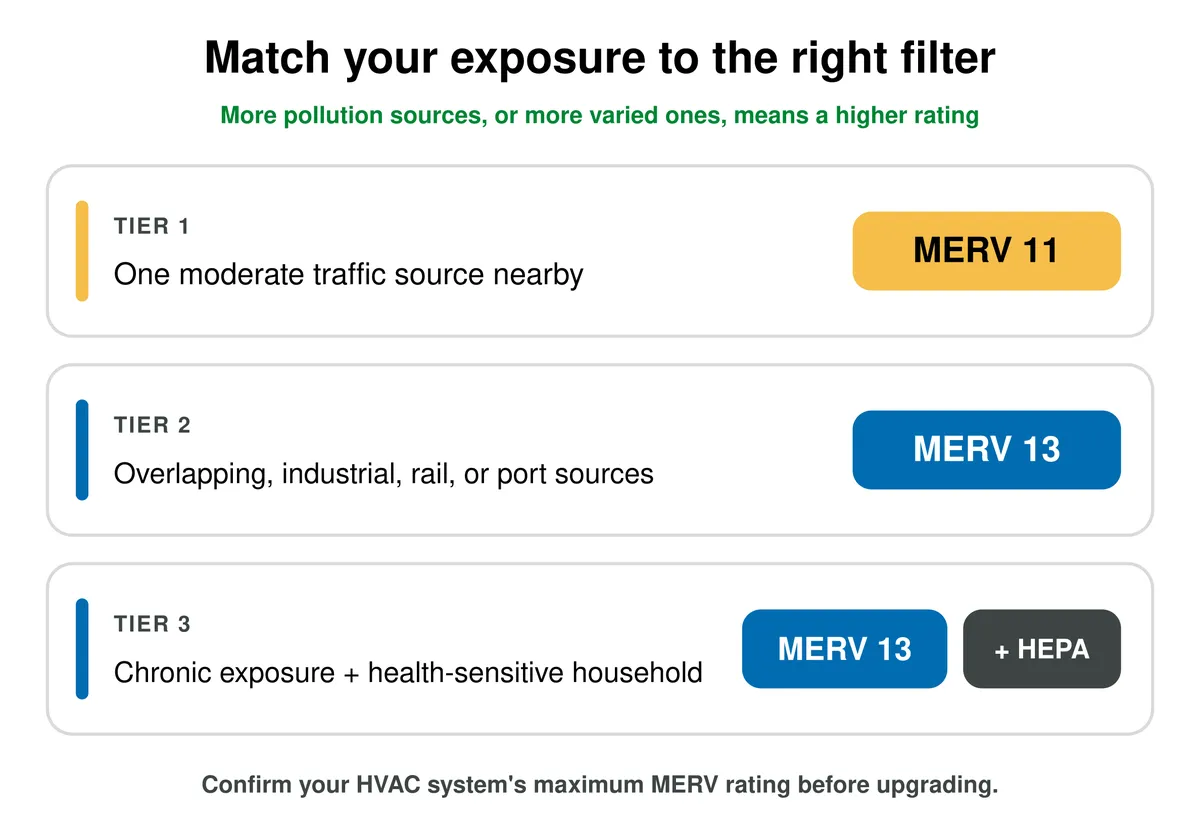
MERV 11 handles moderate, single-source exposure. MERV 13 is better suited to overlapping sources or health-sensitive households.
MERV 13 is the practical ceiling for most residential HVAC systems. Confirm compatibility before upgrading.
Homes in chronic high-pollution zones should replace filters on a fixed, shortened cycle rather than waiting for a visible air-quality event.
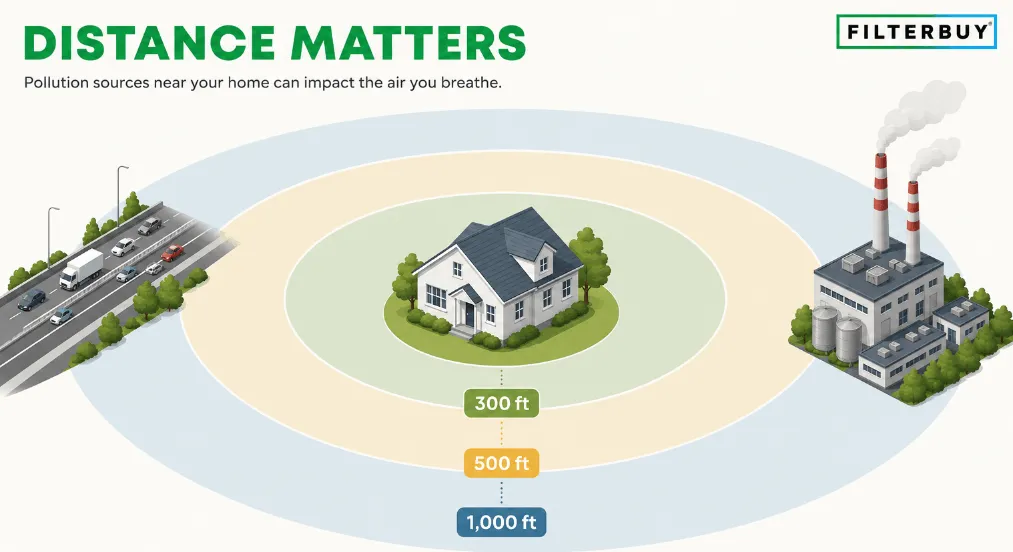
Homes within roughly 300 to over 1,000 feet of a major highway, rail yard, port, or industrial facility face measurably elevated particulate exposure. Unlike a wildfire smoke event or a single bad-AQI day, this exposure doesn't go away when the forecast improves. It's a fixed feature of where the home sits.
The EPA reports that more than 45 million people in the United States live within 300 feet of a major highway, rail yard, port, or similar facility, a group at meaningfully higher risk for reduced lung function, asthma, and cardiovascular effects. A CDC analysis found that traffic emissions typically taper off within about 150 to 300 meters of a roadway, though the exact distance depends on wind patterns, terrain, and traffic volume. Washington's Department of Health similarly estimates that about 1 in 7 residents, roughly 900,000 people, live within a quarter mile of heavy-traffic roadways and breathe measurably more vehicle exhaust as a result. The American Lung Association advises against opening windows if you live close to busy highways, ports, airports, or factories with high emissions, since outdoor pollution can enter faster than it clears.
Distance-to-source pollution guide
Ranges are approximate and vary with wind patterns, terrain, and traffic or facility volume.
If your home sits within these ranges of more than one source, treat your exposure as compounding rather than additive. The Asthma and Allergy Foundation of America lists people who live near busy roadways, power plants, and industrial facilities among the groups most at risk from air pollution, alongside children, older adults, and people with existing respiratory conditions.
Sources worth checking for beyond the obvious highway:
Rail switching yards, where trains idle and combine cars, tend to concentrate more diesel exhaust than a straight rail line trains simply pass through.
Distribution and logistics warehouses, where truck idling at loading docks is a steady, year-round source rather than a rush-hour spike.
Waste transfer or recycling facilities, which combine vehicle traffic with dust and processing emissions.
Small regional airports, where propeller and helicopter traffic can affect nearby homes even without commercial flight paths overhead.
You don't need a specialized tool to self-diagnose your exposure tier. A few minutes with tools you already have will tell you more than a general "near a highway" guess.
Open a map app and measure the straight-line distance from your home to the nearest freeway, rail line, port, or industrial facility. Most map apps show distance when you tap two points.
Check your city or county's online GIS or zoning map (most local governments publish one free) to see if your parcel sits in or near an industrial or heavy-commercial zone.
Note whether you're downwind of the source for most of the year. A source 800 feet upwind matters less than one 1,200 feet downwind.
If more than one source applies, treat your home as Tier 2 or Tier 3 even if no single source alone would push you there.
This isn't a substitute for the distance research cited above. It's a way to apply that research to your specific address in the next five minutes.
A three-tier framework matches the filter to the exposure level rather than defaulting everyone to the highest available rating.
Always confirm your HVAC system's maximum compatible MERV rating before upgrading.
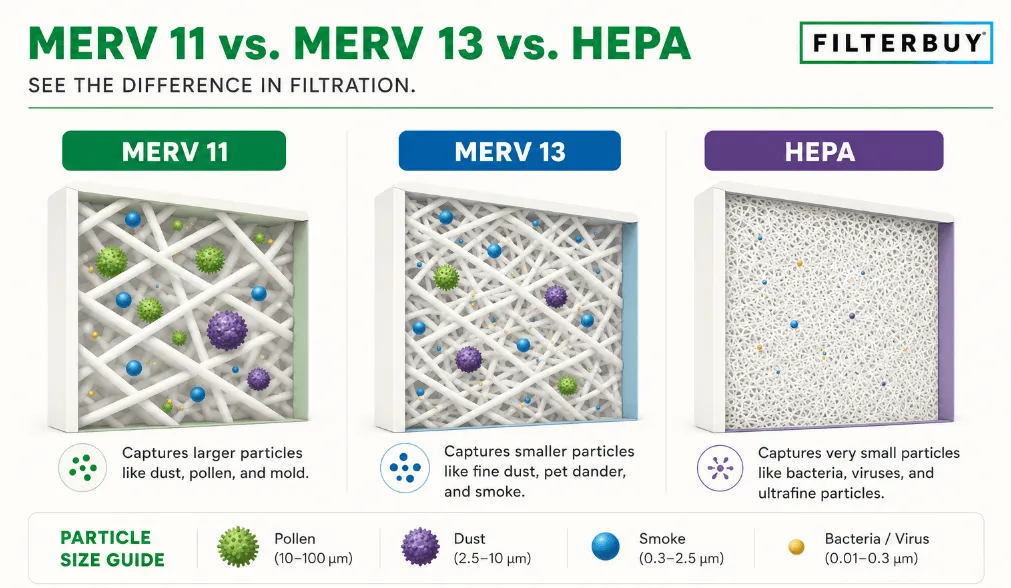
MERV 13 filters capture particles down to about 0.3 microns, covering most combustion byproducts, fine dust, and smoke particles common near traffic and industrial sources. MERV 11 captures a narrower range but still handles the bulk of everyday particulate load in a Tier 1 home. Filterbuy manufactures its pleated MERV 8 through MERV 13 filters domestically in Talladega, Alabama, and makes custom sizing available for HVAC systems that don't match a standard replacement filter size, which matters for the older housing stock common near industrial corridors. The Health Effects Institute's large-scale literature review of traffic-related air pollution's emissions, exposure, and health effects supports stepping up filtration specifically for homes near overlapping or industrial-grade sources. For a foundational primer before deciding, see the full guide to choosing a MERV rating.
MERV 13 filters treat the whole home through the HVAC system. Portable HEPA units treat a single room more intensively.
MERV 13 is not the same as true HEPA. A MERV 13 filter treats your whole home through the HVAC system. A portable HEPA unit treats a single room more intensively. In a Tier 3 home, the two work together rather than substituting for each other. Filterbuy's MERV 13 filters are pleated and electrostatically charged to capture 98 percent of airborne particles as small as 0.3 microns, without unnecessarily restricting airflow. Ready to upgrade? Shop MERV 13 filters sized for your system.
A higher MERV rating restricts airflow more than a lower one, and running that restriction permanently, rather than for a two-week smoke event, changes the math on system strain. Most modern residential systems handle MERV 13 without issue, but some older or lower-capacity systems are only rated for MERV 11 or below.
Before upgrading, check your system's manual for its maximum recommended MERV rating. If the manual isn't available, start with MERV 8 and monitor the system for 30 days. A few warning signs suggest the rating is too high for your system: an energy bill that rises more than 15 percent after switching filters, rooms that feel stuffier than before, an AC or furnace that runs constantly, or a filter that gets dirty much faster than expected. In a chronic high-pollution home, these signs carry more weight than in a typical home, since a higher-MERV filter stays in place year-round rather than for a short smoke event.
A chronic high-pollution home clogs filters faster than a typical home, even without a visible smoke event or AQI spike. A fixed, shortened replacement cycle works better here than waiting for a reason to check the filter. The Los Angeles County Department of Public Health recommends installing MERV 13 filters and replacing them quarterly in housing built near freeways, a cadence that lines up well with chronic-exposure homes generally.
Tier 1 homes: replace every 60 days instead of the standard 90.
Tier 2 and Tier 3 homes: replace every 30 to 45 days, and inspect monthly between changes.
After any unusually heavy traffic, construction, or industrial activity nearby, inspect the filter regardless of schedule.
This differs from the shorter, event-driven cadence used for wildfire smoke spikes matched to today's AQI. A chronic-exposure home needs a permanent shift in its baseline schedule, not just a temporary one during bad-air events. For a chronic high-pollution home, Filterbuy's auto-delivery subscription can help. A fresh filter arrives on the shortened schedule this kind of home needs, without relying on memory to reorder.
Renters and multi-family residents can't always swap their own filter, but you still have real options.
Ask your property manager what MERV rating the building's HVAC system currently uses. Many older multi-family buildings run MERV 4 to 8 fiberglass filters, well below what this guide recommends for a high-pollution address.
Cite the same precedent used earlier on this page: Los Angeles County's public health department recommends MERV 13 filters for new housing built near freeways. That's a reasonable ask, not an unusual one, for a building in a comparable location.
If the building's filter can't be changed, a portable HEPA unit in the bedroom is the most realistic controllable step. It won't filter the whole unit, but it treats the room where you spend the most hours.
If your building allows resident-supplied filters, Filterbuy ships custom sizes for older or nonstandard HVAC units, which are common in older multi-family buildings near freeways and industrial zones.
Not sure which size and MERV rating fits your system? Answer three quick questions and Filterbuy will match you to the right filter for your exposure tier and HVAC system.
"After manufacturing filters for over a decade and serving more than two million households, we've seen how much of a difference the right MERV rating makes for homes near constant pollution sources."
David Heacock, Founder and CEO of Filterbuy
See Exactly How Close Is Too Close To A Highway, Rail Yard, Or Port
The EPA's near-source research explains why living within 300 feet of major transportation and industrial infrastructure raises health risks, and it covers highways, rail yards, ports, and industrial facilities in one place.
Find Out How Far Traffic Pollution Actually Travels
This CDC report measures how far vehicle emissions extend from a roadway before leveling off, giving a concrete distance to check against your own address.
See How Many Of Your Neighbors Are Breathing The Same Air
Washington's Department of Health tracks how many residents live close enough to heavy traffic to see measurable health effects, and it recommends HVAC filter upgrades as a direct response.
Learn When Opening Your Windows Does More Harm Than Good
The American Lung Association explains why ventilating with fresh air backfires for homes near highways, ports, airports, or factories, and what to do instead.
Understand The Health Risks Behind The Distance Numbers
This peer-reviewed review connects near-highway exposure to specific cardiac and respiratory health outcomes, explaining why the distance thresholds matter beyond simple discomfort.
Decode The Air Quality Index Before You Rely On It
AirNow's official breakdown of the 0 to 500 AQI scale clarifies what each color and number means, and why a good daily reading doesn't cancel out chronic local pollution.
Check Whether Your Household Is In A Higher-Risk Group
The Asthma and Allergy Foundation of America lists exactly who faces the greatest risk from air pollution, including households near busy roadways, power plants, and industrial facilities.
Regulators Recommend A 500 To 1,000-Foot Buffer From Freeways
California's CARB recommends a minimum 500-foot buffer between freeways and new housing or schools.
CARB extends that caution to 1,000 feet. Research shows unsafe pollutant levels can persist at greater distances.
LA County's building guidance calls for MERV 13 filters (or higher) on HVAC systems near freeways.
That guidance recommends replacing those filters quarterly.
More Than 1 In 10 California Students Attend School Near Heavy Traffic
Over 10 percent of California public school students attend schools within 150 meters of high- or medium-traffic roads.
Exposure is disproportionately higher among low-income and minority student populations.
353 Peer-Reviewed Studies Support Stronger Filtration Near Traffic
An independent expert panel reviewed 353 published scientific reports on traffic pollution and health effects.
The studies span 1980 to 2019.
It is the largest review of its kind to date.
Yes. Daily AQI reflects regional air quality rather than conditions immediately surrounding your home. Ongoing pollution from nearby roads, factories, or other local sources can continue loading your HVAC filter even when the AQI reports healthy conditions.
Not always. Many modern HVAC systems can safely use a MERV 13 filter, but some older or lower-capacity systems may not be designed for the additional airflow resistance. Check your owner's manual or consult an HVAC professional before upgrading.
A portable HEPA air purifier is a worthwhile addition for bedrooms or other frequently occupied spaces, especially in homes with higher pollution exposure or residents with asthma, allergies, or other respiratory conditions. It complements—but does not replace—whole-home HVAC filtration.
MERV 13 is generally the best choice because industrial facilities and rail yards produce higher and more varied concentrations of fine particles than typical roadway traffic. Stronger filtration helps capture more of these pollutants before they circulate throughout your home.
MERV Rating: Minimum Efficiency Reporting Value, ASHRAE's 1 to 16 scale measuring how effectively an HVAC filter captures airborne particles.
PM2.5: Fine particulate matter measuring 2.5 microns or smaller, an EPA-regulated air pollutant common in vehicle exhaust and industrial emissions.
Near-Road Pollution: Elevated pollutant concentrations found within about 200 meters of highways in epidemiologic research, and up to 1,000 feet or more depending on the study and conditions.
MERV 13: A pleated filter rating that captures particles down to about 0.3 microns, commonly recommended for homes with elevated outdoor pollution.
HEPA: High-Efficiency Particulate Air filter, capturing 99.97 percent of particles at 0.3 microns. Distinct from and more intensive than MERV 13 filtration, typically used in portable units rather than whole-home systems.
AQI: The EPA's Air Quality Index, a 0 to 500 scale reporting daily outdoor air conditions.
