Shop by
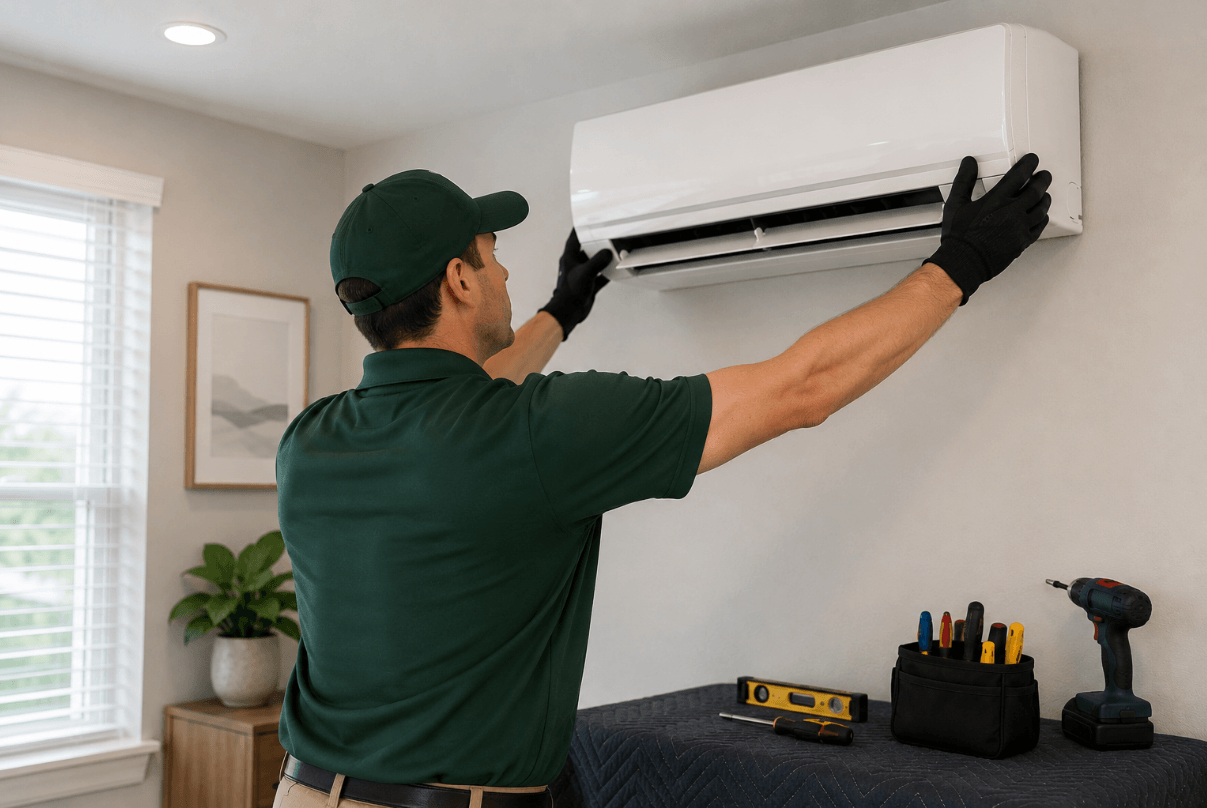
Process, Cost & DIY vs. Pro Guide
We get a version of the same call every spring. Someone bought a mini split online, watched a couple of install videos, and now there is a three-inch hole in the wall and a line set that will not seat right. It usually works out because a ductless mini split is a simpler machine than the central system it replaces.
It comes down to three parts: a short list of connections, and one honest dividing line between what a careful homeowner can handle and what a pro should take. Get that line right, and you save real money. Get it wrong, and you can void a warranty or soak a wall. We make the filters that live behind these units, so we will also cover the one setup step most install guides skip, the part that quietly decides how your system breathes three years from now.
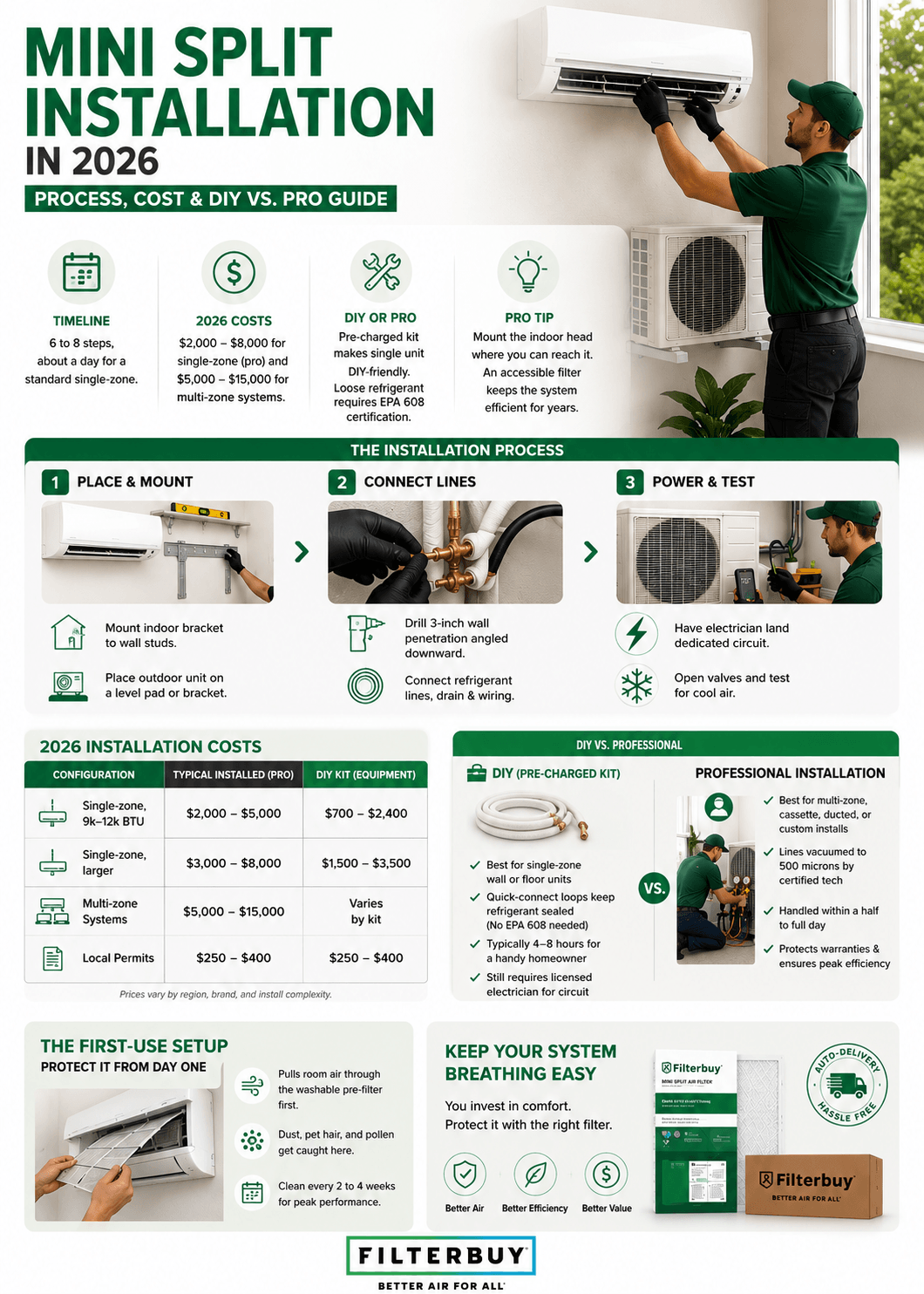
Installing a mini split in 2026 means mounting the indoor head, setting the outdoor condenser, and connecting the refrigerant line set, drain, and wiring between them, then wiring a dedicated circuit and testing for cold air. A single-zone system runs about $2,000 to $8,000 installed by a pro, or $700 to $3,500 as a DIY kit with a pre-charged line set.
The process: 6 to 8 steps, about a day for a single-zone unit.
2026 cost: roughly $2,000 to $8,000 for single-zone (pro) and $5,000 to $15,000 for multi-zone.
DIY or pro: a pre-charged quick-connect kit makes a single wall or floor unit DIY-friendly. Opening a refrigerant line needs EPA Section 608 certification, and most homeowners still hire an electrician for the circuit.
What we'd add: mount the head where you can actually reach it. The filter you can clean in two minutes is what keeps the system efficient years later.
A single-zone mini split usually goes in within a day. Multi-zone, ceiling cassette, and ducted jobs take longer and need a pro.
In 2026, plan on about $2,000 to $8,000 for a single zone and $5,000 to $15,000 for multi-zone, set by zone count, BTU, and how hard the labor turns out to be.
DIY works only with a pre-charged quick-connect kit on a wall or floor unit. Touch loose refrigerant, and you need EPA Section 608 certification.
Budget for a licensed electrician to land the dedicated circuit and disconnect, even on a DIY install.
The filter you run on day one shapes how the system performs at year three. Rinse the washable pre-filter every two to four weeks in heavy-use season.
Every ductless mini split breaks down to three pieces, whether it is a single bedroom head or a six-zone whole-home setup. The outdoor condenser sits outside on a pad or a wall bracket. The indoor head mounts on a wall, ceiling, or floor. A line set carries the refrigerant, a small drain clears condensate, and low-voltage wiring ties the two units together. Getting cold air into the room mostly comes down to joining those pieces in the right order and sealing them well.
Here is how a standard single-zone install goes, start to finish.
Run a load calculation and pick your spots. Size the unit to the room, then place the indoor head and outdoor condenser to keep the line set run short and straight.
Mount the indoor bracket and head. Your installer screws a metal bracket into the wall studs, usually 6 to 12 inches below the ceiling, then clips the head onto it.
Drill the wall penetration. One three-inch hole carries the line set, drain, and wiring through the wall. Angle it slightly down toward the outside so condensate drains away from the house, not back into the wall cavity.
Set the outdoor condenser. Place it level on a composite pad or wall bracket, with room around it for airflow and service.
Run and connect the line set, drain, and wiring. Route everything through the wall sleeve, then join the refrigerant lines, the condensate line, and the low-voltage control wiring between the units.
Handle the refrigerant the right way. On a standard line set, a certified tech pulls the lines down to 500 microns to clear out air and moisture before releasing the charge. On a pre-charged quick-connect kit, you torque the factory fittings to spec and the refrigerant never leaves the loop.
Land the electrical. Connect the dedicated circuit and the outdoor disconnect. Most homeowners hand this step to a licensed electrician, and for good reason.
Open the valves, power up, and test. Crack the service valves, restore power, set the unit to cool, and check for cold air at the head within a few minutes while the outdoor fan and compressor run smoothly.
Strip away the parts and a mini split runs the same refrigeration cycle behind any air conditioning system, moving heat out of the room instead of making cold from scratch. Where the indoor head ends up matters more than most people expect, and it drives comfort as much as the BTU rating does. Our guide to mini split mounting options compares wall, ceiling, floor, and concealed-duct styles so you can match the unit to the room before anyone picks up a drill.
Two numbers drive every mini split quote. The equipment cost tracks BTU capacity, brand, and SEER2 efficiency rating. Labor tracks how hard your specific job is, which means line set length, mount height, the shape your electrical panel is in, and local rates. A clean single-zone install in a first-floor room with an easy panel sits at the low end. A second-story head with a long line run and a panel upgrade climbs fast.
Here is what installed pricing looks like in 2026, based on current ranges reported across multiple industry cost sources.
| Configuration | Typical Installed (Pro) | DIY Kit (Equipment) |
|---|---|---|
| Single-zone, 9k–12k BTU | $2,000 – $5,000 | $700 – $2,400 |
| Single-zone, larger or high-SEER2 | $3,000 – $8,000 | $1,500 – $3,500 |
| Multi-zone | $5,000 – $15,000 | Varies by kit |
| Permit, where required | $250 – $400 | $250 – $400 |
A few choices push that total in your favor. Buy the unit yourself instead of through the installer and you sidestep a markup that often runs 10 to 15 percent. Stick with a wall-mounted head and you keep labor down, since cassettes and ducted units add ceiling work and usually a condensate pump. Cool only the rooms you actually use, rather than oversizing for the whole house, and both the equipment cost and the monthly bill stay in check.
One caution on incentives. The federal tax credit that once helped cover a qualifying heat pump install ended on December 31, 2025, so build your budget without it. Check your state energy office and local utility for current rebates, and confirm you qualify before you buy rather than after.
The honest version of this decision comes down to one question. Will you ever open a refrigerant line? If the answer is no, because you are using a pre-charged quick-connect kit, a handy homeowner can take on a single wall or floor unit. If the answer is yes, the job belongs to a technician with EPA Section 608 certification, full stop. Venting refrigerant is illegal, and an undercharged or contaminated system fails early.
| Factor | DIY (Pre-Charged Kit) | Professional |
|---|---|---|
| Best fit | Single-zone wall or floor unit, standard line length | Multi-zone, cassette, ducted, long or custom runs |
| Refrigerant | Pre-charged quick-connect, no EPA 608 needed | Standard line set vacuumed to 500 microns by a certified tech |
| Electrical | Usually still needs a licensed electrician | Handled within the install |
| Time | 4 to 8 hours | Half to full day |
| Warranty | Confirm your brand allows DIY before buying | Full warranty typically intact |
So here is the practical call. If you are comfortable with a drill, a level, and a wrench, you are installing one wall unit with a quick-connect kit, and you have an electrician lined up for the circuit, a DIY install is a reasonable weekend project that saves real money. The moment the job involves multiple zones, a recessed ceiling cassette, brazed connections, or any loose refrigerant, get two or three quotes and let a pro carry it. The savings almost never cover the cost of a voided warranty or a wet wall cavity.
Most install guides wrap up the second cold air hits the room. That is the exact moment we start paying attention. Every mini split head pulls your room's air through a washable pre-filter before it ever reaches the coil, so the dust, pet hair, and pollen you cannot see all land there first. The habits you set in week one decide how that system performs years down the line.
Start clean. If your unit sat in a warehouse or a garage before install, flip the front face open, rinse the pre-filter under cool water, and let it dry fully before the first run. Then set a rhythm you will actually keep. Through heavy cooling or heating season, rinse that pre-filter every two to four weeks. If your model runs a secondary filter media behind the pre-filter, swap it on the manufacturer's schedule, often every three to six months.
We see the same pattern in the field over and over. The mini-splits that struggle by year three are almost always the ones nobody could reach to clean. A head you can flip open in two minutes stays clean. A cassette that needs a step ladder gets forgotten by July. So as you plan the install, pick a spot and a mounting style you will keep up with, then put the cleaning dates on the calendar before the new-system feeling wears off.
"After manufacturing filters for over a decade and serving more than two million households, we tend to look at a new mini split the way the air does, already thinking about the filter behind the grille before the unit is even on the wall. That filter is the difference between a system running quietly at year five and one working twice as hard to push air through clogged media."
- Filterbuy Team
You are the one who has to live with this system for the next fifteen years, so a few minutes with the right sources pays off before anyone drills a hole in your wall. We work with mini-splits and the filters behind them every day, and these are the seven places we point homeowners who want to get it right the first time.
Before you compare brands, get comfortable with what the system does and why sizing it to the room beats chasing the biggest unit on the shelf. The Department of Energy lays it out without the jargon, which is exactly where we'd start you off.
Source: U.S. Department of Energy, Ductless Mini-Split Air Conditioners
A mini split that sips power in spring can still sting you in August if the rating is wrong for your home. ENERGY STAR puts SEER2 and HSPF2 in terms you can use and points you to certified models through its Product Finder.
Source: ENERGY STAR Ductless Heating and Cooling
We are a little obsessed with proving what equipment actually delivers, and you can be too. The AHRI directory confirms the rated performance of a specific indoor and outdoor pairing, so the efficiency you were promised is the efficiency you bring home.
Source: AHRI Certified Product Directory
Plenty of a mini split install is fair game for a confident homeowner, right up to the moment refrigerant gets involved. EPA Section 608 spells out what you can legally handle yourself and what belongs to a certified technician, so you stay on the right side of it.
Source: EPA Section 608 Technician Certification
If you would rather hand off the job, you want an installer who works to standard and stands behind it. ACCA's locator searches by ZIP for a nationally recognized contractor, so you can choose on quality and follow-through rather than the lowest quote.
Source: ACCA Find a Qualified HVAC Contractor
The federal heat pump credit ended after 2025, but state, local, and utility incentives are still out there, and most homeowners never go looking. DSIRE maps what is available where you live so you do not leave money on the table.
Source: DSIRE Database of State Incentives for Renewables and Efficiency
A surprise at inspection can stall an otherwise clean install for weeks. ICC Digital Codes shows the mechanical and electrical requirements your local building department checks, so you can line everything up before the inspector pulls into the driveway.
Source: International Code Council Digital Codes
Three figures we trust, and what each one looks like from the field.
Mini splits fill the gap central air left behind.
We see it firsthand: the calls come from additions, older houses with no ducts, and converted attics.
The data: 88% of U.S. homes use AC, but only about two-thirds have central systems. The rest run window, wall, mini-split, or portable units.
Professional labor is the real cost driver.
Homeowners tell us: when a quote feels steep, the labor line is usually why.
The data: HVAC installers earned a median $59,810 in May 2024. Employment is projected to grow 8% through 2034, much faster than average.
The takeaway: a DIY kit can pay off on a simple single-zone job. Refrigerant and panel work are worth a trained hand.
Source: U.S. Bureau of Labor Statistics, Occupational Outlook Handbook
Ductless and heat-pump systems keep gaining ground.
We see it in our own orders: more ductless and heat-pump filter sizes move every year.
The data: heat pump use in new single-family homes roughly doubled since 2000, from about 23% to around 45% by 2022.
A few years alongside these systems has taught us the install is rarely the hard part. Here is where it nets out.
The install is simple. The process is short and the costs are knowable.
The one real fork is refrigerant. Whether you ever open a refrigerant line decides DIY versus pro.
A single wall unit is DIY-friendly. Pair a pre-charged kit with an electrician for the circuit and a careful homeowner can handle it.
Hire out the hard jobs. Multi-zone or recessed work earns its professional price, and that is money well spent.
Our honest opinion: what decides whether you still love this system in five years has less to do with the brand or the SEER2 rating than with one quiet choice, which is where you mount the head. We have watched clean installs go bad because the filter sat untouched behind a unit nobody wanted to reach. Size it for the room, mount it somewhere you will keep up with, and let the cold air be the easy part.
A. A single-zone system usually goes in within a day, often 4 to 8 hours for a DIY quick-connect kit and a half to full day for a pro install. Multi-zone, cassette, and ducted systems run longer because of the extra heads, longer line runs, and ceiling work.
A. Yes, within limits. A handy homeowner can install a single wall or floor unit with a pre-charged quick-connect kit, which keeps the refrigerant sealed the whole time. You will still want a licensed electrician for the dedicated circuit, and you should confirm your brand allows DIY before you buy.
A. Often, yes. Many areas require a permit for the electrical work and sometimes the mechanical install, with fees that usually run $250 to $400. Check with your local building department before you start, since an uninspected install can complicate insurance and resale later.
A. Only if you handle loose refrigerant. Pre-charged quick-connect kits are built so you never open the refrigerant, which means no EPA Section 608 certification is needed. Any work that charges, recovers, or vents refrigerant legally requires a 608-certified technician.
A. In 2026, a single-zone system runs about $2,000 to $8,000 installed by a pro, while a DIY kit covers roughly $700 to $3,500 in equipment. Multi-zone systems land between $5,000 and $15,000 depending on the number of heads and the difficulty of the job.
A. Rinse the washable pre-filter every two to four weeks during heavy-use seasons, and replace any secondary filter media on the manufacturer's schedule, often every three to six months. Keep the outdoor condenser clear of leaves and debris, and book a professional check once a year.
You just put real money into cleaner, quieter comfort, so protect it. Filterbuy makes mini split and mini split filters in every size, with auto-delivery that drops a fresh one on your doorstep right when it is time to swap. Set it up once, and your system keeps running at the efficiency you paid for. Shop mini split filters by size and start your install on the right foot.
