Shop by
August 6, 2026
By Michelle Wan | Reviewed by David Clark, Licensed HVAC Technician
Published August 8, 2026 | Last updated August 8, 2026
Indoors is safer than outdoors, but it is not the same as safe. About 55% of outdoor fine particles stay indoors, and your cat breathes them for the entire smoke event — down at floor level, where particle counts run higher, then grooms the settled soot off their coat.
You cannot mask a cat, so the air in the room is the whole lever. Seal the house, leave the fan running, and put the right filter in your return.
MERV 8 — larger debris, dust, and dust mites
MERV 11 — finer particles like pet dander and mold spores
MERV 13 — microscopic particles; highest residential filtration
Odor Eliminator — activated carbon for odor reduction
Not sure what your system takes? Answer a few quick questions and we will match you to the right filter.
Your indoor cat breathes close to the same smoke you do, for longer. On average 55% of outdoor fine particles persist indoors (National Academies). Cats breathe faster at rest, live in the near-floor layer where particle counts run highest, and groom soot off their fur. Feline asthma affects 1–5% of cats, and smoke is on the trigger list. A MERV 13 filter with the fan running is the highest-leverage step.
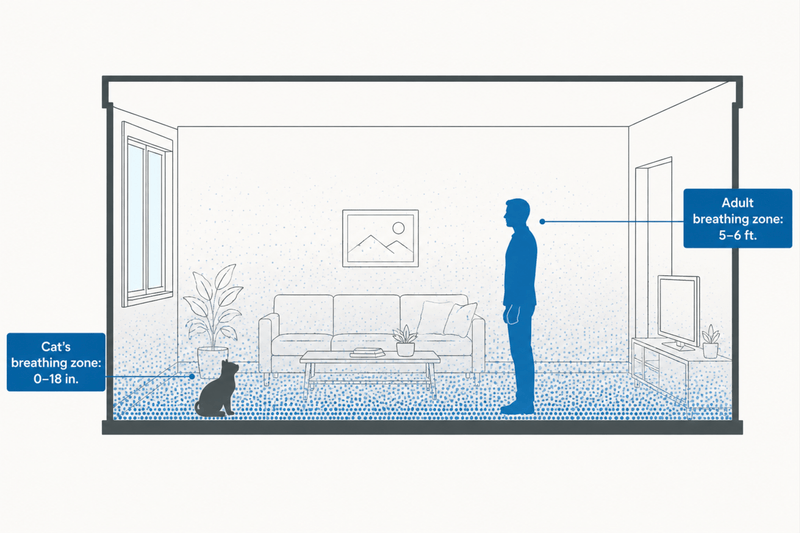
A resting cat breathes 15–30 times per minute (VCA Animal Hospitals), against 12–20 for an adult, and does it within 18 inches of the floor.
Grooming is a second exposure route humans don't have: researchers use pet cats as a sentinel species because they ingest so much settled dust.
Feline asthma affects 1–5% of cats, the most commonly diagnosed respiratory disorder in the species (Cornell).
Open-mouth breathing in a cat is never normal. It is an emergency, not a symptom to monitor.
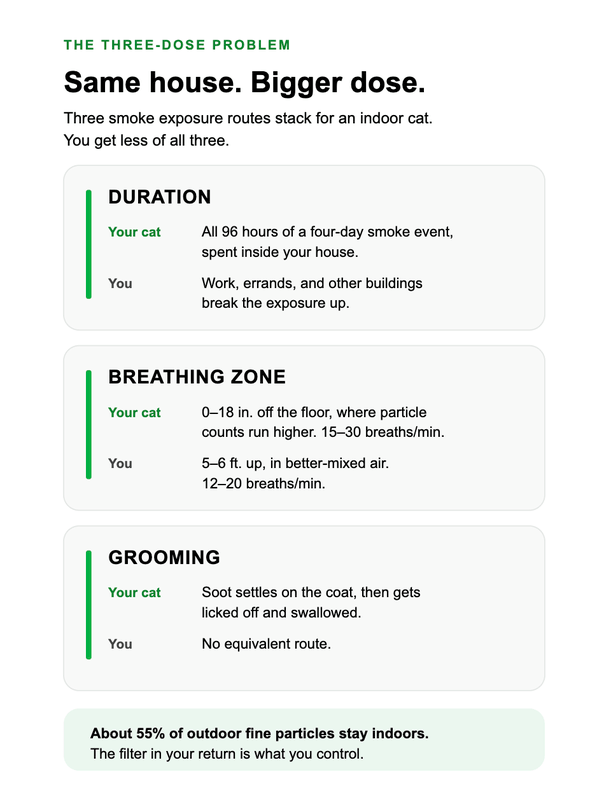
Indoor cats absorb more smoke than their owners because three factors stack: uninterrupted exposure time, a faster breath rate in the dirtiest layer of room air, and grooming that turns settled soot into a swallowed dose.
The Filterbuy framework for why a filter matters more for a cat than for you.
Near-floor particle gradient: National Academies of Sciences, Engineering, and Medicine.
Duration is the factor owners most often underestimate. The AVMA advises letting cats out only for brief bathroom breaks during an alert. For an indoor cat, the house is the entire exposure: no commute to a filtered office, no reprieve.
Floor-level air is dirtier than the air you breathe standing up. At a National Academies workshop, Purdue engineer Brandon Boor reported particulate concentrations are far greater near the floor than at monitor height, and modeling there found shorter people inhale more resuspended dust. A cat naps, eats, and uses the litter box inside that band.
Grooming is the exposure route nobody warns cat owners about. Researchers use pet cats as a sentinel species for indoor contaminants precisely because grooming makes them ingest unusual quantities of settled dust. Smoke settles on every surface, including the coat. Wildfire smoke affects dogs too, but mainly through the airway.
Here is the arithmetic we keep coming back to. A four-day smoke episode is 96 hours, and your cat breathes all 96 in your house. At an infiltration factor of 0.55, an unfiltered home hands over roughly half the outdoor smoke concentration for every one. There is no version of that math where the cat takes a smaller dose than the building. Filterbuy treats the return filter as a pet-health decision, not a comfort one.
“We have manufactured air filters in the United States since our first sale in 2013, in plants across Alabama, Florida, Pennsylvania, and Utah. In all that time, filters have been sold almost entirely on human allergies. The household member who never leaves the building has been missing from that conversation.”
Filterbuy
Wildfire smoke inflames a cat's lower airways, and in predisposed cats it can trigger an asthma attack. Feline asthma is a chronic inflammatory disease of the small airways, where passages swell, narrow, and fill with mucus. The Cornell Feline Health Center calls it an allergic response to inhaled particles, affecting 1–5% of cats, with average diagnosis at four to five years.
Smoke belongs on the established trigger list. Cornell's veterinarians name tobacco smoke and smoke from fireplaces and candles among the suspected airway irritants to remove, alongside dusty litter, aerosol sprays, mold, and dust mites. Wildfire smoke delivers the same insult, plus carbon monoxide and VOCs.
The American Veterinary Medical Association states it plainly: animals with cardiovascular or respiratory disease face higher risk from smoke. Two groups warrant extra attention: cats with existing asthma or bronchitis, who start a smoke event with inflamed airways, and flat-faced breeds like Persians and Exotic Shorthairs. The EPA also flags older, younger, and pregnant animals.
Watch for coughing, wheezing, and a resting breath rate above 30 per minute. Open-mouth breathing, gasping, or a hunched posture with the neck extended is an emergency, not a wait-and-see symptom. The EPA notes cats may also turn restless, seek a cool spot, drool, or develop sweaty paws.
Count a resting rate while your cat is calm or asleep and not purring: watch the chest for 30 seconds, then double it. A healthy cat sits between 15 and 30 breaths per minute.
Sealing the house and filtering the air it already holds is the whole strategy. You cannot mask a cat, and you cannot ask them to breathe less. Everything effective happens at the level of the room.
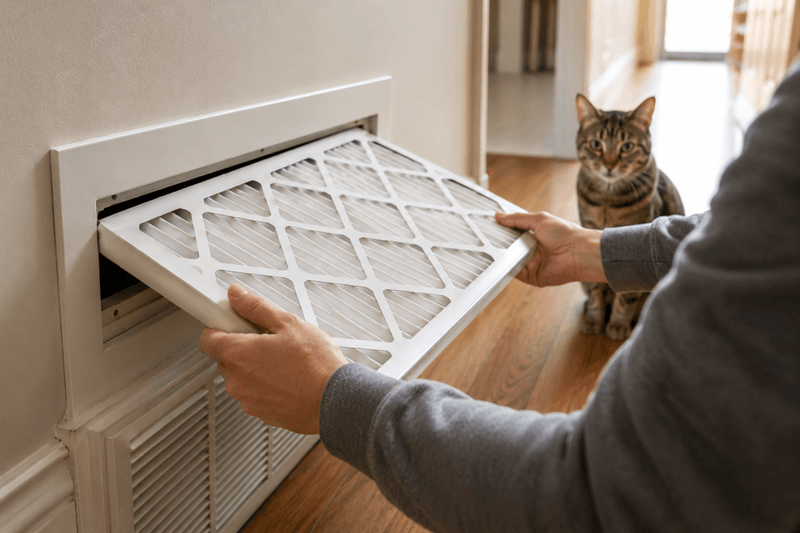
Upgrade to a Filterbuy MERV 13 filter and leave the fan running. The EPA recommends MERV 13 or higher during smoky periods, provided you replace it often. If your system cannot take it, MERV 11 plus a portable unit is the fallback.
Close windows and doors, and set the system to recirculate. Fresh-air intakes become smoke intakes.
Set up one clean room where your cat sleeps. Add a portable HEPA unit sized for the space and shut the door. See how to set up a clean room.
Wipe your cat's coat with a damp cloth once a day during heavy smoke. Vets suggest wiping fur after outdoor time to remove ash. For cats it matters more: anything left on the coat gets swallowed at the next grooming. Plain water and a soft cloth.
Stop adding your own particles. The EPA is explicit: no frying, no vacuuming, no candles or fireplaces. Vacuuming is the one people miss. Research presented to the National Academies found indoor PM2.5 rises two- to five-fold while a vacuum runs.
Check the filter weekly, not monthly. Heavy smoke can load a 1-inch filter in days. Replace it once it looks dark brown or black, and keep filtering after the air clears. Our wildfire smoke recovery checklist covers that.
Everything above assumes ducts and a return vent. Plenty of cat owners rent apartments with neither, and most filter guides skip them. Filterbuy sells filters, so here is the part that costs us the sale: with no return to put one in, do not buy one. Do this instead.
No ducts at all. A portable air cleaner in one closed room is your whole strategy, not a supplement. Make it your cat's room.
Mini split or window unit. The built-in mesh catches lint, not smoke. Rinse it monthly and still run a separate room unit.
Tight budget. The EPA has tested the box-fan-and-filter build and found well-made DIY cleaners can perform similarly to commercial units. Use a 20x20 MERV 13 filter and a fan made in 2012 or later with a UL or ETL mark.
Your landlord owns the equipment. Ask in writing which filter depth and MERV it accepts before buying anything.
A MERV 13 filter captures at least 50% of particles in the 0.3–1.0 micron range under ASHRAE 52.2, the band that matters most for smoke. That makes it the EPA's recommended minimum for smoke events. A Filterbuy rule is that we do not make claims we cannot back, so here is the line:
The evidence in cats specifically is thinner than the marketing suggests. Cornell notes that purifying indoor air is recommended for feline asthma largely because it helps human patients, and has not been rigorously tested in cats. Cutting irritants is sound and low risk, but it is not a proven feline treatment, and we would rather say so.
A filter only cleans air that passes through it. It does not seal a leaky house, and no filter removes carbon monoxide, so a working CO detector is non-negotiable.
Pleated filters catch particles, not gases. The lingering campfire smell is gas-phase. Filterbuy's Odor Eliminator filters add activated carbon for that, which helps the smell but does not touch CO.
A filter is not a treatment. Filtration cuts trigger load. It does not replace prescribed medication or a veterinary exam.
Higher is not always better. Most systems built after 2000 handle MERV 13, but one too restrictive cuts airflow. Our MERV 13 vs HEPA comparison explains why HEPA does not belong in a return.
Three figures from U.S. federal and veterinary sources.
17%: the rise in asthma-related ER visits during 19 wildfire smoke days.
Tracked across ~4,300 U.S. emergency departments.
Peak 24-hour PM2.5 in the hardest-hit region: 259 µg/m³.
Why it matters for cats: the airway insult is identical.
Source: CDC, Morbidity and Mortality Weekly Report, August 2023
90%: the share of time the average American spends indoors.
Some indoor pollutants run 2 to 5 times outdoor levels.
The EPA names particulate matter and pet dander as asthma triggers.
Why it matters: a cat's share is closer to 100%.
Source: U.S. EPA, Report on the Environment, updated May 2026
43.1 million: U.S. households with at least one cat.
32.6% of American homes, 76.3 million cats.
Most live entirely indoors.
Why it matters: filtration is a question for a third of U.S. homes.
Brachycephalic: A shortened, flattened facial structure, as in Persians and Exotic Shorthairs.
Feline asthma: A chronic inflammatory disease of a cat's lower airways causing coughing, wheezing, and labored breathing.
HEPA: High-Efficiency Particulate Air, capturing at least 99.97% of 0.3-micron particles. Too restrictive for most home HVAC.
MERV (Minimum Efficiency Reporting Value): The ASHRAE 52.2 scale rating filter efficiency, 1 to 20. Higher numbers capture smaller particles.
PM2.5: Fine particulate matter 2.5 microns or smaller, the fraction of smoke reaching deep lung tissue.
Resting respiratory rate: Breaths per minute while calm or asleep. Healthy cats sit at 15–30.
Sentinel species: An animal whose contaminant exposure indicates human risk. Cats qualify because grooming makes them ingest dust.
Is my cat safe indoors during wildfire smoke?
Safer than outdoors, but not automatically safe. On average 55% of outdoor PM2.5 persists indoors (National Academies), and a cat breathes it for the full episode.
Can wildfire smoke cause asthma in a cat that never had it?
Wildfire smoke is a recognized airway irritant, and vets report breathing difficulties in otherwise healthy pets. Whether one season causes a permanent diagnosis is not established. What is clear is that smoke inflames feline airways and worsens existing disease.
Should I put a mask on my cat?
No. There is no evidence face coverings protect pets from smoke. The AVMA and EPA point to limiting exposure and cleaning indoor air instead.
How often should I change my filter during a smoke event?
Inspect weekly. A 1-inch filter that normally lasts 60–90 days can load in under a week. Our guide to MERV ratings on high-AQI days covers what to check.
